


More news on this day
Passengers have described scenes of chaos and fear after two passenger trains collided near Bedford, leaving one driver dead and multiple people injured in an incident that has sharply focused attention on rail safety across one of Britain’s busiest corridors.
Get the latest news straight to your inbox!
Low‑speed crash with serious human cost
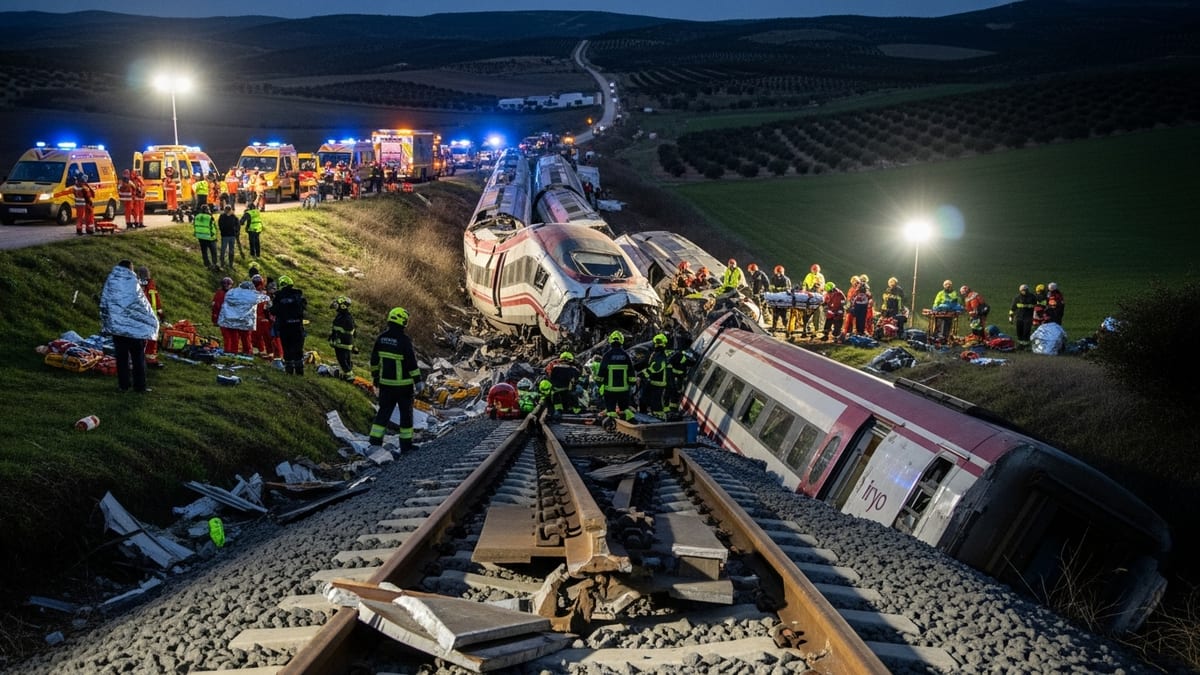
Reports indicate that the collision occurred on Friday 19 June 2026 on the Midland Main Line a few miles south of Bedford, when one southbound passenger service ran into the rear of another that had stopped on the same track. Early descriptions from the scene suggest the impact happened at relatively low speed but was forceful enough to crumple the leading cab of the rear train and derail several carriages.
Rail forums and live coverage from UK news outlets describe how passengers were thrown from their seats, luggage rained down from overhead racks and windows shattered as the two trains came together. One witness, speaking to broadcasters, said it felt as if the carriages had been “picked up and shaken like dice” as the impact rippled down the train.
Emergency services declared a major incident, with paramedics, firefighters and British Transport Police deployed to the embankment site. While many passengers were able to walk away suffering only cuts, bruises and shock, publicly available information indicates that the driver of the rear train died from his injuries, and several people required hospital treatment.
Images shared on social media and in news reports show the rear train’s front cab crushed against the back of the stationary service, with twisted metal and shattered glass strewn along the ballast. Despite the visible damage, rail commentators have noted that the carriages themselves appeared largely intact, something they suggest may have helped limit the number of life‑threatening injuries.
Inside the carriages as the collision unfolded
Accounts gathered by national broadcasters and local media offer a stark picture of what unfolded in the seconds before and after the crash. Passengers on the leading train reported an unscheduled stop south of Bedford, with some initially assuming a routine signal check or minor technical fault.
Those on the following service say they experienced a sudden deceleration and violent jolt rather than prolonged braking. Several described standing in the aisles or preparing to gather their belongings when the collision sent them sprawling. One commuter told reporters the carriage seemed to lift and twist before slamming back onto the track, comparing the motion to dice being shaken in a cup.
As dust and smoke hung in the air, travellers scrambled to help each other, freeing those trapped by bent seat frames and dislodged luggage. Publicly available accounts describe passengers using mobile phone lights to guide others through tilting carriages, while some with first‑aid training improvised bandages from clothing and tissues.
In the moments that followed, many reported a disorienting silence broken only by alarms and the hiss of damaged equipment, followed by cries for help. Several witnesses have told news outlets that they initially feared the train might catch fire, a concern influenced by memories of earlier high‑profile rail accidents, prompting an urgent push to reach doors and emergency exits.
Evacuation on a busy main line
The collision happened on a key section of main line that carries frequent intercity and commuter services between London St Pancras, the East Midlands and northern England. With both affected trains blocking the southbound tracks, services were rapidly suspended in both directions, causing widespread disruption for evening peak‑time travellers.
Reports from rail operators and live travel feeds indicate that stranded passengers were held on undamaged trains for extended periods while the line was secured and rescue access arranged. Some later described walking along the track under the guidance of staff and emergency responders, descending from carriages via ladders or track‑side steps onto an uneven, ballast‑covered embankment.
Those injured in the collision were triaged beside the line and on adjacent land before being transported to hospitals in the region. Others were led to waiting buses or instructed to arrange alternative travel from Bedford, Luton and other nearby stations. Images from stations show crowded concourses and long queues at information points as rail staff tried to rebook journeys and provide updates.
Travel information services have warned that repercussions are likely to continue into the weekend, with ongoing cancellations and diversions while damaged rolling stock is recovered and infrastructure inspections are completed. Commuters and long‑distance passengers have been advised to check revised timetables and allow additional time for journeys through the Bedford corridor.
Early focus on signalling and train protection systems
Although it will be months before an official investigation reaches firm conclusions, rail specialists and commentators have begun to outline potential lines of inquiry based on early information. Several detailed posts on rail enthusiast forums, citing working timetable data and train tracking websites, suggest that the front train had stopped after reporting an issue with its Automatic Warning System, a key part of the network’s train protection technology.
Unofficial reconstructions indicate that the following train then continued along the same line and collided with the rear of the stationary service. Commentators have stressed that, in normal circumstances, a combination of signalling, on‑train protection systems and operating rules is designed to prevent such a scenario, particularly on a heavily trafficked intercity route.
The Rail Accident Investigation Branch has confirmed it is examining the site, and published guidance on its standard process suggests investigators will be collecting data from on‑train recorders, signal boxes and control centres, as well as interviewing staff and passengers. Past reports on rear‑end collisions in the UK have typically scrutinised factors such as driver workload, visibility, system reliability, communication procedures and any temporary operational changes in force on the day.
Rail unions and passenger groups have already called for transparency, arguing that clear, evidence‑based findings are essential both for public confidence and for frontline rail workers. Safety campaigners point out that, while serious train‑to‑train collisions are now rare in Britain compared with previous decades, the Bedford incident illustrates that complex, layered safety systems can still fail under certain conditions.
Shock, tributes and questions for a vital route
News of the driver’s death has prompted tributes from colleagues, local representatives and members of the public, many of whom rely on the route for daily commutes. Messages shared on social media describe the driver as a dedicated professional, and some regular passengers have recalled familiar faces in the cab or on station platforms along the line.
Passengers involved in the collision have spoken about the lingering emotional impact, with several telling media outlets they feel “incredibly lucky” to have escaped with minor injuries. Some have described replaying the moment of impact in their minds, or experiencing anxiety at the thought of future rail journeys, even while acknowledging that serious crashes remain extremely rare.
For communities along the line, the collision has raised fresh questions about the resilience and oversight of a corridor that moves tens of thousands of people every day. Public commentary has highlighted concerns about ageing infrastructure, the demands placed on staff and the challenge of maintaining high safety margins while running intensive timetables.
As the formal investigation gets under way, attention is expected to turn from the immediate drama of the crash to the granular details of how two trains came to occupy the same stretch of track. For those who were “picked up and shaken like dice” in the crumpled carriages south of Bedford, the hope is that the eventual findings will not only explain what happened on a single June evening, but also drive changes that make such an experience less likely to be repeated.