


More news on this day
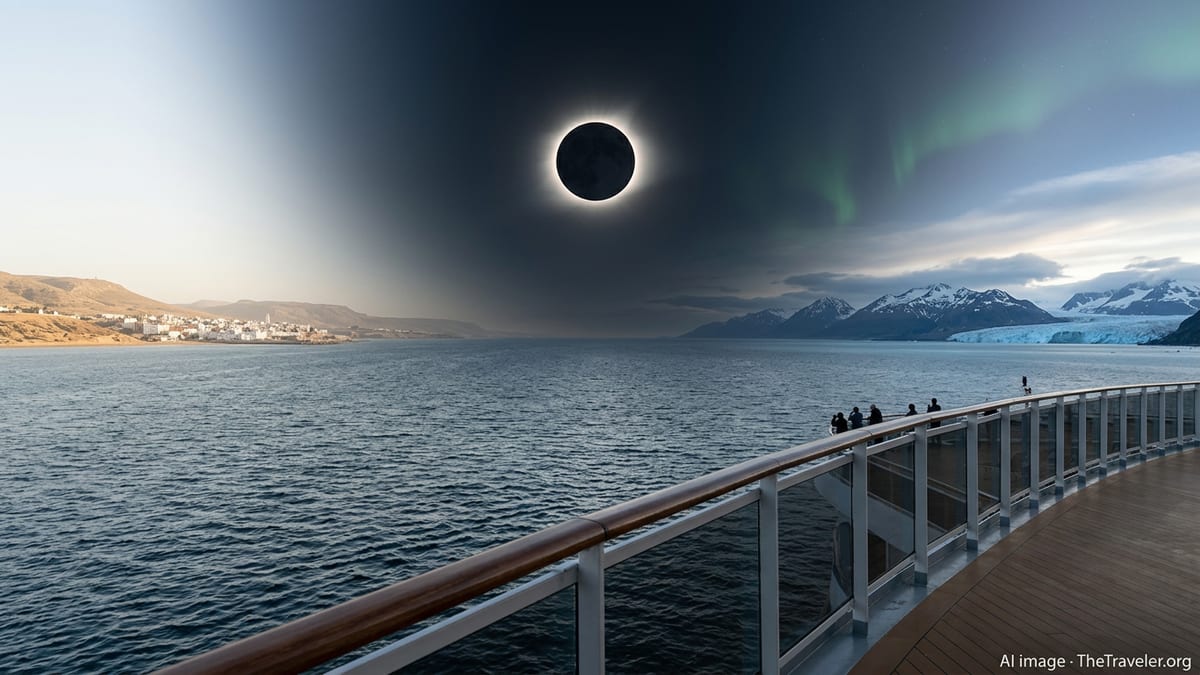
As Europe looked up at darkened skies on August 12, 2026, a cabin full of Wizz Air passengers had a front-row seat from 35,000 feet, watching the Moon’s shadow race across the continent in a rare mid-flight solar eclipse show.
Get the latest news straight to your inbox!
Astronomical Timing Aligns With Wizz Air Flight Path
Publicly available flight-tracking data and social media posts indicate that at least one Wizz Air service operating over western Europe on August 12 intersected the path of the Moon’s shadow as the total solar eclipse swept from Greenland and Iceland toward the Iberian Peninsula. The timing placed the aircraft near the twilight edge of the event, just as large parts of Europe were experiencing late-day partial coverage of the Sun.
According to published astronomical maps, the eclipse path traced a narrow corridor of totality across eastern Greenland and western Iceland before curving southeast over the Atlantic and crossing northern Spain and a small portion of Portugal. Much of the rest of Europe, from Ireland and the United Kingdom to central and southern regions, saw a deep partial eclipse as the Sun sank low in the evening sky.
That geometry meant air traffic flying typical late-afternoon and early-evening routes between central and eastern Europe and Spain, Portugal, or the United Kingdom had an unusually strong chance of intersecting the darkened zone. At cruising altitude, Wizz Air passengers were positioned above many of the clouds that limited views on the ground, turning the jet’s windows into vantage points on a continent-spanning celestial alignment.
Reports shared on public platforms describe passengers abruptly dimming window shades on one side of the cabin, then lifting them in unison as the daylight outside shifted to a silvery twilight, despite clear skies and no sign of sunset on the cabin clocks.
Cabin Turns Into an Impromptu Observatory
Travelers on the Wizz Air flight recounted how the atmosphere inside the aircraft changed as the eclipse progressed. Normal inflight conversation quieted as passengers noticed the odd quality of the light, which took on a muted, metallic hue while the aircraft remained at its usual cruising altitude over Europe.
Several passengers, according to posts and images shared publicly, had prepared with eclipse glasses and phone camera filters, anticipating that a high-altitude vantage point along the busy air corridors could coincide with the event. Others improvised by using the plane’s window frames as shields, carefully angling their views to avoid looking directly at the Sun while still watching the Moon’s silhouette creep across the disk.
From the cabin, the effect differed from classic ground-based views. Instead of a stark plunge into darkness with a horizon-to-horizon twilight glow, passengers reported a more subtle dimming combined with a dramatic transformation of the sky’s color. The Sun appeared partially eaten away above a layer of scattered cloud tops, while the horizon remained brighter than it would during totality viewed from land directly under the shadow’s center line.
Despite the limitations of viewing through double-pane aircraft windows, the altitude granted a sweeping perspective of the evolving light across the cloud deck below. Some images circulating online show a pronounced gradient, with darker tones stretching toward the direction of the Moon’s shadow as it advanced over the Atlantic and into the Iberian Peninsula.
Why Seeing an Eclipse From 35,000 Feet Is So Different
Solar eclipses are defined by precise geometry, and aviation adds several unique twists. At high cruising altitudes, passengers are above a substantial portion of Earth’s atmosphere and many weather systems that typically obscure views on the ground. That clear line of sight can dramatically improve the odds of witnessing the partial phases and, in select locations, the onset or retreat of totality.
However, the experience is also constrained by the aircraft’s speed, direction and timing. Astronomical projections for the August 12 event show the Moon’s shadow racing across Earth’s surface at thousands of kilometers per hour, leaving only a narrow corridor where totality is visible at any given moment. Aircraft on commercial routes rarely track precisely along the center line, so they tend to intercept the edge of the shadow, delivering brief, intense dimming instead of the prolonged, textbook totality that dedicated eclipse chaser flights sometimes achieve.
For the 2026 eclipse, scientific agencies and observatories highlighted how the path of totality reached Europe in the late evening, placing the Sun low over northern Spain and adjacent seas. From a jet cruising well inland and slightly north of the central path, passengers were likely to experience a dramatic partial eclipse with an unusually deep bite out of the Sun’s disk, together with the eerie mid-afternoon twilight more commonly associated with distant storms.
Experts also note that at altitude, atmospheric scattering behaves differently, enhancing contrasts along the horizon. That helps explain why some Wizz Air passengers described seeing a darker band in one direction outside their windows while brighter sky remained elsewhere, a visual cue of the shadow’s sharp boundary as it raced across the curved limb of the Earth.
Europe’s First Totality of the Century Becomes a Travel Moment
The August 12, 2026 eclipse marked continental Europe’s first encounter with a path of totality in more than two decades, and the first such event to sweep across mainland Spain in over a century. Astronomical agencies and tourism boards in Iceland and Spain had long been promoting the date, citing detailed forecasts that showed the Moon’s shadow crossing western Iceland before making landfall over northern Spain and continuing toward the Balearic Islands.
On the ground, public information campaigns prompted cities, rural communities and coastal towns along the path to prepare for an influx of visitors. Observatories organized viewing events, while travel companies offered specialized itineraries built around both eclipse day and the coinciding Perseid meteor shower, which peaks under the same new Moon that enables totality.
Even those far from the narrow center line experienced a notable spectacle. Publicly available guidance from European observatories pointed out that much of the continent would see a partial eclipse with more than half of the Sun’s disk obscured, creating unusual late-day lighting conditions from Scandinavia to the western Mediterranean. It was within this broader zone of partial coverage that the Wizz Air flight’s midair encounter unfolded, turning an ordinary point-to-point journey into an unplanned astronomy experience.
The incident illustrates how major celestial events increasingly intersect with modern mobility. As air travel volumes grow and eclipse paths crisscross densely populated regions, chances rise that commercial flights will coincidentally pass through partial or even total phases, creating shared, serendipitous moments for passengers who may not have planned their trip around the sky at all.
A Preview of Future Sky Shows for Travelers
The 2026 eclipse is part of a cluster of high-profile solar events expected to influence travel patterns in Europe and beyond over the next several years. Astronomical forecasts point to another major total solar eclipse crossing parts of Spain and North Africa in August 2027, again placing popular destinations, busy air corridors and peak holiday season squarely in the path of the Moon’s shadow.
Travel industry observers suggest that the Wizz Air mid-flight viewing could be a sign of what is to come, as more carriers and travelers become aware of eclipse dates and paths. While a handful of operators occasionally organize special charter flights designed to chase the shadow along its route, most encounters will remain unplanned, arising from the routine web of routes that crisscross eclipse tracks at just the right moment.
For passengers, the Wizz Air experience underscores how even a standard low-cost journey can transform into a memorable event when celestial mechanics and flight schedules align. With publicly available eclipse maps now widely accessible, future travelers may increasingly check not only departure times and fares, but also whether their flight path could intersect with the next great shadow sweeping across the Earth.
As Europe reflects on images of darkened skies over Iceland, Portugal and Spain, the photographs emerging from that Wizz Air cabin add an aerial chapter to the story of the August 12 eclipse, capturing a rare moment when airline passengers and eclipse chasers briefly shared the same sky-bound theater.