


Clinging to the southern slope of the Acropolis, the Theatre of Dionysus looks at first like a scatter of marble seats and broken walls. Yet this quiet ruin in central Athens is where Western theatre took shape. Tragedies by Aeschylus, Sophocles and Euripides were first performed here, comedies by Aristophanes mocked politicians here, and Roman emperors later reshaped the stage to suit their taste. For travelers, understanding what happened on this hillside turns a quick photo stop into one of the most powerful historical experiences in Athens.
Get the latest updates straight to your inbox!
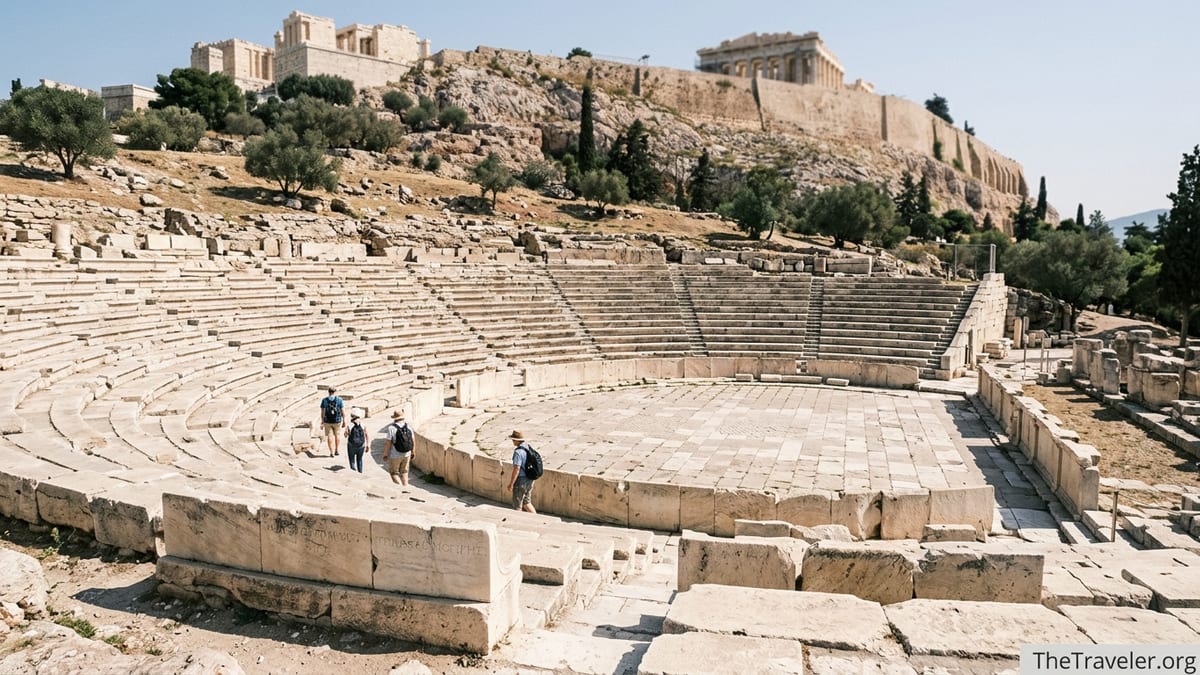
Dionysus and the Birth of Theatre on the Acropolis Slope
Long before there was a stone theatre, this part of the Acropolis slope was a sanctuary to Dionysus, the god of wine, ecstasy and transformation. Athenians gathered here for rituals that combined music, dance and communal drinking around an altar in the open air. Over time, these cult celebrations evolved into more structured performances as worshippers sang dithyrambs, choral hymns that retold myths of Dionysus and the heroes connected with him.
For a modern visitor walking up from Dionysiou Areopagitou Street, it helps to picture the earliest "theatre" as almost invisible. In the sixth and early fifth centuries BC, spectators sat directly on the natural hillside or on temporary wooden benches. The orchestra, the circular dancing floor you can still see today, was originally just packed earth with an altar in the center. There was no permanent stage building, only simple wooden structures that could be dismantled between festivals.
From these modest beginnings, the space became the city’s main venue for worshipping Dionysus through drama. Instead of offering only sacrifices and wine, Athenians began to honor the god by watching characters struggle with fate, justice and the gods themselves. When you stand at the edge of the orchestra now, the idea that drama was born from religious ritual is not an abstraction; you are on the same ground where worship literally turned into theatre.
The City Dionysia: Festival Week in Classical Athens
The Theatre of Dionysus reached its first great flowering during the City Dionysia, Athens’ major spring festival in honor of the god. Every year, usually in March or early April, thousands of citizens and visitors processed through the city to the sanctuary below the Acropolis, where the statue of Dionysus was welcomed and seated in a place of honor. The festival lasted several days and combined sacrifices, parades, drinking and, crucially, competitive drama.
For travelers, it can be useful to think of the City Dionysia as a cross between a religious pilgrimage, a modern film festival and a civic holiday. The state paid a subsidy so poorer citizens could attend, turning theatre-going into a shared democratic experience rather than an elite pastime. On the main days of competition, each tragic playwright presented a set of three tragedies plus a lighter satyr play. A day of comedies followed. Imagine arriving at dawn, sitting on stone benches with up to fifteen thousand other people, and watching stories unfold until late afternoon with only brief breaks.
While you explore the marble seats that survive today, look for the front row of carved thrones known as the prohedria. These were reserved for priests and civic officials, including the priest of Dionysus who presided over the festival. Their presence underlined that tragedy and comedy were not just entertainment but public ritual. When you see these thrones up close, it becomes easier to picture the theatre full, the crowd reacting to a sharp political joke in an Aristophanes play, or falling silent during the recognition scene in Sophocles’ "Oedipus Rex."
How Ancient Drama Worked on This Hillside
Standing in front of the orchestra today, it can be hard to reconstruct how performances actually looked. In the fifth century BC, actors wore masks and padded costumes that allowed their expressions and gestures to be visible even from the upper tiers. A typical tragedy used only three speaking actors who played multiple roles, supported by a chorus of perhaps fifteen men dancing and singing in the orchestra. There was no curtain or complex set changes. Instead, a simple backdrop building, the skene, suggested a palace or house, and much of the drama took place through speech and movement rather than elaborate scenery.
Many of the technical terms still used in modern venues began here. The word "orchestra" comes from the Greek for "dancing place" and referred not to musicians in a pit but to the round performance area in front of you. The "theatron," literally the "seeing place," was the bank of seats curving around it. When you buy a ticket at a contemporary theatre in Athens or New York and see references to the orchestra or scene, you are indirectly dealing with concepts that crystalized at the Theatre of Dionysus.
It is also worth remembering that these plays were municipal business. The city trained and funded the choruses, wealthy citizens sponsored productions as a form of public service, and official boards chose which plays would be staged. When you visit today, you may see school groups from Greece and abroad sitting on the lower seats while guides explain how democracy and drama were intertwined. Their presence is a living echo of the Athenian crowd that once debated the same moral and political questions through theatre.
From Wooden Benches to Stone Monument: Early Theatre Development
The earliest phases of the Theatre of Dionysus left little visible trace, but by the late fifth and especially the fourth century BC, the city embarked on major building projects that created the stone theatre travelers see today. Under the statesman Lycurgus in the late 300s BC, the seating was rebuilt in marble and extended higher up the slope. A horizontal walkway, the diazoma, divided the lower and upper tiers, improving both access and crowd management.
Archaeologists and the Greek Ministry of Culture estimate that in this period the theatre could accommodate roughly fifteen to sixteen thousand spectators. That makes it a little smaller than the modern Olympic Stadium in Athens but larger than many contemporary concert venues. The engineering work required to carve seats into the rock, stabilize the hillside and link the space to the surrounding sanctuary matches, on its own scale, the ambition of monumental building at sites like Epidaurus or later Roman theatres in Ephesus.
The stage building also grew more substantial over time. What began as a temporary wooden skene evolved into a permanent stone structure with projecting side wings known as paraskenia. These offered new possibilities for entrances, exits and visual framing. When you walk along the rear of the orchestra today and see low walls and foundations, you are tracing the footprint of buildings that ancient playwrights came to rely on. They allowed for more complex blocking and for tricks like the use of roof space when a god appeared above the action.
Roman Changes: A Greek Theatre Adapts to a New Empire
By the second and first centuries BC, Athens had lost its political power but retained huge cultural prestige. The Romans admired Greek drama, rhetoric and art, and they refashioned the Theatre of Dionysus to suit evolving tastes. The orchestra was reduced in size and lined with new marble paving, while a more dominant, two-storey stage front, the scaenae frons, rose behind the performance area. This vertical facade, decorated with columns and statues, would look more familiar to visitors who have seen Roman theatres in places like Orange in France or Aspendos in Turkey.
One of the most visible Roman-era additions is the low protective barrier that runs around the front of the orchestra. In late antiquity, the theatre was sometimes adapted for events that blurred the line between performance and spectacle, and this wall may have helped shield front-row spectators. For a traveler comparing sites across the Mediterranean, the Theatre of Dionysus becomes a textbook example of how Roman building ideas were grafted onto earlier Greek forms without completely erasing them.
During the reign of Emperor Hadrian in the second century AD, Athens enjoyed a kind of cultural renaissance. Hadrian was an enthusiastic philhellene, and he supported festivals and building works in the city, including at the Theatre of Dionysus. Inscriptions honor him as "New Dionysus," a reminder that even under Roman rule the theatre’s identity as a sacred space to the god of drama remained central. If you visit both the Theatre of Dionysus and the later Roman Odeon of Herodes Atticus just uphill, you can see in a short walk how imperial tastes layered new structures onto the same slope of the Acropolis.
Decline, Excavation and Modern Restoration
After late antiquity, organized performances declined across the eastern Mediterranean as religious attitudes shifted and large public spectacles became less central to civic life. The Theatre of Dionysus fell into disuse, its stones were robbed for other building projects, and soil slowly covered the orchestra and lower tiers. Travelers in the early modern period often passed the area without realizing they were walking over the birthplace of classical drama.
Systematic excavations began in the nineteenth century, led in part by the German Archaeological Institute and Greek archaeologists, who gradually uncovered the orchestra, front rows and much of the cavea. Detailed studies of inscriptions on the marble thrones helped scholars reconstruct the roles of priests, civic officials and foreign guests. For visitors today, being able to read or at least recognize names carved over two thousand years ago offers a direct human connection to the audiences that once gathered here.
In recent decades, the Greek Ministry of Culture and organizations such as Diazoma have coordinated conservation and limited restoration efforts. These projects have focused less on rebuilding missing structures and more on stabilizing the existing stonework, cleaning and consolidating fragile seating blocks, and improving drainage to protect the orchestra after heavy winter rains. When you enter the site, some seating segments appear newly reset or braced. These are the results of ongoing efforts to keep the theatre accessible and safe without turning it into a modern reconstruction.
Visitors should be aware that the Theatre of Dionysus is part of the wider Acropolis archaeological zone, and access patterns can change as works progress. In recent years, the site has typically been open during the same daytime hours as the Acropolis itself, with combined tickets available that include multiple nearby monuments. Conditions can be hot and bright in summer, so bringing water, sun protection and sturdy shoes makes a significant difference when you are climbing over ancient stone and pausing to imagine the crowds of long-ago festival days.
Why the Theatre of Dionysus Still Matters Today
For many travelers, the headline sights in Athens are the Parthenon above and the grand Roman Odeon of Herodes Atticus just along the slope. It can be tempting to treat the Theatre of Dionysus as a secondary stop. Yet in terms of cultural impact, this semi-circle of marble seats arguably rivals any monument in the city. The genres of tragedy and comedy that were refined here spread through the Roman world, shaped Renaissance drama in Europe and still inform how film and television stories are structured.
Standing in the lower rows and looking up at the curve of the cavea, it is striking how effective the design remains. Even without its original upper tiers, the theatre hugs the hillside in a way that focuses attention on the central performance space. This basic configuration has been repeated, with variations, in venues from ancient Epidaurus to modern open-air theatres in cities like London, Sydney or Los Angeles. When architects today talk about sightlines and acoustics, they are in dialogue, knowingly or not, with places like the Theatre of Dionysus.
The site also matters as a reminder of how public space, religion and art can intersect. The plays staged here did not only retell myths. They questioned how power should be exercised, how communities should respond to war, plague or injustice, and what responsibilities individuals owe to the gods and to each other. In that sense, a visitor reading a translation of Euripides on the steps, or attending a rare modern performance when authorities permit it, is participating in a conversation that has been running on this hillside for more than two millennia.
On a practical level, visiting the Theatre of Dionysus can enrich your overall Acropolis experience. Many travelers choose to start at the lower south slope, exploring this theatre and the nearby Odeon of Pericles before climbing up to the main plateau. This route not only avoids some of the crowding at the main gates during peak hours but also lets you follow, roughly, the path of ancient festival processions as they moved from Dionysus’ sanctuary to the higher temples of Athena.
FAQ
Q1. Where exactly is the Theatre of Dionysus in Athens?
The Theatre of Dionysus sits on the south slope of the Acropolis hill in central Athens, just below the Parthenon and near the modern Acropolis Museum.
Q2. What was the main purpose of the Theatre of Dionysus in antiquity?
It served as the principal venue for Dionysian festivals such as the City Dionysia, where Athenians honored Dionysus with dramatic competitions featuring tragedies and comedies.
Q3. How many people could the Theatre of Dionysus hold?
Estimates vary, but in its classical and Hellenistic stone phase the theatre likely held around fifteen to sixteen thousand spectators spread across the marble tiers.
Q4. Which famous playwrights had their works performed here?
Plays by Aeschylus, Sophocles, Euripides and Aristophanes were all staged at the Theatre of Dionysus, often debuting at the City Dionysia festival before any other venue.
Q5. What visible remains should travelers look for today?
Key features include the circular orchestra, the front row of carved marble thrones for priests and officials, segments of stepped seating and low walls marking the ancient stage buildings.
Q6. How did the Romans change the Theatre of Dionysus?
Roman renovations reduced the orchestra’s size, added elaborate marble paving, raised a two-storey stage facade and built a low protective barrier enclosing the front of the performance area.
Q7. Can visitors still attend performances at the Theatre of Dionysus?
Occasional special events or experimental performances have been held, but regular shows are rare and depend on conservation needs and permissions from Greek cultural authorities.
Q8. Is the Theatre of Dionysus included in Acropolis tickets?
In recent years it has typically been included in combined tickets covering the Acropolis and its south slope monuments, though visitors should check current ticket categories and prices on arrival in Athens.
Q9. How long should I plan to spend at the Theatre of Dionysus?
Most travelers need 30 to 60 minutes to walk the site, study the seats and orchestra, take photographs and connect what they see to the history of ancient drama.
Q10. What is the best time of day to visit?
Mornings and late afternoons are usually more comfortable, especially from late spring to early autumn, when midday sun on the exposed marble can be intense.