


If you have ever tried to book a stay at “Wyndham Ocean Walk,” “Ocean Walk Resort,” or simply “Ocean Walk” in Daytona Beach, you have probably noticed that the same building seems to appear under several different names. Some listings are branded as Club Wyndham, others are advertised as Ocean Walk Resort, and many more show up as private condos on big vacation rental platforms. For travelers, it can be genuinely confusing to understand whether these are different properties, different towers, or just different owners inside the same complex. This guide untangles that naming maze and explains what you are really booking in practical, real-world terms.
Get the latest updates straight to your inbox!
One Oceanfront Complex, Many Names
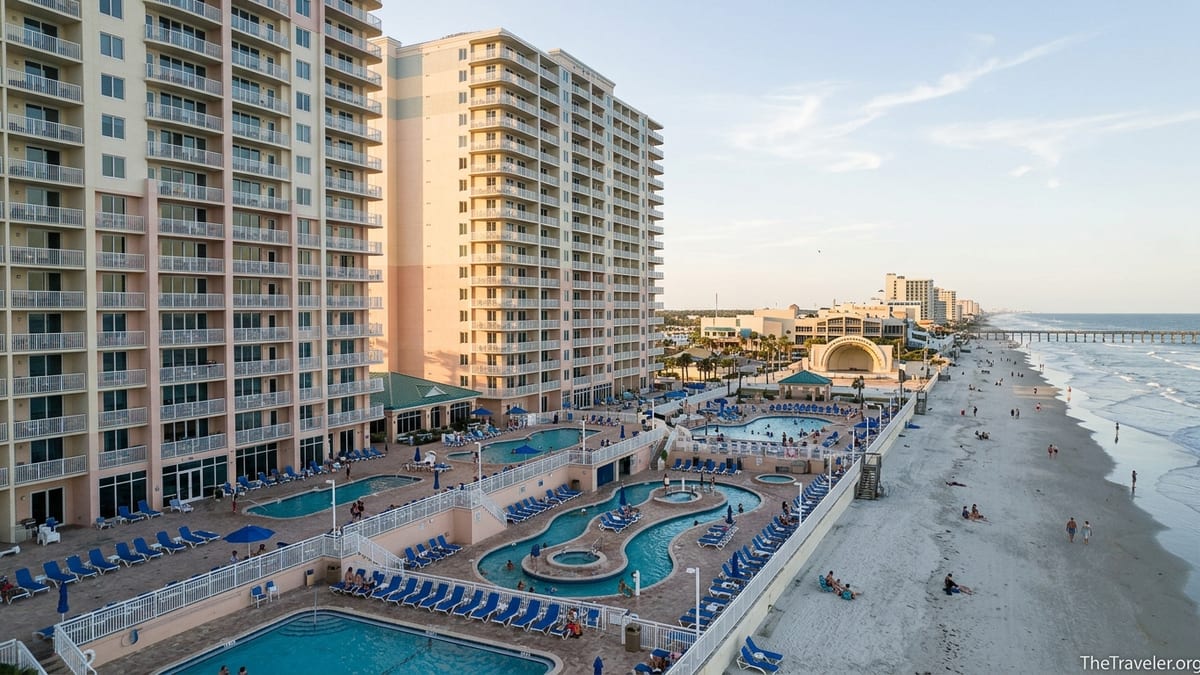
The first key to understanding the confusion is simple: physically, we are talking about one large oceanfront condominium and timeshare complex at roughly 300 North Atlantic Avenue in Daytona Beach. This is a twin-tower property on a no-drive section of the beach, next to the Daytona Beach Bandshell, boardwalk, and Ocean Walk Shoppes. From the pool deck or the lazy river, every guest is looking at the same stretch of sand, regardless of how they booked or what their confirmation email calls the resort.
Within that single complex, several brands and ownership types coexist. Club Wyndham markets the timeshare component heavily and often uses the name “Club Wyndham Ocean Walk” or “Wyndham Ocean Walk.” At the same time, independent management companies, local real estate brokers, and individual condo owners advertise units using generic labels like “Ocean Walk Resort,” “Daytona Beach Ocean Walk,” or “Wyndham Ocean Walk Resort.” On top of that, some WorldMark by Wyndham members will see the property listed in their directory as “WorldMark Daytona Beach – Ocean Walk,” even though they are accessing the same buildings and amenities as Club Wyndham guests.
As a result, when you search online you will see what looks like a dozen different properties along this short stretch of beach. In reality, you are usually seeing different doorways into the same resort. The main practical differences are who owns the unit, who manages your reservation, and what policies or perks they attach to your stay, not which pool or lazy river you can use.
This is why reviews and photos on large vacation rental sites can look nearly identical across multiple listings: the same lazy river, the same indoor pool, the same garage, and the same arcade keep appearing. Travelers sometimes assume those are stock photos or misleading pictures of an entirely different resort. In fact, they are often accurate images of the same shared amenities that everyone at Ocean Walk uses, whether you booked through Club Wyndham or a private owner.
What “Club Wyndham Ocean Walk” Actually Means
Club Wyndham is the timeshare club brand for Wyndham’s vacation ownership properties. At Daytona Beach, its flagship presence is marketed as “Club Wyndham Ocean Walk” and “Wyndham Ocean Walk.” In practical terms, this means certain units in the complex are deeded or assigned to timeshare owners who use Club Wyndham points, and Club Wyndham also rents some of that inventory to the general public like a hotel. When you reserve through the official Club Wyndham or Wyndham-branded booking channels, you are tapping into this pool of timeshare-owned inventory controlled by Wyndham.
For a short-stay guest, Club Wyndham’s involvement mainly affects how you book, your check-in experience, and your customer service channels. You will likely check in at a Wyndham-run front desk, your confirmation will show Club Wyndham branding, and you will be subject to the club’s rules about occupancy, parking, and housekeeping. Many guests also encounter sales staff offering timeshare presentations; this is a common feature at Club Wyndham resort locations rather than at independently managed condos, so it is something to consider if you want a quieter, more anonymous stay.
Club Wyndham’s presence is also why the property shows up in internal Wyndham materials under multiple vacation club names. For example, in recent club guides and supplements the resort appears as both a WorldMark and Wyndham Ocean Walk destination, reflecting two different owner groups using overlapping units in the same complex. For ordinary travelers, the takeaway is that “Club Wyndham Ocean Walk,” “Wyndham Ocean Walk,” and “WorldMark Daytona Beach – Ocean Walk” are identifiers for how owners access the property rather than signs of multiple distinct resorts along the boardwalk.
If you book directly through Club Wyndham as a non-owner, your experience will lean closest to a traditional resort stay. You may find slightly more standardized furnishings and policies, and you will typically get support from Wyndham’s call centers if something goes wrong. The tradeoff is less choice over a specific unit: you are reserving a unit type and view category more than a particular condo number.
What People Mean by “Ocean Walk Resort” or “Daytona Beach Ocean Walk”
Outside of Wyndham’s timeshare system, most people use “Ocean Walk Resort” or “Daytona Beach Ocean Walk” as generic names for the entire property. Independent rental agencies and local brokers who manage multiple condos in the towers use these labels to distinguish their inventory from traditional hotels up and down the beach. For example, a local company might advertise “2-bedroom condos at Daytona Beach Ocean Walk Resort with full kitchens and private balconies,” emphasizing condo-style features rather than the Club Wyndham brand.
This generic naming is why you can find similar-sounding listings like “Daytona Beach Ocean Walk Resort – Oceanfront Rentals” or “Ocean Walk Resort rentals in Daytona Beach” offered by companies that have no corporate connection to Wyndham. They are simply marketing privately owned condominiums inside the same complex. The amenities they describe, such as the lazy river, multiple pools, indoor heated pool, and secured garage parking, are the shared facilities of Ocean Walk itself, not separate features of an off-site building.
On big vacation rental platforms, description text often makes the relationship clear even when the title is vague. A host might headline a listing as a “Private Oceanfront Balcony at Ocean Walk 2BD/2BA” and then note in the description that it is located in a Wyndham Ocean Walk property, with access to the lazy river and four outdoor pools. The host is not misleading you about the resort; they are using the Ocean Walk name to attract guests searching for this particular complex while also acknowledging the Wyndham branding that appears on signage around the property.
For travelers, the practical message is that “Ocean Walk Resort” as a phrase usually indicates the same twin-tower oceanfront complex you see in Club Wyndham materials. The differences lie in who owns the individual condo and how hands-on or hands-off they are in managing guest stays, not in entirely separate physical resorts scattered along the beach.
Private Condos vs Official Club Wyndham Inventory
Inside the Ocean Walk complex, not every unit is controlled directly by Club Wyndham. Many condos are individually owned and rented out as vacation properties, either by the owners themselves or through local agencies. These private condos sit side-by-side with Club Wyndham inventory on the same floors, sharing elevators, pools, parking, and beach access. From a guest’s perspective, your balcony view or walk to the lazy river may be identical regardless of who holds the deed to your specific unit.
The main differences show up in the details. Private owners often personalize their condos, so furniture, flooring, and decor can vary widely even among units with the same floor plan. One two-bedroom may have new appliances, modern tile, and a walk-in shower, while another two-bedroom across the hall still has older carpet and a different bed configuration. Owners also set their own rates based on season, demand, and renovation level. During a mid-summer weekend, you might see one two-bedroom oceanfront condo listed at an approximate nightly rate that is noticeably lower than a recently renovated corner unit on a higher floor, even though both share the same amenities downstairs.
Service level is another key distinction. With private rentals, you might check in through a lockbox or meet a local property manager instead of going to the Club Wyndham front desk. Housekeeping could be limited to before and after your stay rather than daily service. On the other hand, some travelers appreciate dealing directly with an owner who responds quickly to messages and can describe exactly which unit and view they are offering, right down to the balcony angle and bed sizes in each bedroom.
By contrast, official Club Wyndham reservations typically provide more standardized expectations but less unit-specific detail. You reserve a category such as “one-bedroom oceanfront” and are assigned a condo that meets that description on arrival. Soft goods, kitchen inventories, and maintenance schedules tend to follow brand standards, and if you have an issue you call the front desk or Wyndham’s support line rather than tracking down an individual owner. Neither approach is inherently better; it depends on whether you prioritize consistency and corporate support or character and potentially better value from a private owner.
How Third-Party Booking Sites Fit Into the Picture
Most of the confusion for travelers comes not from the buildings themselves but from how they are presented on large online travel and rental platforms. When you search those sites for Daytona Beach, you may see multiple listings that reference “Ocean Walk,” “Wyndham Ocean Walk,” and “Ocean Walk Resort,” often with very similar photos. Some listings are clearly marked as privately owned condos, while others appear as standard resort or hotel rooms, even though they all occupy the same address.
On a typical vacation rental platform, a privately owned unit at Ocean Walk might be listed by an individual host or local company, complete with detailed unit photos and heartfelt descriptions. The host might point out that their balcony looks directly over the lazy river, that the kitchen is fully equipped, and that garage parking is included. On the same platform, another listing might be operated by a larger management company that advertises multiple Ocean Walk units under one brand name. Meanwhile, separate travel-booking sites list “Wyndham Ocean Walk” as a single resort, with availability pulled from Club Wyndham’s inventory rather than from individual owners.
Because each of these booking channels has its own cancellation policies, deposit rules, and customer service procedures, two families staying in almost identical condos side-by-side at Ocean Walk can have very different experiences when something goes wrong. One may call a national customer support line associated with their third-party booking, while the other texts a local owner who lives nearby. This split is what lies behind many online reviews where guests praise or criticize “Wyndham” or “Ocean Walk” for issues that actually originated with the specific booking route they used, whether that was a timeshare system, a local rental agency, or a global travel platform.
Third-party involvement can also affect expectations about housekeeping and extra charges. A guest who books through a travel site expecting daily cleaning and on-demand towel changes might be surprised to learn that, at Ocean Walk, many stays function more like condo rentals, where you handle your own laundry and trash between check-in and check-out. Another traveler, used to vacation rentals, might be pleasantly surprised to discover that their Club Wyndham stay includes midweek towel exchanges or access to on-site maintenance staff for minor issues. The key is to read your specific listing and confirmation details closely rather than assuming every Ocean Walk stay operates like a traditional hotel.
Real-World Booking Scenarios and What to Expect
To make all of this more concrete, imagine three different families booking what looks like the same type of two-bedroom oceanfront stay at Ocean Walk for a spring break week. The first family reserves directly through Club Wyndham’s branded website. Their confirmation highlights Club Wyndham Ocean Walk, includes references to vacation ownership, and mentions optional invitations to an owner update session. They check in at the main Wyndham front desk, receive wristbands for pool access, and handle all requests through Wyndham staff during their stay.
The second family finds a listing on a vacation rental platform labeled “Private Oceanfront Balcony 2BD/2BA at Ocean Walk.” The description notes that the condo is at a Wyndham resort property but clarifies that it is privately owned. The host sends check-in instructions a week before arrival that explain where to park in the attached garage and which desk or lockbox to use to get keys. Inside, the unit has more personal decor and perhaps some upgraded features the owner has installed, like a larger refrigerator or new flooring.
The third family books through a general travel site that lists “Ocean Walk Resort – Daytona Beach” as a condominium-style resort, without heavily emphasizing the Club Wyndham name. Their reservation is technically managed by a distribution partner that has access to certain units. At check-in, they may still interact with Wyndham staff at the front desk, but if there is an issue with overbooking or a billing discrepancy, they might need to coordinate between the travel site and the resort to resolve it.
All three families swim in the same pools, drift down the same lazy river, share the same elevators, and walk the same pathway to the no-drive section of beach. Yet their reviews afterward may look very different. One might rave about attentive resort staff, another might focus on the uniqueness of their privately decorated condo, and a third might complain about confusion between the resort and the travel site during a date change. Understanding which route you are choosing helps set realistic expectations and reduces the chance of disappointment.
How to Decode Listings and Avoid Disappointment
Given the overlapping names, the smartest approach is to treat each listing as a separate product, even if the photos clearly show the same lazy river and pool deck. Start by looking carefully at who is named as the host or manager. If it is Club Wyndham or Wyndham-branded, you are likely booking through the official timeshare-linked resort channel. If it is a person’s name, a small local company, or a non-Wyndham agency, you are almost certainly dealing with a privately owned condo.
Next, read the description for clues about check-in procedures and services. Phrases like “self check-in with lockbox,” “no daily housekeeping,” or “contact owner directly for issues” indicate a private rental setup. By contrast, mentions of “24-hour front desk,” “on-site concierge,” or “timeshare presentation invitations” signal a more traditional resort-style experience under the Club Wyndham umbrella. Neither is inherently superior, but they come with different expectations about support and flexibility.
Pay attention as well to how specific the listing is about the exact unit. If you see detailed photos of one particular condo, with captions describing particular views or a certain floor number, you are more likely booking that exact unit from an owner. If the photos look more generic and the text talks mostly about categories like “one-bedroom ocean view” or “two-bedroom standard,” then you are probably reserving a type rather than a specific door number, just like a hotel.
Finally, check the cancellation, rebooking, and payment terms before you commit, especially around major Daytona Beach events such as race weeks and spring break. Third-party bookings, timeshare point rentals, and privately managed units can each have stricter policies than standard hotels. Knowing whether your reservation is refundable or can be shifted to different dates may be crucial if your plans change or if a storm threatens your travel window.
The Takeaway
When you strip away the branding and booking channels, the story of Wyndham Ocean Walk and Ocean Walk Resort in Daytona Beach is straightforward. There is one large oceanfront complex with a lazy river, multiple pools, and a prime location next to the bandshell and boardwalk. Inside that complex, some units are managed directly by Club Wyndham as timeshare inventory, others are owned by individuals and rented privately, and still others are accessed through different Wyndham-affiliated vacation clubs. The overlapping names you see online mostly reflect those different ownership and management paths, not separate resorts.
For travelers, the most important distinction is not whether your confirmation says “Club Wyndham Ocean Walk,” “Ocean Walk Resort,” or simply “Ocean Walk,” but who is actually responsible for your reservation. If you prefer hotel-like consistency and a clear front desk to handle issues, an official Club Wyndham or Wyndham-branded booking will usually feel most straightforward. If you value unique decor, unit-specific details, and the possibility of more flexible pricing, a private rental at Ocean Walk through a reputable owner or local agency can be an excellent option.
As you compare options, take the time to decode each listing: check the host or manager name, read the description for service clues, and understand the cancellation rules. Doing so turns what looks like a confusing tangle of names into a clear set of choices within the same desirable beachfront complex. With that clarity, you can focus on what really matters during a Daytona Beach vacation: enjoying the ocean views from your balcony, floating the lazy river, and taking advantage of the boardwalk, shops, and events just steps from Ocean Walk’s front doors.
FAQ
Q1. Is Wyndham Ocean Walk the same place as Ocean Walk Resort in Daytona Beach?
They refer to the same twin-tower oceanfront complex. “Wyndham Ocean Walk” usually describes the Club Wyndham timeshare-managed inventory, while “Ocean Walk Resort” is a more generic name used for the overall property and for privately owned condos in the same buildings.
Q2. What is the difference between booking through Club Wyndham and a private owner at Ocean Walk?
Booking through Club Wyndham is more like reserving a stay at a branded resort: you deal with Wyndham’s systems, front desk, and policies, and you reserve a unit type rather than a specific condo. Booking through a private owner typically means a specific, individually decorated condo with its own rules, check-in process, and cancellation terms.
Q3. Will I get access to the same pools and lazy river no matter how I book?
In most cases, yes. Whether you book through Club Wyndham, a private owner, or a local agency, you are staying within the same Ocean Walk complex and using the same shared amenities, including pools, lazy river, hot tubs, and beach access, subject to any resort-wide wristband or rules that apply to all guests.
Q4. Why do so many listings have similar photos of the pools and balconies?
Because they all show the same property. Different hosts, agencies, and Club Wyndham itself often photograph the same lazy river, pool deck, beachfront, and common areas. Each listing may be accurate for that complex even if the pictures look nearly identical across multiple ads.
Q5. How can I tell if a listing is a privately owned condo or official Wyndham inventory?
Look at the host or manager name and the description. Individual names or small local company names, detailed photos of one specific unit, and mention of self check-in are typical signs of a private condo. Listings branded clearly as Wyndham or Club Wyndham with more generic room-type descriptions usually draw from the resort’s official inventory.
Q6. Are the rooms nicer if I book with a private owner instead of Club Wyndham?
It depends on the specific condo and how much the owner has invested in updates. Some private units have high-end renovations and personal touches, while others are more basic. Club Wyndham units are generally kept to brand standards, which can mean more consistency but less individuality. Reviews and recent photos are the best guide.
Q7. Do all bookings at Ocean Walk include daily housekeeping like a hotel?
No. Many stays at Ocean Walk function like condo rentals: housekeeping cleans before you arrive and after you leave, but you manage your own laundry and trash during the stay. Some Club Wyndham reservations may offer limited services like towel exchanges, but daily full-service housekeeping is not guaranteed unless explicitly stated.
Q8. Can I avoid timeshare sales presentations if I stay at Ocean Walk?
Yes. Even though Club Wyndham markets vacation ownership at Ocean Walk, you are not required to attend a presentation to stay there. If you prefer to avoid sales invitations, you can politely decline any offers from staff. Guests who book through private owners often report fewer contacts about presentations, but experiences vary.
Q9. Which booking route is best if I want the most flexibility to change or cancel?
Policies vary widely. Some Club Wyndham or Wyndham-branded rates offer more flexible changes for a fee, while others are nonrefundable. Private owners and local agencies set their own rules, which can be strict around peak events. Before booking, read the cancellation terms carefully and choose the option that matches your risk tolerance and travel plans.
Q10. If something goes wrong with my stay, who should I contact?
Contact the party that issued your confirmation. If you booked through Club Wyndham, start with the resort front desk or Wyndham customer service. If you reserved through a private owner or local agency, reach out to them using the contact details in your booking. If you used a large travel platform, you may need to involve both the platform’s support and the on-site staff to resolve issues.