


If you live near a JetBlue airport and carry the JetBlue Plus Card, there is a good chance you are leaving serious value on the table. This mid-tier airline card looks straightforward at first glance: triple- and double-point categories, a free checked bag and a familiar annual fee. But in practice, most cardholders either underestimate their benefits or use the card in ways that barely justify its cost. With fares, baggage fees and loyalty programs shifting regularly as of 2026, understanding exactly how to work this card can easily mean the difference between saving hundreds of dollars each year and overpaying quietly in the background.
Get the latest updates straight to your inbox!
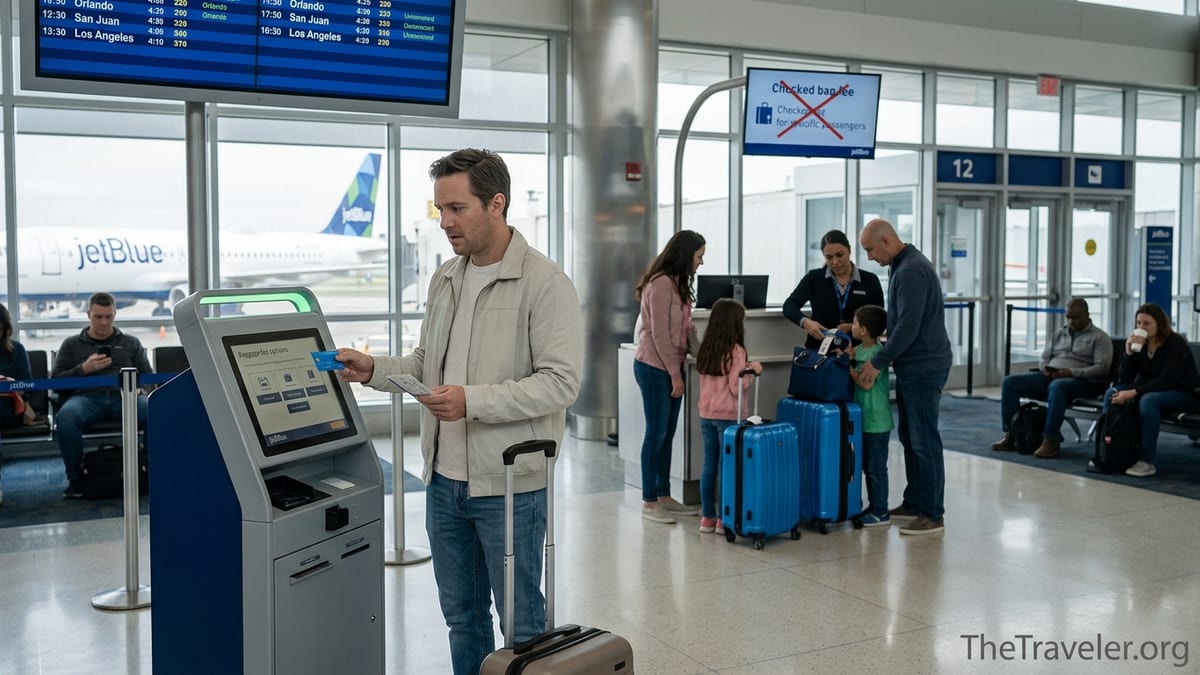
What the JetBlue Plus Card Actually Offers in 2026
The JetBlue Plus Card, issued by Barclays, is designed for travelers who fly JetBlue at least a couple of times a year. As of mid-2026, the card earns 6 TrueBlue points per dollar on eligible JetBlue and Paisly purchases, 2 points per dollar at restaurants and at eligible grocery stores, and 1 point per dollar on everything else. It carries a 99 dollar annual fee and usually comes with a sizable welcome bonus when you meet a minimum spend requirement in the first few months of card membership.
Beyond the raw earning rates, the card’s headline perks are where the real value lives. Cardholders get a free first checked bag for themselves and up to three companions on the same JetBlue reservation, a 50 percent discount on eligible inflight food and drinks, 5,000 bonus TrueBlue points on every account anniversary and a 100 dollar statement credit once per year when purchasing a qualifying JetBlue Vacations package of at least 100 dollars. There is also a 10 percent points rebate when you redeem for and complete travel on JetBlue-operated award flights and no foreign transaction fees when you use the card abroad.
All of this sounds generous, but it only turns into genuine savings if you understand how the benefits work in detail. Many cardholders swipe the JetBlue Plus Card on virtually every purchase, assume the free bag always triggers itself no matter what and never bother to track whether the anniversary points or JetBlue Vacations credit actually offset the annual fee. That is where people start using the card “wrong” and why reassessing your habits can be so valuable.
Mistake 1: Treating It as a General Everyday Spending Card
One of the most common misuses of the JetBlue Plus Card is relying on it for everyday, non-bonus spending. While 6 points per dollar on JetBlue purchases can be excellent, the card only offers 1 point per dollar on categories outside travel, restaurants and grocery stores. For many travelers, that 1X rate is a poor return compared with flexible rewards cards that earn 1.5 or 2 points per dollar and allow transfers to multiple airline and hotel partners.
Imagine a traveler in Boston who spends 1,000 dollars a month in non-bonus categories like online shopping, utilities and subscriptions and puts it all on the JetBlue Plus Card. Over a year, that is 12,000 TrueBlue points. Depending on route and timing, those points might be worth roughly 150 to 200 dollars in flights. If the same traveler used a popular 2X cash back card, they would earn about 240 dollars instead, and that cash would be usable with any airline, not just JetBlue.
A smarter strategy is to reserve the JetBlue Plus Card for its strong categories and for purchases that trigger its unique perks. Use it for JetBlue flights, JetBlue Vacations packages, and regularly for dining and grocery spending if you do not hold another card that beats or matches 2X in those categories. Then, place everything else on a general travel or cash back card with stronger base earning. That way, you still maximize JetBlue points where they are most lucrative without sacrificing value on everyday expenses.
This shift alone can transform your effective rewards rate. Many JetBlue loyalists continue to swipe the Plus Card at warehouse clubs, streaming services and home improvement stores out of habit. Taking one afternoon to map which card you use for which type of purchase can lead to an extra free flight or two every year.
Mistake 2: Wasting the Free Checked Bag Benefit
The JetBlue Plus Card’s free checked bag benefit can easily be worth more than the card’s 99 dollar annual fee on its own, but only if you understand how it is triggered. Cardholders get the first checked bag free for themselves and up to three travel companions on the same reservation when their TrueBlue number is attached and their cardholder status is recognized on the booking. Importantly, the perk is tied to your cardholder profile and JetBlue account rather than to a specific Blue Plus or Blue fare, so it typically applies even on lower-cost Blue Basic tickets where a checked bag would otherwise require a separate fee.
Here is where people go wrong. A family of four flying from New York JFK to Orlando might each check a suitcase at the airport, expecting the free bag benefit to apply automatically. If the primary cardholder’s TrueBlue number was never added to the reservation, or if they canceled the card after booking but before travel, the system may not recognize eligibility, and the family could end up paying around 40 to 45 dollars per checked bag each way. On a round-trip, that could add up to more than 300 dollars in surprise fees, completely erasing a year’s worth of rewards.
Another mistake is booking JetBlue flights through third-party travel sites and never revisiting the reservation in the JetBlue app or on the airline’s website. If you purchase a Blue Basic fare via an online agency and your JetBlue Plus Card details are not attached to the booking, the free bag may not populate automatically when you check in. A better approach is to add your TrueBlue number to every reservation and double-check the baggage summary in the app a few days before departure. If it still shows a fee, contact JetBlue or visit the airport counter to have your cardholder status manually linked before you hand over luggage.
Used correctly, the math is powerful. A couple flying from Fort Lauderdale to Los Angeles twice a year and checking one bag each could otherwise pay around 160 to 200 dollars annually in baggage fees. With the JetBlue Plus Card, that cost typically drops to zero, meaning the free bag perk alone can more than pay for the card even without factoring in anniversary points or inflight savings.
Mistake 3: Ignoring the 5,000 Anniversary Points and Vacations Credit
Many cardholders focus on the flashy welcome bonus and then all but forget about the 5,000 TrueBlue points awarded every year on their account anniversary. While 5,000 points might sound modest, they are a guaranteed deposit as long as you keep the account open and pay the fee. On a typical domestic route such as Boston to Washington National or New York to Charleston, it is not unusual to see off-peak award fares in the 4,000 to 7,000 point range one-way. That means your anniversary bonus alone can cover half or more of a short-haul round-trip each year.
Consider a frequent visitor to Florida who regularly sees JetBlue award prices around 8,000 to 10,000 points one-way between New York and Fort Lauderdale outside peak holidays. If that traveler earns 5,000 anniversary points, plus another 10 percent rebate when they redeem for an award and complete the trip, they might end up using fewer than 15,000 net points for a round-trip that sometimes sells for 200 to 250 dollars in cash. Over several years, these anniversary deposits compound into multiple free flights, yet many cardholders allow the points to sit idle or redeem them inefficiently on marginal routes.
The annual 100 dollar statement credit for JetBlue Vacations purchases of at least 100 dollars is another often-overlooked lever. If you already plan to book a JetBlue flight and hotel package to somewhere like San Juan, Aruba or Cancun, timing that booking so it triggers the credit can feel like getting a night at a midrange hotel for free. Some cardholders never use JetBlue Vacations and therefore write off the credit as irrelevant, but you can often find packages that are only slightly more expensive than buying flights and hotels separately. In those cases, the 100 dollar credit can make the package the cheaper option overall.
To avoid wasting these recurring benefits, set calendar reminders around your card anniversary and note when you last used the Vacations credit. Treat them as “use it or lose it” coupons. Planning even one trip a year with these in mind makes the card’s annual fee far easier to justify.
Mistake 4: Redeeming TrueBlue Points Poorly
TrueBlue is a revenue-based program where the points cost of a ticket tracks closely with the cash price. That means there are fewer wild “sweet spots” than you might find with traditional chart-based programs, but it also means you can reasonably predict the value you are getting. Many JetBlue Plus Cardholders, however, redeem points whenever they feel like reducing a fare, without checking whether the redemption value is actually decent.
Suppose you find a last-minute flight from Newark to Boston for 79 dollars or about 7,000 points. In that scenario, you are getting roughly a little over a cent per point, which is reasonable for an economy ticket, particularly if you factor in the 10 percent rebate that effectively brings your net cost down to about 6,300 points. But if you instead redeem 15,000 points for a 150 dollar flight on the same route during a popular weekend, you might be squeezing out closer to one cent per point, which could still be acceptable but is not particularly impressive given the same points might pay for a more expensive Caribbean route at a similar or slightly better value.
The bigger misuse shows up when people redeem points for things like modest fare discounts or suboptimal flights simply out of impatience. For example, a traveler might use 5,000 points to shave 50 dollars off an already cheap 100 dollar flight instead of saving those points toward a 400 dollar holiday ticket to San Diego that prices at around 30,000 points. Over time, that habit could mean the difference between one extra long-haul trip a year and none.
A better approach is to track your typical point value. Before confirming any redemption, divide the cash price of the ticket by the number of points required and see what that ratio looks like after considering the 10 percent rebate. Many savvy JetBlue Plus Cardholders try to redeem when they can get roughly at least 1.3 to 1.5 cents of value per point on economy tickets, especially on transcontinental and Caribbean routes during peak seasons. If a redemption comes in noticeably lower, consider paying cash instead and using the card to earn 6X points on the purchase for a future, higher-value award.
Mistake 5: Forgetting About Inflight Discounts and World Elite Perks
The card’s 50 percent inflight savings on eligible food and drink is an unglamorous perk that can meaningfully lower your actual travel costs if you fly JetBlue regularly. A typical JetBlue menu might price a snack box around 10 dollars and a beer or wine around 8 dollars. On a five-hour flight from New York to Los Angeles, a couple might easily spend 40 to 50 dollars on drinks and snacks if they are not careful. With the JetBlue Plus Card, that bill would automatically drop to roughly half, saving 20 to 25 dollars per flight.
Across multiple trips, especially with a family, this becomes tangible. Picture two adults flying round-trip from Boston to Denver with two children. If the family spends 30 dollars in snacks and drinks per person per direction, that could come out close to 240 dollars in inflight purchases over the entire trip. Using the JetBlue Plus Card to pay would knock that figure closer to 120 dollars, almost covering the card’s annual fee with onboard savings alone.
Because the JetBlue Plus Card is issued on the World Elite Mastercard platform, some cardholders also overlook the extra benefits that come from the network rather than the airline. Depending on current promotions, you may see credits or discounts for services like rideshare trips with Lyft, movie tickets, food delivery platforms or cell phone protection when you pay your wireless bill with the card. The specific offers change over time, but their value can quietly add up to hundreds of dollars if you enroll and actually use them.
The fix here is simple: always use the card when buying food or drinks onboard JetBlue flights and make a habit of checking the World Elite benefits page a few times a year. Link eligible subscriptions or services where it makes sense, then reassess periodically as offers come and go. Many travelers pay the annual fee purely for the checked bag benefit and never realize that these softer perks can sometimes offset the rest of the cost all by themselves.
Mistake 6: Overlooking How Card Spend Ties Into Mosaic Status
For very frequent travelers, the JetBlue Plus Card can also be a quiet accelerator toward Mosaic, JetBlue’s elite status tier. As of 2026, the card offers a path where spending a high amount in a calendar year, such as 50,000 dollars, can unlock Mosaic benefits for the following year. Mosaic brings perks like earlier boarding groups, additional free checked bags, same-day flight changes at lower or no cost and more favorable options for seat selection and points earning.
This spending threshold is high, and it is not something most people should chase purely for status. A common misuse is deliberately routing large expenses through the card solely in pursuit of Mosaic when a significant portion of that spend would earn more value on another rewards card. For example, directing a major home renovation or business inventory purchase to the JetBlue Plus Card might help you cross the Mosaic threshold, but if you sacrifice thousands of flexible points or cash back in the process, you may end up mathematically behind.
On the other hand, if you already run a small business, manage large reimbursable travel budgets or reliably spend close to that threshold each year, concentrating some of that spend on the JetBlue Plus Card can make sense. Consider a consultant based in Fort Lauderdale who regularly flies to New York, San Juan and Austin throughout the year. If they organically spend around 45,000 dollars annually and can comfortably shift a few thousand more on to the card without giving up other essential rewards, reaching Mosaic might be worth it for the added comfort, flexibility and extra points it brings.
The key is to value Mosaic realistically. Run a rough estimate of how many trips you take annually, how often you check bags, and how much time or money priority services save you. If the tally justifies extra spend on the JetBlue Plus Card, then aim strategically for the threshold. Otherwise, focus on using the card for its core perks and let Mosaic be a pleasant side benefit if you happen to qualify.
The Takeaway
The JetBlue Plus Card is far from a simple “set it and forget it” airline credit card. Used casually, it can feel like any other co-branded product with a midrange annual fee and some on-paper perks that do not always show up in your travel budget. Used deliberately, though, it can become one of the strongest value plays for anyone who flies JetBlue a few times a year, especially if you live near a focus city such as New York, Boston, Fort Lauderdale, Orlando or Los Angeles.
To stop using the card wrong, start by clarifying what it does best. Lean heavily on the 6X earning for JetBlue purchases, the free checked bag for you and up to three companions, the inflight discounts and the anniversary and Vacations benefits that reliably hit your account each year. Pair that with disciplined redemption habits that aim for solid cents-per-point value and back the card up with a strong general rewards product for non-bonus categories.
Once you align the card’s features with how you actually travel, the math often shifts fast. Those free bags, snack discounts, anniversary points and statement credits can stack into several hundred dollars a year in real savings, effectively turning the JetBlue Plus Card from a dusty piece of plastic in your wallet into a tool that actively lowers the cost and stress of your trips.
FAQ
Q1. Do I have to pay for my JetBlue ticket with the JetBlue Plus Card to get a free checked bag?
In most cases, the free checked bag benefit is tied to your cardholder status and TrueBlue account on the reservation, not strictly the payment method, but using the card and ensuring your TrueBlue number is added to the booking helps avoid issues.
Q2. Does the free checked bag apply to Blue Basic fares?
Yes, if your JetBlue Plus Cardholder status is correctly linked to your TrueBlue profile and that profile is on the reservation, the free first checked bag typically applies even to Blue Basic tickets that otherwise would not include a bag.
Q3. How many people on my reservation get a free checked bag from the JetBlue Plus Card?
The benefit generally covers the primary cardholder plus up to three companions on the same reservation, so a total of four travelers can each receive one free checked bag.
Q4. Are TrueBlue points earned with the JetBlue Plus Card subject to blackout dates?
When redeeming TrueBlue points on JetBlue-operated flights, there are typically no blackout dates, although award prices in points will vary based on demand and cash fares.
Q5. How much are my TrueBlue points worth when I redeem them for flights?
Point values fluctuate with route and pricing, but a rough range often falls a little above one cent per point for economy tickets, sometimes higher on more expensive routes or peak travel dates.
Q6. Does the JetBlue Plus Card charge foreign transaction fees?
No, the JetBlue Plus Card does not charge foreign transaction fees, which makes it a practical choice for purchases made abroad or in foreign currencies while traveling.
Q7. What happens to my anniversary 5,000 points if I cancel the card?
If you cancel the card before your anniversary date, you will not receive that year’s 5,000 point bonus, and you may also lose any unredeemed points if your linked TrueBlue account is closed.
Q8. Can I use the JetBlue Vacations 100 dollar statement credit more than once per year?
No, the statement credit is typically limited to one per card account year and requires an eligible JetBlue Vacations purchase of at least 100 dollars made with the JetBlue Plus Card.
Q9. Does spending on the JetBlue Plus Card help me earn Mosaic status?
Yes, significant annual spending on the JetBlue Plus Card can contribute toward earning Mosaic status, subject to JetBlue’s current rules for counting card spend toward elite qualification in a given year.
Q10. Should I keep the JetBlue Plus Card if I only fly JetBlue once a year?
It depends on your trip patterns and baggage needs, but if that single trip involves multiple checked bags or you reliably use the anniversary points and Vacations credit, the card can still justify its annual fee; otherwise, a no-fee or more flexible rewards card might be a better fit.