


Abeid Amani Karume International Airport in Zanzibar is small and often hectic, but with a little preparation you can walk out of the terminal fully connected, with the right cash in your pocket and a clear plan for paying your taxi and hotel. This guide explains exactly how to handle SIM cards and eSIMs, ATMs, currency exchange, taxi payments and card limits from the moment you step into the arrivals hall.
Get the latest updates straight to your inbox!
What to Expect When You Land at Zanzibar Airport
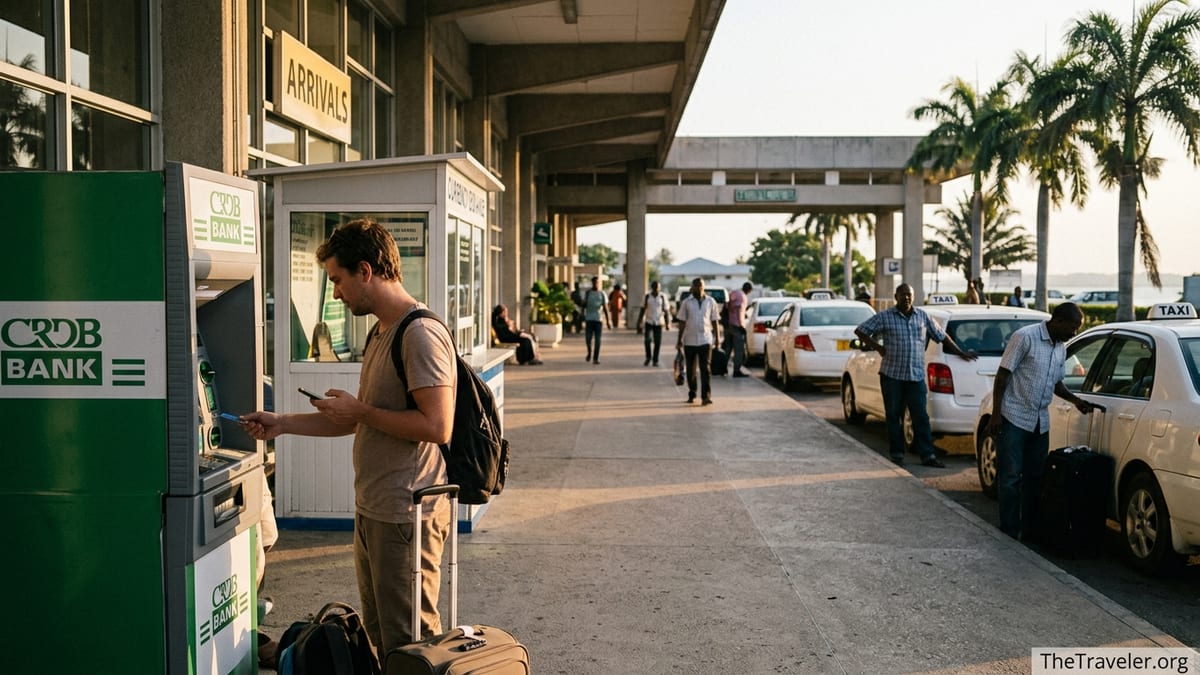
Most international flights into Zanzibar now use the newer Terminal 3, a compact glass-fronted building about 6 kilometers from Stone Town. After disembarking you will clear health checks, immigration and baggage claim before a final customs scan. Only then do you enter the public arrivals hall, where you will find ATMs, a forex counter, a small SIM shop and taxi drivers waiting outside.
The arrivals space is functional rather than polished. There are usually one or two ATMs from local banks such as PBZ Bank and CRDB inside or just outside the terminal, and currency exchange booths signposted as “bureau de change” near the exit doors. These services keep fairly long hours because flights arrive late at night as well as early morning, but they are not always perfectly staffed, so it is wise not to rely on a single option.
You should assume that airport Wi-Fi will be inconsistent and that your roaming may be expensive. Many travelers report that mobile data on a local SIM becomes the only reliable connectivity once they reach their hotel. For this reason it makes sense to think through your SIM and money plan before you reach the front of the taxi queue.
Taxi drivers and hotel representatives stand just outside the sliding doors with signs. Fares to Stone Town are generally around 15 US dollars or the equivalent in Tanzanian shillings, but you will want small notes or exact shilling amounts to avoid awkward negotiations after a long flight.
Cash, Cards and Currency: What You Really Need
The official currency in Zanzibar is the Tanzanian shilling, often written as TZS. You will see prices for local items such as street food, daladala buses and small shops quoted in shillings. Hotels, dive centers and tour operators frequently quote in US dollars, and many are happy to accept major cards, but everyday purchases work best in TZS.
In practice, many visitors arrive carrying around 100 to 300 US dollars in clean, recent bills, then withdraw shillings from an ATM for daily spending. A typical first withdrawal might be 100,000 to 200,000 TZS, which at recent exchange rates is roughly enough for a couple of taxi rides, a few meals and small tips. Because card terminals and ATMs in Tanzania can occasionally be offline, it is sensible to split your spending between one card and some cash rather than relying entirely on either.
Be aware that some banks in North America and Europe automatically block transactions in East Africa unless you have set a travel notice. Before you fly, log into your banking app and confirm that Tanzania is not on a restricted list, and consider bringing at least two different cards, for example one Visa and one Mastercard. Several travelers have reported that one brand occasionally fails while the other works at the same terminal.
For currency choice, shillings are increasingly preferred for everyday purchases and are often a better value. You may still be able to pay in dollars at your hotel or for organized excursions, but government policy has pushed more businesses to price and settle in local currency. As a rule of thumb, use TZS for food, taxis and markets, and reserve dollars for prepaid hotel balances or pre-booked tours if requested.
ATMs and Exchange Desks at Zanzibar Airport
When you walk into the public arrivals area, look left and right for bank logos and ATM signs. Recent reports describe two ATMs clustered on one side of the exit from Terminal 3, usually from local banks such as PBZ or CRDB. These machines dispense Tanzanian shillings only, not foreign currency, and you will typically pay a local fee of around 10,000 to 15,000 TZS per withdrawal on top of any fee from your home bank.
Because ATM reliability in Zanzibar is not perfect, it is wise to withdraw enough for your first few days in one go rather than counting on daily small withdrawals. For example, arriving travelers often take out 200,000 to 300,000 TZS and then top up later in Stone Town, where additional ATMs from banks like NMB and Exim are available. If the first ATM at the airport fails, simply move to the next one or fall back to a currency exchange counter instead of repeatedly retrying a faulty machine.
Official currency exchange desks sit either in the arrivals hall or just outside near the car park. Rates at the airport are usually a little worse than in town but still acceptable for modest amounts. As a practical example, travelers in the past year have described exchanging around 50 US dollars at the airport to cover their immediate taxi and meal costs, then using a Stone Town bureau the next day for any larger conversion. This approach balances convenience with decent rates.
Try to avoid unlicensed individuals offering to change money in the parking lot or at the curb. While some locals may be honest, unofficial money changing carries real risk of counterfeit notes or poor rates. Stick to clearly signed bank branches or bureaus where you receive an official receipt and can count your shillings unhurriedly.
Local SIM Cards, Mobile Data and eSIM Options
Zanzibar is served by the main Tanzanian mobile operators, including Vodacom, Airtel, Halotel and Zantel. All of them sell prepaid SIM cards and data bundles suitable for short visits. Coverage is strongest around Stone Town and the main beach areas such as Nungwi, Paje and Kendwa, though signal quality can vary between operators in more remote coastal villages.
Inside or just outside the international arrivals area you will usually find a small counter or kiosk selling local SIM cards. Travelers arriving in 2024 and 2025 have reported a general pattern: airport SIM prices are higher than in town, but the convenience is often worth the difference. For example, a one-week tourist data package advertised at roughly 10 to 15 US dollars might cost a few dollars more at the airport kiosk compared with a city shop, yet it saves you wandering around Stone Town with no data trying to find a provider’s store.
Typical tourist bundles are generous enough for navigation and light streaming. As an illustration, Vodacom and Airtel have offered multi‑gigabyte weekly bundles that comfortably cover messaging, maps and social media for most travelers. Heavy users who are constantly watching short videos might prefer a monthly bundle instead. Where possible, ask the clerk to install and activate the SIM for you, load an initial amount of airtime and purchase the data bundle on the spot so that you walk away with a working connection.
If your phone supports eSIM, you have two main options. One is to purchase an international eSIM from a third‑party provider before you fly, which will typically roam on one of the Tanzanian networks at a higher per‑gigabyte cost but requires no local registration queues. The second is to visit a physical shop for a local operator in Stone Town, where some branches can now provision eSIM profiles directly. This is usually cheaper but less convenient immediately on arrival, so many travelers combine an airport physical SIM for one device with an eSIM for a backup or second phone.
Paying for Taxis and Transfers on Arrival
Outside the arrivals doors you will see a line of licensed taxis and representatives from hotels and transfer companies. The ride into Stone Town is short, often around 15 to 20 minutes depending on traffic, and guide prices for an airport taxi into the historic center hover around 15 US dollars or roughly 35,000 to 40,000 TZS. Journeys to the northern beaches such as Nungwi or Kendwa are much longer and commonly run to 50 or more US dollars per car based on recent hotel transfer price lists.
You should agree the fare clearly before getting into the car and clarify the currency. If the driver quotes in dollars, you can politely ask for the equivalent in shillings and decide which works better given the cash you hold. Many visitors find it simplest to arrive with at least one 10 or 20 dollar note specifically reserved for the first taxi, then switch to shillings and negotiated rates for later trips around the island.
Most airport taxis still expect to be paid in cash, and card terminals in individual vehicles are rare. Some hotels and guesthouses can add airport transfers to your room bill and then charge your card at checkout, which is useful if you are short on cash when you land. If you have prebooked a transfer through a major booking platform, check in advance whether you have already paid online or will be paying the driver directly on arrival.
If you need to use an ATM or exchange desk before taking a taxi, tell the driver who approaches you that you will first visit the bank inside the terminal. The legitimate airport drivers are used to this request and will usually wait near the exit. Avoid climbing into a random car parked away from the main rank, and do not feel pressured by anyone insisting that you must decide instantly.
Card Limits, Security and Practical Money Tips
Before traveling to Zanzibar, review the daily ATM withdrawal limit on your primary debit card and consider temporarily increasing it if it is very low. Some visitors with limits around the equivalent of 200 US dollars per day discover that high local ATM fees and currency conversion spread make it inefficient to withdraw in many small chunks. A slightly higher limit lets you make one larger withdrawal, absorb the local machine fee once and then rely on cash for several days.
For card security, treat airport ATMs as you would anywhere else. Use machines located inside the terminal or in well‑lit, busy areas rather than isolated corners. Cover the keypad with your hand when entering your PIN and take a moment after the transaction to ensure your card has been returned. Because connectivity glitches are not uncommon, a machine may show an error while your bank registers a withdrawal; keeping screenshots of your banking app and printed ATM receipts can help if you need to dispute a transaction later.
Contactless card payments are increasingly accepted at mid‑range and upmarket hotels, dive centers and some restaurants, but they are not universal. A sea‑view cafe in Nungwi or a kite school in Paje might be able to take Visa but not Mastercard, or vice versa, and a small beach bar may be cash only. As a rule, assume cards will work in supermarkets and larger hospitality businesses and that you will need cash for local transport, roadside snacks and markets.
It is also wise to keep a small reserve of US dollars or euros separate from your main wallet in case of ATM outages or blocked cards. Even if day‑to‑day payments favor shillings, major hotels and tour operators can usually accept hard currency at a fair rate, especially in an emergency such as a broken card or lost wallet.
What to Arrange Before Leaving the Terminal
To leave the airport with minimal stress, think of your tasks as a short checklist to complete before you step into a taxi. First, secure a local connection. Either purchase and activate a local SIM with a data bundle at the airport kiosk, or switch on your pre‑purchased eSIM as you wait for your bags. Test that you can open a map and send a message while still inside the terminal, where you can easily ask the staff for help if something is not working.
Second, handle your immediate cash needs. If an ATM is working, withdraw enough shillings to cover at least your first taxi ride, drinks or snacks that evening and a buffer for tipping hotel staff. If ATMs are down or your card fails, exchange a modest amount of dollars or euros at the airport bureau so that you have cash in hand to pay for the taxi and a meal, then plan to look for better rates in Stone Town the following day.
Third, confirm your onward transport. If you have a hotel pickup arranged, find the sign with your name and reconfirm the price and payment method. For a taxi from the rank, agree a fare and currency, clarify whether the price is per car or per person and confirm that the driver knows your hotel and area. Showing the hotel’s printed name on your phone screen often avoids confusion between similarly named guesthouses.
Finally, make a quick safety and logistics check. Put your passport, phone and wallet in zipped compartments before walking out of the terminal, have a screenshot of your hotel booking saved in case mobile data drops, and keep small bills separate so that you can pay your taxi without pulling out your full cash stash on the curb. Five extra minutes inside the terminal usually save you from the most common arrival frustrations.
FAQ
Q1. Can I buy a local SIM card on arrival at Zanzibar Airport? Yes, there is usually at least one small kiosk or counter in or just outside the arrivals area selling prepaid SIM cards for operators like Vodacom, Airtel, Halotel or Zantel, and staff can help with activation.
Q2. Are there ATMs at Zanzibar Airport and do they accept foreign cards? Yes, there are typically one or two ATMs at or just outside the terminal that accept major international Visa and Mastercard debit or credit cards, though occasional outages mean you should not rely on a single machine.
Q3. Is it better to bring US dollars or use Tanzanian shillings in Zanzibar? Tanzanian shillings work best for everyday spending like food, taxis and markets, while US dollars remain useful for some hotels and organized tours, so many travelers carry a mix of both.
Q4. How much cash should I withdraw or exchange when I land? Many visitors start by withdrawing or exchanging the equivalent of 100 to 150 US dollars in shillings to cover the airport taxi, a few meals and tips, then adjust after seeing local prices.
Q5. Can I pay my airport taxi by card? Most regular taxis at Zanzibar Airport are cash only, though some hotel-arranged transfers can be charged to your room bill and settled by card at checkout, so confirm this with your accommodation in advance.
Q6. Are card payments widely accepted in Zanzibar? Cards are increasingly accepted at mid-range and high-end hotels, some restaurants and supermarkets, but you should expect to pay cash for local transport, small shops and many independent activities.
Q7. Do I need to set up anything with my bank before using ATMs in Zanzibar? It is wise to notify your bank of travel to Tanzania, check or temporarily increase your daily withdrawal limit, and carry at least two different cards in case one brand is declined.
Q8. Is buying a SIM card at the airport more expensive than in town? Yes, airport SIM packages are often a little more expensive than those sold in operator shops in Stone Town, but many travelers accept the small premium for the convenience of being connected immediately.
Q9. Will my international eSIM work in Zanzibar? Many global eSIM plans include Tanzania and will roam on local networks, but data is usually pricier than on a local SIM, so check coverage and cost details before departure.
Q10. What should I definitely arrange before leaving the airport terminal? Before walking out to the taxi rank, make sure your phone has working data, you have enough shillings or small US dollar notes for the taxi and first evening, and you have confirmed your transfer details and hotel address.