


Zayed International Airport in Abu Dhabi is the only airport in the Middle East that offers United States border preclearance. For many travelers on Etihad flights to New York, Chicago, Washington, or other U.S. gateways, this can turn a long transfer into a smoother arrival, letting you land as a “domestic” passenger and head straight to your connecting flight or the exit. This guide explains where the preclearance facility sits in Terminal A, how the process works when it is operating, what timing to plan for, which documents you must have ready, and what to double check before you fly.
Get the latest updates straight to your inbox!
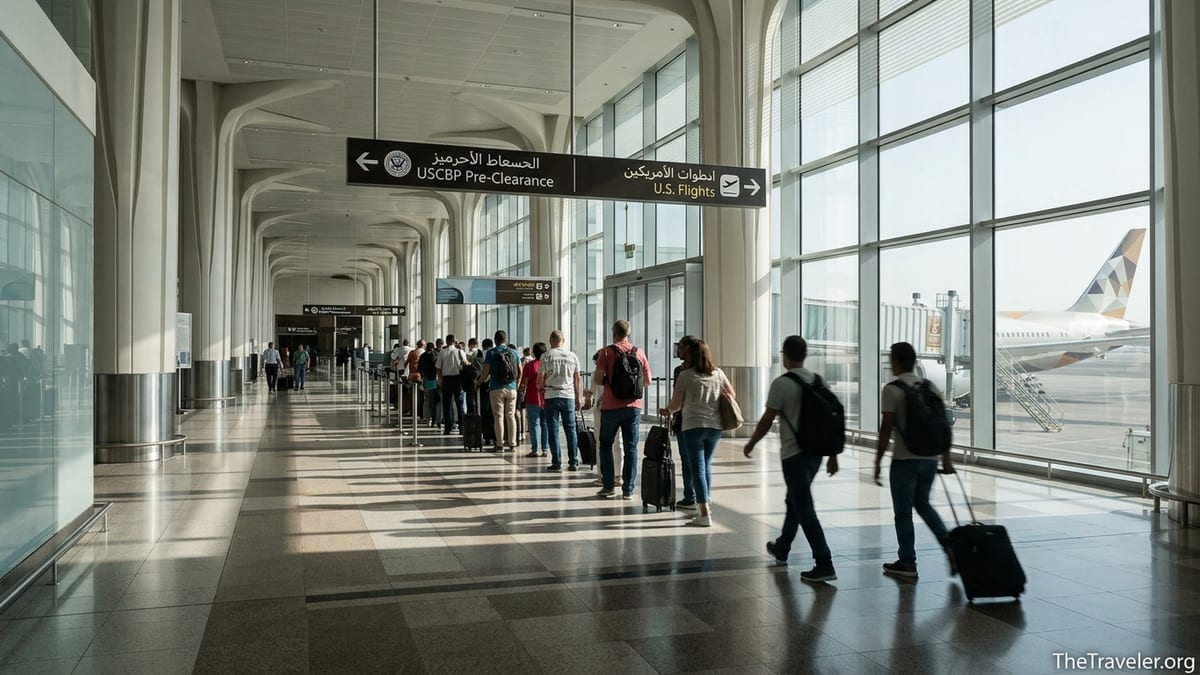
How U.S. Preclearance at Zayed International Airport Works
U.S. border preclearance means you complete almost all the formalities you would normally do on arrival in the United States while you are still in Abu Dhabi. Instead of queuing for immigration control after landing at airports like New York JFK, Chicago O’Hare or Washington Dulles, you see U.S. Customs and Border Protection (CBP) officers in Terminal A at Zayed International Airport. Once cleared, you board your flight and arrive in the United States as if you were a domestic passenger, usually entering through a separate arrivals corridor or domestic transfer area.
When operating normally, the Zayed International Airport facility handles U.S. immigration, customs and agriculture inspections for all eligible Etihad Airways flights bound for the United States. That typically includes major routes such as Abu Dhabi to New York JFK, Chicago O’Hare, Washington Dulles, and sometimes seasonal or secondary U.S. destinations. If your boarding pass and flight information indicate that you are “U.S. Preclearance” eligible, you will be directed to the dedicated area in Terminal A before boarding.
The experience is similar to arriving at a busy U.S. hub, but in a smaller, controlled environment. You present your passport to CBP officers, answer the usual questions about your trip, have your fingerprints and photo taken if required, and collect your checked baggage only when you reach the United States. For example, a traveler flying from Mumbai to Abu Dhabi to Chicago on a single Etihad ticket would clear Indian exit immigration in Mumbai, transfer through Terminal A, complete U.S. preclearance in Abu Dhabi, and then land in Chicago as a domestic arrival, heading directly to a connecting flight to Denver without another immigration queue.
At the time of writing in July 2026, the preclearance facility in Abu Dhabi has been subject to temporary suspensions and reduced operations. Travelers have reported that some flights simply bypass preclearance and complete all U.S. formalities on arrival instead. Because these arrangements can change on short notice, always check your booking details and the latest information from Etihad and Zayed International Airport close to your travel date.
Finding the Preclearance Area in Terminal A
All commercial passenger flights at Abu Dhabi now operate from Terminal A, which is branded as Zayed International Airport. U.S. preclearance is within this terminal complex, in a dedicated zone reached after the main security and departure shopping area. Signage in the terminal typically refers to “USCBP Pre-Clearance” or “U.S. Preclearance,” and is displayed in English and Arabic. From the central departures hall, you follow these signs toward the gates used for U.S.-bound flights, which are clustered in one section to allow secure segregation of precleared passengers.
In practice, many travelers first see preclearance information on the flight information display screens overhead. For example, an Etihad flight EY101 to New York JFK may show a note such as “U.S. Preclearance – proceed to U.S. immigration 2 hours before departure.” When you follow the gate number, additional overhead boards send you toward the preclearance checkpoint rather than directly to the gate. Staff in Etihad uniforms are normally stationed near these junctions to redirect passengers who attempt to bypass the U.S. area by mistake.
If you are in transit, you will arrive in Terminal A’s transfer zone and then pass through standard transit security before entering the main departures level. From there, the route is the same: follow signs to “USCBP Pre-Clearance” and then onward to your specific gate. Travelers report that from the central duty-free atrium it can take 10 to 15 minutes of walking at a normal pace to reach the start of the U.S. preclearance queue, so factor in both walking time and potential crowds. Families with young children or travelers with mobility needs should allow extra time or request wheelchair assistance in advance through their airline.
Because the preclearance zone is treated as a secure “U.S. departures” area, facilities inside are more limited than in the main terminal. There may be a small duty-free kiosk and basic seating areas near the gates, but the bulk of shopping, full-service dining and large airline lounges are located before you enter preclearance. A common mistake is lingering too long in the central food court or luxury boutiques and then having to rush through immigration. As a rule of thumb, plan all serious shopping, dining and lounge time early, then move toward preclearance as soon as the recommended time window opens.
Timing Your Arrival and Connection
Most airlines serving U.S. destinations through Abu Dhabi, particularly Etihad, advise passengers to arrive at Zayed International Airport at least four hours before scheduled departure if they are starting their journey in Abu Dhabi. This is more than the typical three-hour recommendation for long-haul flights, and the extra time reflects the additional immigration step. A realistic breakdown for an economy passenger might be 30 to 45 minutes for check-in and baggage drop, 15 to 30 minutes for outbound security, 30 to 60 minutes for preclearance itself, and a further 15 to 20 minutes of walking and queuing at the boarding gate.
For connecting passengers, the critical variable is your inbound arrival time and whether your bags are checked through to your U.S. destination. A traveler arriving from London on Etihad with a 2 hour 15 minute connection to Washington Dulles, for example, could expect about 20 minutes to deplane and navigate security, 10 to 15 minutes walk to the preclearance area, and then anywhere from 20 to 45 minutes at CBP depending on queues. In many cases this is enough, but disruptions, late inbound flights or extra questioning can eat up the margin. If you are booking your own separate tickets rather than a single through-ticket, avoid self-made connections shorter than 3.5 to 4 hours for U.S.-bound flights.
Timing becomes even more important when preclearance is operating on a reduced schedule. There have been periods where the facility has closed for certain early-morning or late-night departures, meaning passengers were processed on arrival in the U.S. instead. Because the pattern can shift with operational requirements, do not rely on last year’s experience or a friend’s anecdote. Check your airline’s pre-departure emails, the “Manage booking” section of your reservation, or contact customer support a few days before travel to confirm whether your specific flight is expected to use preclearance and what time you should be at the facility.
As a simple planning rule, treat the airport’s published recommendations as a minimum rather than a target. If Etihad suggests you be at preclearance two hours before departure in economy, consider aiming for two and a half hours, especially in peak holiday periods like late December and early January when Gulf hubs are crowded with long-haul transit traffic. For premium cabins such as Business or First, airlines sometimes indicate that 90 minutes at preclearance is sufficient, but it is still sensible to arrive a little earlier if you are unfamiliar with the layout of Terminal A.
Documents and Apps You Should Prepare
Preclearance at Zayed International Airport is an extension of U.S. border control, so the documentation rules are the same as if you were landing at a U.S. airport. At a minimum, you must have a valid passport and an appropriate permission to travel, such as a U.S. visa or an approved ESTA for Visa Waiver Program travelers. Check the validity of your passport well in advance; many airlines will refuse boarding if your passport is close to expiry or does not meet U.S. validity requirements. Travelers using ESTA should apply at least several days before departure and bring a printed or digital copy of the approval email, even though airlines and CBP can usually see your status electronically.
Non-immigrant visa holders, such as F-1 students or H-1B workers, should carry their supporting paperwork in hand luggage, not in checked baggage. In practice this means items like the I-20 or DS-2019 forms for students, employment approval notices for workers, and any documentation showing ties to your home country. For example, an engineering graduate flying from Kochi to Dallas via Abu Dhabi for a new job on an H-1B visa would be well advised to have copies of their job offer letter and approval notice ready for inspection. CBP officers sometimes ask additional questions at preclearance, and being able to provide documents quickly can help avoid delays.
Several digital tools can streamline the process. The CBP Mobile Passport Control app, available for many U.S. ports and some preclearance locations, has periodically been promoted for use at Abu Dhabi. When supported, it allows eligible U.S. and certain Canadian or visa waiver travelers to submit their passport and trip details by smartphone and then join a dedicated line on arrival at the inspection area. However, support for specific airports can change, so verify whether Zayed International Airport is currently listed in the app shortly before you travel.
Frequent travelers who are members of Global Entry or NEXUS programs should be aware that membership does not guarantee special treatment at every preclearance facility. Some locations have dedicated automated kiosks or lanes, while others direct all passengers to the same primary inspection booths. Even if a separate line exists, you still need to carry your Global Entry approval details and the same documents required of any other traveler. In all cases, assume that CBP officers at Abu Dhabi can ask the full range of admissibility and customs questions, just as they would at a U.S. airport.
What To Expect During the Preclearance Process
On arrival at the U.S. preclearance area, you first pass through a security screening that mirrors Transportation Security Administration (TSA) procedures in the United States. You place laptops, liquids and large electronics in separate trays, remove belts or jackets if requested, and walk through a metal detector or body scanner. Travelers carrying items bought in the main duty-free are subject to the usual U.S. rules on liquids and alcohol quantities, so if you plan to purchase large bottles of perfume or spirits, confirm in advance how they will be treated at this secondary screening.
After security, you join the immigration queues. There are usually separate lines for U.S. and Canadian citizens, for visa waiver travelers on ESTA, and for other visa holders. At busy times, such as late-night departure banks when several U.S.-bound flights leave within a short window, queues can build and passengers may be called forward based on departure time. CBP officers will typically ask standard questions: the purpose of your trip, how long you plan to stay, where you will be living, and how you are funding your travel. Students might be asked about their university and course, tourists about their itinerary and return ticket, and business visitors about meetings or conferences they plan to attend.
Once your details are checked and your biometrics taken if required, the officer will stamp your passport or admit you electronically, and you can proceed to the departure gate in the secure U.S. zone. The gate experience then looks much like any other international boarding, with boarding groups called over the intercom. The difference is felt mainly when you arrive in the United States. A family flying Abu Dhabi to New York, for instance, might land at JFK Terminal 4 and follow “Domestic connections” or “Baggage claim” signs rather than the long “Arrivals / Passport control” corridor. For travelers with tight onward domestic connections, this can mean the difference between an easy jog to the next gate and a missed flight.
It is important to understand that preclearance does not eliminate all controls on arrival. U.S. airports may still carry out random agricultural or customs checks, and Transportation Security may rescreen passengers who exit and re-enter secure areas. However, the heaviest part of the process, including the main passport inspection and visa verification, will already have been done in Abu Dhabi. This is particularly valuable at congested U.S. hubs which often experience long immigration lines at peak times.
Contingencies, Closures and What to Double Check
While U.S. preclearance in Abu Dhabi is a long-running program, it is not guaranteed to be available for every flight at all times. In recent years, travelers have reported temporary suspensions linked to operational changes and regional security conditions. During these periods, Etihad and airport authorities redirected passengers straight to the departure gates without full U.S. inspection, and all immigration formalities were completed when the flights landed in the United States. For someone expecting a quick domestic-style arrival, this can be a surprise, so staying informed is essential.
Before you travel, review your airline’s booking management page and any pre-departure emails. If preclearance is planned, your itinerary or check-in prompts often reference U.S. immigration in Abu Dhabi or mention earlier arrival times at the airport. At check-in, staff can usually confirm whether your specific flight is scheduled to use the facility on that day. If your trip includes a tight domestic connection in the United States, ask directly how the current preclearance status might affect your connection time. For example, a traveler connecting in New York with just 2 hours before a separate low-cost domestic flight may need to build in a larger buffer if preclearance is not running.
On the day of travel, pay attention to gate assignments and terminal screens. If your U.S.-bound flight is assigned to a gate within the dedicated preclearance cluster, it is more likely that the facility is expected to operate. If it is reassigned to a different concourse without a preclearance zone, that can be a signal that CBP processing will happen on arrival instead. Airport staff at the transfer desks and the entrance to the U.S. area are the best immediate source of clarification in these situations.
Regardless of whether preclearance is active, you should prepare as though you will be speaking to U.S. border officers in Abu Dhabi. That means having your documents organized, your luggage packed in compliance with both airline and U.S. restrictions, and clear answers in mind about the purpose and length of your trip. Even if the inspection ultimately takes place after your long-haul flight rather than before, this preparation reduces stress and the risk of delays for you and for other travelers in the same queue.
The Takeaway
U.S. preclearance at Zayed International Airport can turn a complex long-haul journey into a smoother experience, especially if you are arriving into a busy U.S. hub and connecting onward. When the facility is operating fully, you exchange the uncertainty of long immigration queues in the United States for a structured process in Abu Dhabi’s Terminal A, often with clear guidance on when and where to go. That can be a particular advantage for families, students with tight semester start dates, and business travelers who value predictability.
Success, however, depends on preparation. Arrive at the airport earlier than you normally would, especially for U.S.-bound flights, and treat the recommended preclearance time as a minimum. Study the signage in Terminal A, keep an eye on flight information displays, and ask staff if anything is unclear. Carry all necessary documents in your hand luggage, including visas, ESTA confirmations and supporting paperwork for your trip.
Because the preclearance schedule can change, do not assume that past experience guarantees the same process next time. Check with your airline in the days before departure to confirm whether your flight is planned to use U.S. preclearance or not, and build sufficient buffer time into any onward connections in the United States. Approached with realistic expectations and a bit of extra time, preclearance at Zayed International Airport can be one of the more traveler-friendly ways to enter the United States.
FAQ
Q1. Is U.S. preclearance at Zayed International Airport currently operating for all flights?
Operations have varied over time, with some periods of suspension or reduced hours. Always check with Etihad or your airline a few days before departure to confirm whether your specific U.S.-bound flight is expected to use preclearance on your travel date.
Q2. How early should I arrive at Zayed International Airport for a U.S.-bound flight?
If you are starting your journey in Abu Dhabi, plan to arrive at Terminal A at least four hours before departure for economy and consider a little earlier in busy seasons. Connecting passengers should avoid self-planned connections shorter than about 3.5 to 4 hours for U.S.-bound flights.
Q3. Where exactly is the U.S. preclearance area in Terminal A?
The facility is inside Terminal A beyond the main security and duty-free zone. Follow signs marked “USCBP Pre-Clearance” or “U.S. Preclearance” from the central departures hall toward the gates used for U.S.-bound flights, and staff will direct you into the correct area.
Q4. What documents do I need for preclearance in Abu Dhabi?
You need a valid passport and appropriate permission to travel to the United States, such as a visa or approved ESTA. Students and workers should also carry supporting forms like I-20s or employment approval notices, and any other documents that explain the purpose and duration of their stay.
Q5. Do I still go through immigration when I land in the United States if I used preclearance?
If you complete full preclearance in Abu Dhabi, you usually arrive in the United States as a domestic passenger and do not pass through the main immigration hall again. However, you may still encounter random customs or agricultural checks and security screening if you exit and re-enter secure areas.
Q6. Can I use Global Entry or Mobile Passport Control at Abu Dhabi preclearance?
Global Entry membership and Mobile Passport Control can be available at some preclearance locations, but support can change. Check the latest CBP guidance and the Mobile Passport Control app shortly before your trip to see whether Zayed International Airport is currently supported and whether special lanes or kiosks are in use.
Q7. Is U.S. preclearance mandatory for all passengers on eligible flights?
When the facility is operating and your flight is designated for preclearance, passengers are normally processed through it as part of the standard departure flow. Opting out is not typically offered, because the entire flight’s arrival handling in the United States is based on passengers having been precleared.
Q8. What happens if preclearance is closed on the day I travel?
If preclearance is suspended for your flight, you will board normally in Abu Dhabi and complete all U.S. immigration and customs formalities on arrival at your first U.S. airport, just as you would from any other international departure point. Plan extra time for connections in the United States if that occurs.
Q9. Can I buy duty-free liquids before preclearance and carry them on my U.S. flight?
Duty-free purchases are subject to U.S. rules on liquids and packaging at the security checkpoint inside the preclearance zone. Sealed, tamper-evident bags and receipts are often required. If you plan to buy large bottles of alcohol or perfume, ask the duty-free staff and your airline how they will be handled during the U.S. security screening.
Q10. Does preclearance change how my baggage is handled?
If you are checked through to a final U.S. destination on a single ticket, your checked bags are usually tagged to that endpoint. When preclearance is used, you often do not see your luggage again until the final airport, although you still follow local instructions at your first U.S. stop. If preclearance is not used, you will typically collect bags and clear customs at your first U.S. arrival airport before rechecking them for any onward domestic flights.