


Zayed International Airport in Abu Dhabi has quickly become a major global hub for Etihad Airways, with the new Terminal A designed to make international connections smoother than at the old airport. For travelers on Etihad layovers, the experience can be anything from a tight 45 minute dash between gates to an overnight stop with time for a shower, a meal, and a quiet corner. This guide explains, in practical detail, how Etihad-focused connections work at Zayed International Airport, with real-world timings, what to expect at security, baggage rules, walking distances, lounges, and how much layover time you realistically need.
Get the latest updates straight to your inbox!
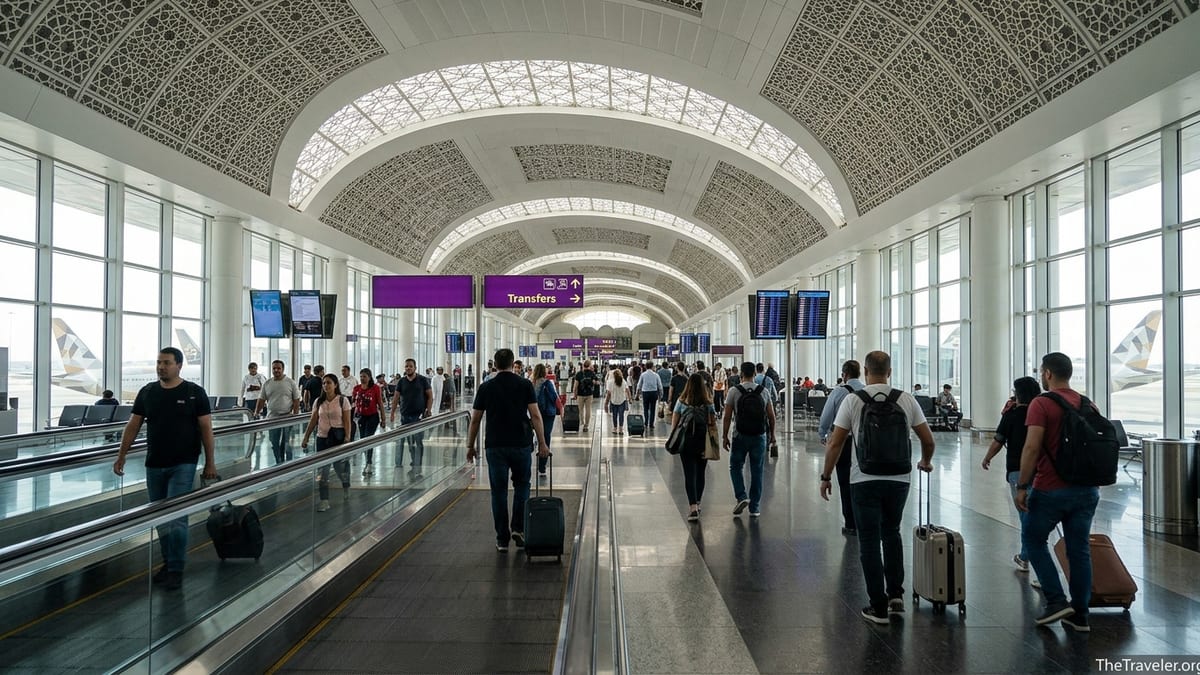
How Etihad Connections Work at Zayed International Airport
All Etihad flights now operate from Terminal A at Zayed International Airport, which removes the need for any inter-terminal transfers. The airport is laid out around a large central hall with three main piers of gates radiating out. In practice, that means that whether you arrive from London, Mumbai, Chicago, or Sydney with Etihad, you will always connect within the same terminal building, following the purple “Transfer” signs instead of heading to Arrivals or Baggage Claim.
For most passengers on a single Etihad ticket, the connection is entirely airside. When you step off your first flight, you simply follow the purple transfer signage, clear transit security, check the flight information displays for your next gate, and walk or use the moving walkways to your departure pier. There is no routine requirement to pass UAE immigration or collect bags during a standard Etihad to Etihad international transfer.
On a typical itinerary such as Frankfurt to Abu Dhabi to Bangkok, both legs operated by Etihad on one ticket, your boarding pass for the second flight is usually issued at your origin. If you checked in online with the Etihad app, you may already have both mobile boarding passes. If for any reason you only have the first boarding pass when you land in Abu Dhabi, you can obtain the onward pass quickly at the dedicated transfer desks just after the transit security checkpoint.
Etihad also operates partner and codeshare flights, particularly within the region and to South Asia. If your connecting flight is marketed by Etihad but operated by another carrier, you will still connect within Terminal A in most cases. The exact process remains very similar, but airport staff may direct you to that airline’s desk if there is an issue with your boarding pass or seat assignment.
Minimum Connection Times and What They Mean in Real Life
Zayed International Airport publishes a formal minimum connection time, and Etihad has set its own for Abu Dhabi based on actual operations. For Etihad to Etihad international connections within Terminal A, the minimum connection time can be as low as 45 minutes when both flights are on a single ticket and on the same booking. In practice, many itineraries seen in booking engines feature layovers of 1 hour 10 minutes to 2 hours, which gives a realistic margin for minor delays and queues.
Connections involving Etihad and a United States destination require more time because of the U.S. pre-clearance facility in Abu Dhabi. For itineraries such as Mumbai to Abu Dhabi to New York, Etihad recommends at least 85 minutes between flights to allow for U.S. Customs and Border Protection pre-clearance in Terminal A. In real life, this can feel tighter than a standard connection because you will pass security, then U.S. immigration and customs formalities, and then potentially a second security check before your U.S.-bound gate.
If you are booking your own flights on separate tickets, treat the official minimum connection time as a hard lower limit, not a target. For example, a traveler booking London to Abu Dhabi on Etihad with one ticket, then Abu Dhabi to Muscat on a completely separate Etihad or partner ticket, should look for at least 3 hours between flights. This extra buffer covers any delay on the first leg, time to speak to transfer staff if bags are not interlined, and potential queues at security. If your first flight arrives on time, that 3 hour window is enough for a relaxed walk through the terminal and even a quick shower in a pay-per-use lounge.
For overnight or long daytime layovers of 6 hours or more, it may be realistic to leave the airport for a short city visit or a hotel stay, but only if you have the appropriate UAE visa or are eligible for visa-free entry. In such cases, you must pass immigration, collect any checked bags, and then return to departures at least 2.5 to 3 hours before your next flight to clear security and immigration again.
Baggage-Through Rules and Separate Tickets with Etihad
On a single through-ticket journey booked under one Etihad reservation number, your checked baggage is normally tagged from your origin airport straight through to your final destination. For example, on a San Francisco to Abu Dhabi to Kochi itinerary purchased in one transaction with both legs on Etihad, your bag tag will show SFO to COK, and you will not see your luggage in Abu Dhabi. The bags are transferred in the secure baggage system within Terminal A while you pass through transit security.
When separate tickets are involved, baggage handling becomes more complicated and depends on interline agreements and the goodwill of the check-in agent. If you are flying Etihad from Paris to Abu Dhabi on one ticket and then Abu Dhabi to Male on a second, also with Etihad, many passengers report that agents are willing to tag bags through to the final destination if both flights are Etihad-operated and the connection is the same day. However, this is not guaranteed and is subject to Etihad’s current policy and check-in system capabilities on the day of travel.
If a non-Etihad airline is involved on a separate ticket, through-checking baggage is much less likely unless there is a specific interline agreement in place. For instance, if you fly into Abu Dhabi on a European low-cost carrier and then connect to Etihad on a separate booking, you should expect to collect your checked bags in Abu Dhabi, clear immigration, walk to departures, and re-check them at the Etihad counters. In that scenario, a layover of 4 to 5 hours or more is sensible, since immigration lines and baggage delivery can add unpredictable delays.
Always check your bag tags at the first airport. A traveler flying Chicago to Abu Dhabi to Colombo on one ticket but then separately Colombo to Male on a low-cost carrier will want to confirm that the bags are tagged only to CMB, not MLE. That confirmation determines whether to budget time in Colombo to collect and re-check bags. The same principle applies in Abu Dhabi: your tag is the final word on where the bags are going, and if you are unsure, have the agent print your itinerary receipt and point out the baggage destination.
Walking Times, Gate Changes, and Getting Around Terminal A
Zayed International Airport’s Terminal A is large and modern, with wide walkways and extensive moving walkways linking the central hall and the three main gate piers. Average walking time from the transit security exit in the central area out to a mid-range gate on one of the piers is typically around 10 to 15 minutes at a normal pace, less if you use the travelators continuously. For outermost gates at the far ends of the piers, allow closer to 20 minutes, especially during busy bank times when many flights arrive and depart within a short window.
Etihad often uses clusters of adjacent gates for widebody aircraft operating to Europe, North America, and East Asia. A passenger arriving from Rome into a mid-pier gate and continuing to Sydney from another nearby gate might only have a 5 to 8 minute walk between flights. Conversely, if your arrival is at a Schengen or regional gate near one end of a pier and your onward long-haul departs from the opposite pier, airport staff may estimate 15 to 20 minutes of walking time including escalators and security exits.
Gate changes can occur right up to boarding time, particularly during peak evening and overnight waves of Etihad departures. It is common for a flight shown at, say, C32 on your boarding pass to shift to C38 or to a gate on a neighboring pier as aircraft assignments are adjusted. For this reason, treat your boarding pass as a starting point only. The flight information display screens in Terminal A are the authority, and they update rapidly. A practical routine is to check the screens immediately after transit security, again when you reach the central atrium, and once more about 30 minutes before scheduled boarding.
For tight legal connections, Etihad ground staff frequently meet arriving flights and direct transfer passengers. On routes feeding heavy long-haul banks, such as flights arriving from regional Indian cities or Jeddah, you may see uniformed staff at the end of the jet bridge holding signs for onward destinations like London, Toronto, or Melbourne. They will direct passengers to the fastest route through transit security and may escort groups on particularly tight connections.
Security, Transit Formalities, and U.S. Pre-clearance
Every international transit passenger in Abu Dhabi must clear security at least once between flights. Immediately after leaving your arrival gate, you follow the purple transfer signs to a dedicated screening area, where carry-ons are x-rayed and passengers walk through metal detectors or body scanners. Liquids and laptops rules are similar to other major hubs, though implementation may be slightly more flexible than at some European airports. Security wait times fluctuate, but most connecting passengers report passing through in 5 to 20 minutes outside of holiday peaks.
If your onward flight is to the United States, you will also use the U.S. pre-clearance facility in Terminal A. After the initial security, you follow dedicated signage to U.S. departures, where you are processed by U.S. Customs and Border Protection officers. You will complete immigration, potentially answer brief questions about your trip, and may be asked to collect and re-screen carry-on items. Because you arrive in the U.S. as a domestic passenger, this process replaces immigration lines upon landing, but it does compress your available connection time in Abu Dhabi.
Passengers connecting from a Schengen or UK flight to a U.S. destination on Etihad should factor in the additional formalities. For example, someone traveling Amsterdam to Abu Dhabi to Chicago with a 1 hour 40 minute layover can usually make the connection if the inbound flight is punctual, but a 30 to 40 minute delay might cause stress. In such cases, Etihad staff at the arrival gate can sometimes fast-track connecting U.S. passengers through security and up to the pre-clearance queue, but that is not guaranteed.
Travelers remaining in the international transit area and not entering the UAE do not pass immigration. However, if you have a long layover and decide to exit the airport for a hotel or city visit, you will go through UAE passport control on the way out and again on your return. Security on re-entry to departures can be busier during the late-night departure wave, so allow increased time if you are coming back to the airport between 10 p.m. and 2 a.m. local time.
Lounges, Showers, and Rest Options on an Etihad Layover
Terminal A at Zayed International Airport offers a broad range of lounges suited to different cabin classes and budgets, with Etihad’s own lounges at the core. Etihad’s main Business Class Lounge in Terminal A, located airside, serves guests traveling in Business or First as well as certain Etihad Guest elite members. Inside, travelers typically find hot and cold buffets with both Middle Eastern and international dishes, barista coffee, quiet zones with loungers, showers, and family areas. For a traveler on a 3 hour overnight layover between Sydney and London in Business Class, this lounge effectively replaces a hotel stop, with a shower and a light meal before the second long-haul sector.
There are also independent lounges at Terminal A that can be accessed regardless of airline or cabin, sometimes branded with names like Pearl Lounge or similar. These facilities, often in the mid-pier levels, usually sell access at the door or via lounge membership programs and premium credit cards. Prices vary but tend to be in the range that makes sense for layovers of 3 hours or more, when the value of a quiet seat, food, Wi-Fi, and a shower starts to justify the cost.
For passengers in Economy with shorter layovers, the central terminal concourse and piers offer extensive seating, cafés, and restaurants. A traveler with a 90 minute connection from Delhi to Madrid, for instance, may prefer to walk directly to the gate area and buy a coffee or quick snack nearby rather than detouring to a lounge. Free Wi-Fi is typically available throughout the terminal, and many seating areas now incorporate charging points for phones and laptops.
For very long connections or overnight stops that stretch to 8 hours or more, a landside airport hotel within the Zayed International Airport complex can be a smart investment. A typical use case is an evening arrival from Europe with a morning departure to Australasia. Instead of dozing in a chair or remaining in the lounge, a traveler might clear immigration, check into the on-site hotel for 6 to 8 hours of proper rest, and then return to departures for the onward flight, all without leaving the airport campus.
Planning Your Layover: Realistic Scenarios and Timing Tips
To turn the technical rules into practical decisions, it helps to look at a few common Etihad connection scenarios. Consider a family flying from Manchester to Abu Dhabi to Phuket on a single Etihad ticket, with a layover of 1 hour 20 minutes. If the inbound flight is on time, 1 hour 20 minutes is normally sufficient: 10 minutes to deplane and walk to transit security, 10 minutes to clear security, and 15 minutes to walk to a mid-pier gate, leaving roughly 35 minutes flex for queues or a restroom stop before boarding.
Now look at a solo traveler doing a self-constructed itinerary: Berlin to Abu Dhabi on Etihad booked in a sale, then Abu Dhabi to Muscat on a separate regional ticket. Because baggage-through may not be guaranteed and because any delay on the first leg would ruin both journeys, this traveler should plan at least a 3 hour layover. The extra time allows for collecting checked bags if required, clearing immigration, dropping baggage again, and passing through security, even if lines are long.
For an ultra-short, same-day connection like Riyadh to Abu Dhabi to Paris, with the minimum 45 minute connection time on a single Etihad ticket, success depends heavily on punctuality and gate proximity. Passengers on such itineraries should sit as far forward as possible on the first flight if seats are free, keep carry-ons compact to avoid delays in the aisle, and move briskly as soon as the aircraft door opens. In many cases, Etihad will monitor these tight connections and may even hold the onward flight briefly when a cluster of connecting passengers is on a slightly delayed feeder flight.
On the other end of the spectrum, passengers with 6 to 10 hour daytime layovers sometimes use the time to see a bit of Abu Dhabi. A traveler landing at 7 a.m. from Singapore and departing at 3 p.m. to Rome, for example, might clear immigration, take a taxi to visit the Sheikh Zayed Grand Mosque, and be back at the airport by midday. That still leaves a comfortable 2 to 3 hours for departure formalities. Such a plan only works, however, if your baggage is checked through, your entry status allows you to leave the airport, and you strictly manage your return time.
The Takeaway
Connecting on Etihad at Zayed International Airport is generally straightforward thanks to the single-terminal layout, clear transfer signage, and modern facilities in Terminal A. For most travelers on a single Etihad ticket, the process is simply a matter of following the purple transfer signs, clearing transit security, checking the screens for your gate, and walking out along the appropriate pier, with no need to handle bags or pass immigration.
Where things become more complex is with very tight connections, U.S.-bound flights that require pre-clearance, and self-constructed itineraries involving separate tickets or non-Etihad airlines. In those situations, giving yourself ample buffer time, double-checking baggage tags, and understanding walking times within Terminal A are critical to a low-stress experience. With a realistic approach to connection timing and a good sense of how security, baggage, and lounges fit into the picture, most Etihad layovers at Zayed International Airport can feel like a comfortable interlude rather than a race through an unfamiliar hub.
FAQ
Q1. What is the minimum connection time for Etihad to Etihad flights at Zayed International Airport?
For Etihad to Etihad international connections within Terminal A, the minimum connection time can be as low as about 45 minutes on a single ticket, though many itineraries build in longer layovers for comfort and resilience against delays.
Q2. Do I need to collect my checked baggage in Abu Dhabi during an Etihad layover?
If your journey is on a single Etihad ticket and your bags are tagged to your final destination, you do not normally collect baggage in Abu Dhabi; it is transferred within the secure system while you remain airside.
Q3. Will Etihad through-check my bags on separate tickets?
Through-checking on separate tickets is not guaranteed. If both flights are Etihad-operated and on the same day, agents may sometimes tag bags through as a courtesy, but policies and systems vary, so you should plan as if you may need to re-check.
Q4. How long does it take to walk between gates at Terminal A?
From the transit security exit to a mid-pier gate usually takes around 10 to 15 minutes at a normal walking pace using moving walkways. Walking to the farthest gates at the ends of the piers can take closer to 20 minutes.
Q5. What extra time do I need if I am connecting to a U.S. flight with Etihad?
Because you must use the U.S. pre-clearance facility in Abu Dhabi, you should allow at least about 85 minutes between flights, and more if possible, to cover security, immigration, and potential queues.
Q6. Can I use a lounge during a short Etihad layover?
Yes, if your ticket or status grants access, or if you purchase entry to an independent lounge. For layovers under two hours, many travelers head directly to the gate, while for three or more hours, lounge access is often worthwhile.
Q7. Is it realistic to leave the airport during a long connection?
It can be realistic for layovers of six hours or more, provided you are eligible to enter the UAE and your bags are checked through. You must factor in time for immigration, transport into the city, and a return to departures at least 2.5 to 3 hours before your next flight.
Q8. What happens if my first Etihad flight is delayed and I have a tight connection?
If your entire journey is on one Etihad ticket, the airline will normally rebook you if a delay causes you to miss your legal connection, and staff may assist tight connections by directing or fast-tracking passengers where possible.
Q9. Do I have to pass UAE immigration during an Etihad transit at Zayed International Airport?
No, if you are simply connecting airside and not entering the UAE, you remain in the international transit area and do not pass immigration. You only go through passport control if you leave the airport or if your itinerary specifically requires it.
Q10. How much layover time should I plan if I book my own separate tickets?
For separate tickets, especially when baggage-through is uncertain, it is prudent to plan at least three hours or more between flights to allow for possible delays, baggage collection, immigration, and re-checking procedures.