


Flying through Abu Dhabi and eyeing a quick visit to the Sheikh Zayed Grand Mosque during your layover at Zayed International Airport (AUH)? It can be a wonderful way to turn a routine connection into a highlight of your trip, but only if you plan the timing, luggage, and dress code carefully. This guide walks through what is realistically possible between flights and how to make a quick mosque visit smooth instead of stressful.
Get the latest updates straight to your inbox!
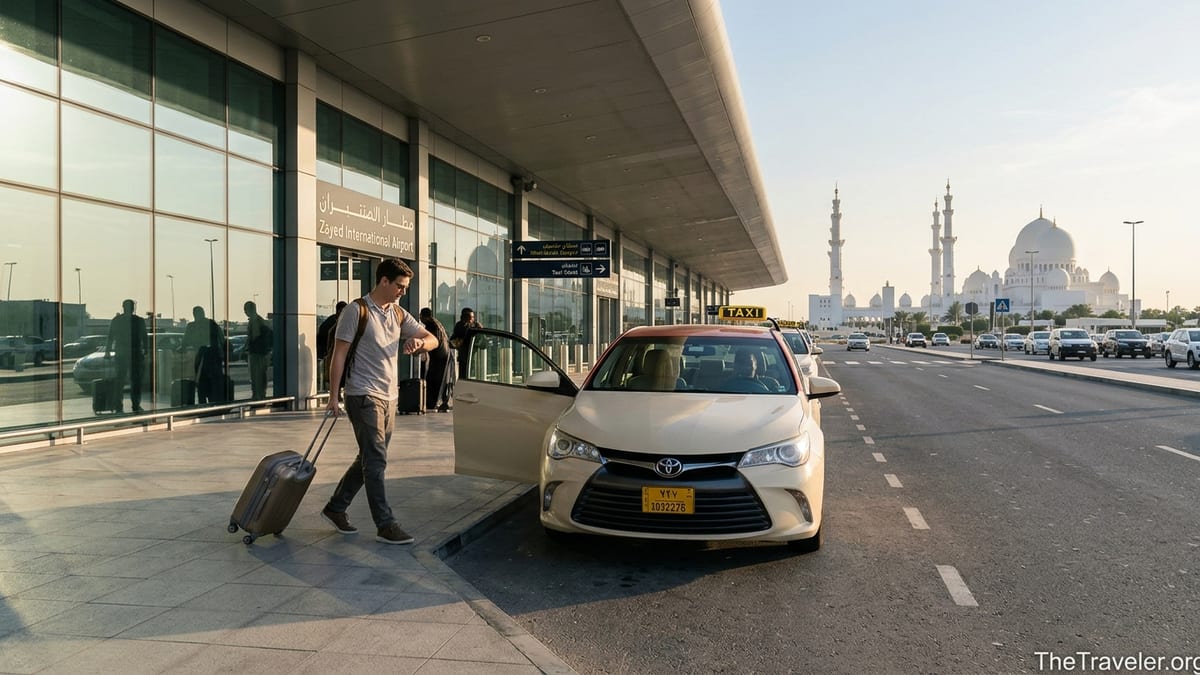
Understanding the Distance, Traffic and Typical Taxi Times
Zayed International Airport sits to the east of Abu Dhabi city, while Sheikh Zayed Grand Mosque is roughly in the middle of the mainland, just off the main highway into town. The driving distance is around 20 to 25 kilometers depending on your route, and in normal conditions taxis cover this in about 20 to 25 minutes each way. Many recent travelers report door to door times from the airport’s Terminal A curb to the mosque car park in the low 20-minute range in light traffic, and closer to 30 minutes at busier times of day.
Traffic in Abu Dhabi is usually heaviest on weekday mornings between about 7:30 and 9:30 and late afternoon from roughly 4:30 to 7:00. During those windows, your ride can creep up to 30 or even 40 minutes, so you should build in extra buffer if your layover overlaps with rush-hour. Late evenings and overnight, especially after 10 p.m., the highway tends to move freely and you are more likely to see the lower end of the timing estimates.
For planning purposes, most visitors should assume a conservative 30 minutes each way rather than the best-case 20. That means just the round-trip travel to and from the mosque will eat about one hour of your layover. Add immigration on arrival, security when you return, and the time you actually spend at the mosque, and it becomes clear that only medium to long layovers are realistic for an off-airport excursion.
One practical example: if you land at 10:00 in the morning, clear immigration by 11:00, take a 25-minute taxi ride, and arrive at the mosque by around 11:30, a one-hour visit brings you back in a taxi by 12:30 or 12:45. Reaching the airport no later than 13:15 gives you about 2 hours before a 15:15 departure. This kind of timetable can work, but it leaves little room for delays.
Taxi, Ride-hailing and Public Transport: Which Is Realistic on a Layover?
The fastest and most straightforward way to reach Sheikh Zayed Grand Mosque from Zayed International Airport is by airport taxi or ride-hailing app. The airport has a dedicated taxi rank outside arrivals with metered silver taxis and branded airport cabs. Typical fares to the mosque currently land in the region of 40 to 60 AED one way, depending on traffic and any airport flag-fall surcharge. Many travelers report paying roughly mid-40s dirhams outside peak times, which is comparable to a short urban taxi ride in many major cities.
Ride-hailing services such as Uber and Careem are officially supported at the airport, with pick-up areas clearly signed near the terminal. Fares via these apps are often similar to or slightly lower than standard taxis, especially off peak or if you share a ride. For example, two or three people splitting a 55 AED ride with Careem from Terminal A to the mosque effectively pay less than the price of a coffee each for the transfer, and they know the fare estimate before getting in.
Budget-conscious travelers might look at public buses. While Abu Dhabi has an expanding bus network that serves both the airport area and the mosque district, making the connection on a short layover is usually not realistic. Routing often involves at least one change, journey times can easily exceed 45 to 60 minutes in each direction, and bus headways add more uncertainty. On a long daytime layover of 10 hours or more, buses can make sense, but if your connection is under 8 hours and you want to minimize stress, taxis or ride-hailing are vastly more reliable.
There is currently no metro or rail link in operation between Zayed International Airport and the mosque, though future transit plans often mention both locations. For now, the choice is essentially between road transport options, and for a time-sensitive layover the safest bet is still a door-to-door taxi or app car.
How Long a Layover Do You Really Need?
The most important question is not how long the taxi takes, but how much total layover time you have between flights. For most travelers, the practical minimum to leave the airport, visit Sheikh Zayed Grand Mosque, and get back without unnecessary risk sits around 7 to 8 hours between scheduled arrival and departure. Anything less quickly becomes tight once you factor in queues and small delays.
Think through the full sequence. On arrival, you must deplane, walk to immigration, clear passport control, and possibly collect checked luggage if it has not been tagged through to your final destination. Even at a modern, efficient airport like Zayed International, this visible and invisible process can easily consume 45 to 60 minutes and occasionally longer at busy times. On your return, airlines typically recommend being back at the airport about 2 to 3 hours before an international flight. That buffer is especially important if you need to check bags again or still have security formalities ahead of you.
As a rule of thumb, many experienced Abu Dhabi travelers find that an 8-hour daytime layover allows a comfortable 2 to 2.5 hours at the mosque, including walking the main prayer hall, marble courtyard, and colonnades, while still keeping healthy buffers at both ends. For example, with an 08:00 arrival and 16:00 departure on separate tickets, you might clear immigration by 09:00, arrive at the mosque by around 09:30, spend until 11:30 exploring and taking photos, then be back at the airport close to 12:00 or 12:15, still 3 hours before departure.
Shorter layovers can sometimes work, especially at off-peak hours, but they carry more risk. With 6 hours, a smooth connection is possible if everything runs on time, but any delay getting off the plane, an unexpectedly long security line, or a slow taxi in traffic can quickly eat your margin. Many local residents and frequent flyers would hesitate to attempt a mosque excursion on anything less than 7 hours unless they are traveling with hand luggage only and are very comfortable with tight schedules.
Luggage: What To Do With Bags During a Mosque Visit
What happens to your luggage often decides whether a quick mosque trip feels easy or impossible. If your bags are checked through to your final destination on a single ticket, life is much simpler. In that case, you only carry your cabin bag, and you can take it directly with you in the taxi. At Sheikh Zayed Grand Mosque you cannot bring large suitcases inside, but typical cabin-sized roller bags and small backpacks are commonly accepted in the visitors’ center and outdoor areas. You should still travel light and avoid bringing valuables you do not need.
If your checked luggage is not tagged through, or if you are on separate tickets and must pick it up in Abu Dhabi, you will need a storage solution. Zayed International Airport operates an official luggage storage facility in partnership with a specialist baggage company. As of mid-2026, published prices for storage run roughly in tiers such as around 35 AED for up to 3 hours, about 55 AED for up to 12 hours, and around 75 AED for up to 24 hours per item, with the facility generally located landside near the arrivals area. This setup allows transit passengers to leave larger suitcases securely at the airport and head into the city with only a daypack.
For travelers on very long layovers or overnight stops, the storage facility can handle multi-day stays with incremental pricing. It is wise to double-check any size limits and current rates at the counter on arrival, but many recent users describe it as quick and straightforward, with 24-hour opening hours that match the airport’s round-the-clock flight schedule. Because fees are charged per item, families often consolidate belongings into fewer large suitcases to keep costs down.
What you should not do is turn up at the mosque expecting to store big bags there. The complex offers security screening and basic lockers for small personal items, but it is not designed as a luggage depot, and visitors with full-size suitcases may be turned away or heavily restricted. If your plan includes a mosque visit, assume that all large bags must either stay checked with your airline or be left at an airport storage facility. Trying to carry heavy luggage through marble courtyards and prayer halls is uncomfortable, impractical, and can draw unwanted attention from security staff.
Dress Code, Advance Booking and Cultural Etiquette
Sheikh Zayed Grand Mosque is a place of worship with a clear dress code that applies equally to visitors on a layover. For women, this normally means arms and legs fully covered, no tight or transparent clothing, and a headscarf. Long loose trousers or a maxi skirt paired with a long-sleeve, non-clingy top usually works well. Many female travelers keep a lightweight scarf in their cabin bag specifically for this purpose, choosing breathable cotton or viscose that feels comfortable in the heat. For men, shoulders and knees should be covered, so T-shirts and long trousers are usually acceptable, while sleeveless tops and shorts above the knee are not.
The mosque has been known to provide abayas and kanduras on loan for visitors whose outfits do not meet the guidelines, but availability and policies can vary and queues for these garments sometimes grow during peak visiting hours. Smart layover visitors plan their outfits before departure. Simple practical steps include flying in loose linen trousers instead of shorts, or packing a light cardigan and scarf in your carry-on even if you spend most of the flight in more relaxed clothes. Remember that heavily branded or slogan-covered clothing, sheer fabrics, and tight leggings without a long top can still be rejected at the entrance.
In addition to clothing, allow time for security and registration. The mosque often requires free online visitor registration with a chosen time slot, especially in the late afternoon and around sunset when demand peaks. While walk-ins may still be accepted in quieter periods, travelers with a fixed departure flight should treat advance time-slot booking as mandatory. If, for example, your layover lets you reach the mosque around 10:30, choose a 11:00 or 11:30 slot rather than the earliest one available, giving yourself a margin for a slow taxi or slightly longer immigration queue.
Once inside, remember that you are in an active religious site. Keep voices low, avoid public displays of affection, and follow marked walking routes. Photography is widely allowed in the courtyards and selected interior spaces, but staff may ask visitors to move along if they linger too long in busy spots, sit on restricted ledges, or pose in ways considered disrespectful. Treat the mosque as you would any major cathedral or temple worldwide: a place where awe, curiosity, and consideration should exist side by side.
Sample Timetables for Different Layover Lengths
To make the trade-offs clearer, it helps to look at realistic sample schedules. Imagine you have an 8.5-hour daytime layover, arriving at 07:30 and departing at 16:00. If your inbound flight is on time, you may be standing in the immigration queue by 07:50 and through by about 08:30. After a short walk to the taxi rank and a 25-minute ride, you could reach the mosque close to 09:00. A reserved 09:30 visit slot gives you time to clear security, adjust your clothing or collect a loaned abaya if needed, and then spend 90 minutes exploring. Calling a taxi around 11:00 could see you back at the airport about 11:30, with ample time to eat, browse duty free, and be at your gate well before boarding for the 16:00 flight.
Contrast that with a 6-hour evening layover arriving at 17:00 and departing at 23:00. Immigration might still take until 18:00, especially if several wide-body flights arrive around the same time. Even if you catch a taxi within minutes, you will likely not reach the mosque before 18:25 or later. Sunset crowds start to build, photo spots are busy, and loan-clothing queues may grow. If you leave again at 20:00, you reach the airport about 20:30, leaving just 2.5 hours before departure, which is the minimum many airlines recommend. That schedule is possible, but it is tight and leaves little room if something runs late.
With really short layovers, such as 4 to 5 hours, a mosque trip becomes a gamble. Consider a 5-hour mid-morning connection with arrival at 09:00 and onward departure at 14:00. Even if everything flows smoothly, you might only reach the mosque close to 10:30 and would need to leave again by 11:30 to protect your return buffer. That grants barely an hour on-site and assumes no delays. In this situation, many seasoned travelers decide to stay in the airport, enjoy a shower, meal, or lounge access, and save the mosque for a future dedicated visit.
On the other end of the spectrum, anyone with 10 to 14 hours between flights has the luxury of building a slower-paced itinerary. One common approach is to visit the mosque in the late afternoon for cooler temperatures and glowing light on the white marble, combine it with a nearby mall stop for a meal and coffee, then head back to the airport after dark. Even then, it is wise to plan your return to the airport at least 3 hours before departure. Abu Dhabi runs smoothly most of the time, but a random traffic delay or longer-than-expected security queue is always possible.
Staying Airside vs Going into the City: Risk and Reward
Every decision to leave the airport on a layover is ultimately a calculation of risk versus reward. Staying airside at Zayed International Airport has clear advantages: you avoid immigration completely, eliminate transport risks, and have direct access to lounges, dining, shopping, and quiet areas with showers. For business travelers on tight connections or anyone dealing with jet lag, simply booking a day-room at the in-terminal hotel or paying for lounge access can be more restorative than rushing out for a quick sightseeing sprint.
Yet for many travelers, especially those who may never pass through Abu Dhabi again, the chance to see Sheikh Zayed Grand Mosque in person is hard to resist. The sight of white domes reflected in still pools, the feel of cool marble underfoot, and the scale of the prayer hall’s chandeliers are not easily forgotten. Transit passengers often describe the visit as the single most vivid memory of an otherwise long-haul itinerary, especially when timed for golden hour or evening illumination.
If you are on a single ticket with both flights protected by the same airline, missing your connection because of a delayed inbound flight is usually the airline’s responsibility. But if you choose to leave the airport and then return late because of your own timing decisions, you carry most of the risk. That risk multiplies for travelers on separate tickets who would need to buy a brand-new onward ticket if anything goes wrong. Before you order a taxi, ask yourself how much appetite you have for uncertainty and whether the potential stress is worth it on this particular trip.
One practical compromise some travelers adopt is to set a strict return-to-airport time alarm, often 3.5 to 4 hours before departure, and promise themselves they will leave the mosque at that time regardless of how tempting it is to take just a few more photos. This simple rule keeps an exciting detour from turning into a nail-biting race back through the terminal.
The Takeaway
Using a layover at Zayed International Airport to visit Sheikh Zayed Grand Mosque is absolutely possible and often deeply rewarding, provided you have enough time and plan carefully. For most travelers, an 8-hour or longer connection offers a comfortable window to clear immigration, store or manage luggage, travel by taxi, respect the dress code and registration process, and still return with healthy margins before your onward flight.
The success of the excursion hinges on a few key choices. Build your schedule around realistic 25 to 30 minute taxi rides each way, not best-case scenarios. Decide early what will happen to your luggage, and do not assume you can leave big bags at the mosque. Dress in conservative, lightweight clothing that satisfies the mosque’s rules straight off the plane, and secure a time slot in advance whenever possible, especially for popular sunset visits.
Finally, be honest about your own travel style and risk tolerance. If the idea of watching the clock during an airport run gives you anxiety, staying airside and indulging in a quieter layover might be the better option. If, on the other hand, you thrive on making the most of every stop and have a sufficiently long buffer, a carefully planned mosque visit can transform your connection through Abu Dhabi from a forgotten blur into a standout travel moment.
FAQ
Q1. What is the minimum layover time to visit Sheikh Zayed Grand Mosque from Zayed International Airport?
Most travelers should aim for a layover of at least 7 to 8 hours between flights. This usually allows time to clear immigration, travel 25 to 30 minutes each way by taxi, spend 60 to 90 minutes at the mosque, and still return to the airport 2 to 3 hours before your next international departure.
Q2. How much does a taxi from the airport to Sheikh Zayed Grand Mosque cost?
Typical metered taxi fares from Zayed International Airport to Sheikh Zayed Grand Mosque usually fall in the 40 to 60 AED range one way, depending on traffic and any airport surcharges. Ride-hailing apps such as Uber and Careem often show similar prices, and splitting the fare between two or three passengers keeps individual costs low.
Q3. Is there luggage storage at Zayed International Airport during a layover?
Yes, the airport operates a baggage storage facility in the public arrivals area in partnership with a specialist provider. Prices are tiered by duration, with rough bands such as around 35 AED for up to 3 hours, about 55 AED for up to 12 hours, and around 75 AED for up to 24 hours per item. Always verify exact current rates and conditions at the counter when you arrive.
Q4. Can I store my suitcase at Sheikh Zayed Grand Mosque instead of at the airport?
The mosque does not function as a full luggage storage facility. While there may be small lockers or areas for modest personal items, visitors with large suitcases or multiple bags can face restrictions and delays at security. To avoid problems, plan to keep big bags checked with your airline or use the official luggage storage at the airport before heading to the mosque.
Q5. What should I wear to the mosque if I am coming straight from a flight?
Dress modestly and conservatively. Women should have arms and legs fully covered, avoid tight or transparent fabrics, and bring a headscarf. Men should wear tops with sleeves and trousers that cover the knees. Loose linen trousers, long skirts, long-sleeve tops, and a light scarf in your carry-on are practical choices that meet the dress code and remain comfortable in the heat.
Q6. Do I need to book a time slot in advance to visit Sheikh Zayed Grand Mosque on a layover?
While walk-in visits are sometimes possible, the mosque often uses a free online reservation system with timed entry slots, particularly for busy periods around sunset and on weekends. If your layover is tight or you are traveling in peak season, it is wise to secure a time slot in advance that aligns with your estimated arrival time from the airport.
Q7. Is public transport a realistic option from the airport to the mosque during a short layover?
For short and medium layovers, public buses are usually not practical. Connections from the airport area to the mosque by bus can take 45 to 60 minutes or more in each direction and may involve transfers and waiting time. On layovers of 10 hours or longer, budget travelers might consider buses, but taxis or ride-hailing are far more reliable for anyone with a time-sensitive connection.
Q8. How much time should I budget for immigration and security formalities?
In typical conditions, you should allow 45 to 60 minutes to clear immigration and enter the arrivals hall after landing, and plan to be back at the airport 2 to 3 hours before your onward international flight to handle security and any check-in for the next leg. These are averages, so you should build in extra buffer at busy times such as early morning and late evening peaks.
Q9. Can I visit the mosque on a layover if my bags are checked through to my final destination?
Yes, if your bags are checked through on a single ticket, a mosque visit becomes much easier because you only need to manage your cabin luggage. You can take a small backpack or cabin suitcase in the taxi and move around more freely at the mosque. Just remember to keep essential items like passports, boarding passes, and a scarf or cover-up in your daypack.
Q10. Is it worth leaving the airport for the mosque if I am worried about missing my connection?
This depends on your risk tolerance and layover length. Many travelers with 8 hours or more find the mosque visit very worthwhile and return with time to spare. However, if a tight schedule causes significant stress or you are on separate tickets that would be difficult or expensive to change, staying airside and enjoying the airport’s lounges and facilities can be the wiser, more relaxing choice.