


Washington, D.C. has a way of appearing familiar long before you ever step out of Union Station or Reagan National Airport. It is the backdrop of State of the Union speeches, protests, and breaking news alerts. But it took one concentrated weekend there, less than 48 hours on the ground, for me to realize how different the nation’s capital feels when you stop treating it as a symbol and start walking it like a real city. Here is how one short trip shifted the way I see Washington, and how you can use a single weekend to do the same.
Get the latest updates straight to your inbox!
Arriving With Preconceptions: First Impressions on a Friday Night
I arrived on a Friday evening carrying every cliché about Washington, D.C. It would be marble and motorcades, suited staffers and solemn memorials. Even my expectations for logistics were colored by the city’s reputation for bureaucracy. Instead, within an hour of landing at Reagan National, I was sliding onto a Metro train and watching commuters scroll through their phones like anywhere else. The ride into downtown took about 15 minutes and cost only a few dollars with a reloadable SmarTrip card, thanks to weekend off-peak fares that are generally lower than weekday rush hour pricing.
Stepping out of the Gallery Place–Chinatown Metro station, I was hit by the bright red and gold of Chinese characters, the sound of a street musician playing go-go music, and the glow of Capital One Arena’s digital boards advertising an upcoming basketball game and a fall concert tour. This was not the quiet, buttoned-up capital I had pictured. It felt like a typical American downtown on a Friday night, complete with teenagers in jerseys, families grabbing burgers, and tourists fumbling with paper maps under the neon lights.
My hotel, a mid-range property just a few blocks away, cost about what you would pay in a major U.S. city: roughly 160 to 220 dollars per night for a standard room on a non-holiday weekend, in line with recent averages for three-star hotels in Washington. Booking close to a Metro station immediately paid off. Instead of spending on rideshares, I could rely on the rail system, which now runs from 6 a.m. until 2 a.m. on Saturdays and keeps trains circulating every 12 to 20 minutes on weekends. That kind of service frequency changes how you move: you do not plan your day around transit, you let it quietly support whatever you want to do next.
By the time I dropped my bag and walked back out into the city, the skyline was a mix of office facades and brick rowhouses. I realized I had made the classic mistake of thinking Washington was its monuments. In reality, those monuments sit inside a much larger and more complicated place, and a weekend is just enough time to feel that difference.
Walking the Monuments: When Symbols Start to Feel Personal
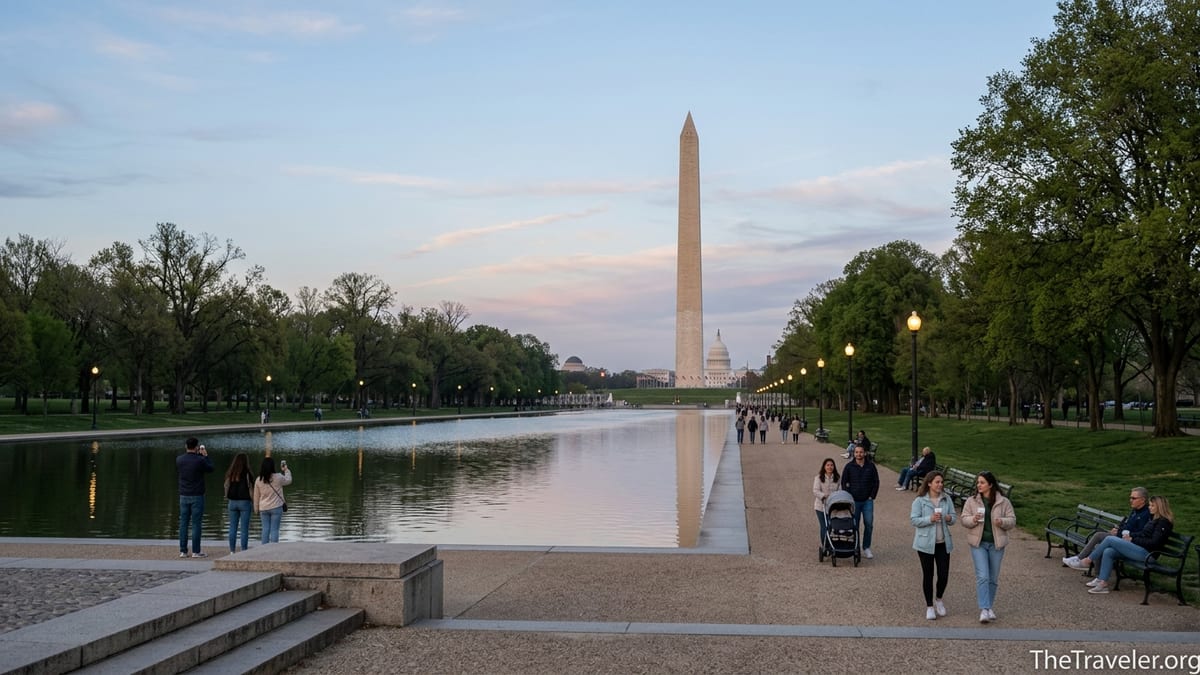
I started Saturday before the city fully woke up, taking the Metro to the Smithsonian stop and emerging onto the National Mall. It is one of the few places in America that looks exactly like it does on television, yet it feels different when there is dew on the grass and only a few joggers in sight. The Washington Monument rose straight ahead, a pale obelisk catching the kind of early light photographers wait for, and beyond it, I could just make out the dome of the U.S. Capitol.
Doing the classic “monuments loop” on foot is free and powerful if you give it time. I walked west toward the Lincoln Memorial, passing the World War II Memorial with its wreaths and granite pillars, then along the edge of the Reflecting Pool where school groups later in the day would gather. On an early weekend morning, you can still find quiet corners at the Korean War Veterans Memorial, where stainless steel soldiers appear to move through low ground cover, or at the Martin Luther King Jr. Memorial, where visitors leave handwritten notes at the base of the stone. These spaces are designed to be national symbols, but in person they invite deeply individual reactions: a veteran tracing a name on the Vietnam Veterans Memorial wall, a family posing for a photo with the Lincoln statue, a child asking why everyone is speaking in hushed tones.
Practical realities cut through the solemnity. There are water fountains that sometimes work and sometimes do not, food trucks selling everything from ice cream bars to empanadas at about 5 to 12 dollars per item, and park rangers answering questions about bathroom locations as often as they answer questions about history. By mid-morning, lines for the elevator to the top of the Washington Monument can stretch, and timed tickets are booked well in advance for popular weekends. Even the most iconic part of Washington operates like any busy public attraction, shaped by crowd management and weather.
What changed my view was realizing that the Mall was not a museum corridor but a civic living room. On that Saturday alone, I passed a small climate rally with homemade cardboard signs, a yoga group folding up mats after a sunrise session near the Capitol Reflecting Pool, and a pickup soccer game using backpacks as goal posts near the Smithsonian museums. Any one of those scenes could have unfolded in another American city park, but here they unfolded in the shadow of the Capitol dome. The capital stopped feeling like a postcard and started feeling like a place where ordinary life and national stories are constantly overlapping.
Inside the Museums: Telling America’s Story From the Ground Up
Like most visitors, I had always thought of the Smithsonian museums as a single, monolithic entity. A weekend visit forces you to make choices. I started with the National Museum of American History, partly because I wanted to see how the country tells its own story right now. Inside, familiar artifacts appear in unexpected context: the Star-Spangled Banner painstakingly preserved in a dimly lit room, a lunch counter from the civil rights sit-ins, and exhibitions that juxtapose farm tools with stories about labor rights and immigration.
Across the Mall, at the National Museum of African American History and Culture, timed entry means you might need to secure a free pass in advance for weekend mornings. Once inside, you descend into galleries that trace a path from the transatlantic slave trade up through Reconstruction, Jim Crow, the civil rights movement, and contemporary culture. The line of visitors falls to a hush in front of a slave cabin or Emmett Till’s casket, then erupts with laughter and recognition upstairs where exhibits celebrate music, sports, and television. The narrative is uncomfortable, joyful, and deeply human. Walking back outside into the bright light, it becomes harder to see Washington purely as a stage for power; it is also a place where the country reckons with itself.
Not every museum moment is heavy. Families with young children gravitate toward the National Air and Space Museum and the National Museum of Natural History, where you can watch kids press their faces to the glass in front of dinosaur skeletons or rocket engines. Tickets and entry to these Smithsonian museums remain free, a rarity in major world capitals. For a traveling family trying to keep costs down, that can mean the difference between doing one big paid attraction or filling an entire day with world-class experiences at minimal cost beyond meals and transit.
By late afternoon, I ducked into a smaller museum that does not make as many bucket lists: the National Portrait Gallery. Housed in a stately building that once served as a patent office, it now holds portraits of presidents alongside contemporary works. The famous portraits of Barack and Michelle Obama still draw crowds, but so do newer additions that highlight poets, activists, and community figures. It is here that the idea of “who belongs in the story of America” feels especially alive. Sitting on a bench beneath skylights, surrounded by portraits of people who shaped policy and culture, I began to see Washington as not just the home of government but as a constantly updated archive of American identity.
Beyond Power Corridors: Neighborhoods That Humanize the City
If you never leave the Mall and the federal core, it is easy to imagine that Washington is populated only by politicians, tourists, and motorcades. A single weekend offers just enough time to step outside that bubble. On Saturday evening I rode the Metro to U Street, once known as “Black Broadway,” where the sidewalks fill with people heading to Ethiopian restaurants, jazz clubs, and late-night diners. At a small neighborhood spot, a plate of tibs and injera cost less than many entrees downtown and came with a side of conversation about how the area has changed over decades of development and rising rents.
The next morning, I walked through Capitol Hill, where rowhouses with carefully tended stoops sit just a few blocks from the dome broadcast around the world. On a Sunday, Eastern Market buzzes with local vendors selling everything from fresh peaches in summer to handmade jewelry and posters year-round. A coffee and a pastry might run 8 to 12 dollars, but you get to enjoy them at a communal outdoor table surrounded by families with strollers, older couples reading newspapers, and teenagers comparing thrifted finds. It feels almost jarring, in the best way, to look up from a farmers’ market stall and see the Capitol rising just beyond the trees.
Later, I headed toward The Wharf, a redeveloped stretch of the Southwest Waterfront where locals and visitors share the same river views. Here, live music floats from outdoor stages, kids lick melting ice cream cones on the boardwalk, and kayakers paddle on the Potomac. Restaurants range from fast-casual counters where you can buy a quick sandwich for under 15 dollars to white-tablecloth spots that command reservations weeks in advance. The prices can be steep, standard for a prime waterfront district, but so are the sunsets reflecting off the water and glass facades. It is a reminder that Washington’s residents are not supporting characters in a political drama; they are people who want good tacos, efficient buses, and somewhere pleasant to walk their dogs.
Seeing these neighborhoods up close changed how I thought about political headlines. When you read about a budget standoff or a government shutdown from afar, Washington can feel faceless and abstract. Standing in line for a latte behind a Hill staffer and a building custodian, it is impossible to ignore the human web underneath the marble and the policy debates.
Moving Through a Working Capital: Transit, Security, and Everyday Inconveniences
Nothing grounds a romanticized city like its transit system. Washington’s Metro has had its share of publicized breakdowns and delays, but on a weekend visit it mostly worked as intended: a network of color-coded lines that can carry you from the airport to the Mall, out to neighborhoods, and across the river into Virginia. Trains on Saturday and Sunday generally start around 6 a.m. and run until about 2 a.m. between many key stations, which means you can catch an early flight or a late show without depending entirely on taxis or rideshares.
Weekend schedules are less frequent than weekday rush hours, and you will feel it if you just miss a train and watch the board click up to a 15 or 20 minute wait. On my trip, signal work meant a single-tracking slowdown on one line, stretching a short hop into a longer ride. But that kind of inconvenience is part of any big-city experience. Washington’s buses fill in the gaps, reaching neighborhoods the rail lines do not cover. With a SmarTrip card, transfers between bus and rail are straightforward and cheaper than piecing together multiple rideshare trips, especially as surge pricing hits during events.
Security is another layer you notice quickly. On my Saturday walk back toward the White House area, streets around Pennsylvania Avenue were closed for a motorcade. Sidewalks funneled into narrow corridors lined with temporary barricades and Secret Service vehicles. What looks theatrical on television feels more like a temporary traffic jam in person. Locals checked their phones to see when the closures would lift, while tour groups used the downtime to take wider-angled photos of the historic buildings. In some spots, you pass through metal detectors just to enter a museum or gallery, a reminder that this is an active seat of government as well as a tourist destination.
Then there are the small, everyday frustrations that quietly define a place: escalators out of service at a busy station, a popular brunch spot in Logan Circle quoting a 45-minute wait, sudden summer rain sending everyone scrambling under awnings on 14th Street. These are not the things you see in aerial shots of the Mall, but they are what make Washington recognizable as a living city instead of a static monument to power.
Eating and Evenings: Where the Capital Lets Its Guard Down
If your mental image of Washington involves stiff receptions and rubber-chicken banquet dinners, a weekend on the ground will correct that quickly. On my first night, I walked from Chinatown toward the Penn Quarter area and found an unpretentious ramen bar doing brisk business with a mix of office workers, tourists, and a group still wearing conference badges. A bowl of tonkotsu ramen cost around 18 dollars, a local draft beer about 9, very much in line with other urban dining scenes. The only thing that felt distinctly D.C. was the table talk drifting through the room, toggling between playoff odds for the local hockey team and speculation about an upcoming committee hearing.
Later, I wandered down 7th Street NW, where the glow of Capital One Arena loomed over the sidewalks. Inside the arena, the schedule rotates between professional basketball and hockey games, family shows, and major concert tours. Even if you do not buy a ticket, you feel the atmosphere spill into the streets: fans in jerseys lining up at sports bars, street vendors selling pretzels, a busker drawing a small crowd near the Metro entrance. On event nights, the surrounding blocks transform into a lively entertainment district that has little to do with federal politics and everything to do with people looking for a night out.
Elsewhere, the city’s night life feels surprisingly varied for a capital often stereotyped as all work and no play. Along U Street, jazz clubs keep the legacy of performers like Duke Ellington alive, while new venues host everything from stand-up comedy to indie bands. In Adams Morgan, late-night pizza slices and rooftop patios attract a younger crowd. On H Street NE, converted warehouses hold cocktail bars where the only visible sign of politics might be a framed vintage campaign poster behind the bar. The city’s go-go music heritage shows up in live sets at local venues and in the rhythms of street performers outside Metro stations.
What struck me most was how quickly the tone shifted between day and night. The same streets where you might watch a motorcade or see reporters do live shots in the morning become places for shared meals and live music once the sun goes down. In those hours, Washington feels less like a stage set for national drama and more like a patchwork of communities unwinding after a long week.
The Takeaway
A weekend is not enough time to “know” any city, especially one as layered as Washington, D.C. But it is enough to shake loose a set of assumptions. I arrived expecting a district defined by marble monuments, loud politics, and carefully managed photo opportunities. I left thinking about crowded Metro cars, Ethiopian dinners on U Street, children racing through the Air and Space Museum, and neighbors haggling over peaches at Eastern Market.
Seeing the capital up close makes national decisions feel less distant and abstract. You realize that every vote in the Capitol and every rally on the Mall ripples through a real place where people worry about rent, school enrollment, and weekend plans just like anywhere else. The grandeur is still there, of course. The Lincoln Memorial at sunrise and the Capitol lit up at night remain powerful sights. But they sit inside a living, breathing city of more than 600,000 residents, millions of commuters, and untold numbers of weekend visitors.
If you have only ever met Washington through screens and headlines, consider giving it a weekend of your time. Walk the Mall at dawn, ride the Metro at rush hour, linger over coffee in a neighborhood far from the motorcades, and catch the city as it lets its guard down in the evening. You may find, as I did, that America’s capital looks less like an untouchable symbol and more like a complex, human-scale place that belongs to everyone.
FAQ
Q1. Is a weekend really enough time to see Washington, D.C.?
Two days is not enough to see everything, but it is enough for a powerful first visit if you focus on a few neighborhoods and key museums instead of trying to do it all.
Q2. What is the best way to get around Washington, D.C. on a weekend?
The Metro rail and bus system is usually the most efficient and affordable option, especially on weekends when traffic near the Mall and popular venues can be heavy.
Q3. How much should I budget for a mid-range weekend in Washington, D.C.?
For a mid-range trip, many visitors spend roughly what they would in other major U.S. cities on lodging, plus daily costs for food, transit, and museum extras.
Q4. Are the major museums and monuments free to visit?
Most Smithsonian museums and the main outdoor monuments on the National Mall are free, though some special exhibits and non-Smithsonian attractions charge admission.
Q5. Do I need to reserve tickets in advance for popular museums?
Several museums use timed entry passes or recommend advance reservations, especially for weekend mornings or holidays, so checking current requirements before you arrive is wise.
Q6. Is Washington, D.C. safe to explore at night?
Many areas popular with visitors stay active and feel comfortable into the evening, but it is still important to use normal big-city precautions and pay attention to your surroundings.
Q7. What is the best neighborhood to stay in for a first weekend visit?
Areas near the National Mall, Penn Quarter, or Capitol Hill give easy access to key sights and transit, while other neighborhoods offer more residential character.
Q8. Can I visit the White House or U.S. Capitol during a short trip?
Tours are possible but require advance planning, and access can change, so a weekend visit is often better spent exploring public spaces that do not require strict scheduling.
Q9. What should I wear for a weekend of sightseeing in Washington, D.C.?
Comfortable walking shoes and layers are essential, since you will likely walk several miles a day and move between air-conditioned interiors and outdoor spaces.
Q10. How can I see a more local side of Washington beyond the monuments?
Spending time in neighborhoods like U Street, Shaw, Capitol Hill, or the Southwest Waterfront, and visiting markets, local restaurants, and small venues, offers a more everyday view of the city.