


More news on this day
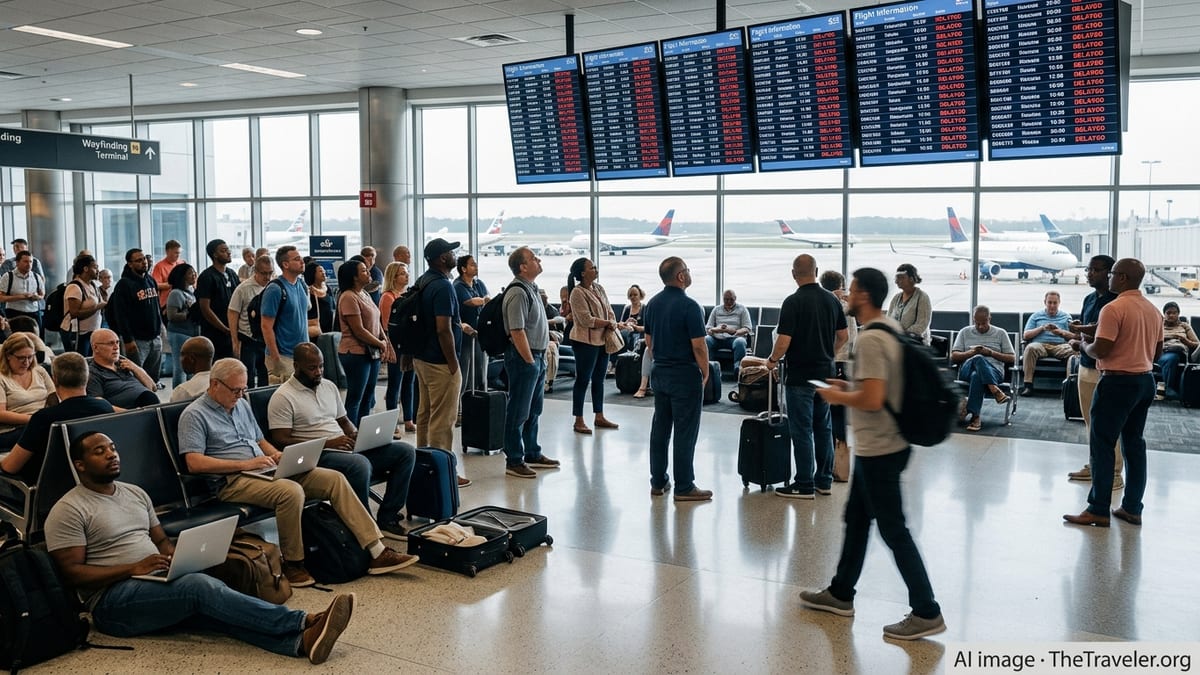
Hundreds of passengers were stranded at Hartsfield-Jackson Atlanta International Airport on Friday as a new wave of disruptions contributed to 854 delayed flights and 42 cancellations across routes spanning the United States, Canada, Mexico and other international destinations, according to live aviation tracking data.
Get the latest news straight to your inbox!
Atlanta Hub Snarled As Summer Weather And Congestion Collide
Live operational dashboards for major U.S. carriers and airports on July 10 indicate that Atlanta once again ranked among the busiest nodes in a broader North American traffic snarl, with rolling delays spreading out from late-morning thunderstorms and dense afternoon schedules. Aviation monitoring platforms show that Atlanta-originating and Atlanta-bound flights accounted for a significant share of knock-on delays across airline networks, even when individual services ultimately departed.
The pattern reflects a familiar summer challenge at the world’s busiest passenger airport. Short but intense storm cells, routine in the Southeast at this time of year, can temporarily halt ramp operations, slow departures and trigger ground delay programs. When this happens at a megahub like Atlanta, aircraft and crews quickly fall out of position, and a relatively small window of bad weather can cascade into widespread schedule disruptions hours later and hundreds or thousands of kilometers away.
Recent federal on-time performance data underscore how quickly those ripples can spread. Air travel consumer reports from the U.S. Department of Transportation describe how late-arriving aircraft and air carrier operational issues frequently outpace pure weather as causes of delay at the nation’s largest hubs, with Atlanta featuring prominently in national statistics. Once a wave of tardy arrivals is in motion, subsequent flights that depend on the same planes and crew often depart late, even after the skies clear.
Travelers transiting Atlanta on Friday reported a mix of extended tarmac waits, rolling gate changes and missed connections, with some itineraries pushed back to late-night departures or rebooked for the weekend. While many flights eventually left, the cumulative effect of dozens of delayed segments was a sharp reduction in overall network reliability for several large U.S. and Canadian carriers.
Network Effects Felt Across US, Canada, Mexico And Beyond
The 854 delays and 42 cancellations recorded by early evening Friday were not confined to Georgia. Publicly available tracking maps showed disruption radiating along some of the busiest domestic and near-international corridors, including links from Atlanta and other U.S. hubs to Canada and Mexico. Major city pairs such as Toronto, Montreal, Mexico City and resort destinations along both Mexican coasts experienced elevated levels of late arrivals and departures as aircraft originating in the southeastern United States missed their slots.
Analysts who follow airline operations note that Atlanta’s central role in several large carriers’ networks amplifies these effects. Aircraft that start the day on short southeastern hops may later be reassigned to transborder or long-haul routes. When those early flights encounter weather or congestion, the resulting delay can propagate throughout the day, affecting travelers far from the original storm zone and even on airlines that do not operate primary hubs in Atlanta.
In Canada, this often manifests as evening arrivals landing well behind schedule, compressing already tight turnarounds before overnight departures. In Mexico, where many airports operate near capacity during peak leisure seasons, late-arriving U.S. flights can be forced into holding patterns or reassigned to less favorable slots, compounding schedule instability. The July 10 disruptions followed that familiar pattern, with departure boards in multiple countries showing clusters of flights running one to three hours behind.
The transborder knock-on also underscores the interconnected nature of modern airline scheduling. A single delayed regional departure feeding a major hub can ultimately touch three or four subsequent flights as the same aircraft cycles between domestic, Canadian and Mexican routes. With Friday’s irregular operations centered on one of North America’s most critical interchanges, the resulting web of missed connections and missed slots spanned much of the continent by day’s end.
Travelers Confront Long Lines, Rebooking Scrambles And Overnight Stays
For passengers on the ground in Atlanta, the statistics translated into familiar scenes of crowded concourses, long service lines and overnight waits. Social media posts and traveler accounts described passengers queued at customer service counters as they sought rebooking on later flights or alternative routings that would bypass the most congested hubs. Others reported spending hours in terminal seating areas as rolling delay estimates shifted in 15 to 30 minute increments throughout the afternoon and evening.
When delays stacked up high enough to push crews against duty-time limits, some flights were ultimately cancelled, contributing to the 42 scrubbed departures reported across the network. In those cases, travelers were frequently reassigned to flights the following day, with some accepting itineraries that would send them through secondary hubs in the Midwest or on connecting services through cities like Dallas, Houston or Charlotte instead of returning through Atlanta.
Airlines publicly encourage passengers caught in such disruptions to monitor mobile apps for gate and timing changes, use digital self-service tools to request alternate routings, and check for travel waivers that may allow free date or destination changes. During multi-day periods of irregular operations, carriers often expand those waivers to include more airports and travel dates, particularly when severe weather in one region repeatedly affects the same hubs.
Airport services in Atlanta also come under strain when large numbers of travelers are unexpectedly forced to remain overnight. Hotel availability near Hartsfield-Jackson can tighten quickly, and dining outlets inside the terminals may be operating near capacity late into the night. For travelers with early-morning rescheduled flights, this can mean short rest periods and additional stress as they navigate security and potential further delays the next day.
Operational Pressures Build On Top Of A Busy Summer Travel Season
The latest Atlanta-centered disruptions arrive during what has already been a demanding summer travel period. Industry coverage in early July has highlighted a nationwide upswing in delays and cancellations compared with prior years, driven by a combination of record passenger volumes, tightly scheduled fleets and recurring bouts of severe weather across multiple regions of the United States.
Transportation statistics published in recent months show that U.S. airlines continue to operate close to their capacity limits during peak travel windows, which leaves little margin for error when storms, air traffic control initiatives or maintenance issues emerge. Historical data indicate that June and July are consistently among the most delay-prone months in the national aviation calendar, with large hubs such as Atlanta, Chicago and New York experiencing especially acute pressure.
That context helps explain why a single day’s tally of 854 delays and 42 cancellations can have outsized effects. When airports, airlines and air traffic managers are already working near the top of their throughput, even modest schedule disruptions can create backlogs that take days to unwind. Once aircraft and crews scatter away from their planned rotations, recovery often requires schedule thinning, rerouting and, in some cases, preemptive cancellations to restore stability.
Passenger expectations, however, have also evolved following high-profile disruptions in prior years. Past episodes, such as the large-scale systems outage that snarled one major U.S. carrier’s operations in 2024, continue to shape public perceptions about airlines’ resilience. As a result, each new wave of delays and cancellations is closely watched by travelers and consumer advocates who track how quickly carriers communicate with affected customers and restore normal operations.
What Travelers Can Do When Atlanta Disruptions Hit Their Itinerary
Travel experts recommend several practical steps for passengers whose itineraries route through Atlanta during volatile summer weather. First, checking flight status frequently on both airline apps and independent tracking sites can provide early warning of emerging problems. While official departure times on airport displays may lag behind operational decisions, third-party trackers and carrier notifications often flag inbound aircraft delays or ground programs before they show up on the gate board.
Second, travelers with tight connections at Atlanta are encouraged to consider voluntarily moving to earlier flights or itineraries with longer layovers when forecasts call for afternoon thunderstorms. Even a 30 to 45 minute buffer can make the difference between a successful connection and an unplanned overnight stay, particularly on routes that rely on a limited number of daily departures.
Finally, understanding airline policies around rebooking and duty-of-care can help passengers make faster decisions when disruption strikes. Publicly available contract-of-carriage documents and consumer guides from transport authorities outline what carriers typically provide during weather-related irregular operations, such as meal vouchers or hotel assistance in some circumstances. While each event is different, travelers who arrive at customer service prepared with alternative routing suggestions and a clear sense of their options often secure better outcomes when large numbers of flights are affected.
With summer storms expected to continue across the Southeast in the coming weeks, operational data suggest that Atlanta will remain a critical pressure point in the North American air travel system. The latest wave of 854 delays and 42 cancellations underscores how quickly localized weather and hub congestion can reshape travel plans across the United States, Canada, Mexico and beyond in a single day.