


More news on this day
Air China is mounting an extraordinary operation to move stranded travelers out of Cuba, after weeks of fuel-linked disruptions left passengers stuck on one of the island’s last long-haul routes to Europe and Asia.
Get the latest news straight to your inbox!
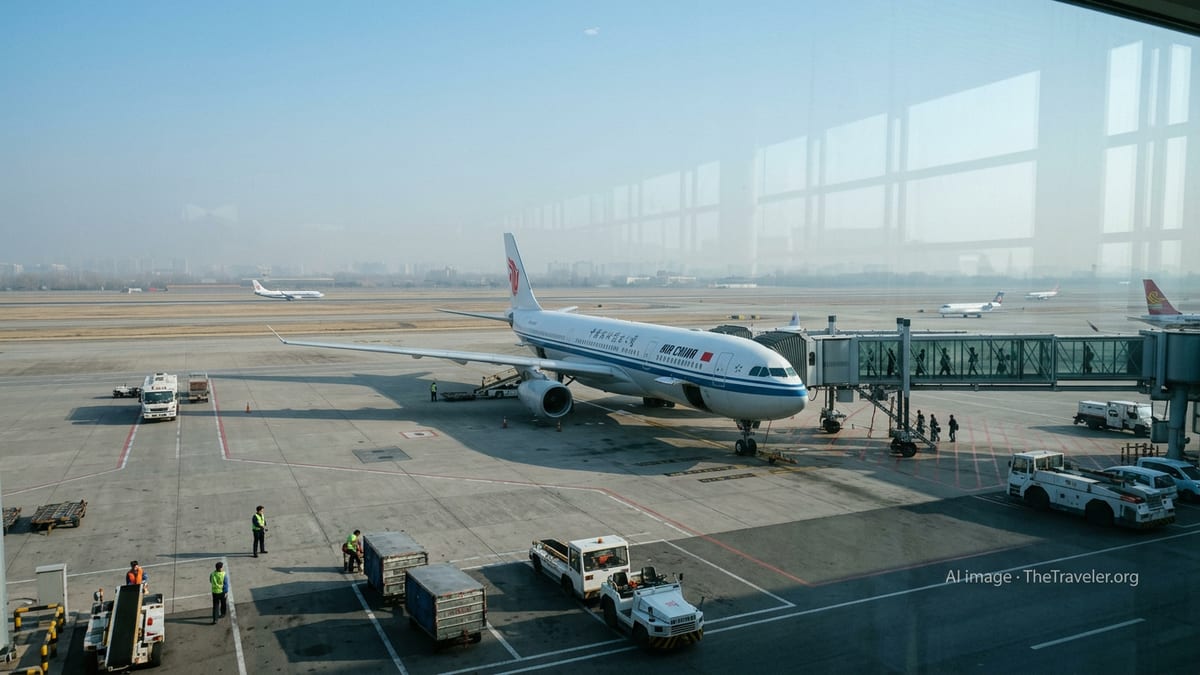
Rescue flight CA590 added as regular link falters
Publicly available notices from China’s embassy in Havana and international flight-tracking data show that Air China has scheduled an additional service, flight CA590, from Havana’s José Martí International Airport on the night of 19 October 2026. The one-off rotation is intended to accommodate travelers whose bookings on the carrier’s regular Beijing–Madrid–Havana service, flights CA865 and CA866, were lost amid a wave of timetable changes and cancellations earlier in the month.
According to published coverage, the replacement flight is set to depart Havana at 22:30 local time on 19 October, following inbound service CA589. Seats have been described as limited, with priority given to passengers whose CA866 departures were canceled on or before 10 October. Rebooking is being handled at Air China counters at José Martí airport rather than through new ticket sales, underscoring the operation’s focus on clearing an existing backlog rather than opening fresh inventory.
Reports on the Beijing–Madrid–Havana route indicate that schedule volatility has intensified since early October. Passengers have been urged in public advisories to reconfirm their flights frequently and to avoid arriving at the airport without checking for last-minute changes, as departure days and even operating flight numbers have shifted with little lead time.
Industry trackers note that the Havana service is one of Air China’s more unusual long-haul routes, combining demand between China and Spain with the niche but symbolically important link between Beijing and Havana. The current disruption has therefore reverberated not only among Cuban nationals and Chinese travelers, but also among Spain-based passengers who rely on the Madrid–Havana leg sold under Air China’s code.
Jet-fuel shortage reshapes Cuba’s air connections
The emergency flight comes against the backdrop of a jet-fuel shortage that has plagued Cuba’s airports throughout 2026. Official aeronautical notices from the Cuban Air Navigation Company have repeatedly carried the warning “JET A1 FUEL NOT AVBL” for ten of the country’s international airports, including Havana, Varadero, Santiago de Cuba and Holguín, at various points since February.
Updated notices verified in mid-October extend the fuel unavailability warning at those airports until at least 04:00 UTC on 1 November 2026. Publicly accessible analyses of these notices emphasize that terminals remain open but are unable to guarantee refueling for visiting aircraft, forcing airlines either to load additional fuel at origin for a round trip or to schedule technical stops outside Cuba for refueling.
Travel and aviation reports trace the current crunch to a wider energy crisis linked to a reduction in fuel shipments and a de facto United States fuel blockade introduced in early 2026. International coverage describes how sanctions and supply constraints have squeezed Cuba’s access to crude and refined products, triggering power cuts on the island and a cascading impact on transport, including civil aviation.
The fuel scarcity has led several foreign airlines, among them carriers from Canada, Europe and Russia, to suspend or sharply reduce their Cuban operations this year. For airlines that continue to serve the island, the need to avoid on-the-ground refueling has significantly raised operating complexity, with extra fuel loads adding weight and forcing trade-offs on payload and scheduling.
Stranded travelers in Havana and Madrid
In the weeks leading up to Air China’s relief flight, Spanish and Cuban media described scenes of travelers stranded in both Havana and Madrid as a result of repeated last-minute cancellations. Reports from Madrid-Barajas Airport recounted how passengers on the Madrid–Havana sector of flights CA865 and CA866 faced days-long waits, missed connections and mounting accommodation costs while they waited for seats on alternative departures.
Coverage from Cuba-focused outlets highlighted that many of those affected were Cuban nationals living or working in Spain, who suddenly found themselves unable to return in time for work commitments or family events. Some travelers reportedly purchased costly one-way tickets on other airlines serving Havana via European hubs such as Paris and Istanbul when those options were still available, while others waited for Air China to arrange a solution.
Public notices from the Chinese embassy in Cuba, circulated in early and mid-October, acknowledged the frequency of schedule changes on CA865 and CA866 and advised passengers not to travel to the airport until they had confirmed that their flight would operate as planned. The embassy did not explicitly link the disruptions to Cuba’s fuel shortage, referring instead to unspecified “technical reasons,” but aviation media have consistently placed the cancellations in the context of the broader jet-fuel crisis.
For passengers already in Havana, the lack of reliable outbound capacity has added uncertainty to stays on the island. Travelers attempting to connect via Madrid to onward destinations in Europe or Asia have had to rebook hotels, rearrange tours and adjust connecting flights, often at short notice and with limited options, particularly as other international services to Cuba have become less frequent.
One of Cuba’s last long-haul links under strain
Despite the turbulence, Air China’s Beijing–Madrid–Havana route remains one of Cuba’s few remaining direct long-haul links beyond the Americas. The carrier reintroduced Havana as a scheduled destination as part of a wider international network that also serves Madrid from Beijing, effectively tying the Cuban capital into a transcontinental corridor linking East Asia and Europe.
With other airlines having suspended or trimmed their services in recent months, especially from Canada and parts of Europe, the Air China connection has taken on heightened importance for both tourism and family travel. According to aviation data cited in industry publications, foreign visitor arrivals to Cuba have fallen sharply this year as fuel-related schedule changes and flight reductions have discouraged bookings.
Analysts note that Air China’s decision to organize an additional outbound rotation suggests a determination to protect the route’s long-term viability by addressing the immediate backlog of displaced passengers. By operating CA590 as an extraordinary service, the airline can clear stranded travelers while continuing to adjust regular frequencies and routings in response to fuel availability and aircraft utilization constraints.
However, observers also point out that as long as Cuba’s fuel situation remains fragile, any long-haul operation into Havana will face elevated risk of disruption. Carriers must balance the cost of tankering extra fuel or diverting via third-country refueling stops against the commercial value of maintaining a presence in the Cuban market during a period of lower demand and high operational uncertainty.
What travelers should expect in the coming weeks
For travelers with tickets on Air China’s Havana services in late October and early November, publicly available guidance stresses the need for close monitoring of flight status. Airline timetables and global distribution systems continue to list services on the Beijing–Madrid–Havana rotation, but recent experience shows that aircraft type, operating days and even intermediate stops can change with limited warning.
Given the current fuel notices in force for ten Cuban airports until 1 November 2026, aviation analysts advise that changes to routings and times are likely to persist at least into early November. Even if formal notices lapse, observers note that previous expirations have not always coincided with a rapid restoration of normal fuel supply, creating a lag between regulatory updates and practical operating conditions on the ground.
Travelers planning trips that involve Cuba during this period are being encouraged in public advisories to retain flexible travel arrangements where possible, including refundable or changeable hotel bookings and generous connection windows for onward flights. Those already on the island and holding Air China tickets are being directed, in official information, to follow updates through the airline’s digital channels and to be prepared for re-accommodation on alternative dates or, in some cases, through different gateways.
While the extra CA590 flight has been welcomed in travel coverage as a vital pressure valve for the current backlog, reporting on Cuba’s energy and aviation sectors suggests that the underlying jet-fuel shortage remains unresolved. As a result, the experience of passengers caught in this month’s disruptions is likely to shape how both airlines and travelers approach Cuba-bound itineraries for the remainder of the year.