


More news on this day
New US security alerts issued across multiple Middle East countries are rippling through airline schedules and travel plans, as governments and carriers respond to worsening regional tensions and renewed risks to civil aviation.
Get the latest news straight to your inbox!
What Triggered the Latest US Security Alerts
Publicly available information from US government channels shows that the current wave of alerts is anchored in an updated Worldwide Caution notice and country-level advisories that highlight increased threats linked to the ongoing conflict involving Iran and its regional allies. The Worldwide Caution, referenced by universities and consular summaries in July and later reiterated in March and June updates, warns that Americans worldwide, and especially in the Middle East, should be prepared for travel disruption, including sudden airspace closures and flight cancellations.
Embassy security messages dated in mid-October and aggregated by independent monitoring forums indicate that US missions have circulated alerts in at least a dozen locations across the Middle East, including Saudi Arabia, the United Arab Emirates, Kuwait, Qatar, Bahrain, Oman, Jordan, Iraq, Lebanon, Yemen, Israel and Iran. These alerts generally repeat core language from the Worldwide Caution, advising US citizens to exercise heightened vigilance, maintain contingency plans for departure and closely monitor commercial flight options.
Country-specific advisories have also shifted in recent days. The Saudi Arabia advisory was updated on October 12, 2026, to Level 3, “Reconsider travel,” citing the heightened risk of terrorism and ongoing missile and drone threats following recent attacks on airports inside the kingdom. Comparable guidance appears across several neighboring destinations, where official risk indicators emphasize terrorism, armed conflict and the limited ability of consular staff to assist if airspace or borders are abruptly closed.
Regional aviation safety bulletins and conflict reporting further explain why these alerts are concentrated around the Middle East. Notices from international aviation bodies and logistics providers in 2026 describe a dense and unpredictable military environment stretching from Yemen and the Red Sea to the Gulf, Iraq and western Iran, raising the baseline risk for any civil aircraft transiting nearby airspace.
How the Conflict Is Affecting Airspace and Routes
The most direct effect of the heightened tension is on Middle East airspace. A standing State Department warning, echoed in media summaries of the Worldwide Caution, specifically notes the possibility of periodic airspace closures across the region and urges travelers to prepare for the knock-on impact on commercial aviation. Similar language has appeared in European and university-level advisories summarizing US guidance, underlining that airspace restrictions are now considered a recurring risk rather than a rare, one-off event.
Aviation industry tracking published in October 2026 shows how these warnings translate into day-to-day operations. Analysis from an international flight-operations group dated October 19 reports that Kuwait has only just reopened to overflights after earlier restrictions, restoring a central routing corridor between Europe and Gulf hubs for airlines that are still permitted to cross Iraqi airspace. At the same time, operators are being urged to avoid or treat with caution the skies over Iran, Iraq and Lebanon, as well as portions of Saudi airspace, because of the proximity of recent missile and drone activity.
Logistics and freight bulletins from June 2026, which remain consistent with more recent operational maps, describe longer routings, reduced frequencies and schedule adjustments across key Gulf and Levant corridors. Airports in Jordan, Lebanon, Qatar and Egypt are reported as open, but airlines have been selectively cutting capacity, adding fuel stops or shifting departure times to route around sensitive airspace. This pattern leaves passenger services technically available on many city pairs but more vulnerable to last-minute change.
These layered restrictions help explain why alerts emphasize preparation rather than immediate evacuation. Civil airspace over parts of the Middle East remains open, but the operational picture is fluid. A route that is considered acceptable one week can become unavailable the next, either because of a new military incident or because a major carrier decides that the residual risk is no longer tolerable.
Flight Cancellations, Detours and Airport Disruptions
The security alerts are emerging against a backdrop of concrete disruptions to commercial flights. Airline schedules compiled by travel industry outlets show that multiple international carriers have suspended or reduced services to the Gulf in response to the security situation. A September 2026 analysis from a business-travel publication notes, for example, that Cathay Pacific cancelled passenger flights to Dubai and Riyadh through November 30, while Finnair removed its Helsinki to Dubai route for the entire winter 2026 to 2027 season, citing the lack of clear improvement in regional security.
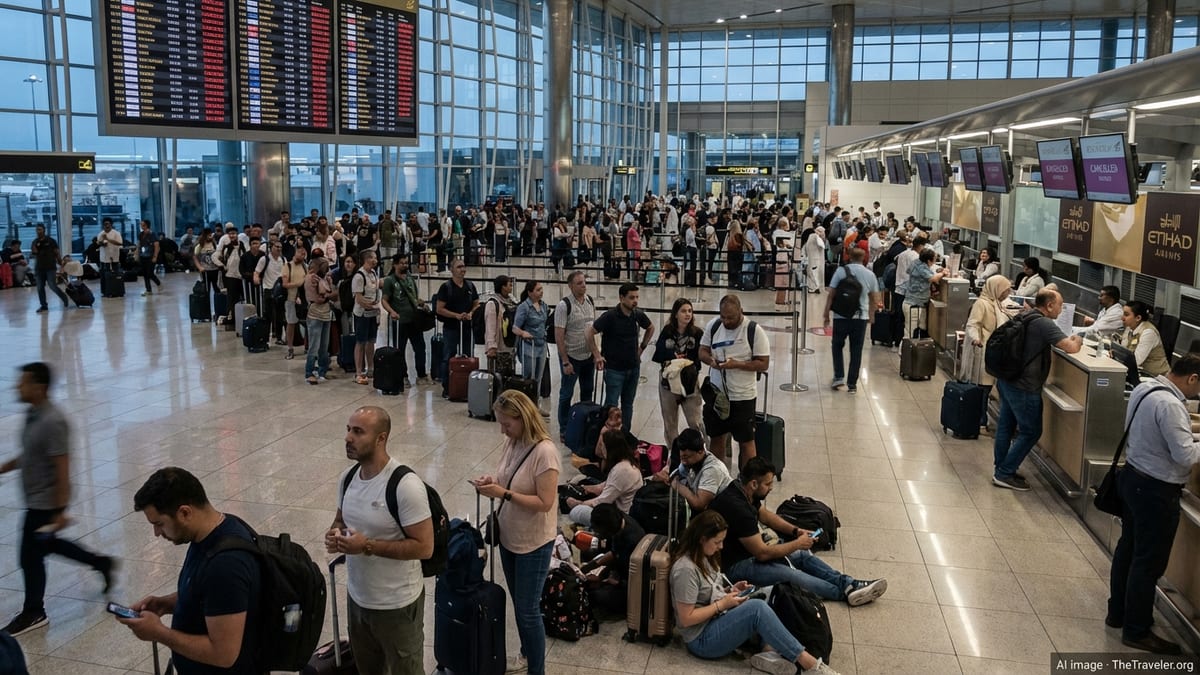
More recently, travel news providers tracking October operations report that the October 6 to 12 missile and drone attacks on Saudi airports prompted widespread cancellations to Riyadh, Jeddah and Dammam. A factbox compiled mid-month lists global carriers that have temporarily halted or rerouted flights to Saudi Arabia after the deadly strikes on Riyadh’s main airport. Separately, a Middle East travel update published on October 19 notes that Riyadh’s King Khalid International Airport reopened for limited operations on October 18 after more than a week of disruption, but with restrictions including prior permission requirements and limitations on its use as a diversion airport.
Regional knock-on effects extend beyond Saudi Arabia. The same October travel update highlights that airlines serving Jordan are advising passengers to check airport departure boards and regulator bulletins shortly before travel, since airports and airspace can close at short notice. Guidance from the European Union Aviation Safety Agency, referenced in industry coverage, currently advises operators under its remit to avoid the airspace of Iran, Iraq and Lebanon, and defined portions of Saudi airspace, further constraining the routing options for European and Asian carriers.
For travelers, the practical outcome is a higher likelihood of long detours, extended journey times and sudden last-minute changes, even on routes that remain officially “open.” Reports from logistics firms and airline customer notices in 2026 emphasize that rerouting can add hours to flights between Europe and the Gulf or South Asia, while capacity reductions make it harder to find alternative seats if a particular flight is cancelled.
What the Alerts Mean for Travelers Right Now
For Americans considering trips to or through the Middle East, the recent alerts signal a need for closer monitoring and more contingency planning rather than an automatic halt to all travel. The State Department’s advisory framework distinguishes between four levels of risk, from Level 1, “Exercise normal precautions,” to Level 4, “Do not travel.” Country pages for Iraq and parts of neighboring states currently reflect the higher end of that scale, including Level 4 designations for areas affected by active conflict or frequent missile activity, while several Gulf states, including Saudi Arabia, sit at Level 3, “Reconsider travel,” as of mid-October.
These gradations matter for routing choices. A traveler whose itinerary requires transit through a Level 4 destination may find that mainstream airlines have already suspended flights, significantly narrowing options. By contrast, Level 2 or Level 3 destinations may retain robust air links, but with elevated security postures at airports, more frequent schedule changes and stricter conditions from airlines on rebooking and refunds.
Travel industry guidance drawing on official notices suggests that passengers with existing bookings should pay close attention to airline travel alerts, particularly for departures to Riyadh, Jeddah, Dammam, Doha, Dubai and Abu Dhabi. As of October 19, regional operations are in a patchwork state: some airports, such as Riyadh, have reopened under restrictions, while others have seen only limited direct impact but remain exposed to potential knock-on effects from airspace changes or new incidents.
Public summaries of US consular messaging also point to the importance of maintaining flexible onward plans. Travelers are being encouraged through publicly posted guidance to keep several days’ worth of essential medication, to carry contact details for their airline and travel insurer, and to consider how they would reach an alternative departure point if their primary hub suddenly shut down. The emphasis is on self-reliance, given that the ability of embassies and consulates to arrange evacuation flights or provide in-person support may be sharply limited during any large-scale airspace closure.
Planning a Trip: Practical Steps and Ongoing Uncertainty
For those still planning trips involving the Middle East, the evolving situation argues for a more conservative approach to timing, routing and insurance. Travel specialists and airline notices highlight the value of booking tickets that allow changes without heavy penalties, and of choosing itineraries with multiple potential routings between origin and destination. Routes that depend on a single, politically exposed hub are more at risk if that airport suddenly becomes unavailable because of a new alert or security incident.
Published guidance from universities and corporate security departments summarizing the Worldwide Caution also emphasizes the importance of monitoring both US government advisories and aviation-industry notices up to the day of departure. Conditions that appear stable when tickets are purchased can shift within days, as shown by the October closure and restricted reopening of Riyadh’s main airport and the ongoing rerouting of flights around Iranian and Iraqi airspace. In this environment, travelers are advised to check for changes not only on departure day but throughout their trip, particularly before connecting segments.
At the same time, publicly available aviation safety analyses point out that many Middle East airports remain open and that large numbers of flights continue to operate safely each day. The risk to any single passenger flight remains low in absolute terms, but the margin for disruption is significantly narrower than in calmer periods. For leisure travelers with flexible plans, the cumulative effect of uncertainty, schedule changes and the possibility of being stranded if airspace closes mid-trip may weigh heavily in destination choices.
For now, the renewed US security alerts underscore a central reality for anyone flying to, from or over the Middle East: itineraries that once felt routine are now subject to a higher level of geopolitical risk. Until there is a sustained easing of tensions and a reduction in missile and drone activity around regional airspace, travelers and airlines are likely to face an extended period of watchfulness and operational improvisation.