


More news on this day
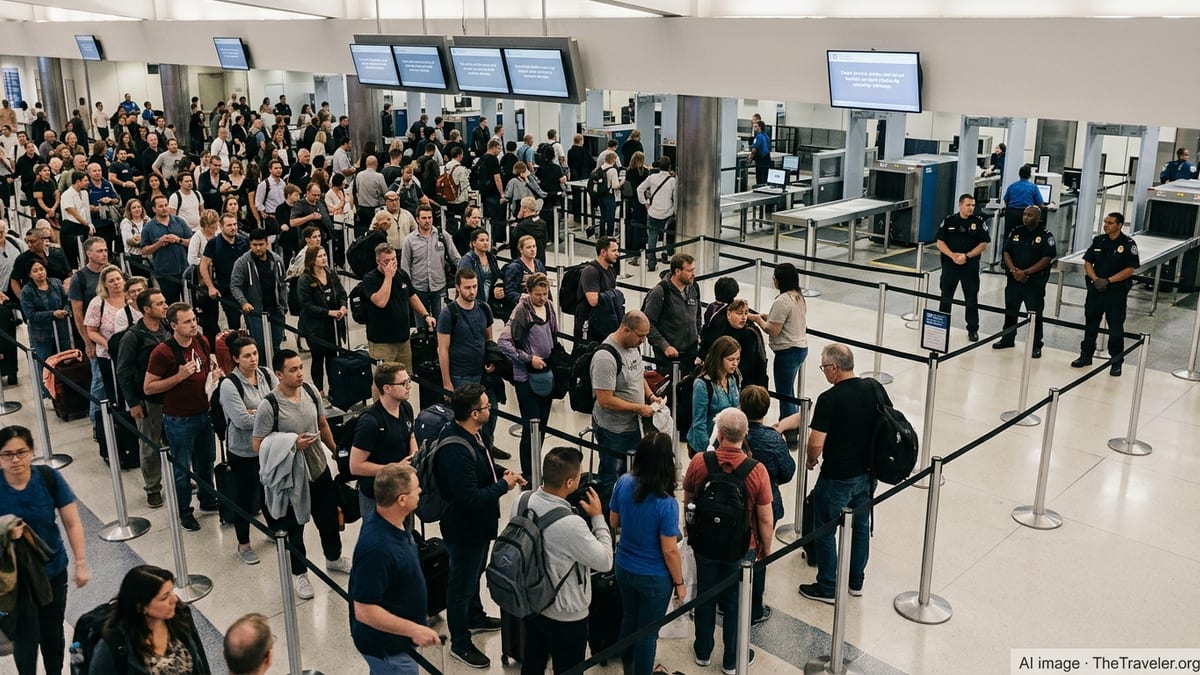
As airports absorb record passenger volumes and recurring delays, the crowded concourses and snaking security lines are turning once-routine courtesies into high-stakes decisions about space, time, and stress management.
Get the latest news straight to your inbox!
Record Passenger Volumes Raise the Temperature
Publicly available Transportation Security Administration data compiled by independent analysts indicates that more than 906 million passengers were screened at U.S. checkpoints in 2025, a new annual record and a slight increase over 2024. The figure caps several years of rapid post-pandemic growth, during which air travel rebounded faster than many airport systems could comfortably accommodate.
Industry analysis from travel organizations notes that the busiest periods have become more intense, even as overall growth has moderated. During the 2024 summer peak between Memorial Day and Labor Day, reports indicate that TSA screened close to 279 million travelers, almost 6 percent more than the same period a year earlier. That concentrated surge has made long lines and packed gate areas a normal part of the flying experience rather than occasional outliers.
At major hubs such as Atlanta, Chicago O’Hare, and Las Vegas, passenger statistics show sustained year-over-year gains in throughput. Atlanta remains one of the world’s busiest airports by passenger numbers, while Las Vegas reported an all-time high of more than 58 million travelers in 2024. Those volumes intensify the social pressure at choke points like check-in, security and boarding, where every hesitation can ripple down a line of hundreds.
The result is a delicate social environment in which minor lapses in etiquette, from blocking a walkway with luggage to cutting into a boarding queue, can quickly escalate tensions among already stressed passengers.
Security Lines Become an Etiquette Minefield
Long security queues have become a defining symbol of modern air travel stress, regularly surfacing in social media posts that show lines stretching out of terminals and along sidewalks. In March 2026, coverage from national media documented scenes at Austin and other airports where travelers followed serpentine lines well beyond the usual checkpoint area. The viral images helped cement public perception of security as a flashpoint in the travel experience.
Travel groups have urged passengers to prepare for the possibility of extended waits, especially during peak holidays and school breaks. Ahead of spring break 2026, one major auto and travel association warned that travelers should expect longer security lines and heavier congestion across U.S. airports, advising them to build extra time into their plans and to use tools such as airport websites or the MyTSA app to check conditions in real time.
At the same time, some airports have begun pushing back against extreme early arrivals. In spring 2026, at least one midwestern airport publicly advised passengers not to show up more than four hours before departure, arguing that ultra-early arrivals actually worsened congestion for those with imminent flights. Such messages highlight a growing tension between individual self-preservation strategies and the collective functioning of the system.
These dynamics complicate etiquette in the line itself. Travel guides and etiquette commentaries increasingly recommend that passengers keep documents ready, remove items that trigger secondary screening in advance, and move promptly through checkpoints, framing these behaviors not only as efficiency measures but as a courtesy to everyone behind them.
Delays, Cancellations and Shifting Norms at the Gate
Flight delays remain a central driver of airport frustration. Data compiled by the U.S. Bureau of Transportation Statistics and summarized in regulatory filings show that in a recent pre-pandemic comparison year, roughly one in five domestic flights arrived 15 minutes or more behind schedule. More recent reports from the Department of Transportation’s Air Travel Consumer Report indicate that lengthy delays and tarmac holds continue to be significant enough to require dedicated tracking tables and enforcement rules.
The Department of Transportation’s aviation consumer website details an expanding framework of passenger protections, including rules governing lengthy tarmac delays and chronic lateness, and ongoing enforcement actions related to unfair or deceptive practices. Additional initiatives such as the FlightRights.gov customer service dashboard and proposed rulemaking on compensation for controllable delays signal an effort to standardize what travelers can expect when disruptions occur.
Those policy shifts feed back into everyday behavior at the gate. When schedules unravel, passengers often feel compelled to guard scarce resources like power outlets, seating and overhead bin space, occasionally at the expense of courtesy. Travel advisories increasingly emphasize practices such as sharing charging stations, keeping carry-on bags within published limits, and giving priority seating space to older travelers, people with disabilities and families, positioning these acts as part of responsible airport conduct rather than optional kindness.
Published coverage also points to a steady rise in consumer complaints, which are collected by the DOT’s Office of Aviation Consumer Protection and used to identify patterns across airlines. The volume and nature of those complaints underscore how closely etiquette is intertwined with structural issues like schedule reliability, staffing levels and communication about delays.
When Running Late, Where Is the Line on Cutting the Line?
Few situations capture the tension between individual urgency and collective fairness as sharply as the traveler rushing through a security queue to make a departing flight. Recent commentary on travel and etiquette sites describes the familiar scene: a passenger approaches a long line, announces an imminent departure time and asks others for permission to pass.
Guidance from etiquette experts cited in major travel coverage typically frames this as acceptable behavior if handled with care. Recommendations include moving along the line one person or group at a time, making a brief, specific request, and accepting “no” as a valid answer. Cutting without asking or using aggressive language is widely framed as out of bounds, regardless of how close the departure time may be.
Some airports and travel advisers suggest that better planning can reduce the need for such requests. Reports examining airport queuing models and operational research into passenger behavior suggest that noncompliance with recommended arrival times and line procedures can worsen bottlenecks for everyone. In that context, repeated last-minute attempts to move ahead can be seen less as isolated breaches of etiquette and more as symptoms of systemic crowding and scheduling challenges.
Still, observers note that many travelers are willing to accommodate a polite request, especially when gate agents are announcing that a flight is closing or when irregular operations leave passengers with limited rebooking options. The unwritten rule emerging from expert advice is that courtesy goes both ways: those asking to pass should do so sparingly and respectfully, while those granting passage can treat the gesture as a small act of solidarity in an often unpredictable system.
Design, Technology and the Future of Airport Courtesy
As travel demand grows, governments and industry groups are exploring structural changes that could ease both operational strain and etiquette conflicts. A 2025 report from a U.S. travel industry commission on seamless and secure travel warned that surging passenger volumes would challenge screening agencies to maintain wait time standards without new technology and funding. The report highlighted the slow rollout of advanced computed tomography scanners in the United States compared with deadlines set in other regions.
Academic research on security-queue management has also focused on how passenger behavior can undermine even well-designed systems. One 2025 study using chance-constrained optimization techniques noted that noncompliance with queuing rules, such as arriving much earlier or later than advised, can create unpredictable surges that lengthen average wait times and increase perceived unfairness. These findings suggest that clear communication and consistent enforcement of procedures may be as important as hardware upgrades.
Airports are experimenting with digital tools that could indirectly support better etiquette. Real-time wait time displays, mobile alerts about checkpoint congestion, and virtual queuing systems at some hubs are designed to spread demand more evenly and reduce the panic that drives behaviors such as camping at gates hours in advance or crowding boarding lanes long before a flight is called.
For now, travelers are largely left to negotiate their own balance between self-interest and shared responsibility. Published guidance converges on a few themes: arrive within recommended windows rather than excessively early, prepare for security in advance, respect personal space and seating priorities, and stay informed about rights when delays occur. In an era defined by record crowds and persistent disruption, these small acts of consideration are increasingly central to keeping airports functional as well as safe.
Bureau of Transportation Statistics – Air Travel Consumer Report
U.S. Department of Transportation – Aviation Consumer Protection