


More news on this day
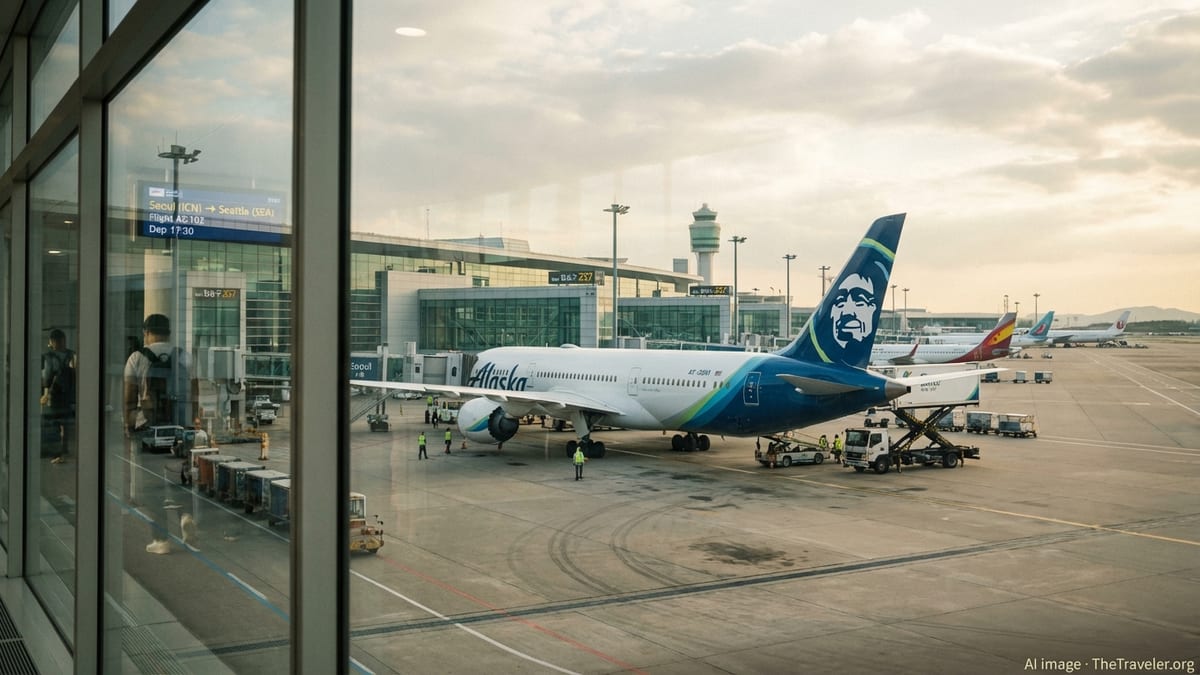
As summer disruptions and weather snarls loom over crowded East Coast hubs, Alaska Airlines is charting a different course across the Atlantic with a new Boeing 737 MAX service linking Seattle and Reykjavik, creating a direct gateway from the Pacific Northwest to Iceland and beyond.
Get the latest news straight to your inbox!
A New Transatlantic Path from the Pacific Northwest
Publicly available information shows that Alaska Airlines began operating seasonal nonstop flights between Seattle-Tacoma International Airport and Iceland’s Keflavik International Airport in late May 2026, using Boeing 737 MAX 8 aircraft on the roughly seven-hour crossing. The route runs during the peak summer travel period and is positioned as part of the carrier’s broader push to transform Seattle into a global connecting hub.
Reports indicate that the Seattle–Reykjavik link is Alaska’s first transatlantic route flown with the 737 MAX and one of the longest nonstop 737 missions operated by a United States airline. The service complements the carrier’s newer widebody flights from Seattle to London and Rome, but stands out because it bridges the Atlantic with a single-aisle jet from the U.S. West Coast.
The new connection also deepens competition in a market historically dominated by Icelandair, which has long used Reykjavik as a stopover waypoint for travelers moving between North America and Europe. With Alaska entering the city pair directly from Seattle, West Coast passengers now have a choice of carriers and schedules that does not depend on flying through East Coast hubs such as New York, Boston, or Washington.
For Alaska, the route is a test bed for how far its narrowbody fleet can stretch while still delivering a product that can compete with traditional long-haul widebody services. For travelers, it offers a more direct way to reach Iceland’s landscapes, geothermal lagoons, and connecting flights to mainland Europe without adding an extra domestic leg.
Bypassing East Coast Congestion and Weather Risks
The timing of the Seattle–Reykjavik service aligns with growing concern over summer travel disruptions at major East Coast airports. Congested airspace, intense thunderstorm seasons, and ripple effects from delays in New York, New Jersey, and along the mid-Atlantic corridor have repeatedly led to missed connections for transatlantic passengers. Against that backdrop, flying over the polar regions directly from Seattle can help travelers sidestep some of the most delay-prone parts of the U.S. system.
Industry coverage highlights that itineraries from cities such as Portland, San Francisco, Los Angeles, and other West Coast markets can now route through Seattle and continue directly to Reykjavik on Alaska’s metal. That structure allows passengers to avoid multi-stop journeys that previously required a domestic leg to an East Coast hub before boarding a Europe-bound flight, a pattern often vulnerable to cascading delays.
Travel analysts note that the geographic position of Seattle gives it a unique advantage for long-range narrowbody flights to the North Atlantic. The distance to Iceland sits near the upper but still practical range of the 737 MAX 8, whereas routes from more southerly West Coast cities may be more constrained by range and seasonal winds. As a result, Seattle functions as a natural launch point where Alaska can offer nonstop transatlantic service while keeping operations within the aircraft’s performance envelope.
For travelers seeking predictability during peak months, a single-connection journey that avoids crowded East Coast airspace can be a compelling proposition. While no route is immune to weather or operational issues, removing one entire region of potential bottlenecks from the itinerary can reduce the number of weak links in an already stressed summer network.
Inside the 737 MAX Experience on the Iceland Route
According to airline fleet data and recent product announcements, Alaska is pairing the new route with an upgraded onboard experience across its 737 family, including the MAX 8 used to Reykjavik. The aircraft is configured with a two-cabin layout featuring a small first class section and a larger main cabin, along with extra-legroom seating at the front of economy for travelers seeking more space without booking a premium cabin.
Publicly available information on the carrier’s interior refresh describes redesigned seats, more accessible power outlets, and enhanced lighting aimed at creating a calmer cabin environment on longer flights. These changes are progressively being rolled out across the 737 fleet so that passengers connecting through Seattle to Iceland encounter a more consistent product, whether they begin their journey on a shorter West Coast hop or board directly at the hub.
Onboard connectivity and entertainment are also highlighted as differentiators on a seven-hour transatlantic sector flown with a narrowbody jet. Industry reports indicate that Alaska is working to align its cabin technology offerings with those of larger global competitors, an important factor for travelers who may be comparing the experience with widebody services from other U.S. and European airlines.
Because the flight length sits in a gray area between traditional domestic and long-haul international durations, product decisions such as seat pitch, meal service, and amenity options take on heightened importance. The airline’s approach on the Seattle–Reykjavik leg will likely serve as a template for any future long-range 737 MAX routes from the West Coast to destinations in the North Atlantic or Asia.
Strategic Role in Alaska’s Global Gateway Ambitions
Alaska Airlines has articulated plans to turn Seattle-Tacoma into a far more globally connected hub, and the Reykjavik route is emerging as a key component of that strategy. Company reports and financial filings describe a multi-year effort to expand long-haul flying from Seattle, supported by substantial orders for new Boeing aircraft, including additional 737 MAX jets and 787 widebodies.
The Iceland service allows Alaska to add another international flag to its network while still leaning on the efficiency of its core narrowbody fleet. Unlike ultra-long-haul widebody missions, the Seattle–Reykjavik route can be operated with aircraft that also fly domestic and medium-haul international sectors, giving the airline flexibility to seasonally adjust capacity and redeploy jets as demand shifts.
From a network perspective, Reykjavik also functions as a connective bridge. Travelers from Alaska’s extensive West Coast and Alaska state networks can flow through Seattle to Iceland and then onward to continental Europe on partner airlines, creating an alternative to traditional connections via London, Frankfurt, or Paris. Conversely, European visitors heading to the Pacific Northwest or Alaska’s namesake state gain a one-stop itinerary that remains entirely outside the crowded East Coast corridor.
Industry observers suggest that the route also offers Alaska valuable operational data on long-range 737 MAX performance from its main hub. Successful seasonal operations to Iceland could influence decisions about future destinations within range of the MAX family, strengthening the case for additional point-to-point international links that bypass the most congested parts of the U.S. system.
Implications for Travelers and the Competitive Landscape
The entrance of Alaska Airlines into the Seattle–Reykjavik market adds capacity and choice at a time when transatlantic demand from North America remains strong. Competing carriers and alliance partners are likely to watch closely how the new service performs, particularly because it directly overlays an existing Icelandair route while bringing a U.S. domestic brand and loyalty program more prominently into the mix.
For passengers, the impact is immediate in the form of more schedule options and potential fare competition on a niche but strategically important route. Leisure travelers targeting Iceland for outdoor adventures can now assemble itineraries that remain entirely within one carrier’s network from many West Coast cities, while business and connecting passengers gain an additional pathway into Europe that avoids traditional choke points in the northeast United States.
Travel media coverage underscores that the Seattle–Reykjavik service illustrates a broader shift toward using new-generation narrowbody aircraft to open thinner transatlantic markets. Airlines across North America and Europe are increasingly experimenting with long-range single-aisle jets that can profitably serve routes too small for daily widebodies yet popular enough to justify nonstop links.
As Alaska’s first full summer of operations on the route unfolds, on-time performance, customer feedback, and load factors will help determine whether the experiment pays off. For now, the launch signals that the carrier sees opportunity in connecting the Pacific Northwest directly to the North Atlantic and in giving West Coast travelers a way to defeat East Coast travel chaos by simply flying around it.