


More news on this day
Cruise passengers heading to Santorini this summer are facing altered access arrangements after a retaining wall collapse below Fira led to the closure of part of the island’s old port, prompting changes to how visitors are landed and moved around the caldera cliffs.
Get the latest news straight to your inbox!
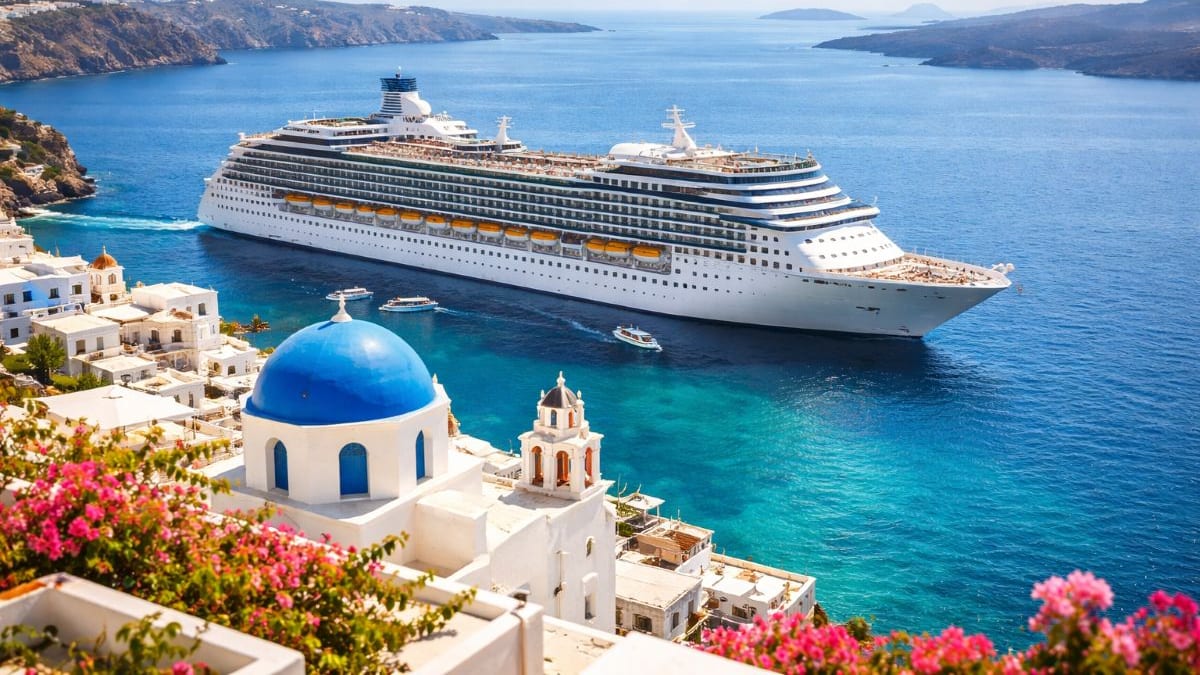
Partial Closure at Fira’s Old Port Disrupts Normal Tender Flow
The incident involves a section of retaining wall along the waterfront area at the Old Port beneath Fira, where cruise tenders typically disembark thousands of visitors per day in peak season. Reports from local and traveler-focused outlets indicate that masonry from the wall fell toward the quayside, damaging part of the pedestrian zone and making sections of the port unsafe for regular use.
Publicly available information shows that authorities in charge of port operations responded by cordoning off the affected stretch and temporarily suspending some tender movements into the most impacted pier areas. While the collapse did not affect the anchorage itself, the loss of usable quayside space has reduced the number of tenders that can safely operate simultaneously at the Old Port.
As a result, cruise lines and local boat operators have been adjusting their landing plans, with some ships increasing their use of the alternative port at Athinios and others staggering tender times to limit congestion at Fira. Travelers arriving in the days following the collapse have reported longer waits both to go ashore and to return to their ships, especially around sunset.
There have been no widely reported serious injuries linked to the wall failure, but the disruption comes at the height of the Aegean cruise season, when Santorini normally ranks among the busiest tender ports in the eastern Mediterranean.
Rebalanced Landings Between Fira and Athinios
Even before the wall collapse, Santorini’s cruise operations were in the midst of a gradual rebalancing between the Old Port below Fira and the ferry and excursion hub of Athinios. A berthing and crowd-management policy adopted for the 2025 and 2026 seasons placed caps on daily cruise visitor numbers and introduced a split in how passengers are distributed between the two landing points.
According to publicly available port documents and recent cruise line materials, only a portion of each ship’s guests may now be routed through Athinios, with the remainder funneled to the Old Port under the caldera cliffs. The partial closure after the wall collapse has made this distribution more difficult to manage in practice, as fewer tender berths are available at Fira just as many itineraries had been scheduled around the existing policy.
Some cruise programs have already been updated to emphasize organized shore excursions that start and end at Athinios, using coaches to bring visitors up to Fira, Oia and the island’s beach areas without relying on the constrained waterfront below Fira. Others are advising independent passengers to expect altered tender routes on the day of call, depending on crowd levels and local directions in effect when ships arrive.
Travel forums and recent port guides describe a patchwork of solutions in use: on some days, early-morning tenders are prioritized for organized tours via Athinios, with later independent visitors shuttled to whatever berth space remains at the Old Port; on other days, ships appear to be concentrating a larger share of traffic at Fira and reducing independent movement through Athinios to ease coach congestion.
Impact on Cable Car, Steps and Shore Excursions
With parts of the Fira waterfront cordoned off, the island’s fragile balance between the cable car, the traditional donkey path and bus-based excursions has shifted again. The cable car, which links the Old Port with Fira on the clifftop, remains the primary vertical route for passengers who land directly beneath the town. However, reductions in pier capacity mean that flows toward the cable car terminals are more uneven, contributing at times to longer queues and wait times.
Recent traveler commentary suggests that those arriving at peak times in the late morning and early evening are particularly affected. Lines at the cable car can build quickly when several tenders arrive in close succession at the reduced number of berths, while the steep stair path, though still used by some visitors, is not a realistic alternative for many passengers with mobility or heat concerns in mid-summer.
Excursion descriptions circulated by cruise operators for late 2026 sailings already reflect the evolving situation. Many highlight coach-based itineraries that either embark from Athinios and return there, or connect Athinios with Fira and Oia by road to avoid placing additional strain on the constrained Old Port access points. These itineraries are being promoted as a way to manage time ashore more predictably when cable car queues and tender delays are possible.
Local businesses in Fira and along the caldera rim are watching closely, as any sustained reduction in spontaneous walk-up visitors from the Old Port could affect cafes, restaurants and small shops that depend on cruise foot traffic. For now, the island remains busy, but patterns of movement around the town’s narrow lanes are changing as more people arrive by road from Athinios instead of funnelling straight up from the quay.
Advice for Upcoming Cruise Visitors to Santorini
For travelers with Santorini on their itinerary over the coming weeks, the evolving access picture means building more flexibility into plans ashore. Published guidance from cruise lines and local port notices emphasizes that day-of-call arrangements may differ from those described at the time of booking, as operators respond to capacity constraints at the Old Port and ongoing safety measures near the collapsed wall.
Passengers who have booked ship-organized tours are likely to see the fewest changes, as these groups can be prioritized on early tenders and moved efficiently by coach from Athinios or whichever landing point is in use that day. Independent visitors, by contrast, may find that tender tickets, cable car queues and last-tender deadlines leave less time than expected for exploring Fira and Oia at a relaxed pace.
Travel reports from this season consistently recommend monitoring cruise line apps and daily programs for updated tender instructions, allowing additional buffer when returning to the ship, and being prepared for the possibility that return tenders may operate from a different port than the one used on arrival. Visitors are also encouraged to plan for heat, as any extended time waiting in exposed queues at the waterfront or cable car can be uncomfortable during July and August.
Despite the disruption, Santorini continues to welcome cruise traffic and to showcase its well-known caldera views, cliffside villages and volcanic landscapes. The wall collapse at Fira and the resulting access changes have, however, underscored how sensitive the island’s visitor infrastructure is to even localized damage, and how quickly cruise operations must adapt when one of the Mediterranean’s most iconic tender ports loses part of its capacity.