


The official brochures pitch Ambergris Caye as Belize’s biggest island and an easy gateway to the Belize Barrier Reef. That part is true. What they do not prepare you for is how different Ambergris feels from block to block: chaotic San Pedro streets, polished resort strips a few minutes away, and long quiet stretches of mangroves and sand where the reef is a constant white line offshore. After several stays spread between town, south end and the far north, here is what it actually felt like to live on the island for a while, not just tick off attractions.
Get the latest updates straight to your inbox!
Arriving on Ambergris Caye: Plane vs Boat
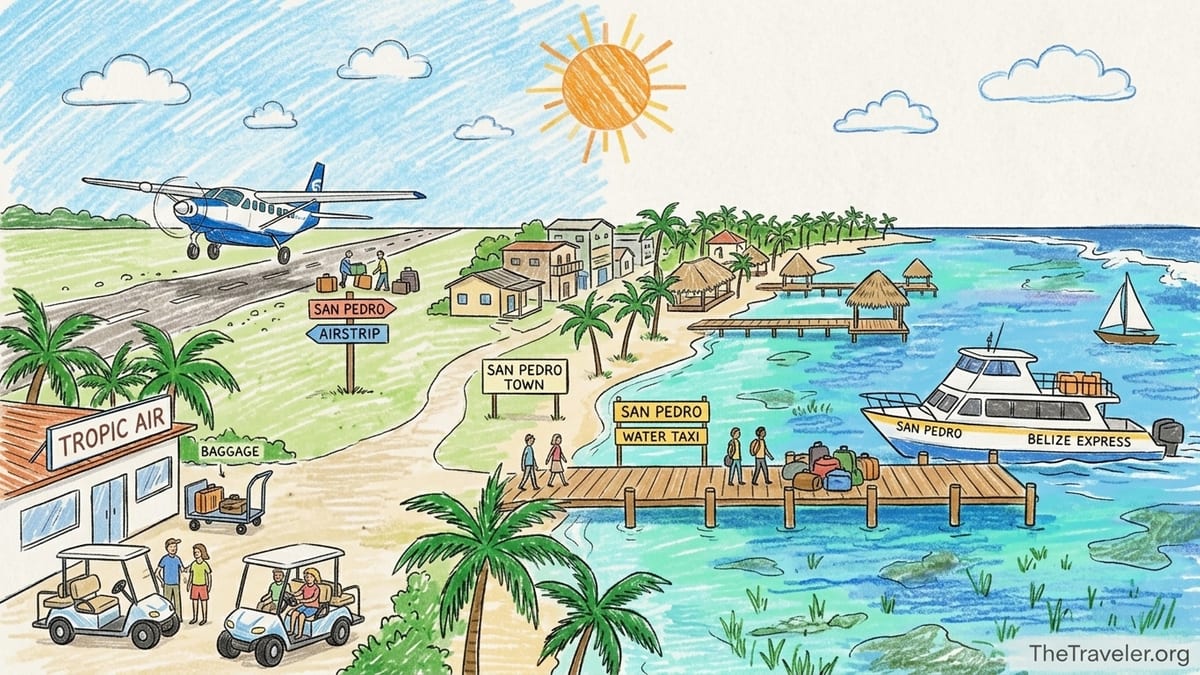
My first arrival on Ambergris Caye was the noisy, low‑altitude way: a 15‑minute hop from Belize City municipal airport in a small Tropic Air plane. Check‑in was almost casual compared with big airports. I showed my passport, stepped on a scale with my daypack, and ten minutes later we were bumping down the runway toward the Caribbean. The surprise came once we were airborne. The plane flies low enough that you can clearly see shoals, patch reefs and the pale turquoise shelf that becomes the Belize Barrier Reef. Watching the white line of surf running along the reef crest made it obvious that this island exists because of the reef, and that almost everything you will do here involves getting out on that water.
Landing in San Pedro is its own jolt. The airstrip runs parallel to town, so the wheels hit the tarmac practically behind people’s backyards. You step out into heat and humidity that feel like opening an oven door, walk a few meters through the tiny terminal, and you are already in the middle of San Pedro. Golf carts honk, taxis call out, and hotel drivers hold up hand‑lettered signs. With only a roll‑aboard, I walked to my first guesthouse in about ten minutes, sweating through my shirt before I even reached Front Street.
Arriving by water taxi feels different. Another trip I took the San Pedro Belize Express boat from Belize City. The current schedule from Belize City to San Pedro runs multiple departures during the day starting around 7:00 a.m. and going into the early evening, with a quick stop at Caye Caulker on some runs. The ride takes about an hour and a half depending on the sea. You load bags onto the dock yourself, crew stack them in the bow, and everyone squeezes onto benches under a fiberglass canopy. As San Pedro appears, you pass docks jutting out over impossibly clear water and resorts that look like they were built specifically to be seen from a boat, not from the street behind them.
Practical detail that surprised me: whether you fly or boat in, luggage is almost never out of sight for long. At the airstrip, checked bags come straight through a side door to a single belt or cart. On the water taxi, porters roll luggage carts down the dock and call hotel names. You can grab your own bag and either walk or hop into a waiting taxi or prearranged golf cart. There is none of the anonymous, warehouse‑scale baggage handling you see in big airports, which makes arrival feel strangely personal and small‑town.
Finding Your Feet in San Pedro Town
San Pedro itself was my biggest early shock. For years I had seen images of quiet sandy streets. The reality downtown is closer to a compact Caribbean city built to scale for golf carts rather than cars. The main streets are paved, lanes are narrow, and for long stretches there are as many carts and motorbikes as pedestrians. My first evening, I tried to pull my carry‑on down Barrier Reef Drive during rush hour and quickly ducked into a side street to regain my nerves.
Once I slowed down and accepted the traffic, I began to enjoy the density. Staying two blocks inland near the Catholic church, I could walk to the beach in under a minute, buy fresh tortillas still warm from the press, and be at the water taxi terminal or the municipal dock in five minutes. Night felt safe in the busy parts of town, partly because restaurants and bars spill right onto the street. Locals greeted friends from passing carts, kids played on the basketball court by Central Park, and you could smell grilled lobster from several blocks away when it was in season.
Daily logistics were easier than I expected. I found two ATMs within a short walk of my guesthouse, a small supermarket for basics like water and snacks, and several produce stands where I could pick up limes, tomatoes and local hot sauce. Most places took Belize dollars and US dollars interchangeably at a simple 2 to 1 rate. The power only flickered once during a storm, and the internet at cafés like the one where I wrote this guide was fast enough for video calls, even if it occasionally stalled during heavy downpours.
The contrast came when I left the core of San Pedro for the first time. Walking a few blocks south, the steady stream of carts and delivery trucks thinned out. Potholes got larger, buildings spaced out, and it started to feel like a beach town again. That quick transition from congested to relaxed is one of the defining quirks of Ambergris Caye, and it took a couple of days before I learned how to use it. My pattern became errands and meals in busy San Pedro, then retreating to quieter stretches just north or south when the chaos felt too intense.
Renting a Golf Cart and Learning Island Rules
I resisted renting a golf cart at first. San Pedro looked walkable on the map, and for a couple of days I managed fine on foot, with the occasional short taxi ride. The turning point was a late dinner at a beachfront restaurant south of town. The food was fantastic, the breeze off the water was perfect, but the walk back along a dark, uneven road while carts and trucks passed inches away was less appealing. The next morning I rented a cart from a small local agency near the airstrip.
Rates on the island in 2026 typically run in the neighborhood of 60 to 80 US dollars per day for a standard 4‑seater cart when renting by the day, with lower effective rates for longer multi‑day rentals, plus fuel. I had to show my driver’s license, leave a credit card imprint and sign a contract that made clear I was responsible for any accidents and that drinking and driving applied as much to carts as to cars. The rental shop staff walked around the cart with me, noted existing scrapes on a diagram, and reminded me to always remove the key and lock the steering wheel when I parked.
Driving rules surprised me in two ways. First, carts in San Pedro follow the same road rules as cars: you drive on the right, obey one‑way signs, and can be stopped for traffic violations. Locals told me police sometimes run checkpoints, especially on busy weekends, to check licenses and make sure visitors are not driving under the influence. Second, despite the informality of it all, the island takes unauthorized vehicles seriously. The municipal authorities require permits for carts and other vehicles brought to the island, and there are fines for unpermitted vehicles. As a visitor renting locally, you do not deal with the permit side, but it reinforced that this is a real town trying to manage very real congestion.
Once I got used to its width and slow acceleration, having a cart changed how I experienced the island. I could pop into town in the morning for coffee and breakfast tacos, then be back at a quiet beach north of the bridge in twenty minutes. I could haul groceries without sweating through my shirt, detour down side lanes just to see where they went, and stay out later at restaurants north or south of town without worrying about a long walk in the dark. The island essentially stretched from a 15‑minute walking radius to a 45‑minute driving radius, all at a top speed that still let me smell grilling chicken and hear music from roadside bars as I passed.
North, South and the Quiet Reaches of Ambergris Caye
Before I came to Ambergris Caye, I imagined San Pedro as the main restaurant hub and the north and south ends as sleepy strips of beach resorts. In reality, you can almost slice the island into three distinct experiences. San Pedro town is busy, loud and social. The near‑south, within two or three miles of town, feels like a chain of standalone resorts and condos, where you drift from one dock to another by boat. And then there is the far north and far south, where the road roughens, the mangroves thicken, and nights can be so quiet you hear only waves breaking on the reef.
Driving south from town in my golf cart the first time, I passed beachfront restaurants, small hotels and clusters of vacation rentals tucked behind palm trees. The beach in this area is attractive, but often narrow, with seawalls and docks claiming much of the shoreline. What surprised me was that the resorts here are oriented more to the sea than to the sand. Guests lounged at pools set back from the beach, boats picked up snorkelers directly from long wooden piers, and the best swimming was often at the end of a dock where seagrass underfoot gave way to clearer water.
North of San Pedro, after crossing the bridge, the road quickly changes character. Paved sections give way to packed sand and occasional ruts. My first drive out to Secret Beach took just under an hour from a hotel in town, with the last stretch cutting across the island to the leeward side where there is no barrier reef directly offshore and the water turns into a flat, bright‑blue lagoon. On that side, people parked their carts under scrubby trees, waded out with beers in hand, and floated in water so shallow you could walk out 50 meters and still be waist‑deep. Compared with town, the soundscape was just distant music from a couple of beach bars and the slap of water against dock pilings.
Farther north and south, beyond where most visitors stay, the island becomes truly quiet. I spent a few nights at a small lodge north of the main resort cluster. There were no neighboring buildings in sight, only mangroves, a narrow strip of sand and a private dock. At night I could see the white surf breaking on the reef in the distance, hear the wind in the palms and little else. Getting back to San Pedro for dinner required a bumpy 40‑minute cart ride, so we mostly ate on‑site or at a couple of neighboring properties accessible by a sandy track. The surprise here was psychological: I was still on the same island as busy San Pedro, but it felt like a different country.
Eating and Drinking: From Beachfront Grills to Town Staples
San Pedro turned out to be much more of a food town than I expected. In and around downtown, I could eat tacos from a cart for the price of a bus ride back home, then turn a corner and find a full‑service restaurant plating lionfish ceviche and fresh lobster caught that day. Breakfast became my favorite meal. Small local spots served fry jacks stuffed with eggs and beans, and beachfront cafés opened early enough for me to watch the first dive boats loading while sipping coffee with toes in the sand.
What surprised me most was how much of the island’s restaurant life is oriented to the water rather than the street. Many of the most memorable meals started with walking down a long dock rather than into a doorway on the road. South of town, I ate grilled snapper and coconut rice at a palapa‑roof restaurant where boats could tie up directly at the restaurant’s dock, and arriving guests often came barefoot straight from snorkeling or fishing. North of town, I spent an afternoon at a resort bar perched at the end of a pier, ordering ceviche and cold beer while watching rays glide in the shallows below.
Prices varied widely, which is worth planning for. In 2026 I routinely saw local taco stands in town selling two or three tacos for a few Belize dollars total, while sit‑down beachfront dinners at resorts could easily reach 30 to 40 US dollars per person with drinks for seafood dishes. Happy hours helped trim costs. Several bars in San Pedro offered drink specials and discounted appetizers in the late afternoon, which made it easier to sample a range of places without pushing the budget too hard.
North and south of town, dining options become more tied to where you are staying. When I based myself at a small resort south of San Pedro, we ate most dinners on‑site or at two neighboring docks reachable in a five‑minute walk along the beach. Lunch often came from the resort’s beach grill or from a passing fisherman selling fillets and lobster tails that the staff would cook to order. Up north near the quieter stretches, small resort restaurants and beach bars were more spread out, and I planned dinners carefully knowing that a second drink meant a slow golf cart ride back along a dark road with very few street lights.
Living With the Heat, Rain and Seasonal Swings
The brochures talk about “year‑round sunshine,” but what it actually feels like on the ground matters more than the slogan. Ambergris Caye sits in Belize’s tropical belt with a pronounced dry and wet season. When I first visited in February, daytime temperatures hovered around the mid‑80s Fahrenheit, humidity was noticeable but manageable, and short showers blew through quickly. It was warm enough that I never needed more than a light shirt in the evening, but cool enough that walking several blocks in town was comfortable if I stuck to the shady side of the street.
On a later trip in late June, everything felt heavier. Average daytime highs on the island in summer creep into the high 80s and low 90s Fahrenheit, and humidity rises along with them. I learned to schedule anything active in the mornings: golf cart runs, walks on the beach, snorkeling trips. By early afternoon, simply standing in the sun on an exposed dock waiting for a boat left sweat running down my back. Air conditioning was not just a comfort but a necessity at night, and I understood why many locals take a rest in the early afternoon and shift outdoor work to later in the day.
Rain changed the island in instant, tactile ways. During one June storm, a blazing morning turned into heavy rain and gusting wind within half an hour. Streets in town puddled quickly, golf carts threw up muddy spray, and some sandy back roads north and south turned into rutted channels of standing water. Power flickered once but came back within minutes. On the upside, the temperature dropped noticeably, and the air felt clean and cool once the squall passed. Offshore, some snorkel trips were postponed or shortened when lightning appeared, but many operators are used to reading the weather and will shuffle departure times around passing showers.
If you are sensitive to weather, timing your visit matters. The traditional dry season runs roughly from late November through April, with February and March often bringing the most reliable streaks of dry, sunny weather. The wet season that follows can still deliver beautiful days, but you should expect higher humidity, more intense afternoon heat, and heavier periods of rain, especially in the late summer and early fall when the broader region’s hurricane season peaks. On my wetter visits, a light rain jacket, plastic bag for electronics and a willingness to get a little muddy on unpaved roads made the difference between frustration and adventure.
Boats, the Reef and How the Sea Shapes Everything
It is one thing to know in theory that Ambergris Caye sits beside the Belize Barrier Reef, the second‑largest reef system in the world. It is another to stand on a dock anywhere along the eastern shore and see the reef as a white‑capped stripe on the horizon, stretching as far north and south as you can see. After a few days on the island, I realized how much this line of breaking waves explains the way Ambergris works. The reef calms the water between itself and the island, creating the glassy lagoon where docks reach out and boats shuttle people to dive sites, sandbars and neighboring cayes.
Every excursion I took involved stepping carefully from a gently rocking dock into a panga or dive boat. For snorkeling at Hol Chan Marine Reserve and Shark Ray Alley, we paid the standard park fee, which in 2026 is about 15 US dollars per non‑Belizean adult on top of the tour price. That fee covers access to a protected area where coral heads rise almost to the surface and schools of fish move like clouds. On my first trip, the captain idled the engine at the edge of the cut through the reef while our guide pointed out the break in the white line of surf where we would cross. Once through, swell from the open sea lifted the bow, a reminder that outside the reef, you are suddenly in much deeper water.
Back inside the reef, life is organized around boats and docks. Divers leave before breakfast, returning in the early afternoon with salt‑stiff hair and stories of nurse sharks and eagle rays. Fishing guides pick up guests from hotel jetties, often barefoot and with coolers already packed with ice. Water taxis buzz up and down the coast shuttling workers and visitors between town and outlying resorts. Even on days when I did nothing more than sit on a shaded dock with a book, the steady movement of small boats was a constant backdrop, more present than cars or trucks on the road behind the buildings.
What surprised me most was how much of Ambergris Caye is effectively accessed only by water. Some of the most relaxed beach bars and quieter patches of sand I visited did not have a clear road entrance. Guests came by boat from town, spent the day, and left as the sun began to drop. Resorts north and south of San Pedro market their private docks as much as their rooms, because the dock is how snorkel trips, diving, fishing and sunset cruises plug directly into each stay. On an island where the reef is both protector and playground, you realize fast that learning to step confidently from dock to boat and back while wind and waves nudge you is an essential skill, not a side detail.
The Takeaway
After several stays on Ambergris Caye, what stays with me is less a checklist of attractions and more a set of contrasts. There is the bustle of San Pedro, with carts swerving around potholes and kids walking home from school in uniforms, and the near silence of far‑north docks where you hear only waves on the reef. There are days when the heat feels like a tangible weight on your shoulders, and evenings when a breeze through a beach bar makes you forget you ever owned a jacket. There are arrivals by plane that feel almost theatrical, with reef and island laid out like a map below you, and arrivals by boat where the town slowly comes into focus through salt spray.
Living on the island, even temporarily, means stitching these pieces together. It means accepting that you will get dusty on unpaved roads and that you will track sand everywhere. It means budgeting for a golf cart so you can explore beyond town and still retreat to a quiet stretch when you need it. It means keeping cash handy for marine park fees and tipping boat crews who navigate narrow cuts through the reef while you take photos. Above all, it means looking up from the beach now and then to notice that white line on the horizon, and realizing that without it, none of this would exist in the same way.
If you come to Ambergris Caye expecting an untouched island with empty beaches, San Pedro’s traffic and construction will probably shock you at first. If you come expecting only a party town, the quiet mangrove‑lined reaches north and south will surprise you in a different way. Somewhere between those extremes, on a dock with your feet in warm lagoon water and the reef rumbling softly in the distance, you will find the Ambergris that keeps people coming back.
FAQ
Q1. Do I need a golf cart on Ambergris Caye, or can I get around on foot?
For a short stay right in San Pedro you can manage mostly on foot and by taxi, but a golf cart makes a big difference if you want to explore north or south of town, visit Secret Beach, or stay at resorts outside the core. On my own trips, renting a cart turned the island from a small town into a much larger playground.
Q2. Is it better to arrive in San Pedro by plane or by water taxi?
Flying is faster and offers stunning views of the reef, with total travel time from Belize City often under 30 minutes terminal to terminal. The water taxi is usually cheaper, takes around 90 minutes from Belize City with intermediate stops, and lets you arrive right at the town dock. I have done both and now choose based on weather, budget and how quickly I want to be on the island.
Q3. What should I expect to pay for a golf cart rental in 2026?
In 2026 typical daily rates for a standard 4‑seater cart on Ambergris Caye run roughly in the 60 to 80 US dollar range when rented day by day, with lower per‑day pricing for multi‑day or weekly rentals. Fuel is extra and you will need a valid driver’s license.
Q4. How busy is San Pedro compared with the rest of Ambergris Caye?
San Pedro town is the busiest part of the island, with dense traffic, shops, schools and year‑round construction. Within a 10 to 20 minute cart ride north or south, the vibe shifts to quieter resort areas with fewer vehicles, more trees and long stretches of beach or mangrove. Farther out, especially on the far north and far south, it can feel almost remote.
Q5. What are current ferry and domestic flight options to Ambergris Caye?
As of late 2026, water taxi companies run multiple daily boats between Belize City, Caye Caulker and San Pedro, starting in the early morning and running into the early evening. Domestic airlines operate frequent short flights from both Belize City’s international and municipal airports to San Pedro throughout the day. Exact times change seasonally, so I always check same‑year schedules before booking.
Q6. How much are Hol Chan Marine Reserve fees and how are they paid?
For non‑Belizean adults, the Hol Chan Marine Reserve fee in 2026 is about 15 US dollars per person, usually paid in cash to your tour operator or directly at their office before departure. Many snorkel and dive tours list this as a separate line item from the tour price.
Q7. What is the weather like on Ambergris Caye and when is the best time to go?
Ambergris Caye has warm temperatures year‑round, with a drier season roughly from late November to April and a wetter, more humid season from May into October. I found February and March to offer the most consistently comfortable weather, while June and later months felt hotter and more humid with heavier showers.
Q8. Are there public beaches, or do resorts own the shoreline?
In Belize the foreshore is public, so you can walk along the waterline even in front of resorts, and locals do. In practice, though, many stretches of beach in the resort zones are lined with docks, seawalls and seagrass, so the nicest sandy and swimmable spots often coincide with resort fronts or beach bars that maintain their patches of shoreline.
Q9. Is Ambergris Caye suitable for travelers who do not dive or snorkel?
Yes, but your experience will be different. I met visitors who were perfectly happy staying poolside, exploring by golf cart, eating well and taking the occasional sunset cruise. That said, much of what makes the island special is tied to the reef and lagoon, so even non‑swimmers often end up on at least one boat trip to see the marine world up close.
Q10. How safe did you feel staying on Ambergris Caye?
Personally I felt comfortable walking around the busy parts of San Pedro in the daytime and early evening, and even later at night along well‑lit main streets and resort areas. I treated it like any small town: kept valuables out of sight, locked my cart and room, used licensed taxis after dark for longer distances, and listened to local advice about which areas to avoid late at night.