


More news on this day
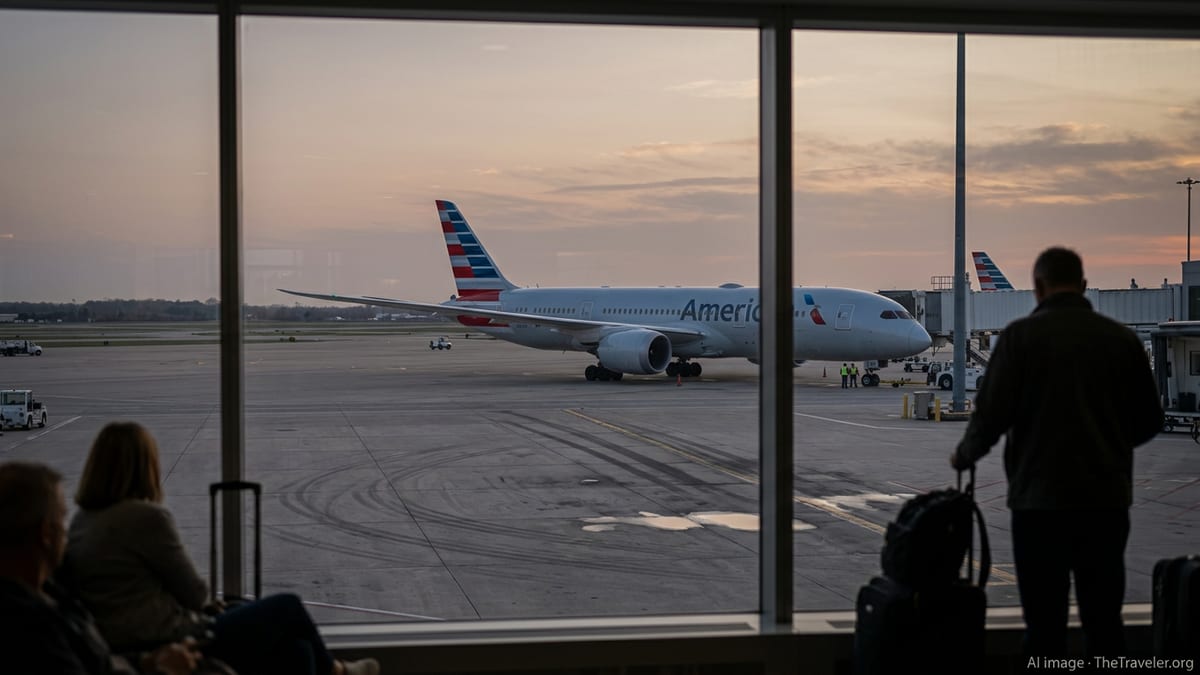
Transatlantic passengers on American Airlines Flight 784 from Charlotte to Munich faced an unexpected diversion this week when the Boeing 777 operating the route was forced to turn back toward New York after a cockpit windshield failure over the Atlantic Ocean.
Get the latest news straight to your inbox!
Mid-Ocean Diversion Redirects Charlotte–Munich Service
Publicly available flight tracking data and aviation incident reporting indicate that the incident occurred late on May 12, 2026, as American Airlines Flight 784 cruised at high altitude over the North Atlantic on a scheduled route from Charlotte, North Carolina, to Munich, Germany. The Boeing 777-200, identified in specialist coverage as tail number N776AN, had already crossed into oceanic airspace when the crew initiated a turn toward the United States.
Reports from aviation incident databases describe a failure involving the cockpit windshield on the first officer’s side, prompting the crew to discontinue the transatlantic crossing. Instead of proceeding toward Europe or diverting to northeastern Canada, the aircraft descended to a lower flight level and set course for New York’s John F. Kennedy International Airport.
Data reviewed from flight tracking platforms show the widebody twinjet landing safely at JFK roughly two and a half hours after the diversion began. There were no early indications in public reporting of injuries among passengers or crew, and the aircraft taxied to the gate under its own power.
The diversion transformed what is ordinarily a direct eastbound overnight crossing into an extended journey for travelers, with the original aircraft remaining on the ground in New York for inspections and maintenance following the incident.
Windshield Failure Raises Safety and Maintenance Questions
According to aviation safety summaries, the crew response followed established procedures for structural or visibility-related issues in the flight deck area. Modern transport-category aircraft, including the Boeing 777, are designed to tolerate localized windshield cracking without immediate loss of pressurization, but operators typically treat any cockpit window failure in cruise as a serious safety event.
Industry analyses note that cockpit windshields are multi-layered, heated units critical to both visibility and structural integrity at cruising altitudes. Reports on the Flight 784 incident point to a problem at the first officer’s window, with damage significant enough to warrant a prompt diversion rather than continuation across the Atlantic. Aviation-focused outlets describe the diversion profile as consistent with a controlled, non-emergency rerouting rather than a rapid descent associated with loss of cabin pressure.
Maintenance specialists observing the case highlight that such events, while rare, can stem from issues with windshield heating systems, material fatigue, manufacturing defects, or foreign object damage. As of the latest publicly accessible updates, there has been no formal indication that the event on Flight 784 is linked to a broader systemic issue with the Boeing 777 windshield design or with American Airlines’ specific airframe.
The incident nevertheless adds to ongoing scrutiny of high-altitude component reliability at a time when long-haul aircraft are increasingly tasked with extended overwater operations between North America and Europe.
Passenger Disruption and Airline Response
Flight history records and schedule information show that American Airlines repositioned another Boeing 777-200 to JFK in order to continue the service to Munich. The replacement aircraft departed New York in the early morning hours and ultimately delivered passengers to Germany with an arrival delay reported to be around seven and a half to eight hours beyond the original schedule.
Travel industry coverage notes that passengers on transatlantic diversions of this kind typically face missed onward connections, rebooking challenges, and disrupted work or holiday plans. In this case, a same-night or early-morning continuation flight appears to have limited the overall delay compared with overnight cancellations that sometimes follow equipment failures on long-haul operations.
Publicly available information indicates that the original aircraft remained out of service in New York for detailed technical inspection and any required repairs. For airlines operating relatively small widebody fleets, the temporary loss of a long-haul aircraft can trigger downline schedule adjustments and equipment swaps on other routes.
Travel analysts point out that, because the flight originated in the United States and was operated by a U.S. carrier, passenger compensation and care obligations fall under a different regime than if the disruption had occurred on a departure from Europe, where European Union rules impose additional consumer protections and payments in certain circumstances.
U.S. and German Aviation Authorities Monitor Event
The diversion of an American-registered Boeing 777 on a U.S.–Germany route has drawn attention from aviation observers in both countries. While formal investigative steps are typically handled by national safety bodies and civil aviation regulators, early information on Flight 784 is emerging mainly through aviation databases, flight tracking services, and specialist news outlets rather than through detailed public statements.
In the United States, cockpit windshield failures on commercial airliners are generally categorized as significant incidents and may be subject to technical review to determine whether they represent isolated defects, maintenance issues, or early signs of a pattern. In Germany, the event is being watched in the context of the country’s role as the intended destination and as a major hub within Europe’s long-haul network.
Analysts note that recent months have seen heightened public sensitivity around aviation reliability on both sides of the Atlantic, with travelers paying closer attention to reports of technical irregularities on large twin-engine widebodies serving intercontinental markets. The Flight 784 diversion adds another data point to that conversation, particularly because it occurred over open ocean on a heavily traveled corridor between North America and Europe.
Published commentary from aviation experts suggests that cooperation and information-sharing between U.S. and European regulatory systems remain central to maintaining confidence in cross-Atlantic operations, especially as fleet renewal, rising utilization, and complex maintenance demands converge on aging widebody types.
Context: Windshield Incidents Amid Broader Safety Spotlight
The Flight 784 event follows other recent reports of cracked or damaged flight deck windshields on commercial jets, including a Southwest Airlines Boeing 737 diversion within the United States earlier this week. Although the aircraft types, operating conditions, and damage mechanisms can differ, the clustering of such reports has contributed to renewed public focus on the resilience of cockpit windows in modern fleets.
Aviation safety analysts caution that, in statistical terms, windshield issues remain rare compared with the vast number of daily flights across the global system. They also emphasize that modern certification standards require multiple protective layers and robust heating and structural systems, giving crews time and options to manage failures safely, as appears to have occurred on American Airlines Flight 784.
Industry observers expect that the incident will feed into ongoing safety data programs operated by airlines, manufacturers, and regulators, which track technical anomalies and maintenance findings across fleets. Those programs are designed to detect recurring patterns early and, where necessary, trigger service bulletins, inspections, or design modifications.
For travelers between the United States and Germany, the Flight 784 diversion serves as a reminder that even routine overnight crossings rely on complex engineering and conservative decision-making, in which rare component failures can lead to major disruptions yet still result in controlled, precautionary diversions to major hubs such as New York.