


More news on this day
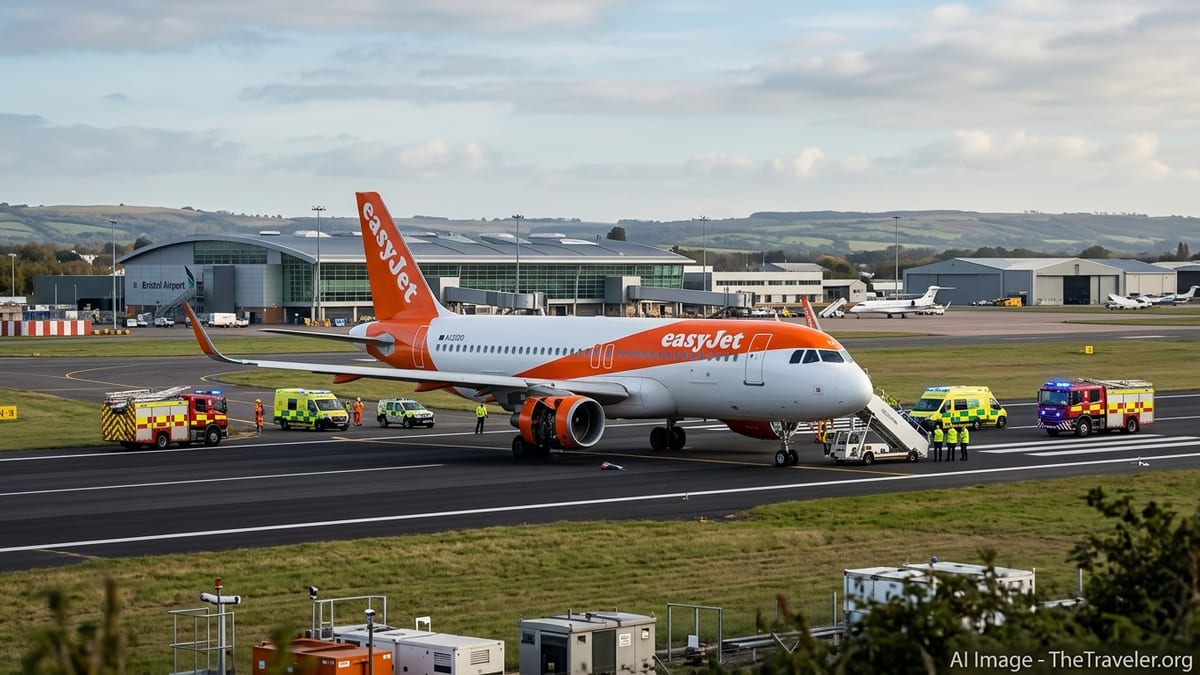
An easyJet service from Bristol to Edinburgh was forced to declare an emergency and return to Bristol Airport on 18 November 2026 after a bird strike damaged one of the aircraft’s engines, a disruption that has refocused attention on how UK aviation manages wildlife risks and what protections passengers actually have when flights are halted for safety reasons.
Get the latest news straight to your inbox!
What happened on the Bristol–Edinburgh flight
According to live flight-tracking data and multiple news reports, easyJet flight U2213 (also shown as EZY213) departed Bristol Airport at around 09:24 on Wednesday 18 November 2026, bound for Edinburgh. The Airbus A320 climbed out over South Wales before declaring an emergency and turning back towards Bristol after a suspected bird strike shortly after take-off.
Flight-tracking records show the aircraft circling over the Bristol Channel area and landing back at Bristol roughly 40 minutes after departure. Aviation specialist outlets report that the crew squawked 7700, the standard emergency transponder code, and that the strike caused damage to one of the jet’s engines. Emergency services were positioned to meet the aircraft on arrival, but no injuries were reported among passengers or crew.
In statements quoted by UK media, easyJet said the aircraft had been hit by a bird during take-off and that the captain elected to return to Bristol as a precaution. The airline stated that safety was its “highest priority” and that customers were re-accommodated on a replacement aircraft to complete their journey to Edinburgh later in the day. Bristol Airport has confirmed the return landing and the emergency response but has not published additional detail about the extent of any engine damage, which is subject to operator inspection.
How common are bird strikes in UK aviation?
Bird strikes are a routine, closely monitored safety issue rather than a rare anomaly. The UK Civil Aviation Authority (CAA), which collates national wildlife strike data, recorded 1,702 reported bird strikes in 2025 across UK operations, according to its latest published workbook of incident statistics. These figures cover everything from minor events with no damage to the aircraft through to the small minority that result in engine inspection or repair.
The CAA cautions that higher reporting rates at a particular airport do not automatically equate to higher risk and that the vast majority of incidents cause no serious harm. In line with global wildlife strike data, only a small proportion of reported bird strikes result in significant aircraft damage or precautionary landings. Nevertheless, UK rules require that commanders and aerodrome operators report significant strikes so the regulator can track patterns and support risk mitigation.
At Bristol, the airport’s aerodrome manual and wildlife hazard procedures set out measures intended to reduce the chance of such events, including habitat management around the airfield, active dispersal of birds, and internal reporting processes whenever a strike is suspected or confirmed. These systems are designed to limit risk rather than to eliminate bird activity entirely, which is not realistically possible at any open-air airport.
What airlines and airports must do after a bird strike
Once a bird strike is suspected, standard operating procedures give the aircraft commander wide discretion to prioritise safety. On departure, that can mean rejecting the take-off if the strike occurs at very low speed, or continuing the initial climb and then returning to the departure airport if performance margins allow, as appears to have happened in the Bristol incident. The immediate aim is to get the aircraft safely on the ground where maintenance teams can inspect it.
On landing, airport emergency plans typically bring fire and rescue, medical and operations staff to standby positions, which is why passengers on the Bristol flight saw emergency vehicles gathered around the runway. Even when there are no injuries and only precautionary checks are needed, the aircraft will usually be taken out of service until engineers have inspected the engines and airframe for any sign of damage.
Under UK safety regulations, commanders must ensure that any significant wildlife strike is reported to the CAA’s birdstrike database. Airports, including Bristol, also have their own internal wildlife-strike reporting and investigation procedures built into their aerodrome manuals. Any serious safety occurrence could also be reviewed by the UK Air Accidents Investigation Branch, although at the time of writing there is no public indication that this particular event has triggered a standalone AAIB investigation beyond routine occurrence reporting.
Passenger rights when a flight is disrupted by wildlife
For travellers, the key question is what they are entitled to when a flight is delayed or diverted due to a bird strike. Under retained EU Regulation 261/2004 and the equivalent UK261 rules, passengers on UK and EU carriers have potential rights to care, rerouting and, in some cases, cash compensation when their flights are disrupted. However, the legal position on cash compensation is restrictive in wildlife cases.
The Court of Justice of the European Union has held that collisions between aircraft and birds fall within the concept of “extraordinary circumstances.” That classification means airlines are not liable to pay the fixed cash compensation that would otherwise be due for long delays or cancellations, provided they can show they took all reasonable measures to avoid the disruption. This principle has been consistently followed in subsequent guidance and remains the basis for how UK and EU regulators interpret bird strike disruptions.
Even where a bird strike counts as an extraordinary circumstance, airlines still have concrete duties. If a delay or cancellation leaves passengers waiting, carriers must usually provide assistance such as meals and refreshments appropriate to the waiting time, and hotel accommodation and transfers when an overnight stay becomes necessary. Travellers must also be offered a choice between rerouting at the earliest opportunity, rerouting at a later date, or a refund if the trip is no longer needed. In the Bristol case, easyJet has stated that customers were moved to another aircraft to reach Edinburgh, which aligns with these rerouting obligations, but there is no suggestion that cash compensation would be payable solely because the cause was a bird strike.
What UK travellers should check after similar incidents
When a flight is interrupted by a suspected bird strike, passengers can reasonably expect safety-first decisions, which often mean returning to the departure airport and waiting for engineers or a replacement aircraft. Travellers should keep boarding passes, booking confirmations and any written updates from the airline, as these documents can be important if they later need to claim reimbursement for meals, accommodation or alternative transport that the airline has agreed to cover.
Before incurring significant out-of-pocket costs, passengers should confirm in writing, where possible, what assistance the airline is offering. Because bird strikes are generally treated as extraordinary circumstances, travellers should not assume they will receive automatic cash compensation under UK261 for delays or cancellations linked to wildlife, although they may still be entitled to care and rerouting. Specialist claim companies cannot change this legal classification, so it is worth checking the regulator’s guidance rather than relying on generic marketing promises.
Looking ahead, the CAA’s annual birdstrike statistics and any formal summaries from the Air Accidents Investigation Branch remain the most authoritative sources for understanding how frequently wildlife strikes occur and how serious they tend to be. Passengers concerned about safety on specific routes can consult the latest CAA data and airline safety information at the time of booking, but current evidence indicates that while bird strikes are a recognised operational hazard, serious consequences for modern commercial flights remain uncommon.