


More news on this day
Turkmenistan has signalled a stronger appetite for practical transport and transit cooperation with Europe, backing EU Global Gateway plans and the Trans-Caspian Transport Corridor at a ministerial meeting on cross-regional security and connectivity in Brussels on 16 November 2026.
Get the latest news straight to your inbox!
A cautious but clear nod to deeper EU connectivity
The second Ministerial Meeting on Cross-Regional Security and Connectivity took place in Brussels on 16 November 2026 alongside the EU Foreign Affairs Council, bringing together EU member states with partners from the Black Sea region, the South Caucasus and Central Asia, including Turkmenistan.
According to the Turkmen government’s readout, a delegation led by Deputy Foreign Minister M. Byashimova represented Ashgabat and underlined the importance of reliable, diversified transport routes at a time of geopolitical and economic uncertainty.
Turkmenistan used its intervention to offer a positive assessment of the EU’s Global Gateway initiative, identify the Trans-Caspian Transport Corridor as a priority channel, and stress the value of regular high-level contacts and institutional cooperation with Brussels rather than one-off events.
Trans-Caspian focus builds on Ashgabat coordination platform
The Brussels meeting comes just over two years after Turkmenistan co-hosted the high-level launch of the Trans-Caspian Transport Corridor Coordination Platform in Ashgabat on 3 October 2024, which formally created a mechanism to promote the route and coordinate priority “hard” and “soft” infrastructure projects.
That platform, supported under the EU’s Global Gateway investment strategy, is designed to look across rail, road, port and border procedures between Central Asia, the South Caucasus and Türkiye, aiming to make the so-called Middle Corridor a more predictable alternative for trade between Europe and Asia.
Turkmenistan’s reaffirmed support in Brussels suggests it is willing for the coordination platform to become more active, with regular technical and policy meetings rather than remaining a one-off launch event and occasional seminars.
Recent steps underline Turkmenistan’s corridor ambitions
While the Brussels gathering did not unveil new routes or funding figures, it builds on a longer-term pattern of Turkmen engagement with regional transport frameworks, including participation in the Trans-Caspian platform and its role in broader Eurasian corridors such as TRACECA and the International North–South Transport Corridor.
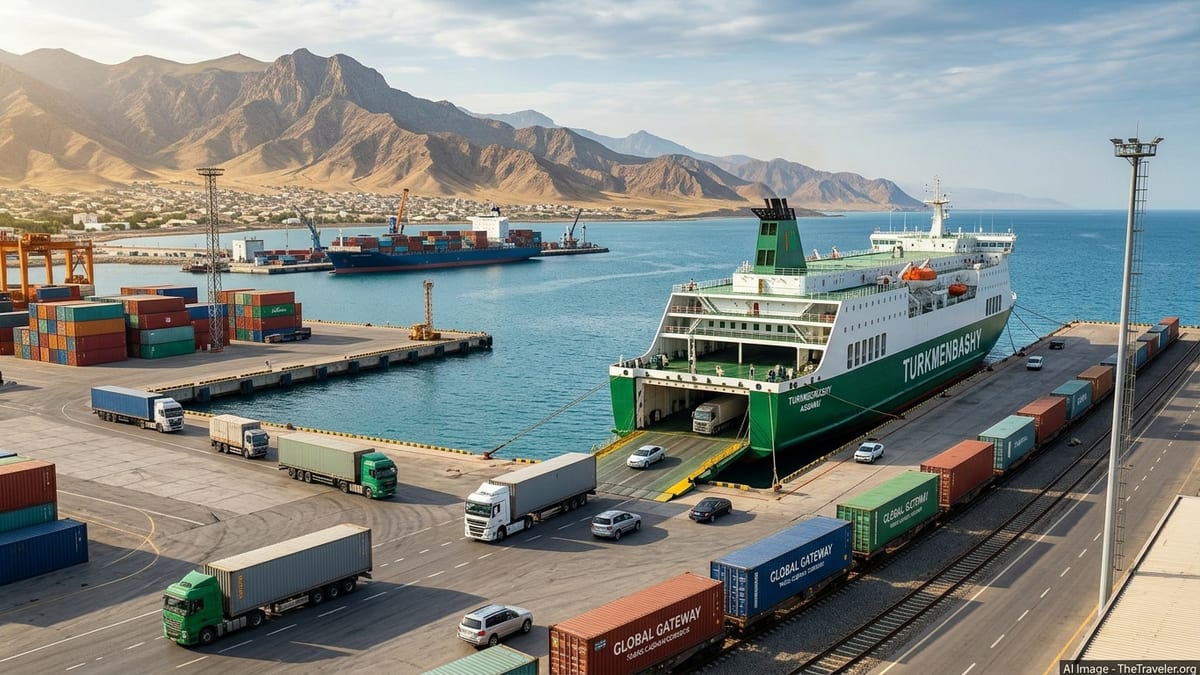
In practical terms, Turkmen authorities have highlighted Turkmenbashi International Seaport on the Caspian Sea as a key multimodal node, handling cargo that can connect via rail, road and ferry links onward to Azerbaijan, Georgia and beyond to European markets.
EU strategy documents now routinely reference the Trans-Caspian corridor as a flagship Global Gateway route, and Turkmenistan’s inclusion in these plans signals that Brussels expects Ashgabat to be part of efforts to shorten and stabilise overland transit times between Europe, Central Asia and western China.
Co-chairs flag next stop: Sofia connectivity summit in 2027
Co-chairs’ conclusions issued after the Brussels ministerial place Central Asia, including Turkmenistan, within a wider Cross-regional Connectivity Agenda that covers transport, digital infrastructure and energy links between the EU and its eastern partners.
The document trails a Regional Connectivity Summit in Sofia in 2027, presented as the next major milestone for moving from political statements toward concrete projects and investment decisions across the interconnected regions.
For Turkmenistan, that Sofia meeting is expected to provide another platform to refine corridor priorities, present project ideas linked to Turkmenbashi and inland rail upgrades, and engage with international financial institutions that could eventually support feasibility studies or financing.
What this means for travelers and what to watch next
For individual travelers, the immediate impact of the 16 November meeting is limited: no new commercial passenger flights, rail services or ferry timetables between Turkmenistan and EU countries were announced in Brussels.
In the medium term, however, more coordinated investment along the Trans-Caspian and related corridors could improve freight reliability and reduce overland transit times, which often underpins the viability of future passenger rail or ferry offerings via Turkmenbashi.
Travelers considering overland routes between Europe and Central Asia should treat the Brussels meeting as a policy signal rather than a timetable change. The next concrete indicators to watch will be any project-level announcements, tender launches or funding commitments linked to Turkmenistan that emerge ahead of, or at, the planned Sofia connectivity summit in 2027.