


More news on this day
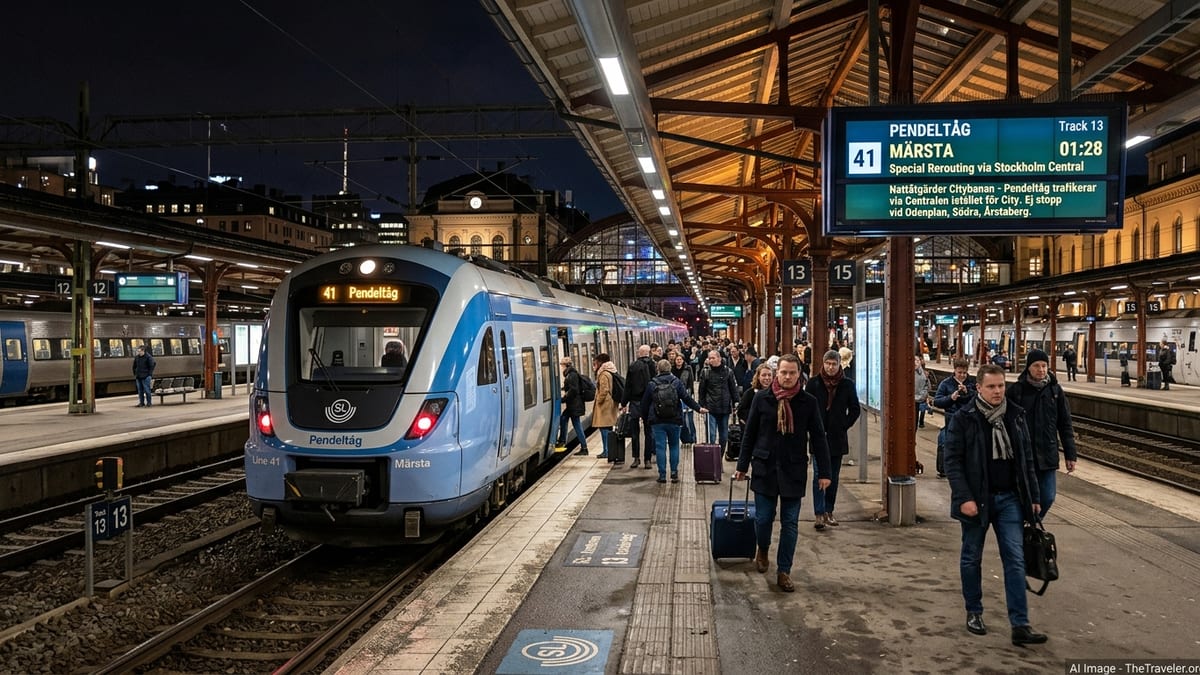
Late‑night Stockholm commuter rail services will be diverted via Stockholm Central station instead of the usual Citybanan tunnel for four consecutive nights from the night of Tuesday 24 November to early morning Friday 27 November 2026, temporarily cutting direct pendeltåg access to Stockholm Odenplan, Stockholms södra and Årstaberg in the small hours.
Get the latest news straight to your inbox!
What exactly is changing on Stockholm’s commuter trains
According to SL’s current traffic advisory on autumn night closures, all Stockholm commuter rail lines that normally use the Citybanan tunnel will run via Stockholm Central station instead between roughly 00.45 and 04.30 from the night of Tuesday 24 November through the early hours of Friday 27 November 2026. During this overnight window, pendeltåg will not stop at Stockholm Odenplan, Stockholms södra or Årstaberg, even though these stations remain open to other modes and daytime commuter services.
Traffic portal Trafiken.nu, citing infrastructure manager Trafikverket, specifies that commuter lines 40, 41 and 43 will depart from Stockholm Central instead of Stockholm City and are scheduled to use tracks 13/14 and 15/16, which are normally used by regional and long‑distance trains. The same source confirms the estimated time window of about 00.45 to 04.30 each night, aligning with Trafikverket’s own text‑message bulletin that states SL commuter trains will “run a different route than usual” and call at Stockholm Central rather than Stockholm City during this period.
Daytime pendeltåg services before and after the nightly works are currently planned to operate on their regular routes via Stockholm City and Stockholm Odenplan. Travelers using these central stations in the daytime should therefore see normal patterns, which may heighten confusion for anyone heading out or returning home after midnight during the affected nights.
Why the late‑night rerouting is happening
SL and Trafikverket attribute the temporary rerouting to planned track work in central Stockholm linked to the Citybanan corridor. Performing the work during the small hours allows them to keep daytime commuter and long‑distance services running largely as normal while securing the extended track access and safety margins required for maintenance and inspections in the tunnel area.
Trafikverket lists the change as a “planned disruption” and has set specific dates and times for the altered routing rather than describing an open‑ended closure. The project is framed as time‑limited maintenance on existing infrastructure rather than the start of a broader shutdown of Stockholm City or Odenplan, and there is no current indication from the authorities that the Citybanan tunnel stations will close permanently or for longer periods as part of this specific work package.
The overnight Citybanan works follow earlier November rail disruptions south of Stockholm, including night closures on the Älvsjö–Tumba section with replacement buses and knock‑on delays after an incident near Flemingsberg. Those events are separate from the late‑November central track maintenance, which is being communicated in advance with a fixed four‑night window so that commuters and late‑night travelers can plan around it.
How late‑night travelers will be affected
The most direct impact is the loss of late‑night commuter rail stops at Stockholm Odenplan, Stockholms södra and Årstaberg on the nights of 24, 25 and 26 November, roughly between 00.45 and 04.30. Anyone who would normally board or alight at these stations during those hours will need to adjust their route, either by using the metro, night buses or transferring at other pendeltåg stations that remain served.
For travelers to and from Stockholm Odenplan, SL points to the Green Line metro as the main alternative, with frequent services between T‑Centralen and Odenplan and interchange passages connecting metro and commuter rail platforms at Odenplan outside the affected time window. For Stockholms södra, the closest alternative overnight rail access is typically via Stockholm Central, with the Red Line metro between T‑Centralen and Mariatorget and a short street‑level walk for those needing to reach the Södermalm area around Södra station.
Årstaberg, which normally offers connections between pendeltåg, Tvärbanan and several bus lines, will also lose direct late‑night commuter rail access during the work. Travelers heading to or from Årstaberg may instead use Liljeholmen or Gullmarsplan as late‑night hubs, connecting onward via Tvärbanan or bus where services are available. As with any planned diversion, journey times are likely to be longer and transfers less intuitive, particularly for visitors unfamiliar with Stockholm’s multi‑layered rail network.
What is not affected and what travelers should check
The rerouting applies specifically to SL commuter trains using the Citybanan tunnel, notably lines 40, 41 and 43. Long‑distance and regional services operated by SJ and other rail companies are not covered by the same notices and are currently expected to continue using Stockholm Central on their normal tracks and schedules, although they may be operating alongside the diverted pendeltåg on some platforms during the overnight window.
Travelers should pay close attention to station names when planning late‑night journeys during 24–27 November. Departures that would usually be shown from Stockholm City may instead be listed from Stockholm Central, and regular passengers at Odenplan, Södra or Årstaberg will need to factor in an extra leg by metro or bus. Because the disruption is confined to a narrow time band, apps and printed timetables may show regular service immediately before and after the works, making it important to check the specific departure time rather than assume standard patterns.
SL and Trafikverket both advise that their real‑time information channels and traffic‑change pages will carry the latest details on any adjustments to the schedule, including potential extensions or changes to the work window. Travelers with fixed late‑night plans in Stockholm during the affected week should recheck official advisories close to departure, confirm which central station their train will use, and allow extra time to navigate between Stockholm Central, the metro and nearby bus stops if they are used to boarding directly at Stockholm City, Odenplan, Södra or Årstaberg.