


More news on this day
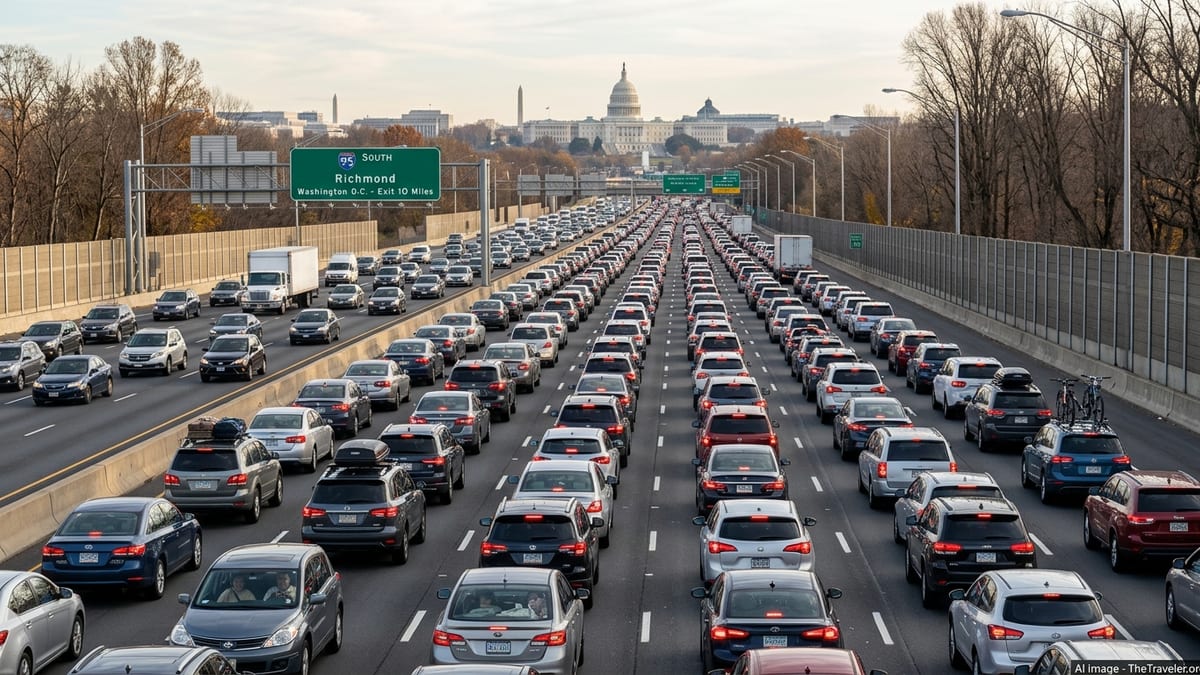
Highways in and out of major U.S. cities such as New York, Washington, Los Angeles and Boston could see more than twice their usual congestion at peak times over Thanksgiving week, according to AAA’s national 2026 holiday travel forecast produced with transportation data firm INRIX.
Get the latest news straight to your inbox!
Forecast: 81.5 million travelers, flat from 2025 but still near record
AAA’s national Thanksgiving 2026 forecast, released on November 16, projects 81.5 million Americans will travel at least 50 miles from home between Tuesday, November 24 and Monday, November 30. That is essentially unchanged from the 81.6 million travelers AAA estimates made a similar trip in 2025, ending a three year run of record Thanksgiving volumes but still keeping activity close to those highs.
About 72.9 million people are expected to travel by car, according to AAA’s breakdown, a slight 0.3 percent decline in Thanksgiving driving volume compared with last year. Air and other modes, including rail and motorcoach, account for the remainder. For travelers in and around large metro areas, AAA is emphasizing that near record overall demand combined with recurring regional choke points will still translate into very long highway trips around the peak days.
AAA is also stressing that these figures are a forecast based on booking trends, economic data and historical travel patterns. Actual volumes could differ if conditions such as weather, airline operations or broader economic developments change before or during the holiday week.
Where delays could more than double: New York, DC, Los Angeles and Boston
INRIX, which supplies traffic analytics to AAA for the forecast, expects that “major metro areas like New York, Washington, DC, Los Angeles, and Boston” could see peak congestion more than twice normal levels at the worst times over the Thanksgiving period. That projection refers to relative delay compared with typical conditions on the same corridors, not absolute standstill traffic across an entire region.
AAA summaries of the INRIX modeling indicate that specific corridors are likely to bear the brunt of the extra traffic. In the New York region, routes radiating from the city, including segments of the New Jersey Turnpike and I 95 toward Connecticut, are highlighted as likely to experience sharply longer travel times, with modeled delays exceeding 100 percent of a typical off holiday baseline in the busiest windows. Between Washington and Baltimore, INRIX identifies the Baltimore Washington Parkway and parallel I 95 stretches as Thanksgiving pressure points, again with travel times on peak afternoons projected at more than double usual levels.
On the West Coast, AAA’s regional releases based on the INRIX table flag portions of I 5 approaching Los Angeles as likely to see substantially longer than normal journeys during the holiday week. In New England, Boston area corridors such as I 95 north toward New Hampshire and I 93 south toward the South Shore appear in the INRIX lists for increased Thanksgiving congestion, with select evening peak periods forecast at more than twice typical travel times. Travelers should note that these are corridor specific forecasts; conditions will vary by route, time of day and local incidents.
Best and worst times to drive, according to the AAA/INRIX schedule
Across the United States, INRIX expects the worst outbound highway traffic on Tuesday, November 24 and Wednesday, November 25, especially from mid afternoon into early evening as commuting and holiday trips overlap. For the return journey, AAA and INRIX point to Sunday, November 29 and Monday, November 30 as the period when traffic heading back into major metros is most likely to peak.
Nationally, the AAA guidance built from the INRIX tables indicates that the least congested times to drive during the core Tuesday to Sunday window are generally early mornings and later evenings. For example, in summaries provided to travelers, AAA highlights that leaving before roughly 10 a.m. local time or after about 7 p.m. on the busiest days tends to avoid the worst traffic pulses on many monitored corridors, while mid day to early evening departures are more exposed to heavy delays.
For New York area drivers, that pattern translates into significantly longer trips if leaving the city or crossing key bridges and tunnels in the mid afternoon on Tuesday or Wednesday compared with early morning starts. In and around Washington and Boston, AAA’s metro specific materials likewise suggest that those able to shift their outbound drive earlier in the day, or to late evening, are more likely to see conditions closer to typical. Travelers should be aware that the precise best and worst windows differ slightly by metro area and are listed in the detailed AAA/INRIX tables that accompany the forecast.
What this means for holiday drivers and connections from big metros
For travelers starting or ending trips in large metro areas such as New York City, Washington, Los Angeles and Boston, the AAA and INRIX forecast implies that door to door journey times by car may be substantially longer than usual if travel occurs during the peak windows. That can affect not only those driving directly to their Thanksgiving destination but also drivers using highways to reach airports, long distance rail stations or intercity bus terminals.
AAA is advising travelers with flights or trains to catch to build additional buffer time into their surface segments if they must travel during the afternoon peaks identified in the INRIX modeling. In practice, that could mean leaving a city several hours earlier than a typical weekend rule of thumb would suggest or shifting to early morning or late evening ground transfers when possible. The same advice applies for those returning through these metros on Sunday and Monday, when inbound congestion levels are forecast to be high.
Where practical, travelers may also want to consider alternatives such as intercity rail on corridors that offer frequent service, particularly in the Northeast where options like the New York–Washington and New York–Boston rail routes provide a way to avoid some of the highway delays. Availability, cost and schedules vary and should be confirmed directly with rail operators, but the AAA forecast underscores that congestion will be concentrated on the main road network rather than on every mode.
Limits of the forecast and what to check before departure
AAA notes that the Thanksgiving 2026 travel outlook is a forecast, not a guarantee, based on modeling and historical patterns. Actual congestion on specific routes will depend on day of conditions, including weather, incidents, work zones and any operational issues in the broader transport system. The projection that some metro corridors could see more than double their usual congestion refers to the modeled worst periods on particular stretches, not to all highways or the entire week.
Because AAA and INRIX periodically fine tune their guidance, travelers planning to drive during Thanksgiving week should consult the latest version of the AAA national Thanksgiving 2026 forecast and its accompanying INRIX tables close to their departure date. Those resources list corridor level expectations and the most current “best and worst times” for individual days and metro areas, which may be updated as new data are incorporated.
Drivers are also encouraged to monitor real time navigation apps and official state or city transportation channels on their travel days to supplement the forecast information. Combining the AAA/INRIX outlook with live traffic feeds can help travelers from New York and other large metros adjust departure times and routes to reduce their exposure to the heaviest congestion during the busy Thanksgiving 2026 travel period.