


More news on this day
American Airlines is accelerating investment in its lounge network for 2026, with Nashville joining Austin, Chicago, Washington D.C., Charlotte and Miami as key airports slated for expanded or upgraded Admirals Club facilities aimed at capturing growing premium and loyalty travel demand.
Get the latest news straight to your inbox!
Nashville Emerges as the Newest Admirals Club Focus City
Recent board documents from Nashville International Airport show that American Airlines plans a significantly larger Admirals Club at the rapidly growing Tennessee hub. Publicly available materials indicate the carrier will replace its current lounge of roughly 7,000 square feet with a new space of about 17,400 square feet, more than doubling capacity for travelers.
The project is described as a multi-million-dollar investment, with construction costs estimated in the high teens of millions of dollars and a financing structure that includes an airport-backed loan to the airline. The new lounge is expected to introduce more seating, upgraded workspaces and refreshed food and beverage areas designed around American’s latest Admirals Club template.
Nashville’s passenger numbers have been climbing steadily as it develops into a stronger connecting and leisure market. The expanded lounge footprint suggests American is positioning itself to defend and grow share among higher-yield travelers who expect quieter spaces, reliable Wi-Fi and consistent service before their flights.
While a firm opening date has not been disclosed, the planning timeline aligns with American’s broader 2026 investment cycle, signaling that frequent flyers at Nashville could see the new facility come online as other network lounge upgrades debut.
Austin to Showcase a New-Generation Admirals Club
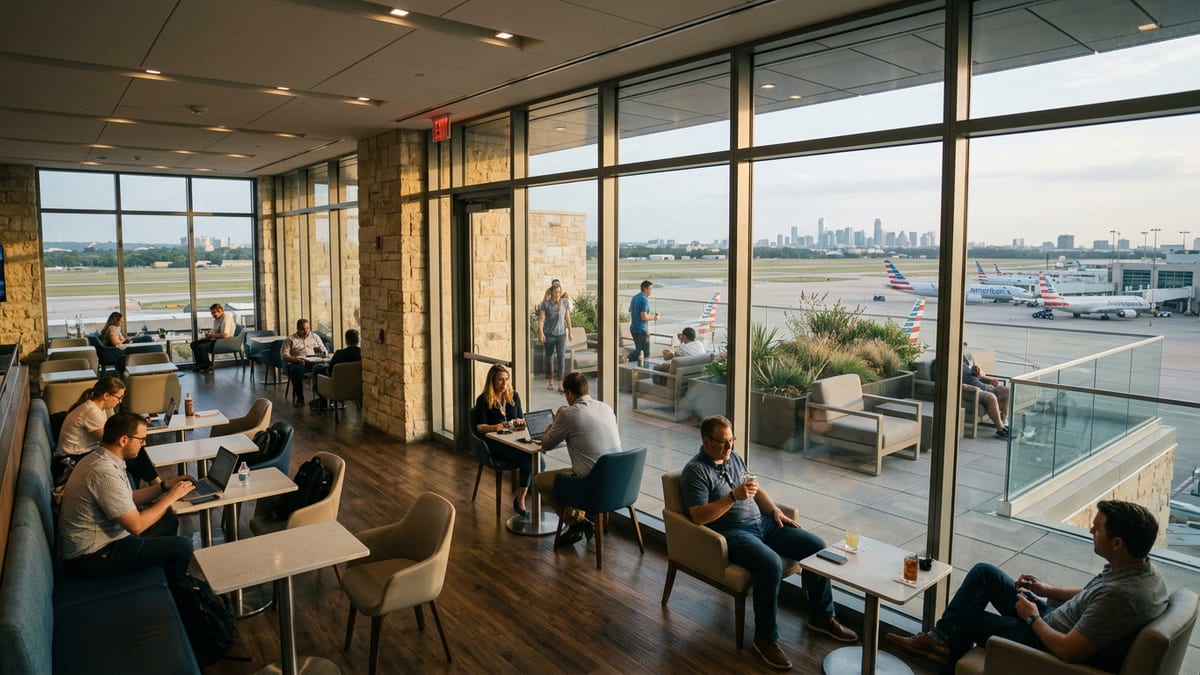
In Austin, American has already outlined plans for a next-generation Admirals Club at Austin-Bergstrom International Airport. According to the airline’s own newsroom information and subsequent industry coverage, the new space will be significantly larger than the current club and is being designed to incorporate an outdoor terrace, a feature that has become a signature element at some of the carrier’s newest lounges.
The Austin lounge is slated to occupy more than 12,000 square feet on the west side of the Barbara Jordan Terminal, effectively doubling the footprint of the existing club. Reports indicate that the design will emphasize natural light, local-inspired finishes and flexible seating zones for work, relaxation and families, reflecting the city’s growing role as a tech and leisure gateway.
Austin has been one of the fastest-growing airports in American’s network, with an expanding set of domestic and limited international routes. The decision to dedicate scarce terminal space to an enhanced Admirals Club underscores the importance of capturing the high-spend traveler base that frequents the region’s technology and creative industries.
The Austin project is part of a strategy that pairs schedule growth with ground-experience upgrades, aiming to keep travelers within the American ecosystem even as competition from low-cost and legacy rivals intensifies in Central Texas.
Chicago, Washington D.C. and Charlotte See Deep Lounge Investments
Chicago O’Hare, one of American’s key connecting hubs, is also on the list of airports receiving heightened lounge attention. Company disclosures and airline-focused outlets describe additional Admirals Club investment at O’Hare, complementing existing clubs in each concourse and a Flagship-branded lounge for long-haul and premium customers. The carrier has been increasing its route map from Chicago, and upgrading lounges is viewed as a critical component of retaining high-value connecting traffic.
In Washington, D.C., American is in the midst of renovating and expanding an Admirals Club at Ronald Reagan Washington National Airport. Public information notes that the project is expected to increase seating capacity and refresh interiors in Concourse D, where heavy business traffic and recurring delays have historically strained lounge space. The D.C. upgrade dovetails with broader terminal improvements that have reshaped the airport’s passenger flow in recent years.
Charlotte, American’s second-largest hub by departures, is set to receive not only expanded Admirals Club capacity but also a new Flagship lounge aimed at long-haul and top-tier loyalty customers. Local reporting in Charlotte points to a wave of premium lounge development at the airport, and American’s own statements highlight CLT as a central pillar in its premium strategy, particularly for transatlantic services.
The depth of investment at Chicago, Washington and Charlotte reflects where American sees sustained connecting volume and corporate travel, as lounge demand in those markets tends to remain robust throughout the year rather than peaking only in traditional holiday windows.
Miami and the Sunbelt: Connecting Premium Demand and Leisure Growth
Miami International Airport rounds out the list of focus-airports where American is upgrading its premium ground product. Company communications highlight plans for both an expanded Admirals Club and a new Flagship lounge at the South Florida hub, already one of the airline’s most important international gateways.
The Miami projects are intended to handle the surge in premium and leisure travelers heading to the Caribbean and Latin America, where American maintains a dense network. Expanded seating, upgraded dining and enhanced shower and relaxation facilities are expected to feature prominently, mirroring the layouts seen in the carrier’s newest lounges in other cities.
Taken together with Nashville, Austin, Charlotte and the D.C. region, the emphasis on Miami underscores how American is clustering its largest lounge investments along a broad Sunbelt corridor where population growth and tourism remain strong. Lounge enhancements at these airports are designed to make connections more appealing and to keep premium and loyalty customers from defecting to rival networks.
For travelers, the Miami expansion should translate into more consistent availability of quiet seating during peak bank times, a persistent pain point in some of the carrier’s older Admirals Club locations.
What 2026 Travelers Need to Know About Access and Expectations
As the bricks-and-mortar projects move forward, 2026 travelers will still need to navigate the existing Admirals Club access rules, which remain anchored in membership, qualifying credit cards, day passes and eligible same-day itineraries. American’s published materials state that annual and lifetime Admirals Club members, Citi-branded AAdvantage Executive cardholders, ConciergeKey members and certain corporate program participants typically receive access when flying on same-day American or oneworld-operated flights.
Day passes remain an option for occasional lounge users, though pricing has risen in recent years as facilities have been upgraded and crowding has become an industry-wide concern. Travelers are encouraged by multiple consumer travel guides to verify pricing and access conditions before arrival, as rules can vary by location and can change with limited notice.
Importantly, lounge expansion does not necessarily equate to looser access policies. Analysts point out that airlines often use new space to improve the experience for existing eligible customers rather than dramatically increasing the number of people admitted. That means 2026 flyers passing through Nashville, Austin, Chicago, Washington, Charlotte and Miami can expect upgraded surroundings, but not necessarily guaranteed seating during the busiest holiday and Monday-morning periods.
For frequent travelers planning their 2026 itineraries, the concentration of Admirals Club and Flagship investment at these airports suggests that routing through them may yield a more consistent premium ground experience. As construction schedules become clearer and individual lounges open or reopen, flyers who rely on quiet workspaces and premium amenities are likely to factor these enhancements into their choice of airline, connection point and even credit card strategy.