


More news on this day
American Airlines is preparing a sweeping overhaul of its domestic narrow-body fleet, committing to larger premium cabins, more extra-legroom seats and the return of seatback entertainment screens in a bid to reposition itself at the top end of the U.S. airline market.
Get the latest news straight to your inbox!
A Strategic Pivot Toward Premium Revenue
Publicly available information indicates that American’s latest cabin program will touch virtually its entire mainline narrow-body fleet, including Airbus A319s, A320s and A321neo aircraft, as well as incoming Boeing 737 MAX variants. The plan centers on boosting high-yield seating at the front of the aircraft and expanding extra-legroom Main Cabin Extra, a configuration shift that aligns the carrier more closely with competitors that emphasize premium revenue.
Reports describe a notable increase in first class capacity on workhorse narrow-bodies. Updated seat maps for retrofitted A320s, for example, show 16 first class seats compared with 12 previously, along with a sharp rise in Main Cabin Extra seating. Similar changes are expected on future A321neo and 737 MAX jets, which are slated to receive larger forward cabins and a greater share of the aircraft devoted to higher-fare products.
The strategy reflects a broader industry trend in North America, where major airlines are using cabin densification and segmentation not only to add seats but to create more price points at the top end. For American, the move is a marked shift from earlier years when the carrier drew criticism for squeezing economy and removing features associated with a full-service product.
Analysts following the airline sector note that premium-heavy layouts can significantly lift revenue per available seat mile on domestic routes, especially in large corporate markets and on longer transcontinental flights. American’s decision to re-weight cabin space toward the front of the plane is being interpreted as an effort to capture more of that demand while still preserving a large economy cabin.
Seatback Screens Make a Comeback
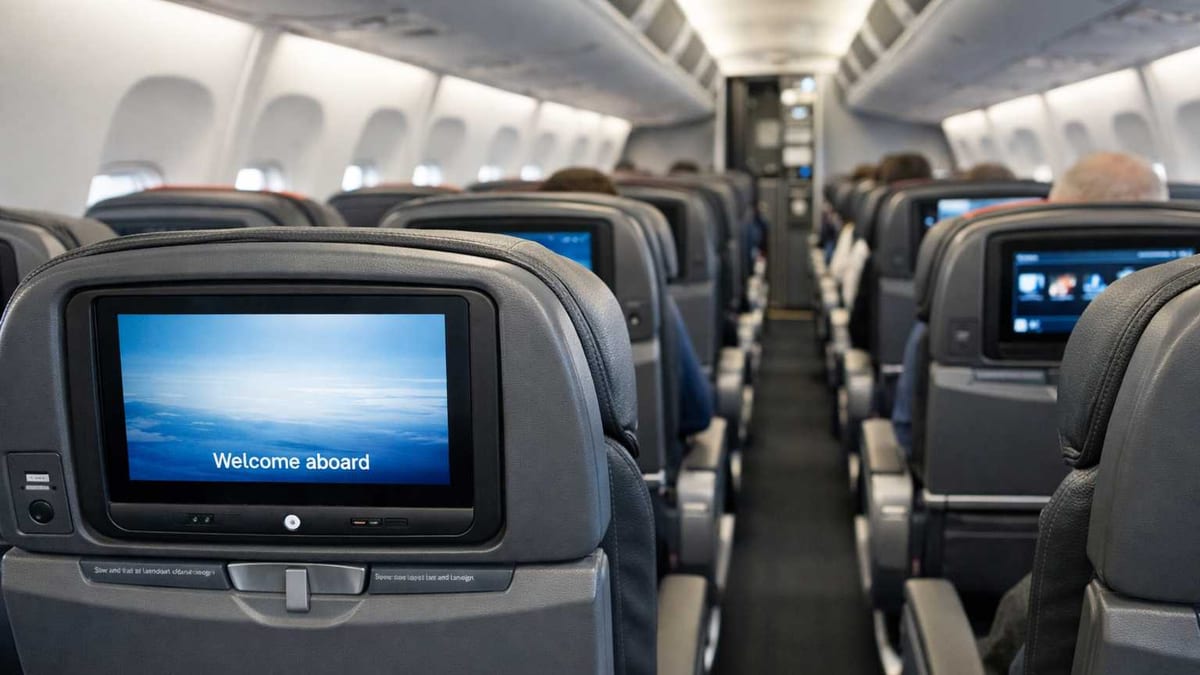
Perhaps the most visible element of the overhaul is American’s decision to reinstall seatback entertainment screens on its narrow-body aircraft after years of relying almost exclusively on passengers’ personal devices. According to published coverage of the announcement, new Airbus and Boeing deliveries from 2028 will feature built-in screens at every seat, with retrofits planned for existing aircraft over several years.
The carrier had progressively removed in-seat entertainment from domestic narrow-bodies during the past decade, arguing that streaming to phones and tablets was sufficient. In practice, that made American an outlier among large U.S. network airlines, as Delta Air Lines and United Airlines continued to market seatback screens as a hallmark of a more premium onboard experience.
The next-generation systems described in recent reports are expected to feature large-format 4K displays, Bluetooth audio pairing and USB-C charging at each seat, bringing narrow-body cabins closer to the standard on many long-haul wide-body aircraft. The new platform is also slated to support more personalized content, such as recommendations and enhanced moving maps, mirroring trends in inflight entertainment across the industry.
Reintroducing screens is likely to be a gradual process. Fleet-wide retrofits typically follow heavy maintenance cycles and can take several years to complete, meaning travelers will see a mix of cabin products across American’s domestic network well into the early 2030s. Even so, the commitment signals a clear reversal from the “bring your own device” model that previously defined the airline’s narrow-body experience.
More Main Cabin Extra and Refreshed Interiors
Beyond first class and entertainment, American’s plan devotes significant attention to the in-between product: extra-legroom Main Cabin Extra. Updated layouts already visible on some A320s show Main Cabin Extra counts nearly doubling compared with older configurations, providing more seats with additional pitch, earlier boarding and other small perks sought by frequent flyers.
Passenger reports on early retrofitted aircraft highlight details such as redesigned sidewalls and lighting, larger overhead bins and revised galley and lavatory layouts aimed at freeing up cabin space. While precise seat pitch figures vary by aircraft type, the general pattern involves fitting more total seats while carving out a greater proportion for premium and extra-legroom sections.
The interior refresh is also expected to standardize hardware across much of American’s narrow-body fleet, replacing a patchwork of legacy US Airways and pre-merger American layouts. That standardization can simplify maintenance and crew operations while giving customers a more predictable experience when booking specific aircraft types.
However, some travelers remain cautious about the trade-offs that often accompany densification. Past retrofit programs at major U.S. carriers have drawn criticism for thinner seat padding and tighter layouts in standard economy, even as premium and extra-legroom offerings expanded. How American balances comfort in the rear of the cabin with its push toward higher-yield seating will be closely watched by frequent flyers.
Competitive Pressures on Domestic Routes
American’s narrow-body overhaul comes against a backdrop of intensifying competition on lucrative domestic and short-haul international routes. Delta and United have spent years promoting their own cabin investments, from seatback screens and upgraded Wi-Fi to broader premium seating footprints across key hubs. Low-cost and ultra-low-cost carriers, meanwhile, continue to pressure fares at the bottom of the market.
Industry commentary suggests American’s earlier configuration choices had left it poorly positioned in direct comparisons, particularly on transcontinental services and important corporate routes where rival carriers marketed more spacious cabins and more consistent onboard amenities. The new program appears designed to narrow that gap by reinforcing American’s status as a full-service network airline rather than a quasi low-cost hybrid.
Improved inflight connectivity also features in the competitive equation. American has already begun rolling out faster Wi-Fi on parts of its fleet, and recent discussions around satellite-based systems point to further upgrades that would complement the new entertainment screens. For business travelers in particular, the combination of reliable connectivity, power at every seat and a more premium physical environment has become a key differentiator when choosing between carriers.
While the overhaul requires substantial capital spending, investors and aviation analysts often view cabin investments as essential to sustaining fare premiums in crowded domestic markets. The long lead time to 2028 and beyond may also allow American to phase costs and adjust details as technology and passenger expectations evolve.
What Travelers Can Expect in the Years Ahead
For passengers, the most immediate impact of American’s strategy will likely be felt incrementally as more aircraft emerge from retrofit lines. Travelers on certain A319 and A320 routes are already encountering refreshed interiors with larger overhead bins and reconfigured premium sections, even before seatback screens arrive on narrow-bodies at scale.
Over time, flyers can expect to see more opportunities to book domestic first class or Main Cabin Extra across American’s network, particularly from major hubs. That could ease upgrade competition for elite frequent flyers and make paid premium seating available on a broader range of routes and departure times.
The timeline means that, for now, the experience on American’s narrow-body jets will remain inconsistent, with some aircraft offering older interiors and limited extra-legroom seating while others debut the latest layouts. Travel advisors and aviation watchers recommend paying close attention to aircraft type and seat maps when booking, as those details will become an increasingly important proxy for the onboard product a customer will receive.
As American works through this long-term transformation, the balance between added capacity, passenger comfort and perceived value will shape how the overhaul is received. The carrier’s wager is that investing heavily in premium cabins and bringing back seatback screens will resonate with travelers who equate those features with a more modern, full-service airline experience.