


More news on this day
Chicago O’Hare International Airport is entering the 2026 peak travel season with a reshaped competitive landscape, as American Airlines accelerates its expansion, United Airlines trims flights under new federal limits, and international links via Delta, Air Canada and carriers from the United Kingdom, Brazil and South Korea gain new prominence.
Get the latest news straight to your inbox!
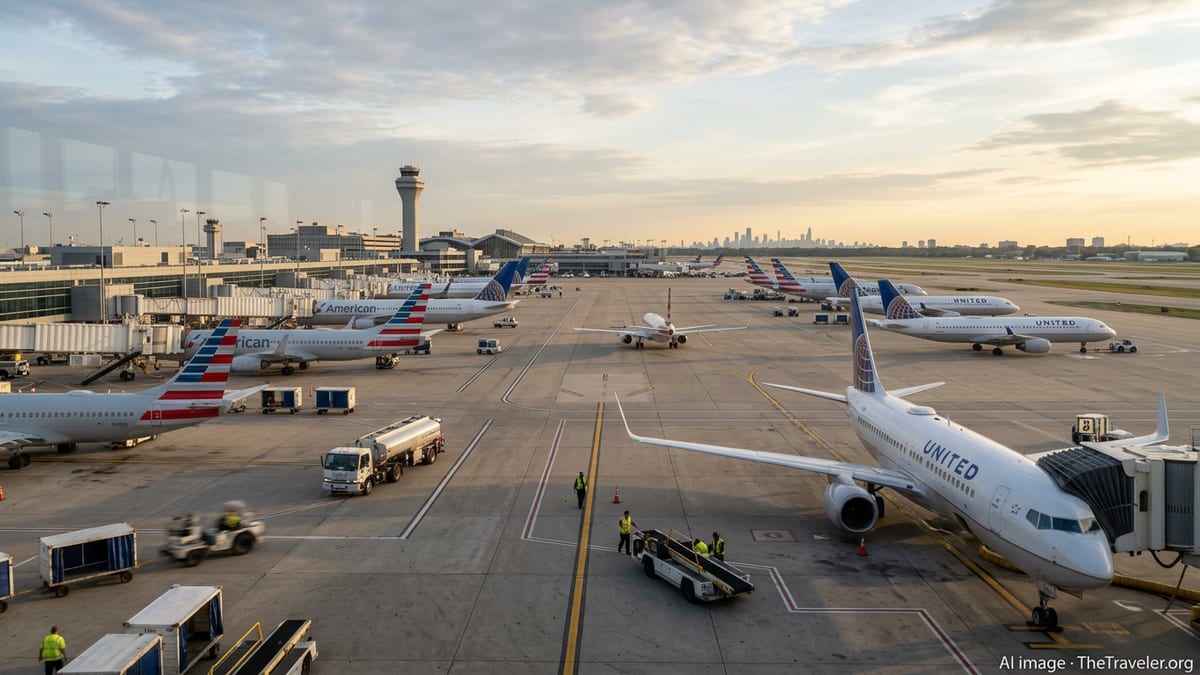
American Airlines Pushes Ahead With Aggressive O’Hare Growth
Publicly available information shows that American Airlines is leaning into Chicago O’Hare as one of the centerpieces of its 2026 growth strategy. A late 2025 network announcement detailed a plan to add roughly 100 peak daily departures from O’Hare, building on several seasons of incremental growth and positioning the carrier as a stronger rival to hometown incumbent United.
Coverage of American’s 2026 schedule indicates that the airline is focusing on both breadth and frequency. American is boosting service to more than 70 domestic and near‑international destinations from Chicago, with additional flights to popular leisure markets such as Las Vegas, Florida Gulf Coast cities and Savannah, along with higher frequencies on trunk routes to the U.S. West Coast. Industry analysis notes that by summer 2026 American intends to operate around 500 daily departures from O’Hare, roughly a one‑third increase compared with its 2025 schedule.
American is also using O’Hare to strengthen its long‑haul portfolio. Route information for summer 2026 highlights continued service from Chicago to London and an expanded Europe program, including added capacity on transatlantic flights aimed at capturing high‑yield business and premium leisure demand. The airline has signaled that Chicago will remain a key connecting point for east‑west traffic across its network, linking Midwest cities to Europe, Latin America and the Caribbean through O’Hare.
The expansion comes as American celebrates 100 years of service and reinforces its historic ties to Chicago. The carrier has emphasized improved connectivity for surrounding Midwestern communities, including additional regional jet and mainline flying to smaller cities that feed its intercontinental departures. For travelers, the result is a denser schedule that offers more options across the day, particularly on routes where American directly competes with United.
United Airlines Scales Back Under New FAA Flight Cap
While American adds flying, United Airlines is moving in the opposite direction at O’Hare in the short term. According to published coverage of a new Federal Aviation Administration order, all airlines at the airport must collectively cut peak‑day flights after regulators concluded that proposed 2026 summer schedules exceeded what the facility could reliably handle. The FAA set a cap on daily operations for the May to October travel season in an effort to reduce chronic delays and congestion.
Local news reports in Chicago indicate that United will respond by removing more than 100 daily flights from its O’Hare schedule this summer, trimming peak departures from around 780 to roughly 650 per day. Although that revised figure still leaves United operating well above its 2025 levels, it represents a notable pullback from the ambitious growth plan the carrier had laid out for its largest hub.
United’s cuts appear to fall most heavily on high‑frequency short‑haul markets and off‑peak services, rather than on marquee long‑haul routes. Industry commentary suggests that the airline is consolidating flights to maintain capacity where demand and revenue are strongest, while complying with the FAA’s new cap. The result is a network that remains broad but somewhat less dense, particularly on regional spokes where travelers may see fewer daily options than originally advertised.
The shift underscores how O’Hare’s tight operating environment has become a constraint for airlines that had been racing to add flying. United still regards Chicago as its primary hub, but the requirement to scale back growth has opened space for competitors to reposition their schedules and capture additional traffic flows, especially on routes where American has been willing to add capacity.
Delta and Air Canada Quietly Build Share at the Chicago Hub
Alongside the headline rivalry between United and American, other network carriers are using the current shake‑up to deepen their presence at O’Hare. Delta Air Lines, which primarily focuses on hubs such as Atlanta, Detroit and Minneapolis in the Midwest, has been edging back into the Chicago market with selective domestic routes. Recent schedule filings highlight additional daily service between Chicago and Delta’s coastal gateways, including expanded frequencies to Los Angeles that connect into the airline’s transpacific network.
Delta’s incremental growth at O’Hare is targeted rather than transformational, but it offers travelers more one‑stop options to Asia and the Pacific through West Coast hubs. With new long‑haul routes from Los Angeles to Hong Kong and other Asia‑Pacific destinations coming online, extra Chicago frequencies effectively widen the catchment area for those flights. For Midwestern travelers who prefer or require a SkyTeam carrier, the increased connectivity can make itineraries via Delta more competitive with Star Alliance and oneworld options.
Air Canada is similarly using Chicago as a key spoke in its transborder network. Schedule data for the 2026 season show additional capacity on routes linking O’Hare with Toronto and Montreal, timed to facilitate onward connections across Canada and to Europe and Asia. The airline’s growth reflects a broader rebound in cross‑border traffic and positions O’Hare as an important access point into the Canadian flag carrier’s global network.
These moves do not yet challenge the dominance of United and American at O’Hare, but they are gradually diversifying the hub’s carrier mix. For passengers, the presence of stronger Delta and Air Canada options can translate into more competitive fares and a wider range of connection possibilities, especially on itineraries that reach beyond North America.
International Routes From the UK, Brazil and South Korea Expand
Beyond North American rivals, O’Hare is seeing a notable surge in long‑haul services from overseas airlines, particularly from the United Kingdom, Brazil and South Korea. Published schedules compiled by aviation industry groups show that 2026 will bring additional nonstops between Chicago and London, including both more capacity from U.S. carriers and renewed growth from British operators. This reinforces London as O’Hare’s premier transatlantic gateway, with multiple daily flights feeding alliance hubs on both sides of the Atlantic.
From South America, Brazilian carriers have been increasing seat counts on Chicago routes, in some cases upgauging aircraft and shifting seasonal services to year‑round operation. Analysts point to resilient business travel tied to finance, commodities and manufacturing, along with growing leisure demand between the U.S. Midwest and Brazilian beach and cultural destinations. These flights also integrate O’Hare into broader South American networks, providing one‑stop access to secondary cities beyond Sao Paulo and Rio de Janeiro.
In Northeast Asia, South Korean airlines are strengthening their Chicago presence to capitalize on strong demand between the Midwest and Seoul. Flight data indicate added frequencies and higher‑capacity aircraft on Chicago–Seoul services, often timed to maximize connections across wider Asian networks that include Japan, Southeast Asia and Australasia. For O’Hare, these routes help sustain its role as a truly global hub, even as domestic slot limits tighten.
The combined effect of this long‑haul growth is a more intricate web of intercontinental links radiating from Chicago. Travelers gain more options for one‑stop connections to secondary cities in Europe, South America and Asia, while airlines leverage O’Hare’s large local market and central geography to funnel traffic across their global systems.
What the New O’Hare Balance Means for Travelers
The shifting balance of power at O’Hare means travelers will encounter a different menu of choices than in previous summers. American’s expansion translates into more flights and, in many cases, larger aircraft on domestic routes where it faces United. That can create opportunities for lower fares or more flexible departure times, especially for passengers willing to fly either carrier.
United’s near‑term reductions, driven by the FAA’s capacity cap, may tighten availability on some of its busiest routes, although the airline still plans to operate more flights than it did in 2025. Travelers loyal to United could see fewer off‑peak departures and may need to book earlier for popular dates, but the carrier’s broad network and alliance partnerships continue to offer extensive connectivity through Chicago.
Meanwhile, the quieter build‑up by Delta, Air Canada and overseas airlines from the UK, Brazil and South Korea widens the range of connection options for international trips. For some itineraries, especially those involving Asia or secondary European and South American cities, it may now be just as efficient to connect through Los Angeles, Toronto, Seoul or London using these carriers as it is to travel on United or American through their primary hubs.
For Chicago and the broader Midwest, the evolving landscape underscores O’Hare’s enduring role as a critical global crossroads. Even with new regulatory constraints on total movements, airlines are reshaping their schedules to prioritize the most valuable routes, resulting in a network that remains dense, diverse and increasingly international in scope.