


More news on this day
The United States and Canada are edging closer to a new era of cross-border rail travel as Amtrak’s next-generation Airo trains move toward launch on the Cascades corridor, a scenic route linking Oregon, Washington and British Columbia.
Get the latest news straight to your inbox!
New Fleet Targets Late 2026 Launch on Cascades Route
Publicly available information from Amtrak and regional agencies indicates that the first Airo trainsets are scheduled to enter passenger service on the Amtrak Cascades line in late summer or fall of 2026. The route follows the 466-mile Pacific Northwest Corridor between Eugene, Oregon, Portland, Seattle and Vancouver, British Columbia, serving 18 cities along the I-5 spine.
Eight Airo trainsets and two new locomotives are dedicated to the Cascades service, according to rail program updates from Washington and Oregon transportation departments. The new equipment is currently undergoing testing and crew training, with one of the first Cascades-branded trainsets recently arriving in Seattle for trials.
Once introduced, the Airo fleet is expected to gradually replace the remaining Talgo and conventional trainsets now used on Cascades services. Reports indicate that the transition will roll out train by train, with mixed fleets likely for a period before the new equipment takes over the entire corridor.
The Pacific Northwest will be the first region in North America to host Airo trains in regular service, positioning the cross-border Cascades line as a showcase for Amtrak’s next generation of short- and medium-distance rail.
Faster, Quieter Trains Designed for Scenic Journeys
The Airo platform, built by Siemens Mobility for Amtrak, is engineered for top speeds of up to 125 miles per hour where track conditions and signaling allow. While current Cascades schedules and infrastructure will continue to limit overall journey times in the near term, the new trainsets are designed to cut running times as future corridor upgrades are completed.
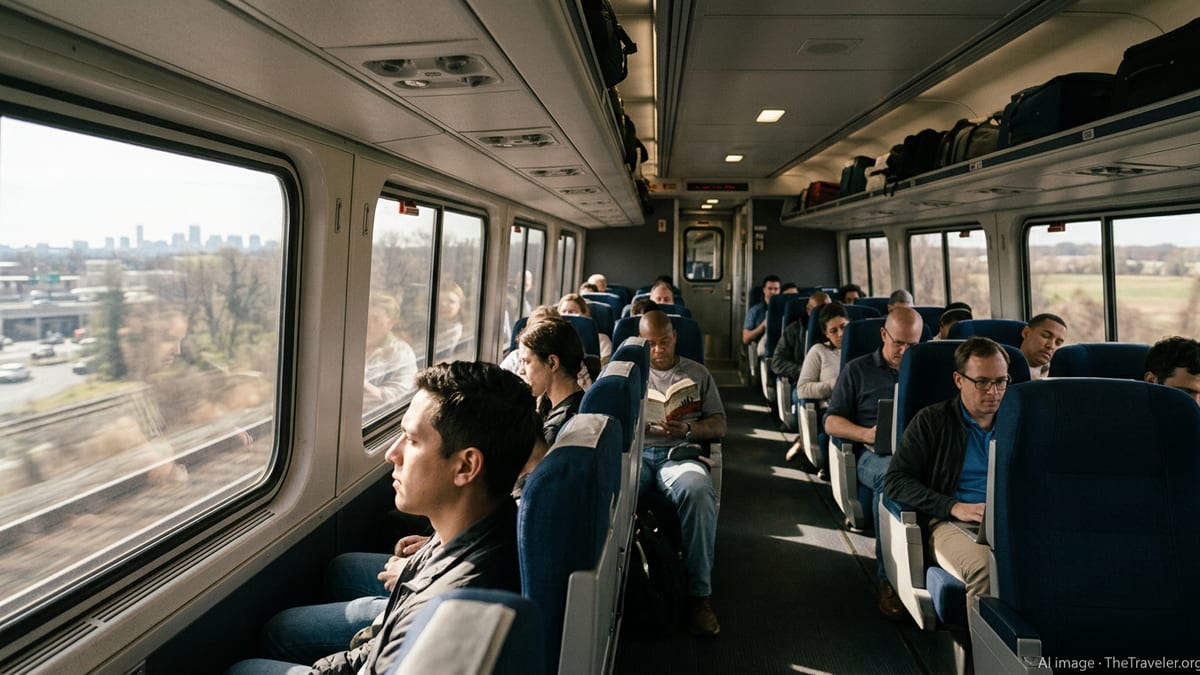
The trains pair powerful new locomotives with semi-permanently coupled coach sets, providing faster acceleration, smoother braking and quieter operation compared with the aging rolling stock they will replace. Interior renderings and preview coverage show larger windows, open sightlines between cars and updated lighting aimed at highlighting the Pacific Northwest’s coastal, river and mountain scenery.
Sustainability has been a central theme in Amtrak’s promotion of the Airo project. The trains incorporate more efficient propulsion technology and are expected to reduce fuel consumption and emissions per passenger compared with existing diesel-hauled trains. On other corridors, the Airo design supports hybrid configurations that can draw electric power where catenary is available, though Cascades itself remains a diesel corridor.
Onboard amenities will include updated seating, power outlets at most seats, modern restrooms and accessible features aligned with current standards. Regional branding elements, including livery inspired by the Cascade Range and locally focused food and beverage offerings, are expected to continue on the new equipment.
Cross-Border Connectivity for U.S. and Canadian Travelers
The Cascades corridor is one of the few passenger rail routes that directly link the United States and Canada, with trains running from Eugene and Portland through Seattle to Vancouver, BC. The Airo rollout is seen by advocates as a way to reinforce that connection at a time when both countries are investing in lower-carbon transport options.
Travel reports show that the Vancouver to Seattle section is particularly popular with international visitors who use the line as an alternative to short-haul flights. The promise of faster, more comfortable trains is expected to enhance the route’s appeal to tourists connecting with cruises, mountain destinations and city breaks on both sides of the border.
The new fleet arrives amid renewed discussion of higher-speed rail in the Pacific Northwest, including studies of potential future lines connecting Portland, Seattle and Vancouver at much higher operating speeds. While Airo trains are not classified as true high-speed equipment, they represent a step toward more modern, higher-performance passenger rail on an established, scenic corridor.
Regional planning documents suggest that improved Cascades service, supported by the Airo trains, could play a growing role in cross-border mobility, helping to shift some travelers from highways and short flights to rail, particularly for trips between the major metropolitan areas of Portland, Seattle and Vancouver.
Part of a Wider Modernization of U.S. Rail Service
The Cascades deployment is only one element of a broader Amtrak fleet renewal program that will eventually place Airo trains on multiple state-supported corridors across the United States. Production plans outlined by Amtrak show a total order of more than 70 trainsets, destined for routes including the Northeast Regional, Empire Service, Keystone Service, Vermonter and several others.
For U.S. and Canadian passengers, the Pacific Northwest rollout effectively serves as a high-profile pilot for the wider Airo program. Performance, reliability and customer feedback on the Cascades line are likely to shape public perceptions of the investment, as well as expectations for forthcoming Airo launches elsewhere in the network.
Rail analysts note that the new trains arrive alongside infrastructure projects funded in part through recent federal legislation. On the Cascades corridor, that funding is supporting track, signal and station improvements that, over time, are expected to allow the Airo fleet to operate closer to its design potential and reduce end-to-end travel times.
The combination of new rolling stock and corridor upgrades marks one of the most significant investments in intercity rail in the Pacific Northwest in decades. For travelers between the United States and Canada, the impending arrival of the Airo trains signals that the familiar coastal route is on the cusp of a substantial transformation in comfort, reliability and long-term growth potential.