


More news on this day
Hundreds of flights across the U.S. Northeast faced cascading delays and cancellations after a telecommunications failure at a key Federal Aviation Administration facility coincided with a cut fiber-optic line in New Jersey, sparking a public blame dispute between Amtrak and NJ Transit.
Get the latest news straight to your inbox!
What happened and why it spread so quickly
Published coverage indicates the disruption began on Monday, September 21, 2026, when a primary data circuit serving the FAA’s Philadelphia Terminal Radar Approach Control (TRACON) facility failed. As systems attempted to transition to a backup connection, the FAA discovered the backup fiber-optic line was not available because it had been severed.
Philadelphia TRACON is a critical hub for guiding aircraft arriving and departing in one of the nation’s densest aviation corridors, with ripple effects that can extend well beyond Philadelphia. With communications constrained, ground stops and flow restrictions expanded across multiple major airports in the region, disrupting tightly scheduled airline networks.
Published reporting also noted the outage echoed earlier operational problems tied to the same Philadelphia-based air-traffic facility that affected Newark-area traffic in prior years, underscoring how technical failures in a single control node can cascade across the broader Northeast system.
Airports hit: Newark’s long pause and knock-on delays in New York
Newark Liberty International Airport experienced some of the most visible impacts. Flight-tracking data cited in published coverage showed that for much of the day, commercial arrivals were effectively halted for hours, with normal landing flows resuming only later in the afternoon.
As delays mounted, the FAA issued ground stops and ground delays affecting additional airports, including New York’s John F. Kennedy International Airport and LaGuardia Airport, as well as Philadelphia International Airport and Teterboro Airport in New Jersey. Travelers at Boston Logan and other airports in the Northeast also saw knock-on impacts as aircraft and crews fell out of position.
Airlines typically respond to these situations by holding departures at origin airports, re-timing arrivals into constrained airspace, and canceling flights that can no longer be operated within crew duty limits. That means disruptions may persist into the following day even after ground stops are lifted, particularly on high-frequency routes connecting the Northeast with the rest of the country.
Amtrak vs. NJ Transit: competing accounts of the cut line
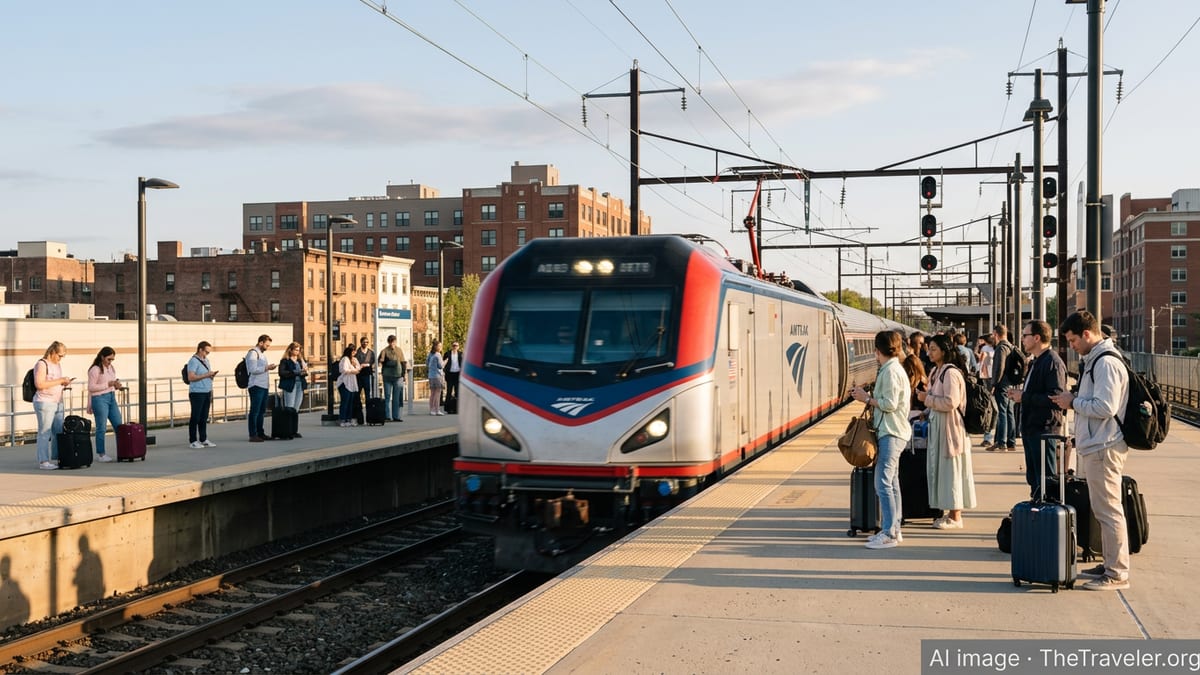
The incident quickly became a high-profile attribution dispute. Early public messaging circulating in published coverage attributed the severed line to an Amtrak construction crew working near rail infrastructure in New Jersey.
Amtrak later pointed to a New Jersey Transit construction crew operating in the rail corridor area between Newark and New Brunswick, New Jersey. Separate coverage also referenced Verizon acknowledging a fiber cable running adjacent to an Amtrak rail line and describing contractors digging up and cutting the cable, without fully resolving which rail operator’s project controls the specific work site.
For travelers, the operational reality mattered more than the finger-pointing: the backup connection intended to provide redundancy was unavailable at the same time the primary circuit failed. That combination turned a technical problem into a widespread service disruption across aviation’s busiest regional airspace.
Why a rail corridor cable cut can disrupt flights
Fiber lines are commonly routed along transportation rights-of-way, including rail corridors, because those paths offer continuous, controlled routes across dense urban areas. When the FAA and telecom providers rely on fiber connectivity for voice and data links supporting air-traffic operations, physical damage to that infrastructure can have immediate consequences.
In this case, published reporting indicated the FAA’s primary circuit failure alone would have been serious, but the inability to switch to a working backup connection amplified the impact. The result was a temporary loss of normal telecommunications capacity needed to manage high volumes of traffic safely, prompting ground stops and traffic management initiatives until service could be restored.
The episode also drew attention to how redundancy is designed and maintained. A system can be labeled “redundant,” but if backup pathways share physical corridors or are vulnerable to common hazards such as construction activity, a single incident can still disable both primary and secondary connectivity when timing is unlucky.
What travelers should do next if they were affected
Flight operations resumed after repairs, according to published coverage, but travelers should expect residual delays and aircraft swaps to continue as airlines rebalance fleets and crews. Passengers traveling through Newark, JFK, LaGuardia, Philadelphia, or Teterboro in the next 24 to 48 hours may see schedule changes even if their specific flight is not canceled.
For travelers rebooking, it may help to check alternate airports within the region and consider earlier departures where seats are available, since later flights are more likely to be impacted by upstream delays. Travelers heading to time-sensitive events should also build extra connection time, particularly for itineraries involving the New York area.
For ground transportation, the incident landed at a moment when the Northeast rail network is already juggling major infrastructure work. NJ Transit and Amtrak have been coordinating significant projects around the Newark to Secaucus corridor, including Portal Bridge cutover work tied to the Gateway Program, which can temporarily reduce rail capacity at times. Travelers shifting from air to rail should verify train availability and schedules before committing to a last-minute switch.