


Climbing into Ano Poli, Thessaloniki’s old upper town, feels like stepping into a different city. Traffic noise drops away, sea views open between tiled roofs and the modern blocks of downtown give way to cobbled lanes, Ottoman-era houses and Byzantine stonework. This is where Thessaloniki’s history survived the great fire of 1917 and where visitors today come for rampart walks, hilltop sunsets and some of the city’s most atmospheric tavernas.
Get the latest updates straight to your inbox!
Why Ano Poli Belongs on Your Thessaloniki Itinerary
Ano Poli, literally “Upper Town,” crowns the hillside directly above modern Thessaloniki’s center. Unlike the grid of downtown, this quarter escaped the 1917 fire that reshaped the rest of the city and still keeps its irregular street plan, traditional houses and sections of the early Byzantine city walls that later became part of Thessaloniki’s UNESCO World Heritage listing. For many visitors it is the single most memorable part of the city, combining history and local life in a compact walkable area.
You experience the difference as soon as you arrive. Lanes that barely fit a car twist uphill past stone walls and fig trees, while elderly residents chat at their doors and cats sleep in the sun. Tourists come for the views from the Trigonion Tower and the Heptapyrgion fortress, or to visit Vlatadon Monastery and the churches scattered among the houses, but Ano Poli is not a museum district. Students rent flats in old houses, laundry hangs over alleys and small convenience stores sell everything from feta to phone top-ups.
The area is also practical to include in a short stay. On a typical weekend visit, many travelers spend one full afternoon and evening in Ano Poli, arriving by taxi or bus, following the walls between Trigonion Tower and the Heptapyrgion, then ending with dinner in a taverna around Tsinari or near the walls before heading back downhill. Others base themselves here for two or three nights, accepting the steep climbs in exchange for quiet streets and sunrise views over the Thermaic Gulf.
If you enjoy historic quarters in cities like Lisbon, Naples or Istanbul, you will likely find Ano Poli just as compelling, but on a smaller and more manageable scale. Think patchwork stonework, bougainvillea over balconies and the sound of church bells in the morning, rather than large crowds and souvenir strips.
Getting to Ano Poli and Finding Your Bearings
Ano Poli sits directly north of Aristotelous Square and the commercial center, but the climb is steeper than it appears on the map. Many visitors choose to arrive by taxi and walk back down. From the waterfront, a regular taxi ride to Trigonion Tower or the Heptapyrgion generally costs only a few euros, depending on traffic and time of day, which makes it an easy starting point if you want to save your legs for exploring at the top.
Public buses run frequently from Egnatia and Agiou Dimitriou streets to stops near the walls and Vlatadon Monastery. Exact routes change periodically, but drivers are used to visitors asking for “Ano Poli” or “Kastra” (the castles). Buying a single ticket from a kiosk or on board is inexpensive, and buses are a good option for solo travelers on a budget. Expect a short but winding ride uphill, with glimpses of the sea between buildings before you step out into narrower streets.
Orientation is simple once you grasp a few anchor points. The northeastern edge of Ano Poli is lined by the best-preserved section of Thessaloniki’s Byzantine walls, culminating in the Trigonion Tower and the view terrace beside it. Just above and slightly west, the massive Heptapyrgion fortress dominates the skyline. To the west and south, houses and lanes slope down toward the Church of Saint Demetrios and the commercial center. A bit north of the densest residential area, Vlatadon Monastery sits on a height with its own viewpoint and small gardens.
Maps on your phone work well, but in practice it is hard to get truly lost. Most lanes either climb toward the walls and fortress or drop toward the modern city. Part of Ano Poli’s charm lies in letting yourself follow whichever alley or stairway looks inviting, then using the sea as your compass when you reach an opening in the houses.
Cobbled Streets, Ottoman Houses and Everyday Life
The appeal of Ano Poli begins at street level. Much of the quarter is still paved with worn cobblestones and irregular slabs that can be slippery after rain, so comfortable shoes are essential. Many lanes are effectively pedestrian, even if a small car or scooter occasionally squeezes past. You will often share the route with schoolchildren, delivery men or elderly residents doing their shopping, which keeps the atmosphere firmly grounded in local life.
Architecturally, Ano Poli is a patchwork of periods. Traditional Macedonian houses are among the most distinctive, with stone ground floors and timber-framed upper stories that overhang slightly above the lane. Many date back to the late Ottoman period, when this hilltop quarter was favored by both Muslim and Christian families for its clean air and views. As you walk between the walls and Vlatadon Monastery, look for houses with enclosed wooden balconies and tiled roofs, sometimes freshly restored, sometimes carefully decaying behind vines.
Scattered among the houses you will find corner groceries, bakeries and simple cafés with plastic chairs and old men playing backgammon. In the late afternoon, when the sun drops behind the hills, entire streets can take on a golden tone. The plaster on walls, whether painted in ochre and terracotta or left bare, shows layers of repairs and history. You might pass a small Ottoman fountain built into a wall, or a simple stone archway leading into a courtyard that has probably seen several generations.
Even the sounds are different from downtown Thessaloniki. Instead of constant traffic, you hear church bells from nearby chapels, a radio playing Greek pop or rebetiko, and the occasional shout across balconies. This contrast is part of what makes Ano Poli feel like a city within a city, one that rewards moving slowly and paying attention to details such as door knockers, iron railings or potted basil outside a kitchen window.
Walking the Byzantine Walls and Trigonion Tower Views
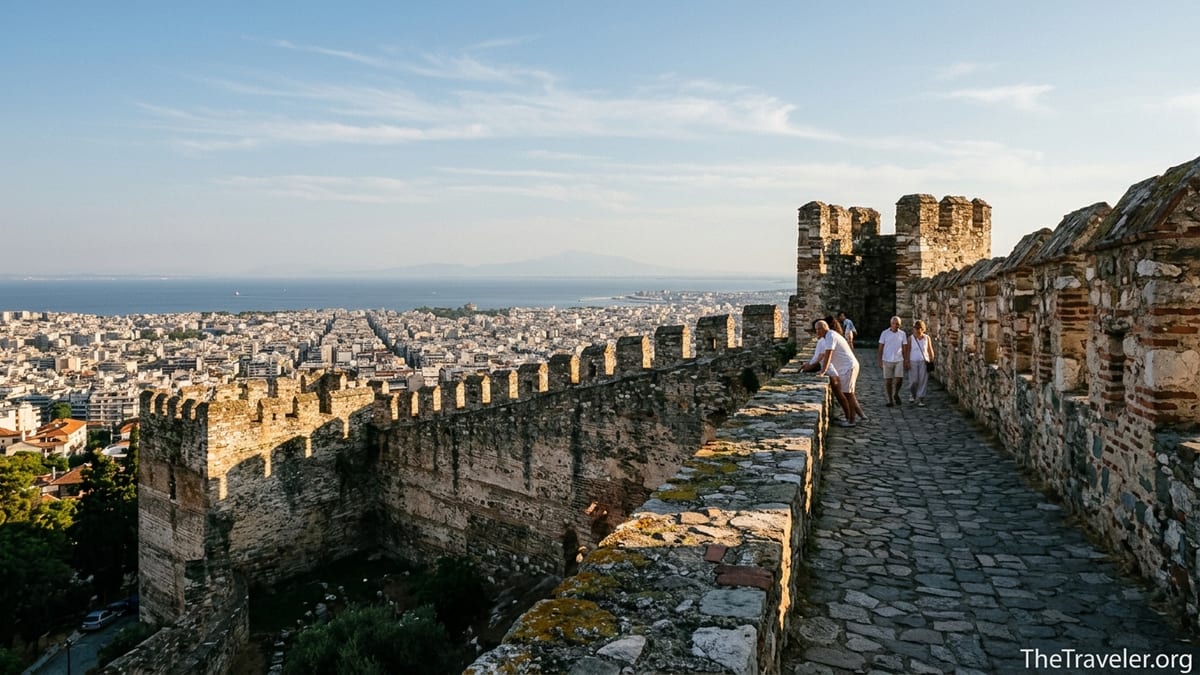
One of the highlights of any visit to Ano Poli is walking beside the surviving walls that once enclosed Thessaloniki. The lines of masonry that you see today largely date from the early Byzantine period, later reinforced under the Ottomans. They are part of the ensemble of Paleochristian and Byzantine monuments that gave Thessaloniki its UNESCO World Heritage status, and they remain a visible reminder of the city’s role as a key stronghold of the empire.
The most accessible and scenic stretch runs along the northeastern rim of Ano Poli, between the Heptapyrgion fortress and the Trigonion Tower. This route offers near-constant views south over the entire city and the Thermaic Gulf, with the line of Mount Olympus visible on a clear day. Many visitors start at the Trigonion Tower terrace, which you can reach easily by taxi, then follow the walls westward before looping back through the residential lanes.
The Trigonion Tower itself is a solid, rounded structure built into the walls above one of the historic gates. Even when the interior is closed to visitors, the area around it functions as a natural balcony over Thessaloniki. Couples come up in the evenings to watch the sunset paint the sea orange, while photographers often arrive earlier in the day for clearer light on the rooftops. Small kiosks and cafés within a few minutes’ walk sell bottled water and coffee, useful in summer when the stones can radiate heat long after midday.
As you walk along the walls, you can usually scramble up a short flight of steps to stand on one of the lower sections, though fenced areas and signs indicate where access is restricted. Take care with uneven surfaces and gaps in the stone. Families with children often choose the gentler paths below the walls, which still give excellent views without steep drops. In spring and early summer, wildflowers and grasses grow against the lower stones, softening the fortifications and adding color to photographs.
Heptapyrgion, Hidden Churches and Monastery Vistas
At the northern apex of Ano Poli, the Heptapyrgion fortress rises above the neighborhood like a stone crown. Its name means “Seven Towers,” though the complex in fact combines Byzantine and Ottoman fortifications and later served as a prison well into the twentieth century. Today, the heavy walls and internal courtyards provide both a lesson in Thessaloniki’s military past and a dramatic vantage point over the city below.
Visiting the Heptapyrgion gives a different impression from the open terraces of the walls. Inside, you move through thick-walled corridors and small courtyards that hold echoes of its time as a penitentiary. Occasional exhibitions and information panels explain the history in Greek and English, while stairways lead up to sections of the ramparts. From the upper levels, you can take in the pattern of Ano Poli’s lanes, the dense grid of the modern center and the curve of the bay in a single sweep of the eye.
Elsewhere in Ano Poli, Byzantine and post-Byzantine churches appear unexpectedly between houses. The Church of Saint Catherine occupies a relatively quiet corner of the northwestern part of the quarter, its brick and stone exterior reflecting the layered styles of late Byzantine architecture. Closer to the eastern walls, the Church of Saint Nicholas Orphanos sits among gardens, with frescoes inside that reward those who time their visit to opening hours. Many of these churches are included in Thessaloniki’s UNESCO-listed monuments, but in Ano Poli they still feel embedded in everyday life rather than isolated as monuments.
Vlatadon Monastery, just north of the densest residential lanes, is another essential stop. Its courtyard and terraces overlook the city, offering a slightly different angle from the walls. Visitors often combine the monastery with a coffee stop at a nearby café, then follow a short path along the outer face of the walls toward Trigonion Tower. This link creates a pleasant, mostly level walking section with uninterrupted views and many opportunities to pause for photographs.
Atmospheric Taverns, Cafés and Where to Pause
Ano Poli’s food scene is quieter than the bars and restaurants of Ladadika or the waterfront, but it has a concentration of appealing tavernas and cafés that feel intimately tied to the neighborhood. Rather than designer interiors and elaborate menus, you are more likely to find checkered tablecloths, handwritten lists of daily specials and a grill smoking just inside the door. In the evenings, the streets around certain small squares fill with the smells of grilled meat, oregano and fried peppers.
One area that many locals and guidebooks recommend is Tsinari, a small square framed by traditional houses and an old fountain. Here you can sit under plane trees and order meze plates such as grilled octopus, spicy cheese dip, local sausages and seasonal salads, washed down with carafes of house wine or tsipouro. Prices are usually moderate compared with the waterfront, and it is easy to linger for several hours as the sky darkens and lights come on inside the surrounding houses.
Near the walls and around Vlatadon Monastery, several cafés and ouzeri offer terraces with partial views over the city. These are ideal for a mid-afternoon break during a walking loop. Ordering a Greek coffee or a glass of iced espresso is inexpensive, and you can often find simple snacks such as toasted sandwiches or small pies. In cooler months, indoor tables near windows become popular vantage points, especially on days when clouds and changing light create dramatic scenes over the bay.
If you prefer a quieter experience, consider visiting tavernas for lunch rather than dinner. Around midday, you might share the room mostly with local workers or older residents, and service is often quicker. In the high season evenings, particularly Friday and Saturday, making a reservation by phone can be wise for popular places, especially if you want an outdoor table. Wherever you choose, menus commonly mix classic northern Greek dishes with a few modern twists, but vegetarian travelers can usually find a range of vegetable stews, bean dishes and grilled cheeses without difficulty.
Suggested Walking Routes and Managing the Hills
The best way to explore Ano Poli is on foot, but planning your route can help you make the most of the steep topography. One of the most rewarding circuits begins at Trigonion Tower. From the terrace, walk west along the walls toward the Heptapyrgion, stopping for views and photos from gaps in the masonry. After visiting the fortress, follow lanes downhill toward Vlatadon Monastery, then continue descending through the residential streets until you reach the Church of Saint Demetrios and the edge of the modern center.
Another option is to start from the lower city and climb gradually. Beginning near the Roman Forum, follow small streets north that switch back and forth uphill. Along the way you pass a mix of modern apartment blocks and older houses before reaching the more consistently historic fabric of Ano Poli. This approach gives a sense of how the city layers change with elevation, but the climb can be demanding on a hot afternoon. Many travelers compromise by taking a bus or taxi up and walking down, which still allows them to experience the narrow stairways and alleys without a long ascent.
Whichever direction you choose, expect frequent short, steep sections, irregular steps and occasional cobbles. Flat sandals and smooth leather soles can be uncomfortable and even hazardous on polished stone, especially if there has been recent rain. Lightweight trainers or walking shoes with some grip are a better choice. In summer, carrying a refillable water bottle and wearing a hat can make the difference between an enjoyable stroll and an exhausting slog, as shade is not continuous along the walls.
Time-wise, allow at least two to three hours for a relaxed circuit that includes the walls, Heptapyrgion, Vlatadon Monastery and a coffee stop, without entering every church. If you plan to visit several interiors, photograph extensively or linger over sunset, you can easily extend your visit to fill an entire afternoon and evening, especially once you add a sit-down meal in one of the tavernas.
Photo Spots, Best Light and Practical Tips
For photographers, Ano Poli offers a concentration of viewpoints and details within a relatively small area. The classic panorama from beside the Trigonion Tower is a must, showing the curve of Thessaloniki’s bay framed by sections of the walls in the foreground. On clear days, the distant silhouette of Mount Olympus rests above the sea, while in the evening city lights form a dense carpet of yellow and white below. Bringing a camera with a moderate wide-angle lens will help you capture both the fortifications and the cityscape in one frame.
Within the lanes, look for compositions where timber-framed upper stories lean toward each other above a cobbled alley, or where a brightly painted door stands out against an old stone wall. Small shrines, potted plants and laundry lines add human texture. Early morning, when streets are quiet and shadows are soft, is good for atmospheric street scenes, while late afternoon provides warmer tones on plaster and terracotta roof tiles. At night, the contrast between yellow streetlamps and the dark sky can produce evocative images, though you will need a steady hand or a camera with good low-light performance.
Respect is important when photographing in a lived-in neighborhood. Avoid pointing your camera directly into private courtyards or through windows, and be discreet when residents are clearly engaged in daily routines. In and around churches and monasteries, pay attention to any signs regarding photography inside; in some cases flash is prohibited to protect frescoes, while in others interior photography may not be allowed at all. When in doubt, a polite question in English or a few words of Greek are usually enough to clarify.
Practical details can make your visit more comfortable. Streets can be uneven, so those with limited mobility may find certain areas challenging, though there are some taxis that will drop passengers quite close to the main viewpoints. There is usually at least some mobile coverage throughout the neighborhood, but signal can weaken in narrow alleys between thick stone walls. Cash is still useful for small cafés and kiosks, although most tavernas now accept cards. Finally, remember that Ano Poli is primarily residential, so keep noise levels low late at night and avoid blocking narrow lanes when stopping for photos.
The Takeaway
Ano Poli offers a side of Thessaloniki that you cannot experience from the waterfront promenades or shopping streets alone. Within a short climb of the center, you step into a hilltop world of Byzantine masonry, Ottoman-era houses and lived-in lanes, all framed by some of the broadest views in northern Greece. The quarter’s surviving walls and towers recall centuries when Thessaloniki was one of the key cities of the Byzantine Empire, while its churches and monastery courtyards still serve local worshippers as much as visitors.
At the same time, the neighborhood remains firmly part of the modern city. Students walk past fifteenth-century stones on their way home, tavernas serve grilled meats and meze as they have for decades and small cafés host conversations that run late into the night under climbing vines. This blend of deep history and everyday life is what makes Ano Poli an essential stop, whether you have a single afternoon in Thessaloniki or several days to explore.
Plan your visit with the hills and paving in mind, arriving by taxi or bus if necessary and wearing shoes suited to cobbled streets. Allow enough time to follow the walls between the Heptapyrgion and Trigonion Tower, to pause at Vlatadon Monastery and to sit down for a meal or coffee in one of the small squares. With a little forethought, even a short visit can yield a string of vivid memories: sunlight on stone, the sound of bells, the smell of grilled oregano and the sight of the city and sea spread out below you.
If Thessaloniki is a city of layers, Ano Poli is where many of those layers remain visible at once. Come prepared to climb, to wander and to look closely. The reward is a vantage point not only over the rooftops, but over the city’s past and present at the same time.
FAQ
Q1. Is Ano Poli the same as Thessaloniki’s old town?
Ano Poli is effectively Thessaloniki’s old town and upper town, the main historic neighborhood that survived the 1917 fire, with traditional houses and sections of the Byzantine walls still visible.
Q2. How much time do I need to visit Ano Poli properly?
Most visitors should plan at least two to three hours to walk the walls, visit one or two key sites and have a drink, but a half day allows a more relaxed pace with a meal.
Q3. What is the easiest way to get up to Ano Poli from the city center?
The simplest option is a short taxi ride from the waterfront or Aristotelous Square to Trigonion Tower or the Heptapyrgion, though several city buses also climb into the neighborhood.
Q4. Are the streets of Ano Poli very steep and suitable for all travelers?
Many lanes are steep, cobbled and stepped, which can be challenging for those with limited mobility; using taxis to reach the higher viewpoints and then walking shorter, flatter sections is often a good compromise.
Q5. When is the best time of day to visit for views and photos?
Late afternoon into sunset offers the most atmospheric light on the walls and cityscape, while early morning provides quieter streets and softer shadows for photos of the lanes and houses.
Q6. Can I visit the interior of the Heptapyrgion and the churches in Ano Poli?
Access to the Heptapyrgion and church interiors depends on current opening hours and restoration work; it is wise to check locally on the day and be prepared for some sites to be closed or partially accessible.
Q7. Are there good places to eat in Ano Poli or should I return downtown?
Ano Poli has several traditional tavernas and cafés, especially around small squares and near the walls, where you can enjoy meze, grilled dishes and drinks without needing to head back downtown.
Q8. Is Ano Poli safe to walk around after dark?
The neighborhood is generally considered safe, with many residents and students living there, but as in any city it is sensible to stick to lit streets, keep valuables discreet and avoid very isolated corners late at night.
Q9. Do I need a guided tour or can I explore Ano Poli on my own?
You can easily explore on your own with a basic map or offline navigation, though a guided walking tour can add context about the walls, churches and historic houses that might otherwise be easy to overlook.
Q10. What should I wear and bring for a comfortable visit?
Wear comfortable shoes with good grip for cobblestones, bring water and sun protection in warm months and consider a light jacket outside summer, as temperatures on the hill can feel cooler in the evening.