


Thessaloniki is one of those cities that wins you over slowly. It does not rely on a single blockbuster monument, but on layered history, lived-in neighborhoods, and a waterfront that pulls locals and visitors out for a stroll every evening. This guide walks you through the best things to do in Thessaloniki today, from climbing the White Tower and exploring Ano Poli to wandering its markets, churches, museums, and that famous seafront promenade at sunset.
Get the latest updates straight to your inbox!
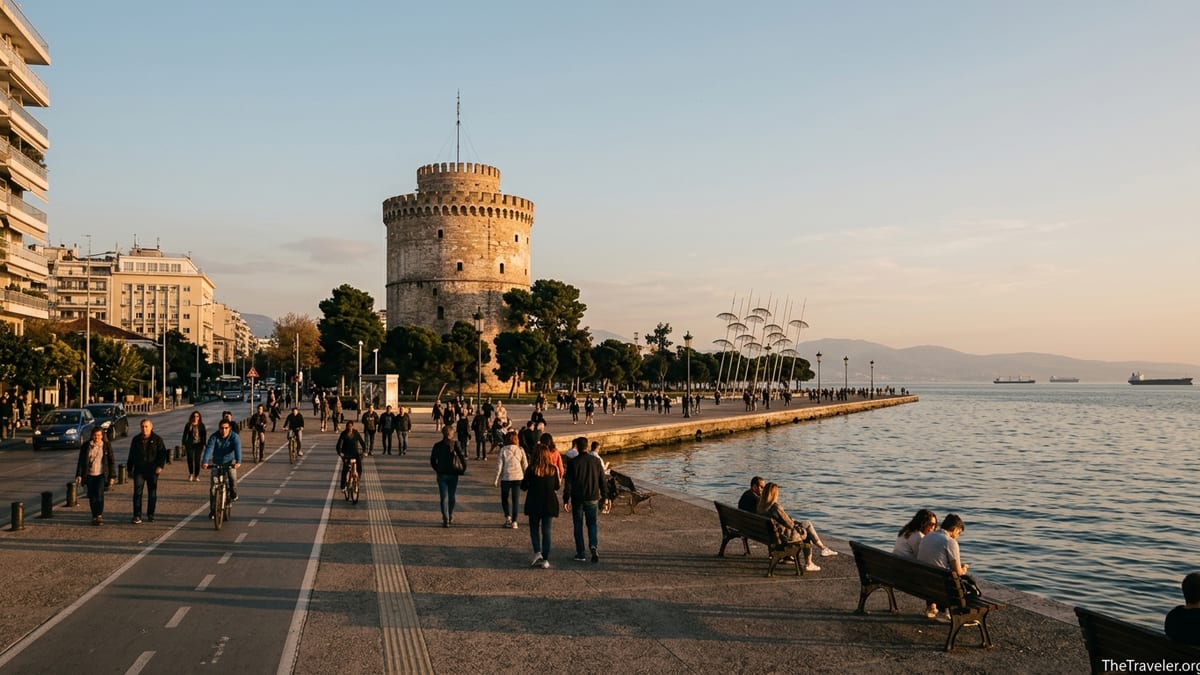
Start at the White Tower and the Seafront Promenade
The White Tower is Thessaloniki’s postcard symbol and a logical starting point for exploring the city. The 15th century tower now houses a compact, modern museum about the city’s history, with exhibits spread over several floors connected by a stone spiral ramp. Visitors can expect to pay around 10 euros for a single ticket or use a combined ticket that typically also covers the Archaeological Museum of Thessaloniki and the Museum of Byzantine Culture on the same day, which is good value if you plan a full day of sightseeing. Inside, the displays use multimedia, models, and short films to trace Thessaloniki’s story from ancient times to the 20th century.
The real payoff comes at the top. After about 20 minutes of slow climbing, you step out onto an open terrace with a 360 degree view. To one side lies the curve of the Thermaic Gulf, often backed by hazy outlines of Mount Olympus on clear days. On the other, you see the city rising in tiers toward Ano Poli and the old walls. Many travelers time their visit for late afternoon, around an hour before sunset, to see the city glow in golden light while still having daylight inside the museum.
From the base of the tower, the city’s beloved waterfront promenade unfolds in both directions. To the west, the older seafront leads toward Aristotelous Square and the port; to the east, the newer Nea Paralia section stretches for several kilometers past themed gardens, bike lanes, and the famous Umbrellas sculpture. In practice, many visitors simply join the locals and start walking, stopping for a soft-serve ice cream cone from a kiosk or a takeaway freddo espresso from one of the many cafes lining the first blocks back from the sea.
Walk Thessaloniki’s Waterfront: Nea Paralia and Sunset Strolls
Thessaloniki’s waterfront is often described as one of Europe’s most successful urban promenades, and it is easy to see why in the early evening. The Nea Paralia section, redesigned in the 2010s, runs from the White Tower east to the concert hall. It is a wide, flat boardwalk with separate lanes for cyclists and pedestrians, benches looking out to sea, and a string of small themed gardens. These include a Garden of Roses planted with tidy beds of colorful blooms, a Garden of Sound with subtle acoustic installations, and play areas where families gather until late on summer nights.
One of the most photographed spots along this walk is the steel Umbrellas sculpture by George Zongolopoulos. Dozens of umbrellas appear to float on tall, thin poles high above the promenade, and in the late afternoon their shadows fall in dramatic patterns across the wooden decking. Couples pose here, joggers weave around photographers, and street vendors sometimes set up nearby with corn on the cob or koulouri, the local sesame bread ring that costs just over 1 euro from most carts.
For a classic evening, start your walk at the White Tower about an hour before sunset and follow the line of the sea eastward. You will pass the equestrian statue of Alexander the Great, skateboarding teenagers, and elderly locals chatting on benches. Many residents bring canned beers from the supermarket rather than sitting in a bar, but you can also stop at one of the waterfront cafes closer to the concert hall for a glass of local white wine or a tsipouro with meze. On breezy days you may see ferries and cargo ships lined up in the gulf, their lights flickering on as the sky turns deep red, a view that many repeat visitors to the city cite as their lasting memory.
Bike rental is a practical way to experience the full length of the waterfront. Several small rental stands and shops around the White Tower and Aristotelous Square offer simple city bikes and e bikes by the hour, often for 5 to 7 euros for the first hour and decreasing rates thereafter. Helmets are not always included by default, so ask specifically if you want one, and ride slowly among pedestrians, as the seafront can be crowded on weekend evenings.
Ano Poli and the City Walls: Thessaloniki from Above
High above the modern grid of the city, Ano Poli, or Upper Town, feels like a different world. This is the area that largely survived the great fire of 1917, so it still has narrow lanes, traditional houses with overhanging upper floors, and tiny courtyards scented with jasmine. To get here, many visitors either take a taxi from the center for about 6 to 8 euros to the Trigonion Tower area, or they ride one of the hill climbing buses from Egnatia Avenue and then walk the last stretch up.
At the top, the old Byzantine and later Ottoman city walls run along the ridge. Around Trigonion Tower and the nearby Eptapyrgio fortress you can stand at the parapets and look down over Thessaloniki’s full sweep. You see the rectilinear streets of the modern city, the White Tower as a small dot on the seafront, and the container cranes of the port further west. It is an excellent place to orient yourself early in your stay and to return to at sunset on a clear day, when the sea and sky often blend into pink and orange stripes.
Within Ano Poli itself, it is worth putting your map away and simply wandering. You might stumble on a small cafe with a handful of tables looking over the city, or a family run taverna grilling sardines on a charcoal barbecue right on the pavement. Many of these spots serve traditional northern Greek dishes such as soutzoukakia (spiced meatballs in tomato sauce), bougiourdi (baked feta with peppers and tomatoes), and savory pies with seasonal greens. Prices are generally gentler than on the main seafront; a filling dinner with house wine for two people can still be around 30 to 40 euros depending on what you order.
Along the way, you will come across important churches and monasteries, some of them UNESCO listed. Vlatadon Monastery, for example, is an active monastery with a peaceful courtyard and an excellent view back toward the sea. Many churches in Ano Poli are small and dimly lit but filled with frescoes and icons. Dress modestly when you visit, with covered shoulders and shorts or skirts to the knee, and avoid disturbing services if you happen to arrive during a liturgy.
Roman Thessaloniki: Rotunda and the Arch of Galerius
In the lower town just uphill from the modern commercial center, two Roman era monuments sit only a few minutes’ walk apart and are easy to combine on a short visit. The Rotunda, a massive circular building originally constructed in the early 4th century as part of the palace complex of Galerius, has served over the centuries as a pagan temple, a Christian church, and an Ottoman mosque. Today it operates as a monument and occasional event space, with an entrance fee that is usually just a few euros. Inside, fragments of early Christian mosaics still cling to the high dome, and the vertical space is impressive even to travelers who have seen many churches.
Just down the short pedestrian street connecting the two stands the Arch of Galerius, or Kamara as locals call it. The surviving part of this triumphal arch is set right on a busy student thoroughfare, with cafes and gyro shops facing it on both sides. As you wait to cross the street, you can study the reliefs carved into the pillars, which depict Galerius’s campaigns against the Persians. Because the arch is free and always open, it is an easy place to swing by more than once, perhaps in the morning light and again after dark when it is lit up.
In practical terms, many visitors link the Rotunda, Kamara, and nearby Navarinou Square into a short walking loop from Aristotelous Square or the waterfront. Navarinou Square itself sits over the remains of the Roman palace complex, and you can peer down into the excavated area from the fenced edges of the square before sitting at one of the surrounding cafes with a coffee or a beer. This area has a large student population thanks to the nearby Aristotle University, which keeps prices relatively low and gives the streets a lively energy late into the night.
Squares, Ladadika Nights, and the Feel of the Modern City
Aristotelous Square is Thessaloniki’s living room, a long open space that runs from the waterfront up toward Egnatia Avenue and is flanked by arcaded buildings. On sunny days, the square fills with families, students, and street performers. The ground floor arcades host cafes where a cappuccino freddo or fresh orange juice typically costs between 3 and 5 euros. Service can be leisurely, but that is part of the appeal: sitting here lets you watch cruise ship passengers mix with local office workers and teenagers meeting after school.
From the upper end of Aristotelous Square, it is a short walk west to Ladadika, the restored old commercial quarter near the port. Once filled with olive oil warehouses, the narrow streets now house bars, ouzeris, and small restaurants in colorful old buildings. In the early evening, Ladadika can look quiet, but from about 9 pm onward the tables fill with locals and visitors sharing grilled octopus, fried calamari, and platters of meze. Many places offer live music on weekends, especially rebetiko or laiko, and it is common to see people spilling into the streets between venues.
Ladadika is a good area to try a variety of northern Greek meze without spending excessively. For example, you might order a small bottle of tsipouro or ouzo accompanied by a plate of marinated anchovies, fava purée topped with caramelized onions, and grilled vegetables. Split between two people, you can often eat well here for 20 to 30 euros before drinks, depending on how many dishes you choose. Do check menus before sitting down, as a handful of very touristic spots closer to the main square charge noticeably higher prices than the more tucked away side streets.
Safety wise, central Thessaloniki, including Ladadika and Aristotelous Square, feels generally safe into the late evening, with plenty of people around. As in any busy European city, keep an eye on your belongings, particularly in crowded bars or when walking along the seafront at night with a phone in hand for photos.
Markets, Street Food, and Everyday Thessaloniki
Thessaloniki’s markets reveal the city’s working side and are worth a detour from the main monuments. The historic Modiano Market, the city’s iconic covered food market dating from the early 20th century, has undergone a multi year restoration and has gradually reopened with a mix of traditional stalls and more contemporary food counters. Today you can walk under its glass roof and find butchers, fishmongers, spice sellers, and small stands selling bougatsa, the local custard or cheese filled breakfast pastry dusted with powdered sugar.
Next to Modiano, Kapani Market spills into the surrounding streets with open air stalls. This is where local residents buy seasonal vegetables, olives, feta, and fresh fish. Prices are often significantly lower than in supermarket chains. For example, during peak tomato season you might see crates of ripe tomatoes for a fraction of what you would pay in Northern Europe. It is entirely acceptable to buy just a few pieces of fruit as a snack, and stallholders are generally friendly, though not all will speak English fluently.
Street food is another accessible way to experience the city. Koulouri stands appear on many corners from early morning, selling sesame bread rings that locals grab on the way to work. A classic gyro in pita, filled with pork or chicken, fries, tomato, onion, and tzatziki, usually costs in the range of 3 to 4 euros in simple grill houses around Egnatia Avenue or near the university. Bakeries throughout the center offer bougatsa, spanakopita, and other savory pies, and it is common to see students sitting on the low walls around Agia Sofia or in small squares with takeaway coffee and pastries instead of a formal sit down breakfast.
If you visit in the morning, combine the markets with a coffee break in one of the traditional kafeneio style cafes around them, where older men often play backgammon and smoke. Ordering a Greek coffee “sketo” (no sugar), “metrio” (medium sweet), or “glyko” (sweet) is a simple way to feel the rhythm of daily life in Thessaloniki, which often runs at a slower, more conversational pace than in larger European capitals.
Museums and Churches: Tracing Thessaloniki’s Layers
Thessaloniki’s museums are both manageable in size and rich in content, making them good anchors for days when the weather is too hot or too wet for extended walking. The Archaeological Museum of Thessaloniki, set back from the seafront near the White Tower, is one of Greece’s major museums and focuses on finds from Macedonia and northern Greece. Exhibits include gold wreaths from royal Macedonian tombs, finely painted pottery, and everyday objects that help bring ancient life into focus. Recent updates by the Greek Ministry of Culture in 2026 highlight ongoing work to refresh displays and digital interpretation, so visitors now encounter more explanatory texts and interactive elements than in the past.
Adjacent to it, the Museum of Byzantine Culture covers the era when Thessaloniki was a key city in the Byzantine Empire. The galleries trace themes like city life, trade, and religious art through mosaics, icons, textiles, and carved marble. The design is modern, with low lighting and carefully highlighted objects. Many visitors choose a combined ticket that grants access to both this museum and the White Tower, making it easier to spread cultural visits over one or two days without buying separate entrance each time.
The city’s active churches are as important to understanding Thessaloniki as the museums. Agios Dimitrios, dedicated to the city’s patron saint, is a sprawling basilica on the site of an earlier church destroyed in the fire of 1917. Inside, you can see surviving fragments of older mosaics and descend to the crypt where, according to tradition, Saint Demetrius was martyred. Agia Sofia, modeled loosely on its more famous namesake in Istanbul, has a central dome and a more intimate feel, with frescoes and a peaceful courtyard. Both are free to enter, though donation boxes are present, and services can be busy on Sundays and feast days.
Dress and behavior matter in these sacred spaces. Avoid beachwear, keep voices low, and refrain from flash photography where prohibited. Even if you are not religious, spending a few minutes sitting quietly in a pew as locals light thin beeswax candles and cross themselves offers a glimpse into the living Orthodox tradition that shapes Thessaloniki’s calendar and public life.
Planning Your Days and Practical Tips
Because Thessaloniki’s main sights are relatively concentrated, most visitors explore largely on foot, occasionally using buses or taxis. The newly opened metro lines have started to change local movement patterns, but for most central attractions such as the White Tower, Arch of Galerius, Rotunda, Ladadika, and the markets, walking remains the simplest option. Flat shoes are essential, especially for Ano Poli where cobbled lanes and steep slopes can be slippery after rain.
Ticket prices and opening hours for museums and monuments in Greece have increased in recent years, and combined tickets that once existed in many places have been adjusted or withdrawn. In Thessaloniki, a flat one day combined ticket typically covers the Archaeological Museum, the Museum of Byzantine Culture, and the White Tower at a price that is still competitive compared with buying three separate admissions, though exact pricing can change seasonally. It is worth checking locally at the first museum you visit for the current offer, especially if you plan to visit all three within one or two days.
Food and drink remain relatively affordable by European city standards. In non touristy tavernas away from the immediate seafront, a main course might range from 9 to 15 euros, with large shared salads and carafes of house wine adding a few euros more per person. Coffee culture is strong; locals may linger over a single iced coffee for an hour, paying 3 to 5 euros but effectively renting their café chair for as long as they like. Tipping is modest but appreciated. Many residents simply round up the bill or leave 5 to 10 percent in cash on the table.
Seasonally, Thessaloniki can be very hot in July and August, with daytime temperatures often above 30 degrees Celsius and a noticeable urban heat effect. In these months, plan museum visits and indoor breaks in the middle of the day and concentrate your walking on mornings and evenings. Spring and autumn, particularly May, June, September, and early October, are often the most pleasant times to combine city exploration with potential day trips to the beaches of nearby Halkidiki.
FAQ
Q1. How many days do I need in Thessaloniki to see the main sights?
Most travelers find that two full days is enough to cover the White Tower, waterfront, Ano Poli, the Rotunda and Arch of Galerius, a couple of museums, and time in the markets, with an extra day allowing for slower evenings in Ladadika or a short side trip.
Q2. Is the White Tower worth going inside, or should I just view it from outside?
The view from the top is the main reason to go inside, and the small historical exhibits add context. If you are fit enough for the steady climb and have around an hour to spare, it is worth the entrance fee rather than only seeing it from the promenade.
Q3. When is the best time of day to walk the Thessaloniki waterfront?
Early evening, roughly an hour before sunset, is ideal. Temperatures are lower, locals come out for their daily stroll, street vendors appear, and you have a good chance of seeing the dramatic red sunsets over the Thermaic Gulf.
Q4. How do I get up to Ano Poli and the city walls without a car?
You can either take a taxi from the center, which is usually inexpensive for the short ride, or use uphill city buses that run from Egnatia Avenue. Many visitors ride up and then wander down through the lanes on foot, which is easier on the legs.
Q5. Are the markets in Thessaloniki open on Sundays?
Central food markets like Modiano and Kapani typically operate Monday to Saturday and are either closed or very limited on Sundays. If you want the full atmosphere of fresh produce and local shoppers, plan your visit on a weekday morning.
Q6. Is Ladadika too touristy, or do locals still go there?
Ladadika does attract many visitors, especially in peak season, but locals still frequent its better tavernas and bars, particularly on side streets away from the busiest corners. Checking where Greek is being spoken at the tables is a simple way to gauge how local a place feels.
Q7. Can I visit the Rotunda and the Arch of Galerius in a short stopover?
Yes. The Rotunda and the Arch of Galerius are only a few minutes’ walk apart, and you can comfortably see both, plus nearby Navarinou Square, in about one to one and a half hours, making them suitable even for a tight schedule.
Q8. Do I need to dress in a special way to enter churches and monasteries?
Modest clothing is recommended. Cover shoulders, avoid very short shorts or skirts, and remove hats inside. Light scarves or a thin shirt in your day bag make it easy to adjust your outfit before stepping indoors.
Q9. Is Thessaloniki walkable for travelers with limited mobility?
The flat waterfront, Aristotelous Square, and the main commercial streets are generally manageable, but Ano Poli has steep, uneven lanes and may be challenging. Taxis are affordable, so using them to avoid hills and long distances is a practical option.
Q10. What is a typical budget for eating out in Thessaloniki?
On a moderate budget, you can expect to spend around 10 to 15 euros for a casual lunch and 15 to 25 euros for dinner per person excluding drinks, with street food options like gyros or bakery pies costing only a few euros when you want to save.