


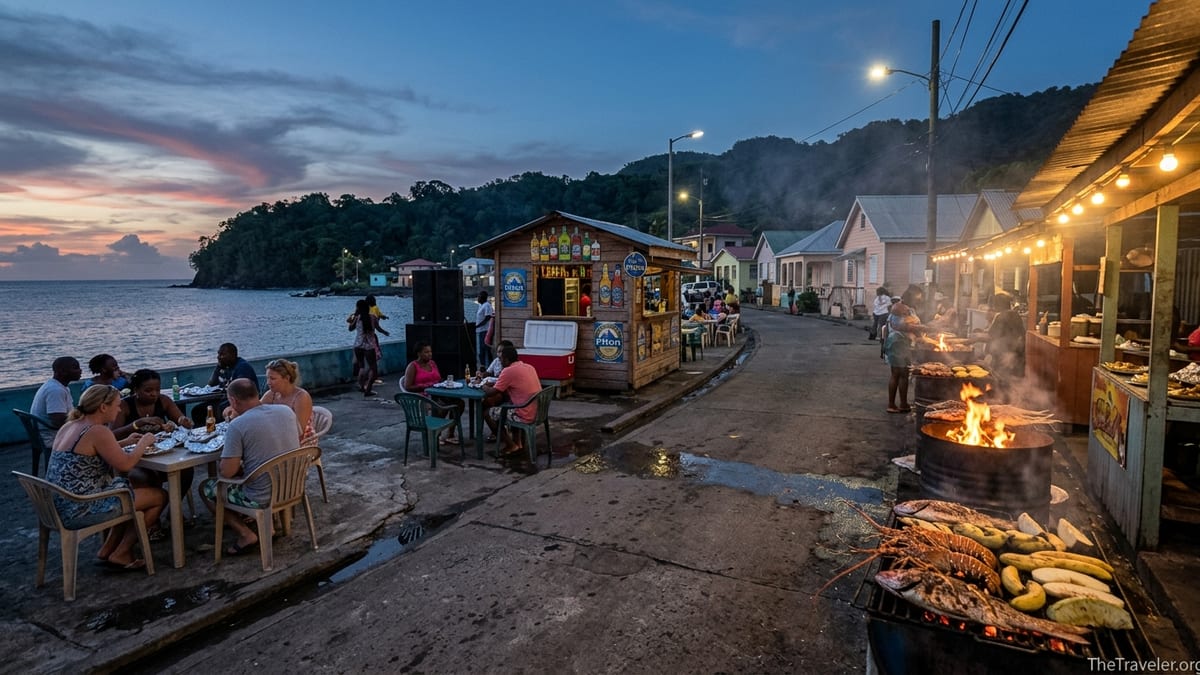
On Saint Lucia’s rugged west coast, the fishing village of Anse La Raye transforms each Friday evening into one of the island’s most atmospheric street food events. The waterfront fish fry, often called Seafood Friday or Fish Fry Friday, blends grilled catch-of-the-day with rum punches, soca and reggae, and a laid-back village vibe that feels distinctly different from the bigger, party-focused scene up in Gros Islet. This guide walks you through everything you need to know, from what time to arrive and what to eat to how to pay, where to sit and what the evening is really like on the ground.
Get the latest updates straight to your inbox!
When and Where the Anse La Raye Fish Fry Happens
The Anse La Raye fish fry is a weekly Friday-night event held in the village of Anse La Raye on Saint Lucia’s west coast. The action centers along the waterfront on Front Street, which runs parallel to the beach and the small fishing harbor. On a typical Friday, vendors start setting up grills and food stalls in the late afternoon, and the street begins to come alive around sunset.
Official start times are loose, as with many Caribbean street events, but most visitors find that things are properly underway by about 6:30 to 7:00 p.m. Early in the evening you will see families and local residents arriving first, picking up takeaway containers of grilled fish and sides, while some tourists wander in from Castries or the northern resorts once the heat of the day has faded. The atmosphere gradually builds through the evening and typically stays lively until around 10:30 or 11:00 p.m., sometimes a bit later in busier periods.
The fish fry takes place outdoors, along a compact section of the waterfront, so it is easy to find once you are in the village. As you come into Anse La Raye from Castries or Soufrière, you simply follow the main road down to the seafront. On Friday nights you will usually hear music and see smoke rising from grills before you even reach the stalls. There is no entry fee to the event itself; you simply pay for whatever food and drinks you choose to buy.
It is worth noting that while the event has been running for many years, there have been occasional pauses or quieter periods, for example during major storms or global disruptions. As of 2026 it is generally back on the local calendar, but if your schedule is tight it is still wise to confirm with your hotel, guesthouse host or a local taxi driver that the fish fry is active the Friday you plan to visit.
What Time to Arrive and How the Evening Flows
Your ideal arrival time depends on what kind of evening you want. If your priority is food and a more relaxed scene, arrive between 6:00 and 7:00 p.m. That is when grills begin turning out the earliest plates of mahi-mahi or snapper, and queues are shorter. You are more likely to find a spare plastic chair or one of the simple wooden benches near the stalls, and you can wander around to see which vendors appeal to you before the lines build.
Travelers who enjoy a busier, more social atmosphere often target 8:00 to 9:00 p.m., when the music is louder, the crowd has thickened and the rum punches are flowing. By this point, some of the more popular stalls might sell out of lobster or specific fish, but there is still usually plenty of choice. Expect to stand in line for 10 to 20 minutes at the busiest grills during peak times, especially in high season when hotel tour groups or cruise passengers come in by minibus.
A typical evening follows an easy rhythm. In the early part of the night, the focus is squarely on food: fishermen and vendors weigh and season fresh catch, charcoal fires flare, and people carry away foil-wrapped packets and Styrofoam containers stacked with fish, breadfruit and salad. As it gets dark, speakers or a DJ turn up the volume with soca, dancehall, reggae and sometimes zouk and older calypso tracks, while locals chat at roadside coolers and visitors linger over beers by the sea wall. Toward the end of the evening, some stalls close once they sell out, while a few core vendors and bar setups keep going for the last wave of late diners.
If you plan to come from farther away, such as from the resort area of Rodney Bay, consider the timing for the return drive. Roads along the west coast are narrow and winding, and while they are commonly used at night, many visitors prefer to head back by about 10:30 p.m. If you have your own rental car, arriving early allows you to find easier parking on the edge of the village and leave before the latest, rowdiest hour.
Seafood Dishes, Portions and Typical Prices
Seafood is the star of the night, and much of it is landed by the same boats you see pulled up on the beach. Expect to see whole grilled fish such as snapper, mahi-mahi (often called dolphin locally, not to be confused with the mammal), kingfish and sometimes tuna steaks. Vendors typically season the fish with a local green seasoning blend, garlic, herbs and spices, then grill it over charcoal until the skin is crisp and the flesh is just cooked through. Portions are generous: a whole snapper with sides can easily fill one hungry adult.
Beyond the grilled fish, you will often find lobster in season, conch, shrimp skewers and various fish kebabs. Many stalls offer fish or conch in creole sauce, stewed in a lightly spicy tomato and herb base. Side dishes are a big part of the plate: look for roasted breadfruit slices, green fig (boiled green banana), plantain, macaroni pie, rice and peas and simple coleslaw. Some stalls also sell accra (saltfish fritters), bakes (fried dough rounds) and small cups of fish broth earlier in the evening.
Prices can vary depending on the stall, the size of the fish and whether you choose lobster or premium items. As a guide, a plate with a piece of grilled fish and two or three sides might run roughly 20 to 35 Eastern Caribbean dollars per person, while a whole lobster plate or a large shared seafood platter might cost more, often in the 50 to 70 Eastern Caribbean dollar range. Many visitors find they can comfortably eat and have a couple of drinks for the equivalent of a mid-range sit-down restaurant meal, but with much more atmosphere.
Vendors usually display prices on hand-painted boards or on cardboard signs next to the grills. If you do not see a clear price list, it is entirely acceptable to ask the price of a plate or of a particular fish before ordering. Placing your order is straightforward: you point out the fish you want, choose your sides and pay the vendor directly at the stall. Portions are hearty, so some couples choose to share a larger plate of fish and sides and then supplement with extra snacks later from a different stall.
Drinks, Music and the Nighttime Atmosphere
Drinks are sold from both fixed bars along the waterfront and temporary coolers set up just for the fish fry. You can expect local beers such as Piton and Kubuli, plus regional lagers, as well as rum punches, simple rum-and-juice mixes and standard spirits with soft drinks. Fresh coconut water, bottled water and sodas are also widely available. A cold beer often costs only a little more than in a local bar, while cocktails and rum punches are modestly priced compared with hotel bars, making it easy to linger over a couple of drinks as the night unfolds.
The music at Anse La Raye’s fish fry is part of what sets the tone. Most nights feature a DJ with large speakers set up in the street, though occasionally a small live band might play, particularly around holiday weekends or during island festivals. Expect a mix of soca, reggae, dancehall and Caribbean pop, often with the volume turned high enough to feel like a low-key street party rather than a quiet village market. At the busiest times, people might dance near the speakers or sway by the bar, but the energy is generally more relaxed and local-focused than at the larger, more crowded Friday-night event in Gros Islet.
The general atmosphere is friendly and informal. Children run around early in the evening, neighbors greet each other, and visitors are usually welcomed with a smile and a sales pitch. A few guides and taxi drivers may approach tourists to offer additional tours or rides back north later that night. Streetlights and stall lights provide enough illumination to see what you are eating, though the overall effect is still quite atmospheric: grills glowing, smoke drifting in the sea breeze and the constant low throb of music behind the sound of waves slapping on the nearby shore.
Because this is an open-air street event, conditions can vary with the weather. On clear, dry evenings the waterfront feels festive and breezy, with stars visible overhead. On rainy nights, some stalls may use tarps or tents, and locals might cluster under awnings or near bars. Light rain does not necessarily stop the event, but heavy downpours can reduce the crowd and occasionally prompt an early close. Bringing a light rain jacket or at least being flexible in your plans is sensible in the rainy season.
Seating, Payment and Practical Logistics
Seating at the Anse La Raye fish fry is simple and limited. Most stalls rely on a scattering of plastic chairs, a few folding tables and some wooden benches near the waterfront. These seats are unreserved and move around during the night as people come and go. If you arrive early, you have a better chance of grabbing a table close to your chosen stall. Families sometimes push a few chairs together, while couples might perch on the sea wall with their plates balanced on their laps.
With limited seating, many visitors adopt a flexible approach: eat the first round quickly at whichever chair you can find, then wander, drink in hand, and snack again later while standing or leaning against a low wall. Since food is served in takeaway containers or foil, it is easy to move around. Flats or sandals are more practical than heels, as you will be stepping over curbs, walking on uneven surfaces and possibly on damp patches near the beach.
Cash remains the norm. The safest assumption is that most vendors accept only cash in Eastern Caribbean dollars, though some may also accept U.S. dollars at an agreed rate. While larger, more permanent bars in the village might have card machines, many of the temporary food stands and coolers do not. There is no guarantee of easy access to an ATM right on the waterfront, and island connectivity can be fickle, so it is best to bring enough cash for your evening, including extra in case you want to try a second or third stall.
When it comes to hygiene and safety, many visitors find the fish fry broadly in line with other Caribbean street food events. Stalls cooking over high heat and turning food frequently tend to inspire the most confidence. If you have a sensitive stomach, you might choose well-cooked grilled fish over raw or lightly marinated dishes and avoid ice in drinks from smaller coolers. As always in crowded settings, keep valuable items close and avoid flashing large amounts of cash, but opportunistic petty crime is not a defining feature of the event and many families and couples report feeling at ease throughout the night.
Getting There and Getting Home
Anse La Raye sits roughly a 25-minute drive south of Castries along the island’s main west-coast road. From the popular resort area around Rodney Bay and Gros Islet, the journey is a bit longer, commonly in the 45- to 60-minute range depending on traffic. From Soufrière in the south, you can expect a drive of around 30 to 40 minutes. The route hugs hillsides and drops down into coastal villages, with plenty of curves and occasional steep sections, so driving takes some attention, especially after dark.
The most straightforward option for many visitors is to hire a taxi for the evening. Taxi drivers based in Castries, Rodney Bay and Soufrière are well acquainted with Friday nights in Anse La Raye and will often quote a round-trip rate that includes waiting time or a set pick-up hour. Prices vary with distance, fuel costs and negotiation, but a couple traveling from the north often finds the shared cost worthwhile for the convenience of being driven along unfamiliar roads after a few drinks.
More independent travelers sometimes choose to rent a car. This gives you the freedom to combine the fish fry with other stops, for example an afternoon at Marigot Bay on the way down or a sunset viewpoint along the roadside. If you drive yourself, aim to park on the outskirts of the village rather than right in the tightest part of the waterfront, both to avoid congestion and to make your exit easier later in the evening. Take it slowly on the return journey; road markings and lighting can be patchy by North American standards.
Public minibuses are the cheapest way to move along the coast, but they are not specifically designed around late-night events. Daytime and early evening services from Castries toward Soufrière pass near Anse La Raye, usually with the village as a recognized stop, and fares are low by international standards. However, last departures back to town may not run as late as the fish fry itself, and vehicles can be crowded. It is possible in theory to ride a bus there in the late afternoon and take a taxi back after 9:00 or 10:00 p.m., which some budget-conscious travelers do by asking local drivers at the event for a rate.
Families, Couples and What the Evening Really Feels Like
Compared with bigger party scenes, the Anse La Raye fish fry keeps a distinctly village feel, which makes it appealing for a broader range of visitors. Families with children often come early, between 6:00 and 8:00 p.m., when there is still daylight for a portion of the evening, the music is not at full volume yet and it is easier to find seating. Children usually enjoy the simple grilled fish, fries or macaroni pie, and can watch the bustle of vendors turning fish on the grill and fishermen hauling gear near the shoreline.
Couples, especially those staying at resorts in the north, often treat it as a more low-key and authentic alternative to spending Friday night at a hotel buffet or the louder street party in Gros Islet. The combination of sea breeze, village chatter and music, plus the glow of oil drums and charcoal grills, creates an atmosphere that feels romantic in an unpolished, real-world way. It is not a nightlife district with clubs or dress codes; casual clothing, light summer dresses, shorts and sandals are the norm.
During the busiest periods of the tourist season, you may encounter a mix of locals, Saint Lucians home from abroad, cruise passengers on shore excursions and independent travelers. On quieter Fridays outside peak season, the crowd skews more local, and you might find only a handful of visitors, which can be just as enjoyable if you are looking for a more relaxed evening. The event’s character depends heavily on who turns up, but the consistent thread is food first, music second, and a shared gathering place for the village community.
By the time you leave, your clothes might carry a trace of wood smoke and seafood, your ears might still be humming with a soca bass line and your phone may hold a few half-blurry photos taken in the shifting light of the waterfront. For many travelers, this is precisely the point: an evening that feels less like a packaged attraction and more like dropping in on a regular village Friday, where the week’s work at sea ends with food, music and a chance to unwind together.
FAQ
Q1. What night does the Anse La Raye fish fry take place?
It is held on Friday nights, with vendors setting up along the waterfront in Anse La Raye and the event usually running from early evening into late evening.
Q2. What time should I arrive for the fish fry?
Arriving between 6:00 and 7:00 p.m. works well for smaller crowds and more seating, while 8:00 to 9:00 p.m. is best if you prefer a busier, more energetic scene.
Q3. How much should I budget for food and drinks?
A typical plate of grilled fish with sides might cost roughly 20 to 35 Eastern Caribbean dollars, with larger seafood platters more. With drinks, many visitors spend the equivalent of a mid-range restaurant meal.
Q4. Is the fish fry suitable for children and families?
Yes, many local families attend, especially earlier in the evening. The atmosphere is informal, outdoors and generally relaxed before the music gets louder later at night.
Q5. What kind of food can I expect besides grilled fish?
You will often find lobster in season, conch, shrimp, fish in creole sauce and sides such as breadfruit, green fig, plantain, macaroni pie, rice and coleslaw, plus snacks like accra and bakes.
Q6. Do vendors accept credit cards or should I bring cash?
Most stalls operate on a cash-only basis, primarily in Eastern Caribbean dollars. Bring enough cash for food, drinks and any extras, as card facilities and ATMs are limited.
Q7. How do I get to Anse La Raye from Castries or Rodney Bay?
The village is about a 25-minute drive from Castries and 45 to 60 minutes from Rodney Bay along the west-coast road. Visitors typically use taxis, rental cars or a combination of minibus and taxi.
Q8. Is there plenty of seating at the fish fry?
Seating is limited and informal. Expect plastic chairs, simple tables and benches, plus the sea wall. Arrive early if you want a better chance at a proper seat.
Q9. What should I wear to the fish fry?
Casual, comfortable clothing is ideal. Light summer outfits and sandals or sneakers work best for walking on uneven ground and standing while you eat.
Q10. Is the event safe to attend at night?
The fish fry draws local families and visitors and is generally considered safe. As with any crowded event, keep valuables secure, carry only what you need and use licensed taxis for late-night transport.