


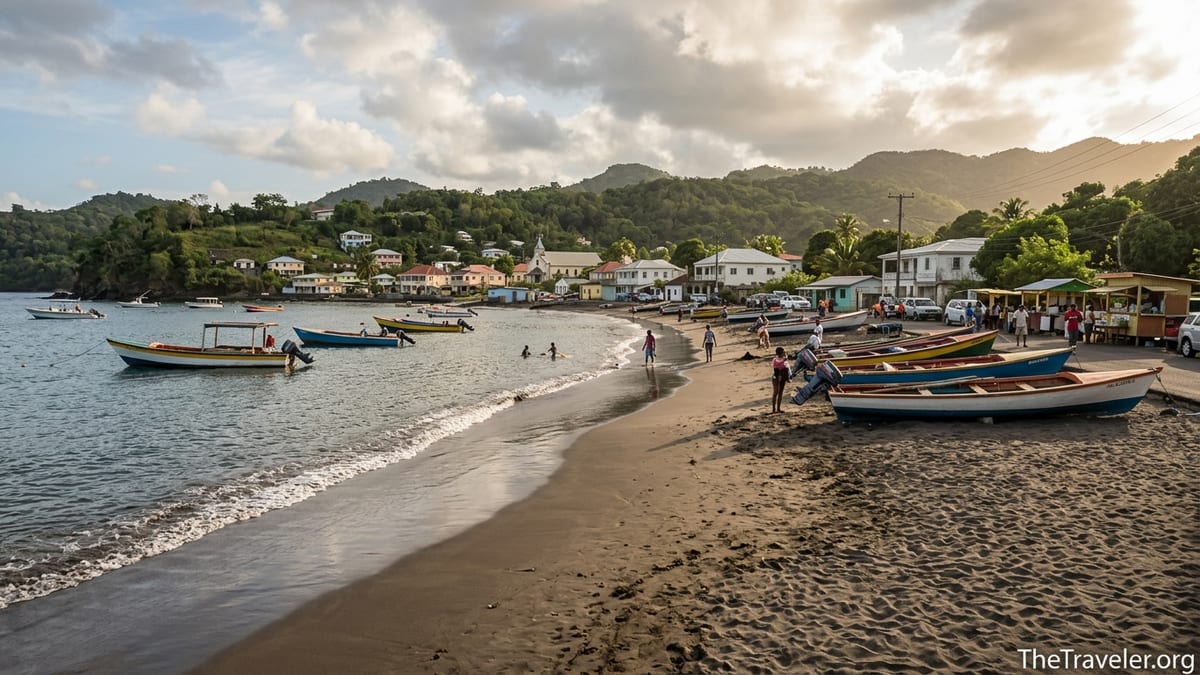
Anse La Raye on Saint Lucia’s west coast is first and foremost a working fishing village, and its waterfront beach reflects that mix of everyday island life and low-key visitor appeal. This is not a manicured resort strand with rows of loungers, but a strip of dark volcanic sand where colorful pirogues pull up after dawn, children splash after school, and on Friday nights the smell of grilled snapper drifts across the bay. For travelers who want to experience a more local side of Saint Lucia and do not mind sharing the shoreline with boats and village routines, Anse La Raye Beach can be a rewarding stop or a relaxed half-day outing.
Get the latest updates straight to your inbox!
Orientation: Where You Are and What to Expect
Anse La Raye village sits roughly halfway down Saint Lucia’s sheltered west coast, about a 20 to 30 minute drive south of Castries along the island’s main coastal road. The beach runs directly in front of the village, a gently curving bay backed by low buildings, almond and palm trees, and the small jetty that serves local fishers and boat tours. You are in the heart of an active community rather than in a self-contained resort zone, so expect the sound of engines, conversation in Creole, and the rhythms of everyday life alongside the sea.
The sand here is characteristically dark brown to charcoal, the result of Saint Lucia’s volcanic geology. It is not the powdery white sand of some Caribbean postcards, but under strong sunlight it can look striking, especially where the wet sand near the waterline mirrors the clouds and fishing boats. The beach itself is moderately wide in most sections, narrowing near the village center where the road runs closest to the sea.
Overall, Anse La Raye Beach feels intimate and unpolished rather than grand. Concrete slipways where boats are hauled out break up sections of sand, and you will see piles of nets and coolers near the water. Visitors who appreciate a bit of grit and authenticity tend to enjoy the setting; those seeking a fully serviced resort beach often use Anse La Raye as a short cultural stop on a day tour rather than as their primary swimming spot.
Because the bay faces west into the Caribbean Sea rather than the open Atlantic, conditions are usually calm outside of stormy weather. That, combined with the bay’s modest size, helps the area feel sheltered. However, water clarity and the overall feel of the beach change depending on rainfall, wave action, and how many boats are working the shoreline on a particular day.
Sand, Water and Swimming Conditions
The sand at Anse La Raye is generally firm and compact, especially near the waterline, which makes walking along the shore comfortable in flip-flops or bare feet. The darker color means it can heat up quickly under afternoon sun, so stepping back from the high-tide line around midday is often more comfortable. There are occasional pebbly patches and bits of coral rubble closer to the village jetty, but most of the central sections are sandy underfoot.
Entry into the water is mostly gradual with a gentle slope, suitable for wading and casual swimming. On most calm days, the first 10 to 15 meters offshore stay relatively shallow. This can be good for less confident swimmers, as long as they are comfortable sharing the area with moored fishing boats. The best sections for a relaxed dip are usually a little away from the densest clusters of vessels, often toward the edges of the village stretch rather than right in front of the busiest slipways.
Water quality in a working fishing bay can vary. On clear, dry days the water can appear clean with a soft green-blue tint, but after heavy rain runoff from the surrounding hills can cloud visibility, and boat traffic occasionally stirs up sediment near shore. You may notice a mild diesel smell close to the jetty or where boats anchor in tight clusters. Visitors who prioritize pristine snorkeling typically head instead to Anse Cochon or Anse Chastanet, both within roughly 30 to 45 minutes by boat or car from the village, and treat Anse La Raye as more of a cultural and food stop than a snorkeling destination.
There is no lifeguard service on the village beach. Swimming is at your own risk, and it is wise to keep a clear distance from boat lanes and avoid swimming at dusk or after dark when visibility drops. When the sea is calm, confident swimmers can enjoy short open-water laps parallel to shore, but currents can strengthen in rougher weather. For families with children, many local guides suggest keeping youngsters in the shallows near a parent and avoiding the areas closest to the concrete launching ramps and moored pirogues.
Fishing Boats, Working Waterfront and Local Atmosphere
Fishing has shaped Anse La Raye for generations, and the village is still recognized nationally as a key landing point for small-pelagic catches. Early mornings often bring a flurry of activity as wooden and fiberglass boats return with their haul, men in rubber boots haul nets or crates ashore, and small pickup trucks arrive to collect fish. If you visit between about 7 and 9 a.m., you are likely to see this side of life on the sand, with boats pulled partway up the beach and locals bartering over fresh catch.
For visitors, the boats lend the bay a colorful, photogenic quality. Many are painted in bright blues, reds, and yellows with names along the bow. However, they also occupy space on the sand and in the shallows, so this is not the kind of beach where you find long, uninterrupted strips of open sand. You will often need to weave around hulls and gear when walking, especially near the village center where the road runs closest to the shore.
The working nature of the waterfront shapes the atmosphere throughout the day. You may see fish being cleaned at basic tables, hear radios from parked cars, and watch groups of schoolchildren cutting across the beach on their way home. Compared with resort areas like Rodney Bay, interactions tend to feel more casual and personal: a vendor might offer you a grilled fish plate during the Friday night events, or a fisherman might chat briefly if you admire his boat. Tipping for informal photo opportunities or for quick explanations of the nets and gear is appreciated but not obligatory.
The community has also leaned into tourism via the well-known Friday night seafood street party, often referred to locally as Fish Friday. In recent years, village and national authorities have worked on upgrading vending stalls and waterfront spaces so the event can better accommodate visitors while still feeling rooted in the local culture. When Fish Friday is in full swing, the atmosphere on and around the beach shifts from quiet fishing village to lively open-air festival.
Shade, Comfort and On‑Beach Facilities
Shade along Anse La Raye Beach mainly comes from natural trees and nearby buildings rather than from organized rows of umbrellas. Large almond trees near the village center cast pockets of shade that locals and visitors share, especially in the early afternoon. Outside of those areas, the beach can be exposed, so bringing a hat, high-SPF sunscreen, and perhaps a lightweight travel umbrella or small beach tent is a sensible choice if you plan to stay longer than an hour or two.
There are no large-scale commercial lounger rentals directly on the main village beach in the way you might find at a resort. During busy periods, especially on Fish Friday or when boat tours call in, you may find a handful of plastic chairs or benches set up by informal vendors or small bars. Availability is inconsistent, so most day visitors either sit directly on the sand, use a lightweight travel mat, or perch on the low sea wall bordering parts of the beach.
Basic public restrooms exist near the waterfront road and by the areas used for Fish Friday, and several recent visitor reports note that at least one set of toilets near the north end of the main beachfront road is usually in better condition, often with hand-washing basins. Facilities are not luxurious, and it is smart to carry tissues or wipes and a small bottle of hand sanitizer. Showers are limited, occasionally appearing as simple outdoor rinse-off pipes near village edges or by newer tourism-oriented facilities a short drive from the central village, such as the Glittering Sands development just north of Anse La Raye, which was designed with day visitors in mind.
Accessibility is acceptable for many travelers but far from barrier-free. In several spots the road runs only a few steps above the sand, allowing relatively easy access down short, sometimes uneven paths. However, wheelchair users or those with limited mobility may find it challenging to reach the firm sand without assistance, as ramps and smooth paved walkways are sparse. If mobility is a priority, consider coordinating with a local driver or guide who knows the easiest access points and can park close to them.
Food, Drinks and Nearby Options
Food is one of the strongest reasons to spend time in Anse La Raye. On regular weekdays, you will find small local eateries and bars along the main street parallel to the waterfront, serving creole dishes such as grilled snapper or mahi-mahi with rice and peas, breadfruit, and green fig salad. Menus change depending on the day’s catch, but a simple plate of fried fish with sides might run in the rough range of 25 to 40 Eastern Caribbean dollars per person, with a local beer or soft drink adding a few dollars more. Portions are generally hearty and informal, reflecting a community that eats what it catches.
On Friday evenings, the village’s Fish Friday event is the headline attraction. Rows of vendors set up along the seafront road and near the beach, selling everything from fish kebabs and lobster skewers in season, to lambi (conch) stew, fish cakes, and grilled corn. The air fills with smoke and music, and visitors mingle with locals out for the evening. Here, you might pay a modest price for a generous portion of grilled lobster or a combo plate of several small dishes, with the ability to snack from multiple stands over the course of the night. Payment is typically in cash, so bringing smaller bills in Eastern Caribbean dollars or US dollars is useful.
Beyond the immediate village waterfront, a short drive north or south along the coast opens up more formal dining and beach options. A few kilometers north, the Glittering Sands project offers a more curated beach experience with a restaurant and bar, souvenir shop, and watersports services, while still sitting within the Anse La Raye district. To the south, beachside restaurants at Anse Cochon, often associated with small resorts or guesthouses, provide lunch options for visitors who might combine a morning swim or snorkel there with an afternoon or evening wander in Anse La Raye village.
For self-caterers staying in nearby guesthouses or hilltop villas, a stop at Anse La Raye’s informal fish market in the morning can be one of the more memorable experiences. Buying a few freshly landed fish or a bag of smaller pelagic species directly from fishers and grilling them back at your accommodation connects you to the village’s daily rhythm in a very tangible way. Asking your host for guidance on current prices and how best to negotiate is a good way to keep interactions respectful and fair.
Spending a Full Day vs a Short Visit
Because Anse La Raye Beach is woven into a working village rather than organized as a resort-style attraction, it is often best suited to a few focused hours rather than a full day of stationary beach lounging. Many independent travelers and small-group tours stop in mid-morning or late afternoon: walk the narrow streets, take photos of the church and waterfront, talk with residents, have a drink or snack, and perhaps go for a short swim before continuing along the coast to Marigot Bay or Soufriere.
A relaxed half-day can work well, especially if you are staying nearby. For example, you could arrive around 9 or 10 a.m., watch any remaining fishing activity, stroll the beach, and swim for an hour or two during the calmer late-morning period. After that, lunch in a local restaurant provides a chance to try creole dishes and cool off in the shade. Early afternoon heat is often intense, so many visitors either retreat to their accommodation, drive up into the hills for viewpoints, or continue to a more shade-rich or facility-rich beach such as Anse Cochon for the rest of the day.
On Fridays, it is more realistic to see Anse La Raye as an afternoon-into-evening outing. Some visitors arrive before sunset, explore the village, maybe wade or paddle in the shallows, then transition into the Fish Friday food and music scene as vendors fire up their grills. In this scenario, daytime swimming is just one piece of a broader cultural experience that extends late into the evening, with taxis or pre-arranged shuttles returning guests to resorts in Rodney Bay, Castries, or Soufriere.
Those determined to make Anse La Raye their primary daily beach hangout need to be comfortable with basic facilities, limited organized shade, and the ebb and flow of village life around them. Bringing your own beach gear, water, and snacks fills gaps in local services. For many travelers, however, a balanced approach works best: combine a couple of hours on the sand and in the water here with excursions to nearby waterfalls, hillside viewpoints, or snorkeling beaches, and reserve Anse La Raye itself for its culture, food, and atmosphere.
Photography, Safety and Practical Tips
From a photography standpoint, Anse La Raye is less about dramatic rock formations or expansive sand and more about people, boats, and village textures. Early morning offers soft light over the bay with boats coming and going, while late afternoon and sunset bring warm tones on the dark sand and silhouettes of pirogues moored in the calm water. Walking a short distance along the waterfront road can reveal vantage points where you can frame the colorful boats against the low-rise village and the forested hills behind.
Respectful photography etiquette is important in a close-knit community. Boats, nets, and general beach scenes are usually fine to photograph from a distance, but it is considerate to ask before taking close-up portraits of individuals or focusing your camera on someone cleaning fish or relaxing on the sand. A simple smile and gesture with your camera can go a long way, and buying a drink or small snack from a vendor after photographing their stand helps maintain goodwill.
In terms of safety, Anse La Raye is generally described by recent visitors as friendly, but normal travel precautions apply. Avoid leaving bags or valuables unattended on the sand while you swim, and do not flash large amounts of cash. At busier times, petty theft can be a risk in any tourist area, so it is wise to bring only what you need for a few hours: some cash, a copy of your ID, sunscreen, and a simple phone or camera. If driving, park in a visible, well-used area and avoid leaving attractive items in plain sight inside your vehicle.
Weather conditions on Saint Lucia’s west coast are usually warm and humid, with brief showers possible at almost any time of year. A compact rain jacket or poncho can keep you dry if a passing squall blows in while you are on the beach, while the same clouds can also produce beautifully dramatic light for photography once the sun reappears. During the wetter months and hurricane season, heavier rain can affect water clarity and bring more debris into the bay, making swimming less appealing on certain days. Checking conditions with your accommodation host or a local guide before setting out can help you choose the best time of day to visit.
The Takeaway
Anse La Raye Beach is best understood as the front yard of a living fishing village rather than as a packaged beach resort. Its dark volcanic sand, clusters of painted fishing boats, and low-key waterfront create an atmosphere that is more about community and culture than about chaise lounges and cocktails brought to your chair. Swimming is certainly possible in the calmer, less crowded sections of the bay, but the real draw lies in watching the boats come in, chatting with locals, and tasting freshly grilled seafood a few steps from the water.
For travelers willing to trade some comfort and polish for authenticity, Anse La Raye offers a memorable glimpse into everyday life on Saint Lucia’s west coast. Plan on a few hours rather than a full day on the sand, bring what you need in terms of shade and snacks, and consider timing your visit to coincide with the village’s Friday evening street food festivities. Paired with swims and snorkels at nearby coves and visits to the island’s better-known beaches, time spent here rounds out a more complete picture of Saint Lucia beyond its resort brochures.
FAQ
Q1. Is Anse La Raye Beach good for swimming?
Swimming is possible in the calmer parts of the bay, especially away from the clusters of fishing boats, but there are no lifeguards and water clarity can vary with weather and boat activity.
Q2. What is the sand like at Anse La Raye Beach?
The sand is dark brown to charcoal volcanic sand that feels fairly firm underfoot, with mostly gentle entry into the water and occasional pebbly patches near the village jetty.
Q3. Are there beach chairs and umbrellas for rent?
There is no large organized lounger or umbrella rental operation on the main village beach, so most visitors sit directly on the sand or bring their own lightweight gear.
Q4. Are there restrooms and showers near the beach?
Basic public restrooms are available near the seafront road and Fish Friday area, and simple outdoor rinse-off points may exist, but facilities are limited and not resort-style.
Q5. What kind of food can I find near Anse La Raye Beach?
Nearby eateries and street vendors serve creole dishes like grilled fish, lambi, and fish cakes, with an especially wide choice and lively scene during the Friday night seafood street party.
Q6. Is Anse La Raye Beach suitable for a full beach day?
Because of limited shade, basic facilities, and the presence of fishing activity, most travelers treat it as a short or half-day stop rather than a full-day lounging beach.
Q7. How busy does the beach get on Fish Friday?
On Friday evenings the waterfront road and areas near the beach become lively with food stalls, music, and visitors, creating more of a night-time street festival atmosphere than a quiet beach scene.
Q8. Is Anse La Raye safe for visitors?
The village is generally friendly, but visitors should follow normal precautions, such as not leaving valuables unattended on the sand and carrying only the cash they need.
Q9. Can I buy fresh fish directly from the fishermen?
In the mornings, it is often possible to buy freshly landed fish from local fishers or small stalls near the beach, especially if you ask politely and have cash in small denominations.
Q10. Are there better nearby beaches for snorkeling?
For clearer water and richer marine life, many travelers head to nearby coves such as Anse Cochon or Anse Chastanet, using Anse La Raye more for its village atmosphere and food.