


Touching down at Antalya Airport is the moment your Turkish Riviera holiday really begins. Whether you are heading for a resort in Lara, Belek, Side, Alanya or into Antalya’s old town, knowing exactly what happens after landing will save time, stress and in many cases money. This guide walks you through each stage of the arrival process at Antalya Airport, from passport control and baggage claim to ATMs, SIM cards, taxis, tram connections and resort transfers, using real-world examples to help you plan with confidence.
Get the latest updates straight to your inbox!
Understanding Antalya Airport on Arrival
Antalya Airport (AYT) sits about 13 kilometres northeast of Antalya city centre and handles tens of millions of passengers each year, especially between April and October. The airport has three main passenger terminals: Terminal 1 and Terminal 2 for international flights, and a separate Domestic Terminal used for flights within Türkiye. Most European charter and low-cost carriers use Terminal 1 or 2, while domestic airlines such as Turkish Airlines and Pegasus arrive into the Domestic Terminal. The terminal your flight uses is shown on your ticket and on the airport’s information screens, but for most passengers the arrival experience is similar in each building.
On the ground, Terminal 1 and the Domestic Terminal form a northern cluster, while Terminal 2 stands alone a short distance to the south. A free inter-terminal shuttle bus connects the terminals landside, useful if you land internationally in Terminal 2 and have a separate domestic connection from Terminal 1. Travelers report that the shuttle ride plus walking time typically takes around 20 to 30 minutes, so if you are self-connecting you should avoid very tight layovers.
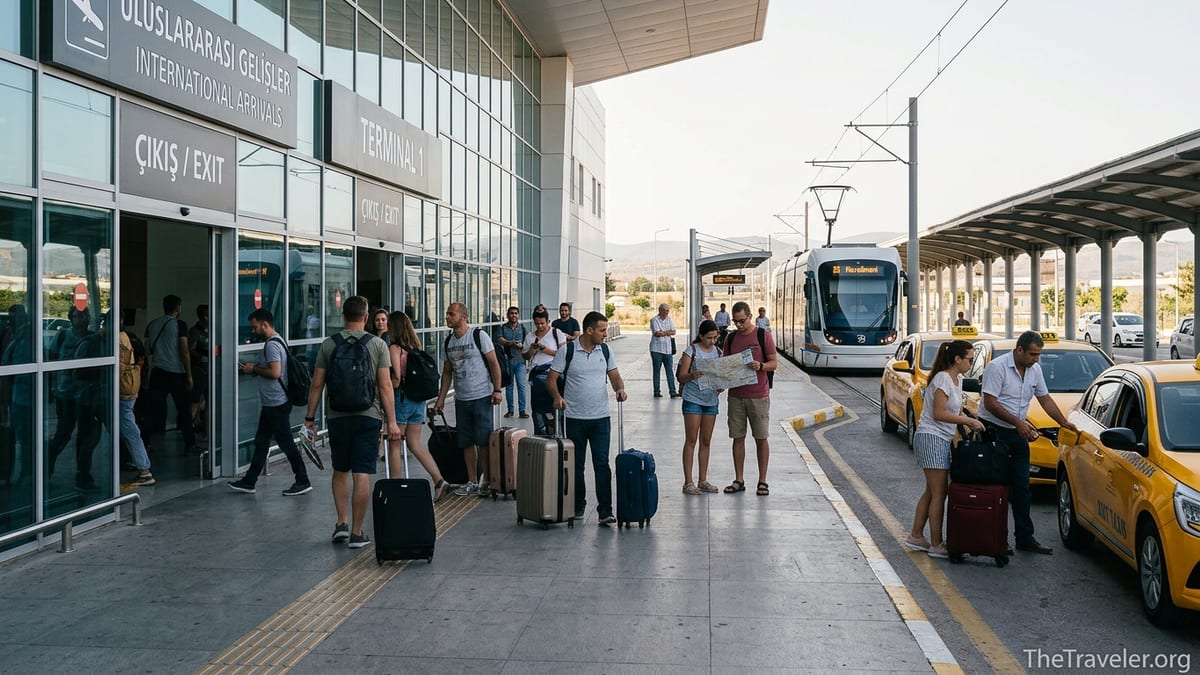
All terminals are operated by Fraport TAV, and the basic flow for arriving passengers is the same: leave the aircraft, follow the “Arrivals” and “Passport Control” signs, clear border checks, collect your luggage, pass through customs, then exit into the public arrivals hall where you will find ATMs, SIM card desks, car rental counters, transfer companies and access to taxis, buses and the AntRay tram. Understanding this sequence helps you decide where to focus your time and what can wait until you reach your hotel.
Wheelchair users and passengers with reduced mobility are supported by an airport-wide accessibility program. Assistance should be booked through your airline in advance, but on arrival dedicated staff can accompany you from the aircraft through passport control and baggage reclaim to the arrivals hall. Elevators, ramps and accessible restrooms are signposted in Turkish and English, and wheelchair users can also access the AntRay tram via level platforms at the airport stop.
Passport Control and Entry Requirements
After leaving the aircraft, arriving international passengers are funnelled toward passport control. There are separate lines for Turkish citizens, foreign passports and, in some cases, e-gates or “e-passport” lanes. The majority of holidaymakers from the European Union, United Kingdom and several other countries do not need a visa for short tourist stays, but rules can change, so it is essential to check the latest entry requirements with the Turkish Ministry of Foreign Affairs or your airline before you fly. Your passport typically must be valid at least for the duration of your stay, and many travellers sensibly ensure at least six months of validity remaining.
In the busiest summer months, multiple long-haul charter flights can land within a short window, which can create queues at passport control, especially in Terminal 1. Recent passenger reports suggest that at quieter times early in the morning or late at night, clearing passport control may take only 10 to 20 minutes, while at peak times you should be prepared for 30 to 60 minutes. Families with young children and passengers needing assistance may occasionally be directed to shorter lanes, but this is not guaranteed, so allow enough time if you have a same-day onward domestic flight.
When you reach the border officer, you will typically be asked the purpose of your visit and length of stay. Having your hotel name, address and return flight details to hand is a good idea. If you are carrying a printed package holiday voucher from a major tour operator, you can present that as confirmation of your accommodation. The officer may also check that your passport has an entry stamp or electronically registered entry record. Türkiye has tightened exit checks in recent years, so make sure your passport is properly stamped or scanned as you enter.
Some nationalities who still require an e-visa should ideally obtain it online well before travel rather than relying on any on-arrival facilities. Airlines often check visa compliance at your departure airport and may deny boarding if your documents are not in order. For example, passengers from certain Asian countries have reported being turned away at check-in in their home country when they lacked the correct e-visa approval for Türkiye, even though they assumed they could arrange it on arrival.
Baggage Claim, Lost Luggage and Customs
Once you have cleared passport control, you will walk directly into the baggage reclaim hall. Overhead screens list flight numbers alongside assigned carousel numbers, and free baggage trolleys are available. Baggage delivery times vary, but for most European arrivals luggage begins to appear within 15 to 30 minutes after aircraft block-on. For late-night charter flights in peak season, some passengers report waiting a little longer when multiple flights are sharing handlers.
If your bag does not appear, do not leave the baggage hall. Every carousel area has desks for the airlines or their ground handling partners. For example, a passenger arriving with SunExpress or Corendon in Terminal 1 would speak to the handler’s desk located beside the relevant carousel to file a Property Irregularity Report. You will need your baggage tag, boarding pass and a description of your luggage. Once the form is submitted, bags are often delivered to hotels in the Antalya region when they arrive on a later flight, though this can take a day or more, so keeping key items and medication in your cabin bag is important.
After you collect your luggage, you proceed toward customs. Türkiye operates a familiar red and green channel system. If you have nothing to declare and are within your duty-free limits for items such as cigarettes and alcohol, you follow the green channel and usually walk straight into the arrivals hall without further checks. If you are carrying goods above allowance, commercial samples, high-value electronics in large quantities or restricted items, you should enter the red channel and declare them. Customs officers may also conduct random checks in the green channel, so keep receipts for expensive items you intend to keep, such as professional camera equipment or laptops, in case you are asked to clarify ownership.
Tourists seldom have issues at customs provided they are not carrying prohibited items such as weapons, certain medications without prescriptions, or large undeclared sums of cash. As with any international border, rules can change, so those bringing specialist equipment, drones or large camera rigs for professional work should consult current Turkish customs guidance before travel. For the vast majority of holidaymakers, the customs stage is simply a short corridor that leads directly into the public arrivals concourse where your onward journey begins.
Money, ATMs and Mobile SIM Cards in the Arrivals Hall
As you exit customs into the arrivals hall you will see a mix of airport services: ATMs, currency exchange counters, car rental desks and tour operator stands. Several large Turkish banks operate ATMs in the arrivals areas of Terminals 1, 2 and the Domestic Terminal. These machines usually dispense Turkish lira, and some may allow foreign currency withdrawals. Fees depend on your home bank, but many travellers report better exchange rates when using ATMs compared with airport currency exchange kiosks, which can charge higher margins. If your bank card supports fee-free international withdrawals, using an ATM to obtain a modest amount of cash for taxis, snacks and tips is often the most practical first step.
Most payments in Antalya, including at hotels, restaurants, major tourist sites and on public transport, can be made by card. Contactless Visa and Mastercard work widely, including on the AntRay tram gates and many public buses. For example, a single tram fare from the airport to Antalya city centre is typically charged directly to a contactless card at a cost broadly similar to using the local Antalyakart transport card. That said, resort taxis, small convenience stores and local markets still appreciate cash, so withdrawing at least a small amount of lira in the arrivals hall is wise.
Mobile SIM card stands from major Turkish operators such as Turkcell, Vodafone Türkiye and Türk Telekom are usually found in the international arrivals halls. They target tourists with prepaid packages that might include, for instance, 20 to 40 GB of data plus local minutes and texts for 28 to 30 days. Prices change frequently with inflation and exchange rates, but visitors commonly pay the equivalent of several dozen euros for a full tourist package. While this is more expensive than local plans, it offers the convenience of immediate activation, staff support and the ability to use local data for map apps during your first taxi or tram ride.
Some travellers choose to rely on international roaming from their home provider instead, which can be cost-effective if your carrier offers a capped daily roaming charge. If you plan to stay more than a couple of weeks, a local SIM from a downtown branch of a Turkish operator may offer better value than airport packages, though you will then need to reach the city first. In any case, having mobile data as soon as you leave the terminal is extremely helpful for checking addresses, booking ride-hailing services where available, and confirming that your pre-booked transfer driver is in the right meeting zone.
Taxis, Ride Options and Private Transfers
Official airport taxis are lined up outside each terminal, usually in a clearly marked rank. Vehicles operate on a regulated meter system with tariffs set by local authorities, but travellers regularly report that agreeing an estimated total price before departure and confirming that the meter is switched on can reduce misunderstandings. Fares rise periodically with inflation, but as a rough guideline a daytime taxi from Antalya Airport to the city centre or the historic Kaleiçi district often costs significantly more than the AntRay tram yet remains modest compared with private resort transfers to more distant areas such as Belek, Side or Alanya.
For popular coastal resorts east and west of Antalya, many visitors pre-book private transfers through tour operators or specialised shuttle companies rather than relying on ad-hoc taxis. For example, travellers staying in Lara Beach, around 20 minutes from the airport, often book a private minivan transfer included in their package holiday, so a representative meets them in the arrivals hall holding a branded sign and directs them to a dedicated coach bay. Similar services operate for Belek and Side, with shared shuttle buses that depart once a set of flights has arrived. These transfers can be cost-effective for families or groups and remove the need to negotiate directly with taxi drivers after a long flight.
Some independent companies sell door-to-door transfers online with fixed pricing per vehicle, often quoted in euros or British pounds. A typical offer might be a private car from Antalya Airport to a mid-range hotel in Belek for a price comparable to two or three airport taxis, but with a guaranteed meet-and-greet, bottled water and child seats included. Always verify whether your provider is licensed and confirm pick-up details: reputable operators send a driver’s phone number or WhatsApp contact and specify exactly where in the arrivals hall you will meet, since Terminals 1 and 2 have different exit doors and waiting zones.
Ride-hailing apps operate with varying coverage in Türkiye, and their availability can change. In Antalya, the most reliable same-day arrival options remain official taxis and pre-booked transfers rather than assuming you can hail an app-based ride from the terminal. If you do use an app, check the pick-up point carefully and be aware that some drivers may still negotiate off-app, especially for longer journeys to resort areas. In any case, for longer trips, a fixed confirmed price can provide peace of mind, particularly late at night or when travelling with children.
Public Transport: AntRay Tram, Buses and Reaching the City
For many independent travellers, the AntRay tram is the most economical way to reach central Antalya. The modern light rail line connects the airport with the city via the T1A route. The airport stop is located outside the Terminal 1 and Domestic Terminal cluster and is connected by short signposted walks. Trams normally run from early morning until late evening, with headways around 10 minutes during the day. Journey time from the airport to central stops near the old town is typically around 35 to 45 minutes, depending on where you get off.
Tickets are paid using either an Antalyakart, which can be purchased from machines near the station, or a contactless bank card. Recent fare tables show that a single adult trip using Antalyakart or contactless is priced in Turkish lira at a level that remains far cheaper than taxis, even when accounting for currency fluctuations. For example, by mid-2026 many travellers report paying the equivalent of only a few euros for a one-way tram ride into the city centre. The tram is air-conditioned and has dedicated spaces for luggage and wheelchairs, which makes it a practical option even with medium-sized suitcases.
From central tram stops such as İsmetpaşa or Burhanettin Onat, passengers can walk into Kaleiçi, connect to buses toward Konyaaltı Beach or take a short taxi ride to hotels not directly on the tram line. Travellers heading to Antalya’s intercity bus terminal, Antalya Şehirlerarası Otobüs Terminali, can also continue on the tram beyond the city centre to the Otogar stop, then transfer to long-distance coaches serving destinations such as Kemer, Kaş, Fethiye or Cappadocia.
In addition to the tram, municipal buses operate between the airport and different parts of Antalya. Services and numbers can change over time, but historically there have been bus routes linking the airport with the city centre and resort areas, often departing at intervals aligned with typical flight arrivals. Some passengers prefer buses when they want a one-seat ride to certain districts without transferring from tram to bus. As with the tram, Antalyakart and contactless cards are commonly accepted, and fares are generally similar to or slightly higher than light rail, remaining far below taxi prices.
For travellers heading directly to holiday resorts outside the city, such as Alanya or Kemer, it can be more efficient to travel first into Antalya’s bus terminal using the tram and then take a scheduled intercity coach. These long-distance buses are usually comfortable, air-conditioned and may include basic refreshments. While resort transfers sold by tour operators are convenient, independent travellers on tighter budgets often combine tram and coach to keep costs low, at the price of a longer overall journey and the need to handle luggage during transfers.
Car Rental and Driving From Antalya Airport
Car rental counters are prominently located in the arrivals halls of each terminal, with both international brands and local agencies represented. Companies such as Avis, Budget, Enterprise and Europcar typically share space with well-established Turkish brands. Many visitors pre-book rental cars online to secure better rates and guaranteed vehicle categories, especially during peak summer months when demand from families heading to villas and self-catering apartments is high. On arrival, you present your booking confirmation, passport and driving licence at the desk, sign the contract and are directed either to an on-site car park or a nearby off-site lot served by a shuttle.
Rental prices in Türkiye fluctuate with the season, currency and availability, but travellers commonly find that compact cars offer the best value compared with SUVs or premium models. Agencies frequently request a credit card deposit or pre-authorisation that can reach several hundred euros’ equivalent, refunded or released after you return the car undamaged. Inspecting the vehicle carefully for existing scratches, photographing them and ensuring they are noted on the rental form helps avoid disputes later. Fuel policies vary between full-to-full and pre-purchase options; full-to-full is usually most transparent and economical if you are comfortable refuelling before returning the car.
Driving from Antalya Airport is reasonably straightforward. The terminals connect quickly to the D400 highway, which runs along the coast linking Antalya with Lara, Belek, Side, Alanya and beyond. Road signage is in Turkish with Latin script, and major destinations like “Antalya,” “Alanya” or “Kemer” are clearly marked. Speed limits and enforcement cameras are in place, and seat belts are compulsory. Many hotel areas, especially large all-inclusive resorts in Lara and Belek, provide free parking for guests, while some central Antalya hotels rely on nearby paid car parks or street parking.
While having a car gives you maximum flexibility for day trips to sites such as Termessos, Perge, Aspendos or the Düden and Kurşunlu waterfalls, it may not be necessary if you plan to stay mainly within a single resort complex. Traffic into central Antalya can be heavy in the late afternoon and early evening, and navigating narrow streets of the old town with a rental car is not recommended. In that case, combining a taxi or tram from the airport with local tours booked through your hotel could be more relaxing than driving yourself everywhere.
Resort and Hotel Transfers: From Package Holidays to DIY
Many visitors to Antalya arrive on package holidays sold by European tour operators. In these cases, the arrival process after customs is often tightly organised. Representatives from companies such as TUI, Jet2holidays or major German and Scandinavian tour brands typically wait in clearly numbered meeting zones. Travellers check their welcome documents for the correct counter number, show their voucher, and are directed to specific coaches lined up outside. Each coach may serve a cluster of hotels within a resort area like Lara Beach or Belek, making several stops along the way. While this can add an hour or more to your journey if your hotel is last on the route, it removes all planning and payment decisions on the day.
Independent travellers frequently compare three main options: pre-booked private transfer, on-the-spot taxi, or a tram-and-taxi combination. A couple travelling light to a city-centre boutique hotel might ride the AntRay tram from the airport to a central stop for a very low fare, then take a short taxi or walk to their accommodation. A family with small children and large suitcases heading to a resort 40 to 60 kilometres away may find a door-to-door private minivan transfer more practical, even at a higher cost, because child seats can be requested in advance and there is no need to haul luggage between modes.
For budget-conscious solo travellers, another strategy is to use the tram from the airport to the city, stay one night in a central Antalya hotel or guesthouse, then travel onward by long-distance bus to resort towns such as Kaş or Kemer the next morning. This spreads travel over two days and lets you experience Antalya’s old town and marina area, rather than heading straight to a resort. Intercity bus companies typically allow you to buy tickets online or at the bus station, and some offer complimentary shuttle transfers from the station to certain central hotels.
Whichever option you choose, it is sensible to have your hotel’s full address and phone number written down or saved offline, as spelling differences between Latin-script place names and local usage can cause confusion. When using taxis or independent transfers, showing the hotel location on a map app in addition to telling the driver the name helps ensure you are dropped at the correct entrance, especially in districts where multiple hotels share similar names.
The Takeaway
Arriving at Antalya Airport is the gateway to one of Türkiye’s busiest and most popular coastal regions. By understanding the basic flow from passport control through baggage claim and customs, you can move confidently from aircraft door to arrivals hall. Using airport ATMs for a modest cash withdrawal, considering whether an airport SIM package or your home roaming plan suits you best, and choosing between taxis, public transport and pre-booked transfers all become easier decisions when you know what to expect.
For city stays in Antalya itself, the AntRay tram provides a cheap and efficient link between the airport and central districts, while taxis and private cars are often the best choice for resorts along the coast. Car rental is straightforward for those planning extensive sightseeing beyond their hotel. Above all, a little preparation before you land goes a long way. With documents ready for passport control, a plan for how you will pay for your first journey, and your hotel address at hand, your arrival in Antalya can be smooth, quick and relaxed, leaving you free to focus on the beaches, ruins and vibrant streets that brought you here in the first place.
FAQ
Q1. How long does it usually take to get through Antalya Airport after landing?
At quiet times you might clear passport control, baggage claim and customs in 30 to 45 minutes, but in peak summer periods it can take an hour or more, especially if several international flights arrive together.
Q2. Is there a tram from Antalya Airport to the city centre?
Yes. The AntRay light rail line serves the airport and runs to central Antalya, with trams typically every 10 minutes during the day. It is one of the cheapest and most convenient ways to reach the city.
Q3. Can I pay for the tram or bus with a contactless bank card?
In most cases yes. AntRay tram gates and many municipal buses accept contactless Visa and Mastercard, as well as the local Antalyakart transport card that you can buy from machines near major stops.
Q4. Are airport taxis in Antalya reliable and how much do they cost?
Airport taxis are licensed and use meters, but it is wise to confirm that the meter is on and to ask for a price estimate before departure. Fares are higher than tram or bus but moderate compared with private resort transfers, and prices rise periodically with local tariffs.
Q5. Should I withdraw cash at Antalya Airport or wait until I reach the city?
Withdrawing a small amount of Turkish lira from an airport ATM is practical for taxis, tips and small purchases. Exchange offices often have less favourable rates, so many travellers rely mainly on ATMs and card payments in town.
Q6. Is it better to buy a Turkish SIM card at the airport or in the city?
Airport tourist SIM packages from major operators are convenient and activate immediately but tend to be more expensive. Buying a SIM in the city can be cheaper if you have time and are comfortable visiting a local phone shop.
Q7. How do I reach resort areas like Lara, Belek or Side from Antalya Airport?
Lara is close enough for a short taxi or shuttle transfer, while Belek and Side are typically reached by pre-booked private or package transfers, or by combining a tram or taxi into Antalya with an intercity coach from the main bus terminal.
Q8. Is renting a car at Antalya Airport a good idea?
Renting a car is useful if you plan day trips to sites like Perge, Aspendos or the waterfalls and want flexibility. For a simple resort stay, many visitors find transfers and occasional taxis easier than dealing with driving and parking.
Q9. What happens if my luggage is lost or delayed at Antalya Airport?
If your bag does not appear on the carousel, stay inside the baggage hall and file a report at your airline or ground handler’s desk. They will track your luggage and usually arrange delivery to your hotel once it arrives.
Q10. Do I need to worry about customs checks when arriving in Antalya?
Most tourists simply walk through the green channel with nothing to declare and are not stopped. If you carry goods above duty-free limits or restricted items, use the red channel to declare them and follow instructions from customs officers.