


Far beneath the traffic and vespas of Naples, the catacombs of San Gennaro and San Gaudioso feel like another city entirely. Visitors arrive expecting dark tunnels and a macabre atmosphere. What they rarely anticipate is how alive these underground spaces feel, layered with color, faith, political power, and even the modern struggles of the surrounding Sanità district. A visit here does not just tick the “catacombs” box. It quietly rewires how you think about Naples itself.
Get the latest updates straight to your inbox!
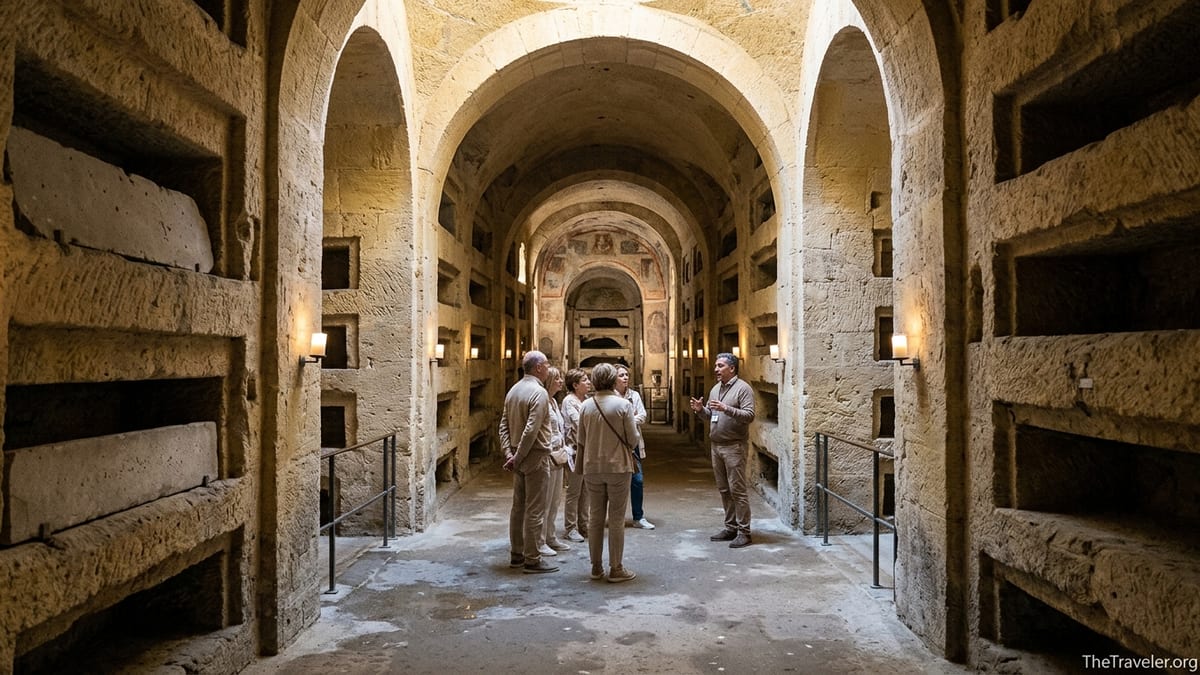
A Cathedral Carved Out of Rock, Not a Narrow Tunnel
If your mental image of catacombs comes from Paris or horror films, the first surprise at San Gennaro is the sheer scale of the underground basilicas. Instead of tight corridors, you step into vast spaces carved into the soft yellow tuff beneath the Basilica of San Gennaro extra Moenia. Some visitors compare the main chamber to a subterranean church more than a burial ground, with broad aisles, high ceilings and a real sense of volume.
Guides often start by dimming the lights slightly before illuminating different sections in turn. The effect is disorienting and impressive. From the upper gallery you can look across to see pillars rising from the rock and arched burial niches cut into the walls in stacked rows. It is closer to walking into a hollowed-out cathedral than a cramped mausoleum. For many travelers, this first view instantly overturns expectations of claustrophobic tunnels.
On recent tours, guides from the local cooperative La Paranza like to point out how the early Christians engineered the spaces. You see ventilation shafts and drainage cuts, subtle but essential details if you imagine hundreds of burials over several centuries. Instead of a chaotic warren, the catacombs feel almost urban in their planning, with “streets” and side chapels opening off a central axis. It is organized, deliberate, and surprisingly easy to navigate, even if you are mildly nervous about underground spaces.
The scale also affects sound. When a group falls silent, the guide’s voice carries in a soft echo, and the scrape of a shoe on the stone floor sounds louder than you expect. It is one of the few archaeological sites where even children tend to hush themselves, not out of fear but because the space itself feels like a sacred underground hall.
Color in the Dark: Frescoes, Mosaics and Painted Tombs
Another thing most visitors never expect in catacombs is color. Yet both San Gennaro and San Gaudioso preserve early Christian frescoes and painted tombs, fragments of a world that is usually left to museum walls. In San Gennaro, a side chamber still shows portraits of local bishops with carefully outlined eyes and stylized robes. Under the guide’s flashlight, reds and ochres reappear from the seemingly gray rock.
Instead of the highly finished art you might see in the National Archaeological Museum, these paintings are rougher and more intimate. A tiny painted fish, a simple cross, a vine winding around a niche: details that once spoke directly to families returning to visit their dead. Guides sometimes compare them to handwritten notes in a book margin, visual reminders that this was a place of memory long before it became an attraction with scheduled tours and ticket prices starting around 13 euros for adults.
In San Gaudioso the artwork becomes stranger and more theatrical. Seventeenth century Dominican monks partially reused the older paleo-Christian spaces, covering some walls with frescoed full-length bodies dressed in elaborate clothing. Only the real skull of the deceased was left exposed, set into the painted neck. You stand in front of rows of headless painted figures topped with genuine skulls, a powerful and almost surreal reminder of status and mortality.
Many visitors find this mix of paint and bone unnerving, yet it is one of the most unforgettable sights in Naples. The guide might point out a noblewoman identified by a faint inscription near her skull, or a Dominican friar portrayed with his habit still clearly visible. These were not anonymous skeletons, but individuals who chose this very visible form of burial, a kind of posthumous portrait gallery under the church of Santa Maria della Sanità.
Burial Rituals You Have Probably Never Heard Of
Beyond the visual impact, the burial traditions revealed in these catacombs often catch first-time visitors off guard. People expect rows of sarcophagi. Instead, they are introduced to loculi, arcosolia, and one particularly startling practice in San Gaudioso: the scolatoi, or “draining” tombs. These stone seats with holes carved into them were used in a two-stage burial ritual for wealthier Neapolitans in the early modern period.
Guides explain, often with a mix of scientific detail and dark Neapolitan humor, how the deceased body was placed upright so that bodily fluids could drain away over months. After decomposition, the cleaned bones were transferred to a more permanent niche. For modern visitors used to discreet cemeteries and closed coffins, the frankness of this ritual can be shocking. Yet within the Dominican community that managed the catacombs, it was seen as a devotional act emphasizing humility and the temporary nature of the body.
In San Gennaro, the burial system is more typically late antique. Families purchased or were granted burial niches cut into the walls, sometimes enlarging them for several relatives. Many niches were sealed with marble or terracotta slabs, some of which still show engraved Chi-Rho symbols or simple Christian messages. Today the slabs have often disappeared, leaving only the hollow impression and occasional painted outline, but the guide’s descriptions help you imagine a much more personalized space than the uniform rows suggest.
This detailed explanation of burial customs often becomes the most talked-about part of the visit. Over coffee afterward in the nearby Piazza Cavour or in a bar along Via Vergini, you hear travelers comparing the scolatoi to modern cremation, or wondering aloud how future archaeologists will interpret today’s cemeteries. The catacombs turn into a lens for thinking about how every culture, including our own, handles death and remembrance.
A Living Neighborhood’s Story Beneath Your Feet
Perhaps the most unexpected layer inside these catacombs is not ancient at all. Both San Gennaro and San Gaudioso sit beneath the Rione Sanità, a working-class district that long suffered from neglect and stigma. Many visitors arrive on the number 3 bus from the Museo stop or walk up from the National Archaeological Museum without realizing how closely their ticket money is tied to the neighborhood outside.
The guided tours in both catacombs are run by La Paranza, a social cooperative founded by young locals who began restoring and reopening the sites in the 2000s. Guides are often from families who live just a few streets away. They point with quiet pride to the way tourism revenue has funded scholarships, youth programs and even small hospitality projects like the bed-and-breakfast created in a former Dominican cloister near San Gaudioso.
Inside the catacombs this story appears not on panels but in anecdotes. A guide might pause in front of a tomb and explain how, when he was a teenager, this entire corridor was filled with rubble and trash, effectively cut off from the city. Now, thanks to regular tours priced competitively with other Naples attractions, the same space feels cared for and protected. You glimpse a side of urban regeneration that goes beyond the polished waterfront and into a neighborhood that for years was written off by many Neapolitans.
Travelers who come only for an atmospheric underground walk often leave talking about the cooperative instead. It is not unusual to hear visitors ask how to tip or donate further, or to plan a follow-up stop at a local pizzeria on Via Arena alla Sanità or Via Sanità to keep spending in the district. In that sense, the catacombs become an unexpected bridge between ancient history and the present-day social fabric of Naples.
Practical Surprises: Climate, Comfort and Crowd Patterns
Even the physical experience underground brings surprises. Many people expect the catacombs to be cold and damp. In reality, the tuff stone keeps a stable temperature year-round, often cooler than the street in August but noticeably milder than outside in January. Light layers are usually sufficient; a heavy coat can feel cumbersome when you are navigating gentle slopes and short flights of stairs.
The floor is mostly level, but it is still uneven rock, so guides strongly recommend closed shoes with decent grip instead of sandals. Flash photography is limited or discouraged to protect the frescoes, but strategically placed lighting makes it easier to move than many visitors expect. Those who worry about claustrophobia are often reassured by the relatively generous width of the main corridors, especially in San Gennaro.
From a planning perspective, another surprise is the strictly guided format. You cannot wander on your own as you can in some Roman catacombs. Tours typically last around one hour per site, with combined tickets covering both San Gennaro and San Gaudioso often valid for several days. Standard adult prices start at roughly the cost of a simple trattoria lunch in the historic center, with discounted rates for students and children.
Crowd patterns are also counterintuitive. Many travelers assume these catacombs are a niche attraction and arrive without reservations, only to find that English-language tours at peak times in spring and early autumn can sell out a day or two ahead. Meanwhile, late afternoon slots on weekdays or early morning winter departures often have far fewer participants. Booking in advance online or through your hotel desk is increasingly wise, especially if you want to combine both sites in the same day as part of the popular “sacred mile” walking route across the district.
From Martyrs to Refugees: Layers of Faith and Identity
Most guidebooks briefly mention that San Gennaro is the patron saint of Naples. Inside the catacombs, the story becomes much more tangible. In one chamber, the guide stops at the spot traditionally associated with the transfer of San Gennaro’s relics in late antiquity. Nearby frescoes and inscriptions reference not just him but earlier figures like Saint Agrippinus, the city’s first patron, reminding you how fluid and political saintly patronage could be in a metropolis that kept reinventing itself.
San Gaudioso brings a different narrative. According to tradition, Gaudiosus was an African bishop, exiled and shipwrecked in the Bay of Naples in the 5th century, who founded a monastic community and was buried in the catacombs that now bear his name. Standing by his supposed tomb, you realize that refugees and displaced people were shaping Neapolitan identity 1,500 years ago, just as new waves of arrivals do today in the streets above.
Guides sometimes weave in stories of the catacombs’ later uses, including as bomb shelters during the Second World War, when residents took refuge underground from air raids. For many visitors, this link between ancient tunnels and modern conflict is unexpected and moving. The same spaces that hosted early Christian liturgies and baroque skull chapels also sheltered families in the 1940s, adding yet another layer of meaning to the rock.
Religious or not, travelers often describe a quiet emotional shift as they move through these overlapping histories. A teenager might arrive intrigued by skulls and dark passages, then leave discussing how communities remember trauma. A parent might initially frame the visit as an educational stop between pizza meals, only to find their children asking thoughtful questions about faith, death and migration as they climb back into the sunlight of the Piazza Sanità.
Navigating Between San Gennaro and San Gaudioso in One Visit
On a map, the catacombs of San Gennaro and San Gaudioso look relatively close, both perched along the slope that rises toward Capodimonte. In practice, the route between them reveals another set of surprises. Many visitors expect a sterile museum corridor connecting two similar sites. Instead, you emerge onto busy neighborhood streets, passing fruit sellers, shrines in street corners, laundry strung across alleys and the dome of Santa Maria della Sanità hovering above the traffic.
A typical combined visit starts at San Gennaro, near the Capodimonte park. After the tour, you might walk downhill in about 15 to 20 minutes, following local guidance past vantage points with views toward Vesuvius, until the streets tighten into the Sanità district. Suddenly you are crossing one of Naples’ most atmospheric bridges and entering the piazza in front of Santa Maria della Sanità, where scooters weave around the tram tracks.
Here, the entrance to San Gaudioso hides almost in plain sight inside the basilica. Visitors used to conventional museum signage are often surprised to find that their guide meets them directly in the church, sometimes while a local Mass or baptism is taking place in a side chapel. This coexistence of everyday parish life and centuries-old burial site underlines how deeply integrated the catacombs remain in the neighborhood’s identity.
Because the ticket for one catacomb usually includes access to the other within a set time period, travelers can spread their visits over two days. Some opt to see San Gennaro in the cooler morning, then return another afternoon just for San Gaudioso and to sample pastry shops and trattorias around Piazza Sanità. The result is an experience that feels less like a single sightseeing stop and more like an evolving relationship with one corner of the city.
The Takeaway
What most visitors never expect inside the catacombs of San Gennaro and San Gaudioso is how human these underground spaces feel. Yes, there are skulls, niches and rituals that challenge modern comfort zones. Yet there are also painted faces, family tombs, refugee stories and the voices of young Neapolitans guiding you through the dark with practiced ease.
Instead of a grim curiosity, the catacombs reveal themselves as a kind of underground archive of Naples. Early Christian bishops share space with baroque nobles, African exiles, Dominican friars and families from the 1940s seeking shelter from bombs. Above them, today’s residents are rebuilding pride in a district long overlooked, using ticket revenues and storytelling to carve out new possibilities.
If you arrive expecting only eerie corridors and a handful of bones, you will leave with something more complicated and more rewarding: a sense that Naples is not just chaotic streets and bright sunlight, but also a city that has always known how to live, worship and even resist in the shadows. In the cool quiet beneath San Gennaro and San Gaudioso, Naples’ past and present meet in ways that few travelers see coming.
FAQ
Q1. Are the catacombs of San Gennaro and San Gaudioso scary or claustrophobic?
For most visitors, no. The main corridors in San Gennaro are wide and high, more like a rock-cut church than a narrow tunnel, and San Gaudioso, while smaller, still offers enough space to move comfortably. If you are very claustrophobic, discuss your concerns with the guide at the entrance so they can advise you on the easiest parts of the route.
Q2. How much time should I plan for visiting both catacombs?
Each guided tour usually lasts around one hour, plus a short time at the entrance for ticket checks and introductions. If you plan to walk between San Gennaro and San Gaudioso and perhaps stop for a coffee or snack in the Sanità district, set aside at least half a day to avoid feeling rushed.
Q3. Do I need to book tickets in advance?
Booking in advance is increasingly recommended, especially for English-language tours in spring, summer and early autumn. While you can sometimes get same-day spots on weekdays or in the low season, weekend time slots and late-morning departures often sell out at least a day or two ahead.
Q4. What should I wear inside the catacombs?
Wear comfortable closed shoes with good grip, as the stone floors can be uneven. The temperature underground is fairly stable and mild, so a light layer or thin sweater is usually enough. Because both catacombs are also religious spaces, modest clothing that covers shoulders and knees is appreciated, especially at San Gaudioso where you enter through an active church.
Q5. Are the catacombs suitable for children?
Many families find the catacombs engaging for children aged around seven and older, especially those curious about stories, tunnels and history. The guides are used to mixed-age groups and often adjust their explanations. Sensitive children may find the skulls and burial explanations intense, particularly at San Gaudioso, so it can help to discuss what they will see beforehand.
Q6. Can people with limited mobility visit the catacombs?
The catacombs involve slopes, some steps and uneven surfaces, and they are carved into ancient rock, so full accessibility is limited. However, San Gennaro in particular has wider passages and may be manageable for some visitors with moderate mobility issues who can handle short staircases. It is best to contact the ticket office in advance with specific needs so they can explain what is realistically possible.
Q7. Is photography allowed inside?
Non-flash photography is generally allowed for personal use, but tripods, bright lights and flash are usually restricted to protect the frescoes and avoid disturbing the group. Always follow your guide’s instructions; in some sensitive areas they may ask you to put cameras and phones away so everyone can focus on the explanations.
Q8. How do I get between San Gennaro and San Gaudioso without a car?
Most visitors either walk or use public transport. A common route is to start at San Gennaro, then walk downhill through the neighborhood to Santa Maria della Sanità for San Gaudioso, which takes about 15 to 20 minutes at a relaxed pace. Alternatively, local buses link the Capodimonte area with stops near the Sanità district and the historic center.
Q9. Can I visit only one of the two catacombs?
Yes, you can visit just San Gennaro or just San Gaudioso, depending on your interests and time. However, combined tickets are common and offer good value, and experiencing both sites gives a fuller picture: San Gennaro for its vast early Christian spaces, San Gaudioso for its unique skull-lined frescoes and baroque burial rituals.
Q10. Is it necessary to speak Italian to enjoy the tours?
No. Regular tours are offered in Italian and in other languages, typically including English at scheduled times. When you book, you can choose your preferred language slot. Even if you join an Italian tour, many guides speak enough English to answer basic questions before or after the main visit.