


Florence is the ideal springboard for exploring Tuscany, and two of the most tempting targets for a day trip are Arezzo and Siena. Both offer superb art, striking medieval streetscapes and rewarding food experiences, but they deliver them in different ways. Understanding how you actually get there, what it costs, and what you can realistically see in a single day is the key to choosing the right destination for your trip.
Get the latest updates straight to your inbox!
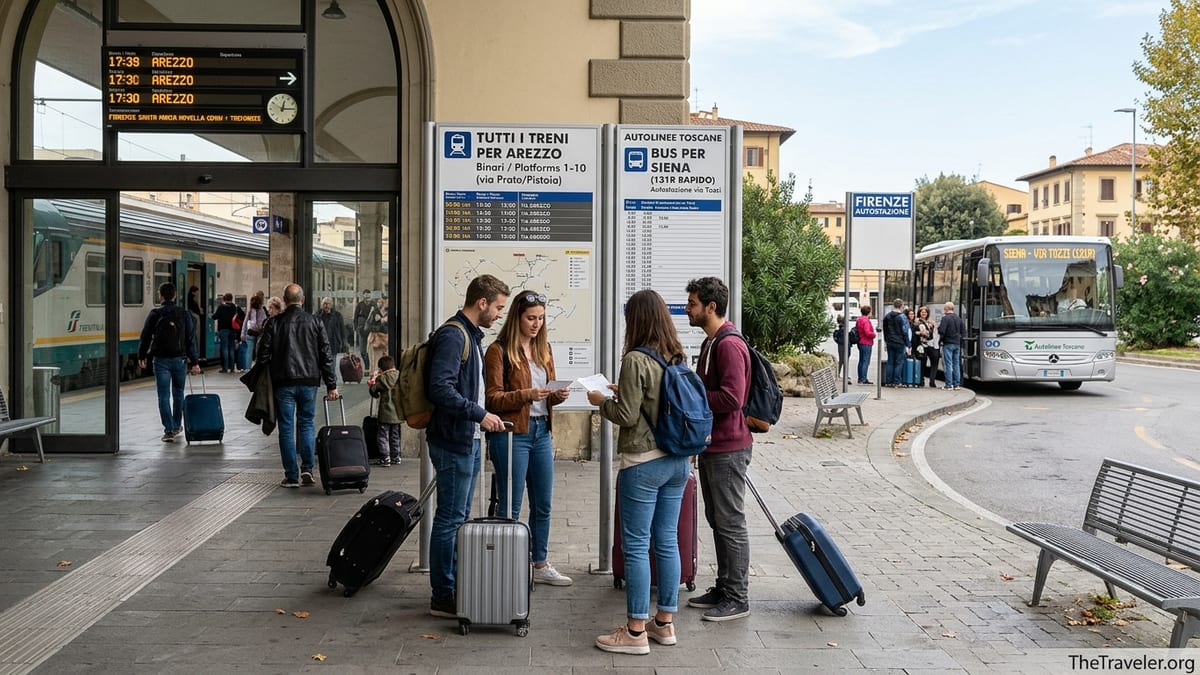
Getting There: Trains to Arezzo, Buses and Trains to Siena
The most practical distinction between Arezzo and Siena as day trips from Florence begins with transport. Arezzo is firmly on the main Florence–Rome rail corridor, so Florence Santa Maria Novella has frequent direct regional trains to Arezzo throughout the day. Recent Trenitalia timetables show morning Regionale services taking about 1 hour 15 minutes from Florence to Arezzo, with many departures each hour at peak times and standard regional fares around 9 to 11 euros one way in 2026. That makes Arezzo a straightforward rail outing where you simply board at Santa Maria Novella and ride directly into the historic city.
Siena sits on a secondary rail line with slower speeds and some indirect services via Empoli. Current schedules indicate a mix of direct Regionale trains and connections, with typical journeys between Florence and Siena taking roughly 1 hour 30 to 1 hour 40 minutes and walk-up regional fares quoted around 12 euros one way. Although there are direct trains, travelers often find the bus a better option for Siena, largely because of where each mode drops you in relation to Siena’s hilltop center.
Autolinee Toscane operates the Florence–Siena intercity buses, including the rapid 131R service. Winter and autumn timetables show multiple daily departures from Firenze Autostazione, just a short walk from Santa Maria Novella station, to Siena’s central Piazza Gramsci area in roughly 1 hour 15 minutes in light traffic. Fare bands introduced from August 2026 place a single Florence–Siena ticket in the 8 to 11 euro range, depending on the exact stops, and the operator recommends using its website or app to see the precise fare for your date and route. The same channels show the last 131R buses back to Florence on many weekdays in the early evening, typically before 21:00, so day trippers need to check late return times carefully.
In summary, Arezzo is more clearly a train destination from Florence, with frequent, relatively fast Regionale services and simple ticketing. Siena, by contrast, gives you a real choice between a reasonably quick direct bus that arrives closer to the medieval center and a slower rail option that may require more local connections and extra walking or escalators before you reach the sights.
Arriving in Town: Stations, Bus Stops and the Walk into the Historic Centers
Arezzo’s railway station sits on mostly level ground at the edge of the compact city, and this makes arrival pleasantly straightforward. From the station forecourt, the walk to the historic heart around Piazza Grande is about 15 to 20 minutes on foot. The first part is nearly flat, as you follow Corso Italia and adjoining streets, then the route climbs steadily but not brutally as you near the upper town. Even with a small roller bag, most travelers find it manageable, and there are frequent local buses and taxis outside the station if you prefer to avoid the final incline up to the Duomo and the Medici Fortress park.
Siena is different because of its topography. The Siena railway station lies in a lower modern district roughly 2 kilometers from Piazza del Campo, with the old city sitting on higher ridges above. To reach the center on foot you either climb a sequence of steep urban streets or use a multi-part escalator system and underground corridors that lift you toward the historic core. This journey usually takes 20 to 30 minutes and can be tiring in summer heat or with mobility issues, even with the escalators.
Travelers who arrive in Siena by 131R bus usually disembark near Piazza Gramsci or the adjacent Via Tozzi. This area is already inside the historic walls and only about a 10-minute mostly level walk from Piazza del Campo. Siena Cathedral is another 5 minutes uphill from the Campo, so the overall ascent is gentler and more direct than from the rail station. For day trippers with limited time or who are sensitive to steep climbs, this difference in arrival points is significant, and it is a major reason many visitors prefer the bus when choosing Siena over the train.
In everyday practice this means that a Florence–Arezzo itinerary can happily revolve around train timings, while a Florence–Siena itinerary often starts with checking the Autolinee Toscane schedule to see which combination of bus departure, walking time and return options fits your day best.
Art and Atmosphere: Piero della Francesca in Arezzo vs the Duomo Complex in Siena
Arezzo’s star attraction for art lovers is the Basilica di San Francesco and its Bacci Chapel, home to Piero della Francesca’s celebrated fresco cycle The Legend of the True Cross. Local tourism information and official booking channels state that entry to the frescoed chapel is strictly controlled, with small groups admitted at set times and a maximum stay that is carefully enforced. Recent guidance from Discover Arezzo confirms that reservations are compulsory and must be made together with ticket purchase, especially in peak seasons, because the chapel has limited capacity and popular time slots can sell out well in advance.
Beyond San Francesco, Arezzo rewards slow wandering. Piazza Grande slopes dramatically, surrounded by medieval palazzi, loggias and the crenellated Palazzo della Fraternita dei Laici. The Cathedral of Arezzo crowns the upper town with stained glass windows and frescoes, while the Medici Fortress gardens offer sweeping views across the Tuscan countryside. The city’s atmosphere can feel more local and workaday than Siena’s; businesses serving residents share the streets with antique shops, enotecas and small artisans, giving a balanced feel between tourism and daily life.
Siena’s art experience centers on its monumental cathedral complex. The OPA SI PASS, detailed on the official Opera Duomo site, includes entry to Siena Cathedral, the Piccolomini Library, the Baptistery, the crypt, the Museo dell’Opera, the panoramic Facciatone terrace and associated spaces. Information from the cathedral authorities notes that the pass is valid for three consecutive days from purchase and is designed so visitors can complete the core itinerary in about two hours, although many travelers linger much longer. During special periods when the cathedral’s marble floor is fully or partially uncovered, between late June and late October in 2026, timed entry and advance purchase are strongly recommended because capacity is limited and the most popular slots frequently book out.
In practical terms, art lovers will find Arezzo more focused and intimate: you plan your visit around a timed entrance to one extraordinary Piero cycle and then explore a compact set of additional churches and museums. Siena offers a broader and perhaps more overtly spectacular package, with golden mosaics in the Baptistery, Renaissance frescoes in the Piccolomini Library and the chance to climb the Facciatone for bird’s-eye views of the terracotta roofs radiating around the cathedral. Deciding between them often comes down to whether you prefer the quiet intensity of a single masterpiece or the variety and scale of a cathedral complex.
Historic Streets, Events and Crowds: Antique Fairs vs the Palio
Arezzo’s historic streetscape is a pleasing tangle of medieval and Renaissance buildings that has attracted film productions but generally remains calm compared with major Tuscan icons. The city’s most famous recurring event is the Fiera Antiquaria, a major antique and vintage market held on the first full weekend of each month. On those weekends, stalls fill Piazza Grande and spill into surrounding lanes, drawing dealers and browsers from across Italy. Hotel prices and visitor numbers rise accordingly, and trains into Arezzo on Saturday mornings are busier than usual, but the crowd profile is more about collectors and Italian families than mass tour groups. On non-market weekends and weekdays, Arezzo’s lanes and squares feel relaxed and relatively uncrowded even in summer.
Siena’s historic center is more dramatic and more intensely touristed. Piazza del Campo ranks among Europe’s great medieval squares, a sloping shell-shaped space lined with cafes and dominated by the Palazzo Pubblico and its Torre del Mangia. Surrounding streets climb and fall along ridge lines, revealing one photogenic brick vista after another. This concentration of beauty draws heavy day-trip traffic from Florence and cruise excursions from coastal ports, and at peak times in high summer, the Campo and Via di Città can feel very busy.
Crowd dynamics change radically in Siena around the Palio horse races, which take place on 2 July and 16 August, with rehearsals and contrada events filling the preceding days. On and around those dates, accommodation within the center is booked out well in advance, restaurant reservations become harder to secure, and transport into the city is heavily subscribed. Visiting Siena during the Palio can be thrilling but is not ideal for a first, leisurely look at its monuments. By contrast, Arezzo’s monthly antique fair and its medieval Giostra del Saracino tournaments attract spikes of visitors but rarely overwhelm the city in the way Siena experiences during Palio season.
For travelers seeking an ordinary weekday experience, this means Arezzo is more likely to provide wide, walkable streets and easy access to viewpoints without jostling for space. Siena, especially in peak tourist months, rewards a slightly earlier start and strategic timing of visits to Piazza del Campo and the Duomo to avoid the noon and mid-afternoon surges.
Reservations, Tickets and Typical Costs
Both cities now expect visitors to organize key tickets ahead of time, but they differ in rigidity. In Arezzo, the Legend of the True Cross in the Bacci Chapel operates with mandatory reservations. The local tourism board explains that you choose a specific time slot when buying your ticket and that only a limited number of visitors may enter at once. Same-day tickets are sometimes available in low season, but anyone coming from Florence for a single day should book online or through official channels before traveling, because that fresco cycle is the main reason many people visit the city.
Siena’s Duomo complex uses the OPA SI PASS as its principal ticket. Official information indicates that the pass covers multiple sites with one purchase and is valid for three consecutive days, allowing some flexibility in how you schedule your visits. While walk-up tickets are often available outside the busiest weeks, the cathedral administration highlights periods of high demand, particularly when the marble floor is uncovered or during major holidays, when advance purchase lets you secure an entry window and reduces waiting time at ticket offices. Extremely popular add-ons, such as the Porta del Cielo rooftop tours, are strictly timed and usually sell out early in busy seasons.
On the cost side, a Florence–Arezzo day trip in 2026 typically involves two regional train tickets at around 9 to 11 euros each way, a reserved entry to the Bacci Chapel priced in the low to mid-teens of euros, and perhaps one or two additional modest museum or church admissions, many of which sit under 10 euros. A Siena day trip built around the OPA SI PASS will usually start with two bus or train tickets at roughly 8 to 12 euros each way and a cathedral complex pass in the mid- to high-20s per adult, according to current posted pricing ranges. Extras like climbing the Torre del Mangia or visiting smaller civic museums add further modest costs.
Because transport and admissions change regularly, the most reliable approach is to treat these figures as examples based on current schedules and pricing bands rather than fixed totals. Before departure, travelers should check Trenitalia’s official booking channels for latest fares and timetable variations and the Autolinee Toscane travel planner or app for the up-to-date Florence–Siena bus schedule and ticket prices.
Food, Prices and Overall Cost for a Day Trip
Arezzo and Siena both sit in central Tuscany and share many culinary foundations, including ribollita vegetable soup, pici or tagliatelle pasta with ragù, and grilled meats. Where they differ is in the level of tourist demand and the consequent pricing, particularly in the most scenic squares. In Arezzo, lunch in a trattoria a few minutes’ walk from Piazza Grande often runs in the 15 to 20 euro range for a pasta dish, a glass of house wine and water, based on recent local menu checks. A more complete sit-down meal with antipasto, main course and dessert for two, without expensive wines, might land in the 50 to 70 euro band depending on location and choices.
In Siena, restaurants directly on Piazza del Campo often charge a noticeable premium. A simple lunch of salad or pasta and a drink on the square can easily exceed 25 euros per person once service charges are factored in. However, just a few streets away in less prominent lanes, plenty of osterie and wine bars offer lunch options closer to 18 to 22 euros per person for a plate of handmade pici all’aglione, water and a glass of local Chianti. Traditional Sienese sweets such as ricciarelli and panforte, widely sold in pasticcerie around the center, add a few more euros to daytime snacking costs.
Putting these pieces together, a realistic solo day-trip budget in 2026 might look like roughly 60 to 90 euros for Arezzo, including return train fares, fresco ticket, a coffee, lunch, a second museum or cathedral visit and a late-afternoon aperitivo. Siena, by contrast, could fall in the 80 to 120 euro per person range once return transport, an OPA SI PASS, one or two additional attractions and central meals and drinks are included. Couples tend to benefit from shared bottles of wine and splitting larger dishes, but admission and transport scale linearly, so a couple’s Siena day can comfortably approach 180 to 220 euros if they include multiple paid sites and a full dinner before returning to Florence.
Overnight stays alter the math slightly. Mid-range double rooms in Arezzo just off the historic core often price somewhat below equivalent accommodation in Siena that is close to Piazza del Campo or the Duomo, particularly outside Palio dates and major festivals. Staying over in either city allows you to shift a substantial evening meal and several drinks from Florence prices to local ones, and in Siena’s case it gives access to quieter early morning and late evening photography windows when day trippers have departed.
One-Day and Two-Day Itineraries for Each City
A practical Arezzo day trip from Florence might start with a morning Regionale train around 8:00, arriving about 9:15. From the station you could walk up Corso Italia, pausing for coffee and a pastry at a local bar, then continue toward the Basilica di San Francesco in time for a late-morning reserved entrance to the Bacci Chapel. After absorbing Piero della Francesca’s frescoes, you might stroll uphill to the Cathedral and the Medici Fortress gardens for expansive views before a relaxed lunch near Piazza Grande, perhaps sampling crostini with chicken liver followed by handmade pasta.
The afternoon could be spent browsing antique shops and smaller galleries around Piazza Grande, or visiting the Museo di Arte Medievale e Moderna if open hours align. A late-afternoon gelato or aperitivo back near the station would precede a 17:30 to 18:30 train back to Florence. For a two-day variant, you might stay overnight in a guesthouse above the old town, allowing an evening passeggiata and dinner in one of the vaulted restaurants off Piazza Grande, then use the next morning for a leisurely museum visit or a side trip by local train toward Cortona before returning to Florence in the afternoon.
A Siena day trip might begin with a 131R bus departing Florence in the 8:00 to 9:00 window, putting you near Piazza Gramsci around 9:30 or 10:00. From there, walk into the center and head first to the Duomo ticket office to pick up your OPA SI PASS, timing cathedral entry earlier in the day before crowds build. You could spend the rest of the morning exploring the cathedral interior and Piccolomini Library, then descend to the Baptistery and crypt before breaking for lunch in a side-street osteria.
After lunch, move to Piazza del Campo to tour the Palazzo Pubblico and its frescoed council chambers, then climb the Torre del Mangia if you have pre-booked a slot and are comfortable with steep stairs. Late afternoon can be devoted to wandering the quieter contrada neighborhoods, visiting the Basilica of San Domenico or simply lingering in the Campo with a coffee while the light softens on the brick facades. A late bus or train returns you to Florence in the early evening. With an overnight stay, you could arrive later on day one, dine overlooking the Campo, then use the early morning of day two for photography from the Facciatone terrace and walks through backstreets that feel surprisingly uncrowded before midday visitors arrive.
In both cities, longer stays reward those who want to savor local rhythms rather than just tick sights off a list. Arezzo invites you to step into a Tuscan provincial center where daily life and tourism coexist gently, while Siena offers a concentrated medieval drama that feels more theatrical and more intensely curated.
Terrain, Climate and Photography Considerations
Both Arezzo and Siena are hill towns, but they differ in how their slopes affect visitors. Arezzo’s main climbs are shorter and more contained, with the route from the station to the upper town unfolding as a steady uphill walk rather than a series of punishing spikes. Older travelers and those with mild mobility limitations often report that with sensible pauses and comfortable shoes, the ascent is manageable even in warmer months. Side streets can be steep, but much of the exploring around Piazza Grande and the Cathedral takes place within a relatively compact area once you have gained height.
Siena, in contrast, is built across multiple ridges and valleys, so exploring between the Campo, the Duomo and secondary churches means frequent elevation changes. Even fit travelers notice the cumulative effect of ascents and descents in summer heat. While escalators from the station reduce the initial climb into town, there is no mechanical help in the medieval core itself. Travelers with knee issues or those pushing strollers may find the repeated slopes more challenging than in Arezzo, and should factor in extra time for rest stops in shaded squares.
Summer temperatures in inland Tuscany can climb well above 30 degrees Celsius from late June through August, and stone-paved streets reflect heat into the afternoons. In that context, Arezzo’s relative lack of crushing crowds can make it feel more comfortable, as breezes circulate more easily and shaded corners are easier to claim. Siena’s tighter lanes around major attractions can feel noticeably hotter and more airless at mid-afternoon, encouraging early starts and late-evening strolls when the brick takes on a warm glow without radiating as much heat.
For photographers, both cities are rich hunting grounds. Arezzo offers layered views from the Medici Fortress over terracotta roofs toward distant hills, and the sloping Piazza Grande creates striking perspective lines, especially in the golden hour. Siena delivers iconic shots of Piazza del Campo from above and below, the zebra-striped Duomo framed between lanes, and rooftop panoramas from the Facciatone or Torre del Mangia. However, those viewpoints require climbing significant stairs, which again favors travelers who are comfortable with exertion in variable weather.
Verdict: Which Day Trip Wins for You?
When weighing Arezzo against Siena as a day trip from Florence, it can help to think in categories. For Renaissance art, Arezzo has the edge thanks to Piero della Francesca’s Legend of the True Cross, which rewards focused, close-up viewing that is easier to savor in a quieter chapel with controlled numbers. Siena still offers powerful religious art across its Duomo complex and civic museums, but its appeal leans more toward the overall ensemble of marble, mosaics and frescoes than a single, defining cycle.
For medieval architecture and urban drama, Siena is the clear winner. Piazza del Campo, the soaring Duomo facade and the dense network of contrada streets together deliver the quintessential image of a Tuscan hill town. Arezzo’s Piazza Grande and upper town are handsome and historically rich, but they do not match Siena’s scale or theatrical impact.
On transport convenience, Arezzo earns top marks for Florence-based travelers who prefer trains. Direct, frequent Regionale services from Santa Maria Novella, reasonable journey times and a station within easy walking distance of the center make logistics simple. Siena’s rapid 131R bus is a good solution and deposits you near the heart of the old city, but it requires consulting separate schedules, understanding fare bands and accepting a bus-based trip rather than a straightforward mainline train ride.
In terms of crowds and overall calm, Arezzo usually offers lower visitor density outside its monthly antique fair weekends and special events, making it attractive to travelers who want a quieter, more local-feeling Tuscan city. Siena inevitably draws larger numbers, and around the Palio its narrow lanes and central squares can feel overwhelmed. Food quality is high in both cities, but Arezzo often delivers slightly better value once you step away from a handful of showcase restaurants, while Siena charges a premium for Piazza del Campo views and heritage-heavy dining rooms.
For pure day-trip value, many travelers will find Arezzo the better choice if their priorities are unhurried museum visits, a memorable but not exhausting hill-town experience, and a manageable budget. Siena is the right decision if you want the full medieval spectacle, are willing to navigate steeper streets and bigger crowds, and are happy to invest more time, energy and money into one truly grand Tuscan city. Ideally, allow enough days in your itinerary to experience both: Arezzo for intimate Renaissance art and quieter streets, Siena for monumental architecture and the thrill of a living medieval city.