


More news on this day
Flights across Argentina are expected to face delays and possible cancellations on Thursday and Friday as a 48-hour airport strike called by civil aviation workers targets peak travel hours at dozens of terminals.
Get the latest news straight to your inbox!
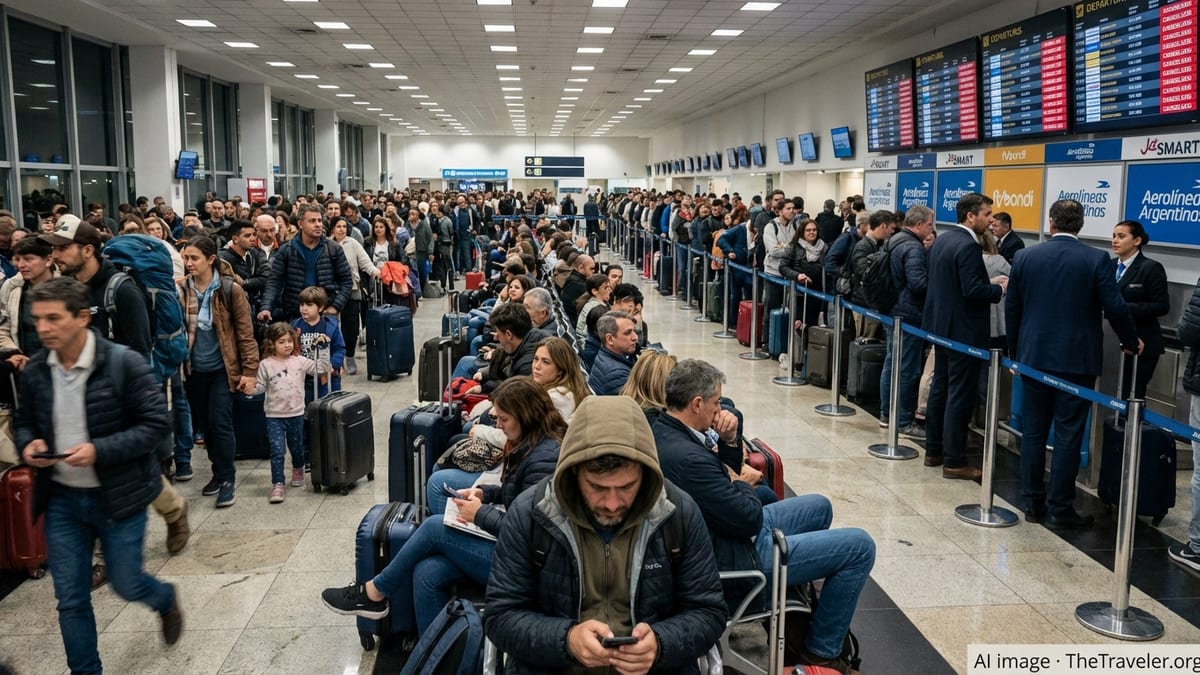
Strike to hit 27 airports during peak travel windows
Publicly available information indicates that workers from Argentina’s National Civil Aviation Administration (ANAC), grouped in the State Workers Association (ATE), plan a 48-hour protest that will affect airport operations on Thursday, September 3, and Friday, September 4. The action focuses on two daily time bands, from 9 a.m. to 12 p.m. and from 6 p.m. to 9 p.m., when traffic is typically busiest.
Reports from local media state that at least 27 of the country’s roughly 40 commercial airports are included in the measure, among them the main international gateway, Ministro Pistarini International Airport in Ezeiza near Buenos Aires, and Jorge Newbery Airport in the city’s riverside Aeroparque district. Regional hubs in cities such as Córdoba, Mendoza, Bariloche and Iguazú are also expected to experience operational impacts.
The protest is structured as a series of stoppages, assemblies and demonstrations within those time slots, rather than a continuous 48-hour shutdown. Outside the designated hours, airports are expected to operate under more normal conditions, although knock-on delays could continue throughout the day as airlines work through backlogs.
Government communications and press reports highlight that Argentina’s aeronautical sector is classified as an essential service, which requires a minimum level of coverage during industrial action. Authorities have indicated that at least 75 percent of normal services must be maintained during the strike windows, an obligation that could limit the scale of disruption but is unlikely to eliminate it entirely.
Who is striking and which services are affected
The announced action involves state employees working under ANAC rather than airline staff directly. According to published coverage, participants include ground traffic coordinators, airport firefighters, health and emergency personnel, safety inspectors and administrative workers stationed across the national airport network.
These groups are responsible for critical safety and operational tasks on the ground, including runway oversight, fire and rescue response and regulatory inspections. Even with a legal requirement for minimum service, reductions in staffing in these areas can slow boarding, turnaround times and aircraft movements, creating bottlenecks for both departures and arrivals.
Union communications reproduced in the local press emphasize that air traffic controllers, pilots, cabin crew and other airline employees are not formally part of this specific strike call. As a result, several outlets report that widespread preemptive cancellations are not anticipated. However, analysts of the aviation sector quoted in specialized publications note that delays, rescheduling and some targeted cancellations remain likely, especially around the busiest airports.
During the work stoppage windows, workers have signaled that only a limited set of operations will receive priority, such as medical evacuations, humanitarian missions, organ transport and official flights. Commercial passengers are therefore more exposed to schedule changes during the affected hours.
Salary dispute and safety funding at the core of demands
The conflict arises from a broader salary and funding dispute between the union representing ANAC workers and the national government. Coverage in national newspapers reports that ATE accuses the authorities of failing to fully implement agreed pay increases and of delaying payments owed to staff across the civil aviation system.
Beyond wages, union communiqués reproduced by regional media highlight concerns about resources for key safety and oversight areas. In particular, ATE cites the need for dedicated funding for the airport Rescue and Fire Fighting Service, known by its Spanish acronym SSEI, and for inspection and supervision units that monitor airport operations and infrastructure.
Union leaders argue that chronic underfunding has left essential services overstretched at a time when passenger numbers have been recovering, and that work stoppages are intended to draw attention to what they describe as structural risks. Government statements, in turn, stress the obligation to uphold minimum service levels and frame the aviation sector’s essential status as a legal safeguard for travelers and commerce.
Observers of Argentina’s labor landscape note that this strike follows a series of aviation and transport protests over the past two years in response to inflation, public spending cuts and stalled wage negotiations. The airport action fits into that wider context of pressure on the government to revisit compensation and staffing in critical public services.
What domestic and international travelers should expect
Travel industry outlets and specialized aviation sites advise passengers flying to, from or within Argentina on September 3 and 4 to prepare for schedule disruptions, particularly around the two daily strike windows. Delays are considered more probable than outright cancellations, but airlines may adjust or consolidate flights if operational constraints become severe at certain airports.
Publicly available information suggests that the impact will not be uniform across the country. Major hubs at Ezeiza and Aeroparque are expected to see the greatest strain, while smaller provincial airports may experience slower processing rather than large-scale disruption. However, even limited delays at origin or destination can cause missed connections, especially on multi-leg international itineraries.
Airlines operating in Argentina have begun issuing general advisories asking customers to monitor flight status closely in the days leading up to travel and on the day of departure. Some carriers are also offering limited flexibility to rebook flights at no extra charge within a defined travel window, depending on route and fare conditions.
Travelers with tight connections, time-sensitive commitments or complex itineraries are being encouraged by industry analysts to consider adjusting plans where possible, including allowing longer buffers for transfers, carrying essentials in hand luggage and ensuring that contact details are up to date in airline reservations for real-time notifications.
Practical guidance and information sources for passengers
Public advisories emphasize that passengers should check multiple sources when confirming their plans, as conditions may evolve over the course of the 48-hour protest. Official websites of airports and airlines typically provide the most current departure and arrival information, although pages may experience high traffic during peak disruption periods.
Argentina’s national airport operator and ANAC publish flight status and operational updates online, while major carriers serving the country maintain dedicated travel alerts sections. For travelers already in transit, staff at check-in counters and boarding gates can offer route-specific guidance, though waiting times for in-person assistance may lengthen if call centers and customer service desks experience heavy demand.
Travel experts recommend that visitors to Argentina avoid making nonrefundable onward bookings during the impact window, such as domestic flight connections, long-distance bus tickets or prepaid excursions that hinge on precise arrival times. Where changes are unavoidable, retaining documentation of any disruptions may assist with later insurance or compensation claims under applicable fare rules.
Given the essential nature of civil aviation in Argentina and the legal requirement to maintain a majority of services, most analysts expect the system to continue functioning, albeit at reduced efficiency and with significant stress during the targeted hours. Passengers flying on Thursday and Friday are therefore being urged to remain flexible and informed as the situation unfolds.
Buenos Aires Herald coverage of the planned airport strike
Argentina government notice on ANAC airport assemblies