


More news on this day
Direct rail connectivity between Badgam in central Kashmir and Shri Mata Vaishno Devi Katra in Jammu is gaining fresh momentum, as the Badgam–Katra special train settles into a regular six-day schedule that promises smoother, faster journeys for residents, workers and pilgrims alike.
Get the latest news straight to your inbox!
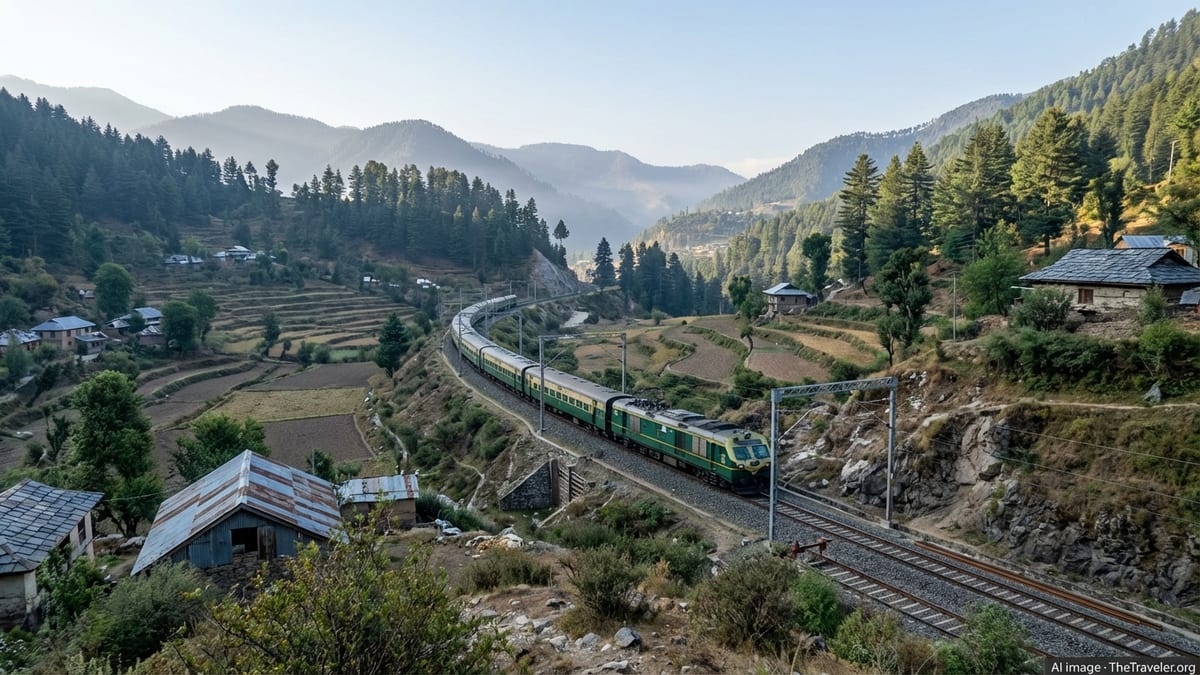
Regular Six-Day Service Reconnects Valley and Pilgrimage Hub
Publicly available timetable data shows that train numbers 04687 and 04688, operating between Shri Mata Vaishno Devi Katra (SVDK) and Badgam (BDGM), are now running on a near-daily basis, covering six days each week. The SVDK–Badgam Special departs Katra at 13:45 and reaches Badgam at around 20:00, while the Badgam–SVDK Special leaves Badgam at 07:20 and is scheduled to arrive at Katra around early afternoon, restoring a full-length link across the Pir Panjal range.
Scheduling information from multiple rail-tracking platforms indicates that the pair of specials has been structured as a regular service window rather than a limited festival or holiday run, with operations shown on Sunday, Monday, Tuesday, Wednesday, Thursday and Saturday between Katra and Badgam, and corresponding outbound departures from Badgam on matching days. This pattern effectively provides six days of direct connectivity in each direction along one of Jammu and Kashmir’s most strategically important corridors.
The service had seen interruptions earlier in the summer travel season, particularly during the peak of the Amarnath Yatra, when capacity was reallocated and sections of the route experienced temporary suspensions. Recent coverage from regional outlets reports that the trains have since resumed operations over the full Budgam–Katra stretch, reverting to their previously advertised timetable and restoring a predictable option for cross-region travel.
With both valley commuters and religious tourists depending heavily on this axis, the move toward a stable six-day schedule is being viewed in transport circles as a significant reinforcement of the Jammu–Kashmir rail bridge. For many, the Badgam–Katra pair now functions as a workhorse connection, complementing the newer semi-high-speed services on adjacent sections of the network.
Timings and Route Across the Pir Panjal
According to route charts compiled by independent rail information portals, the Badgam–Katra Special (04688) begins its run at 07:20 from Badgam and initially serves valley stations such as Srinagar, Awantipora, Anantnag and Qazigund. It then crosses the historic Banihal tunnel to enter Jammu division, continuing through Khari, Sumber, Sangaldan, Sawalkote, Dugga, Bakkal and Reasi before terminating at Shri Mata Vaishno Devi Katra after covering roughly 200 kilometres in about six hours.
The return working (04687) leaves Katra in the early afternoon, offering a through service back into the valley on six days of the week. Journey time is broadly similar in the reverse direction, with evening arrival at Badgam enabling onward local movements within central Kashmir. The pattern ensures that passengers heading towards Katra can reach in time for afternoon and evening activities, while those returning to the valley can complete their trip before late night.
Operational data suggests that this timetable has been designed to dovetail with other long-distance connections feeding into Katra and Jammu, including express and premium services from Delhi and the wider Indian network. For many riders, the direct Badgam–Katra run replaces what was previously a multi-stage journey involving a transfer at Banihal or reliance on road transport through the mountains.
In practice, the through train is cutting down waiting time at intermediate stations and simplifying ticketing for those planning end-to-end itineraries across the Union Territory. Pilgrims in particular can now treat Katra as a single-seat ride from the valley, rather than negotiating a series of handoffs between different trains and buses.
Boost for Pilgrimage and Tourism Flows
The resumption of a steady six-day direct service is expected to provide a notable lift to tourism and pilgrimage traffic. Media reports from Jammu and Kashmir highlight that the Badgam–Katra trains are especially valuable for visitors headed to the Shri Mata Vaishno Devi shrine, one of India’s most frequented pilgrimage destinations. The availability of a morning departure from Badgam allows pilgrims to reach Katra in time to begin their climb or arrange overnight stays with greater certainty.
Regional coverage also points to the benefit for those combining multiple spiritual and leisure circuits within the Union Territory. With upgraded services now linking Jammu and Katra to the Kashmir Valley, travellers can more easily integrate Vaishno Devi darshan with trips to Srinagar, Gulmarg, Pahalgam or Sonamarg, relying predominantly on rail for the long intercity legs.
Tour operators and travel planners are increasingly building these direct rail options into package itineraries, treating the Badgam–Katra special as a backbone connection alongside faster semi-high-speed trains on adjoining segments. For time-pressed domestic travellers, the simplicity of boarding a single train in the valley and alighting within walking distance of Katra’s town centre is emerging as a key selling point.
The broader impact is not limited to pilgrimage. Business travellers, government employees, students and healthcare seekers are using the service to move more efficiently between central Kashmir and the Jammu region. For many such passengers, the stability of a six-day timetable can be as important as speed, particularly during the winter months when road routes over high passes face weather-related disruptions.
Strategic Role Within the USBRL Project
The Badgam–Katra connection sits within the larger Udhampur–Srinagar–Baramulla Rail Link (USBRL), a 272-kilometre project that has progressively stitched together the Jammu plains and the Kashmir Valley. Government briefing documents note that the Baramulla to Banihal segment in the valley and the Jammu–Udhampur–Katra section in Jammu have been commissioned, with the intervening Katra–Banihal stretch forming the engineering heart of the project.
Over the past two years, trial runs and incremental openings across this challenging mountain section have paved the way for regular passenger operations. Reports of final long-distance test runs between Katra and Badgam underscored both the technical complexity and the strategic importance of the line, which traverses a series of tunnels and bridges through the Pir Panjal mountains.
With the introduction and consolidation of the Badgam–Katra specials, the corridor is transitioning from a construction-led narrative to one focused on daily utility. Regular six-day services symbolise the shift from project milestones to routine connectivity, embedding the line into the lived experience of commuters and travellers across the Union Territory.
Transport analysts point out that such through services are crucial to unlocking the full socio-economic potential envisioned for USBRL, as they convert infrastructure investments into real-world mobility gains. Steady patronage on the Badgam–Katra route can, in turn, support the case for additional services, capacity upgrades and timetable refinements in the future.
Improved Integration With Wider Rail Network
The growing regularity of the Badgam–Katra special is also enhancing integration between Kashmir’s local rail system and India’s broader rail grid. Katra functions as a key terminus for a range of long-distance trains from the north, west and central parts of the country, and the direct link to Badgam allows valley residents to tap into these routes with fewer logistical hurdles.
Public railway maps and planning documents place Badgam and Srinagar firmly within the Northern Railway zone’s ambit, connected southward via Banihal and onward to Katra and Jammu. As daily and six-day services solidify on this alignment, passengers gain more reliable options for interchanging between regional trains and cross-country expresses without lengthy road transfers.
For the tourism industry, this rail-based integration is especially significant. It enables smoother point-to-point journeys such as Delhi–Katra–Srinagar or Mumbai–Katra–Gulmarg using a combination of long-distance expresses, premium services and the Badgam–Katra special. Travel advisers note that as these patterns mature, visitors are likely to spend less time in transit and more time at destinations, potentially lifting stays and local spending.
From a policy perspective, the performance of services like the Badgam–Katra special will be closely watched as a barometer of how effectively USBRL is transforming access between Jammu and Kashmir’s two principal regions. Regular six-day operations, growing passenger numbers and increasing timetable stability on this corridor are emerging as early indicators that the ambitious mountain railway is beginning to deliver on its long-promised connectivity gains.
SVDK–Badgam Special 04687 schedule
Badgam–SVDK Special 04688 timetable