


The Arlberg is one of Europe’s classic ski regions, linking St. Anton, St. Christoph, Stuben, Lech, Zürs, Warth and Schröcken into Austria’s largest connected ski area. For a first-time visitor, the choice of villages, ticket options and transport can feel overwhelming. This guide focuses on clear, current, real-world details to help you turn a strong urge to ski Arlberg into a smooth, well planned winter holiday.
Get the latest updates straight to your inbox!
Understanding the Arlberg Ski Area
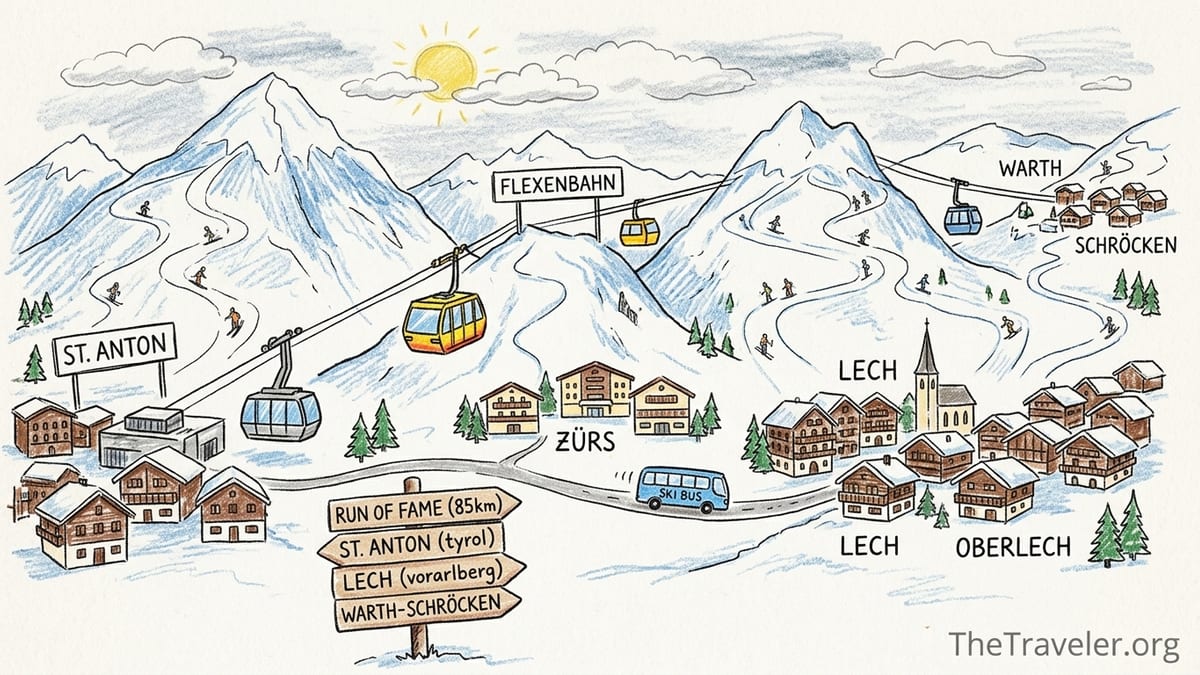
"Ski Arlberg" is the umbrella name for the interconnected lift network covering St. Anton am Arlberg, St. Christoph, Stuben, Lech, Oberlech, Zürs, Warth and Schröcken. Official figures describe roughly 300 kilometres of marked pistes and around 200 kilometres of ungroomed ski routes, all on one lift pass. The modern Flexenbahn gondola, opened in 2016, links the St. Anton side with Lech and Zürs, while the Auenfeldjet gondola connects Lech to Warth-Schröcken. In practice this means you can start in St. Anton and, without taking your skis off, reach Lech or even Warth on snow when conditions and time allow.
The area is often described in three main sectors: the eastern side around St. Anton, St. Christoph and Stuben; the western side around Lech, Oberlech and Zürs; and the northern spur to Warth-Schröcken. These labels mainly help you think about where to stay and how you will move around. For example, St. Anton has the busiest après-ski scene and a strong reputation for challenging terrain, while Lech and Oberlech attract many families and higher-end hotels. Warth-Schröcken is a little quieter, popular with freeriders for its snow record.
For a first-time visitor, it is important to understand that the sheer scale makes it impossible to "do it all" in one day. The classic "Run of Fame" circuit, which attempts to tour the entire area from St. Anton through Lech and Warth and back, covers about 85 kilometres of slopes and is usually only recommended for very fit, confident skiers who keep breaks short. Most beginners and intermediates will be happier focusing on one or two adjacent sectors per day, such as St. Anton and St. Christoph, or Lech and Zürs.
Snow conditions vary across the Arlberg, with higher, more north-facing slopes above Zürs and Warth holding cold snow well into spring in many seasons. Lower south-facing runs to village level, particularly around St. Anton late in the season, can become soft or rely on artificial snow in warm spells. When you are planning a late March or early April trip, factor in that you might download on lifts at the end of the day instead of skiing back to the village on slushy home runs.
Choosing the Right Base: St. Anton, Lech and Beyond
For many first-timers, the main decision is whether to stay on the Tyrolean side in St. Anton, St. Christoph or Stuben, or on the Vorarlberg side in Lech, Oberlech, Zürs, Warth or Schröcken. St. Anton am Arlberg is the largest village, with frequent long-distance trains, lots of ski shops, and famous après-ski bars such as MooserWirt and Krazy Kanguruh. Accommodation ranges from simple guesthouses in nearby villages like Pettneu and Flirsch to four-star hotels close to the Galzigbahn base station. This makes St. Anton a strong choice for mixed groups that want nightlife, varied dining and direct rail access.
Lech and Oberlech sit on the other side of the Flexen Pass and have a different feel. Here you find many high-end hotels, smart restaurants and a quieter, more polished après-ski scene. Condé Nast Traveller readers recently voted Lech Zürs one of Europe’s top ski destinations, reflecting the quality of its hotels and on-mountain services. Prices for accommodation and dining in Lech are usually higher than in St. Anton, but the return is ski-in ski-out convenience in Oberlech, wide intermediate-friendly slopes and easy access to both Zürs and Warth.
Zürs itself is a compact ski village on the pass road between Stuben and Lech, with several four and five-star hotels directly at the lifts. It is practical for keen skiers who want to be on the Flexenbahn or Trittkopf lifts early without village crowds. Stuben am Arlberg is much smaller, positioned at a key junction where you can ride up toward the Albona freeride terrain or cross via Flexenbahn to Zürs. For budget-conscious skiers, Stuben can offer slightly lower-priced guesthouses while still giving quick access to the full area.
Warth and Schröcken, further north, are quieter villages with a reputation for generous snowfall, as moist air from the north and west tends to dump snow on their north-facing slopes. Many Austrian families choose Warth-Schröcken for a less crowded experience than St. Anton, while still holding a Ski Arlberg lift pass. If you stay in the Lechtal valley villages such as Steeg or Holzgau you can use the regional bus to reach Warth’s Salober lifts, which is a realistic option for travellers who prioritise budget over ski-in ski-out convenience.
Lift Passes, Dynamic Pricing and What It Really Costs
The Ski Arlberg lift pass covers the entire connected area including St. Anton, Lech, Zürs, Warth and Schröcken. In recent seasons, prices have followed a dynamic model where the day rate changes depending on booking date and projected demand. A recent independent survey for winter 2026 and 2027 suggests that a 6 day adult Ski Arlberg pass costs around 468 euros, which works out at about 78 euros per day. Separate trade information from Vorarlberg businesses indicates that a typical adult day ticket for Ski Arlberg is now listed at about 81 to 85 euros in peak periods, with early or low-demand days somewhat cheaper.
This is a notable rise compared with half a decade ago, and many long-time visitors discuss the higher prices openly. For planning purposes, first-time visitors should assume that a full area adult day ticket in high season will be in the low to mid 80 euro range, and a 6 day ticket will be in the mid 400 euro range. Children and youths pay significantly less, and small children born after a certain cut-off year can often ski for a very low season-rate fee with a photo pass, but the exact reductions change over time so it is important to verify current child and youth bands in the official Ski Arlberg price calculator when you book.
The system also uses seasonal bands within the winter, with prime weeks around New Year and February school holidays priced higher than early December or mid-April. If a 6 day pass runs across two seasonal bands, a mixed price is calculated automatically at the ticket office or when purchased online. Many hotels in both St. Anton and Lech can issue Ski Arlberg passes directly at reception, which saves queuing at the lift cashier on your first morning. There is usually a 5 euro deposit for the reusable chip card, refunded when you return it at the end of your stay.
First-time visitors sometimes ask about cheaper alternatives. There is no smaller "St. Anton only" or "Lech only" ticket for the main winter season that offers a large discount, because the Arlberg marketing is strongly focused on the unified area. However, there are occasional special products such as regional passes for neighbouring valleys that include limited Arlberg days, and some multi-resort passes list Warth-Schröcken as one of several included ski areas. These options are mainly interesting for season-long or regional skiers rather than a one-week holidaymaker focused on the Arlberg alone.
Getting to the Arlberg and Moving Between Resorts
For international visitors, the main gateways are Innsbruck, Zurich and Munich airports. From Innsbruck and Zurich you can usually find direct or one-change rail connections to St. Anton am Arlberg station, which sits only a few minutes’ walk or a short taxi ride from the main Galzigbahn and Rendlbahn lifts. In winter, Austrian Rail and other operators add extra trains to cope with ski holiday demand, and St. Anton is a scheduled stop for long-distance services crossing the Alps. Many first-time visitors choose St. Anton as a base precisely because they can avoid winter mountain driving and rely on trains and local buses instead.
From St. Anton station, the Landbus Klostertal and Arlberg network and regional buses connect over the pass to St. Christoph, Stuben, Zürs and Lech. A particular example is bus line 750, which links Langen am Arlberg, Stuben, Zürs and Lech, giving public transport access to the Vorarlberg side. On the Lech side, blue local buses circulate frequently between Lech, Oberlech and Zürs, and there are further connections for Warth-Schröcken and the Lechtal valley through regional bus routes. This integrated public transport system makes it realistic to stay in one village and explore others without a car, even in mid-winter.
Within the ski region, the official Ski Arlberg ski bus network is an important part of how the lift system works. In winter, ski buses in St. Anton and nearby villages such as St. Jakob, Pettneu, Schnann and Flirsch run on timetabled routes to the main lifts. On the Vorarlberg side, local blue buses in Lech and Zürs, as well as the Warth-Schröcken ski bus between Schröcken-Unterboden and Warth-Lechleiten and the Lechtal ski bus, are free of charge when used for alpine skiing with a valid Ski Arlberg ticket. This means that a family staying in, for example, Holzgau in the Lechtal can reach the Salober base area in Warth without paying an extra bus fare if they already hold the right ski pass.
One important detail for first-timers is that some regional buses that are not labelled as local ski buses do charge regular fares. For instance, yellow Postbus services between St. Anton or St. Christoph and Lech and Zürs require a paid ticket for most of the route. If you plan to ski on one side of the area and return by bus to save time, it is worth checking at the tourist office or online timetables to see which departures count as ski buses and which are standard regional buses. As a concrete example, skiers who complete a long circuit from St. Anton to Warth sometimes choose to ride a paid bus back to St. Anton in the afternoon to avoid the time pressure of skiing back before the lifts close.
On-Mountain Experience for First-Time Visitors
First-time visitors often underestimate how complex the Arlberg piste map feels on the ground. In St. Anton alone, you have several access lifts at village level, including Galzigbahn for the main central area, Gampen and Nasserein lifts for return routes, and Rendlbahn for a separate sunny sector with its own character. Above Stuben, the Albona lifts lead into a network of less groomed ski routes and off-piste lines that are famous among experienced skiers. On the Lech side, Schlosskopf and Rufikopf lifts from the village link to wide blue and red runs that are very friendly for new or cautious skiers.
For a first-time visit, it is wise to dedicate your first full day to orientation on easier slopes close to your base. For example, if you stay in Lech, you might begin with gentle blue pistes above Oberlech, ride up to Petersboden, and then gradually explore toward Kriegerhorn, without yet attempting to reach Warth. If you stay in St. Anton and are at intermediate level, you could start on the blues and easier reds accessed from Galzig and Gampen, and only after lunch consider the link to St. Christoph and Stuben. This staged approach reduces the risk of getting stranded far from home when lifts start to close in the afternoon.
Snow safety and marked ski routes are another aspect that can surprise newcomers. The Arlberg is famous for off-piste terrain, but much of what looks like simple side-of-piste powder actually lies in avalanche-prone bowls and gullies. The ski map marks special numbered ski routes that are not groomed but are avalanche-controlled. These routes, such as the Madloch run down to Zug, are popular and can feel like an adventure for strong intermediates, yet they still demand good technique and awareness of changing snow. Truly off-piste skiing beyond these controlled routes should only be attempted with proper equipment and ideally with a certified local guide.
Weather can change rapidly across the Arlberg. St. Anton often sits under cloud and snowfall when Lech enjoys brighter spells, and vice versa. A practical on-the-ground example is that a windy storm day can shut higher lifts to Valluga or Kriegerhorn while lower tree-lined runs stay open. It is smart to check the morning lift and piste report, which is updated online and on display boards at main base stations in St. Anton and Lech, and adjust your plan. On days with poor visibility up high, many skiers focus on lower wooded sectors like the Galzig trees or the runs toward St. Christoph, where contrast is better.
Ski Schools, Guiding and Learning the Arlberg Safely
The Arlberg has a long history of ski instruction, and today each village hosts at least one established ski school. In St. Anton, the Skischule Arlberg is one of the largest in Austria, with group and private lessons in multiple languages. In Lech and Zürs, several schools offer premium small-group instruction and guiding that appeals to international guests. For a first-time visitor, booking at least one day of guiding is often the most efficient way to learn the safest and most enjoyable connections between sectors, especially when considering ambitious routes such as St. Anton to Warth.
Group lessons for adults usually run in blocks of three or five half-days, with meeting points near the main base lifts. Children’s lessons typically include supervised lunch and use gentle beginner zones such as the practice areas above Nasserein in St. Anton or near Oberlech. Prices vary by school and season, but a full day of private instruction for up to two or three people often costs several hundred euros. While that is a significant extra expense on top of lift passes, many guests find that one good day with an instructor saves time and reduces stress navigating the huge area.
Mountain guides and specialist freeride schools operate across the region, focusing on avalanche awareness and off-piste technique. Booking a guide is particularly recommended if you want to explore beyond marked routes such as the classic Valluga north-facing descents, or if you plan to ski long itineraries that depend on reading avalanche bulletins and weather fronts. Most guides will insist that each participant carries a modern avalanche transceiver, shovel and probe, which can be rented locally, and will adjust the day’s plan according to the current avalanche danger level posted by regional authorities.
For families and cautious skiers, it is equally valid to use ski school time simply to build confidence on-piste. For example, a first-time skier based in Oberlech might spend two days on the gentle slopes above the village, working with an instructor to progress from snowplough to controlled parallel turns, before venturing down the longer blue run to Lech. Similarly, a returning intermediate in St. Anton could book a "technique refresh" session focused on handling crowded afternoon pistes safely, which are a reality during peak holiday weeks.
Practical Tips, Season Timing and Crowd Management
When to visit the Arlberg is a crucial decision, especially with strong winter demand and growing global interest in the region. Early December can offer quiet slopes and attractive accommodation deals, but snow coverage down to village level is not guaranteed every year, and some valley runs may rely heavily on artificial snow. Late December through early January brings festive atmosphere, higher prices and heavy crowds, particularly in St. Anton. February, especially around school holidays in Austria, Germany, the Netherlands and the United Kingdom, is usually the busiest and most expensive period.
For many first-time visitors, late January and early March strike a good balance between reliable snow and manageable crowds. Temperatures are cold enough for quality snow on most runs, but accommodation and lift lines are slightly less intense than in peak holiday weeks. Late March and early April can still provide excellent skiing on higher slopes above Zürs, Lech and Warth, often with long sunny afternoons, but you may need to adapt your day to avoid lower slushy runs and watch for earlier closing times on key connecting lifts.
A few practical habits make a tangible difference to your experience. Buying your lift pass online in advance, where available, allows you to secure lower dynamic prices for some dates and reduces time at ticket offices. Starting early is important in such a large area; arriving at main lifts like Galzigbahn or Rufikopf shortly before opening gives you quieter first runs and more flexibility to explore. Planning your lunch away from obvious hotspots at 12:30, for example by booking a table at a slightly earlier or later time in a mountain hut near the edge of the main circuits, helps you avoid queues for both food and toilets.
Transport planning also matters. If you want to explore the opposite side of the region from your base, it can be more efficient to start the day with a ski bus. For example, skiers staying in St. Anton who want to experience the slopes above Lech and Warth sometimes take the morning bus from St. Anton to Lech, which can cut an hour or more of connecting lifts from the journey compared with skiing there entirely on snow. You then spend the day gradually working your way back on skis and lifts, using the bus only once rather than multiple times.
Is the Arlberg Right for Your First European Ski Trip?
Ski Arlberg is not the cheapest or simplest ski area in Europe, but it offers a mix of heritage, terrain variety and village atmosphere that many skiers find compelling. For a confident intermediate or advanced skier planning a first big European trip, basing in St. Anton or Lech with a full area pass delivers almost endless exploration potential. You can ski relaxed wide pistes one day, tackle the Run of Fame section by section the next, and dip a toe into controlled off-piste routes under the guidance of a local instructor.
For absolute beginners or very budget-conscious travellers, the Arlberg can still work, especially if you stay in a quieter outlying village, use the free ski buses tied to your lift pass and focus on local beginner areas rather than chasing every corner of the map. What matters most is setting realistic expectations about costs, distances and your own ability. Booking instruction early, studying the piste map in advance, and giving yourself buffer time for connections will make the region feel manageable instead of overwhelming.
Strong winter search interest in the Arlberg reflects a wider trend of skiers looking for large, snow-sure destinations with character. If you prepare with the same thoroughness you would apply to a long-haul trip, the rewards are significant. From the first glimpse of the jagged peaks above St. Anton station or the twinkling lights of Oberlech at dusk, to the satisfaction of navigating across passes and valleys entirely on skis, a first Arlberg holiday has every chance of becoming the benchmark by which you judge future ski trips.
With clear information on resorts, lift passes and transport now in hand, you can move from browsing photos to booking dates, choosing a base village and sketching out your first days on snow. The Arlberg is big, busy and sometimes expensive, but for many skiers and snowboarders, that first trip marks the beginning of a long-term relationship with one of the Alps’ most storied ski regions.