


Grindelwald has long been a classic Swiss ski base under the north face of the Eiger. In recent winters, though, search data and booking platforms show a broader audience discovering the village: non-skiers, multi-generation families and remote workers are now joining traditional ski travelers. That shift is shaping how people move around the Jungfrau region, which winter attractions are booked out first, and what visitors pay for beds and lift passes in peak season.
Get the latest updates straight to your inbox!
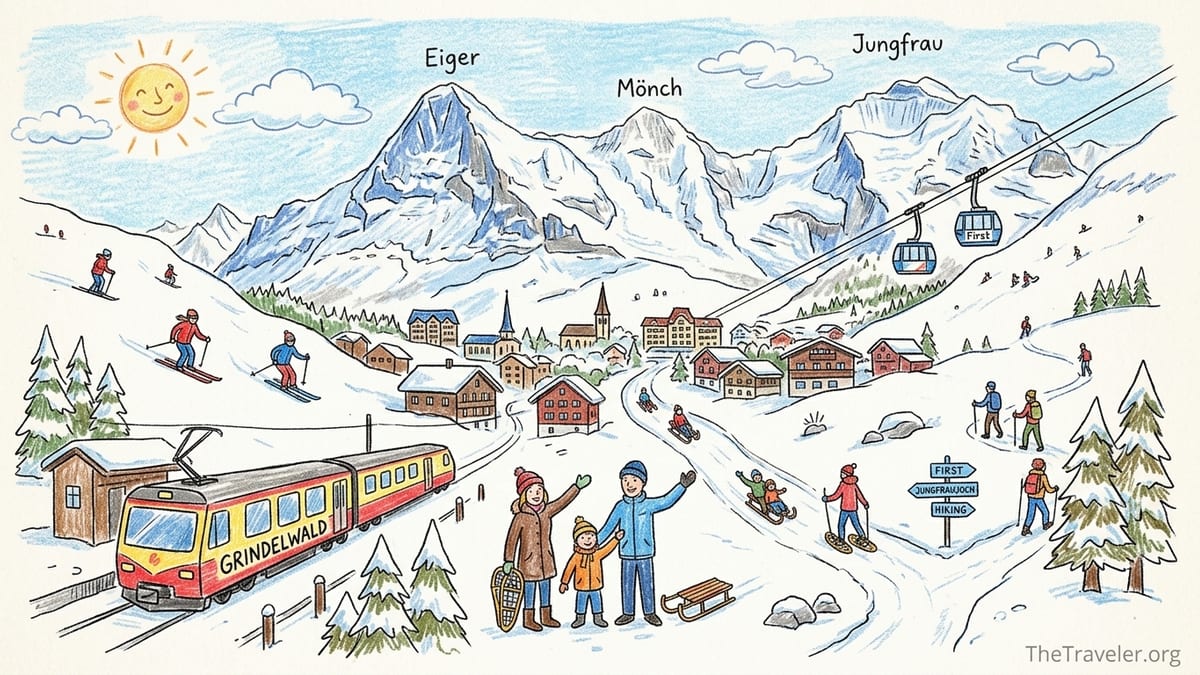
Rising winter interest and who Grindelwald now attracts
Search and booking platforms tracking European ski traffic report steady winter growth for Grindelwald and the wider Jungfrau Ski Region. Crowd-analysis tools that combine online search interest, booking statistics and school holiday calendars highlight Jungfrau as one of the resorts where winter demand increasingly extends outside the traditional Christmas and February peaks. In practice, this means weeks in January and early March that were once noticeably calmer now see stronger advance bookings, especially from international guests.
The profile of visitors has also broadened. Ski-focused outlets still market Grindelwald as an intermediate-friendly ski base linking to Wengen and Mürren, but tourism businesses locally report rising interest in non-ski winter experiences like Jungfraujoch excursions, winter hiking and tobogganing. Online travel agencies list more flexible stays of four to five nights rather than the classic Saturday-to-Saturday ski week, reflecting a mix of short ski breaks and weekend visitors who may only ski for part of their stay.
Winter demand is increasingly driven by imagery rather than piste statistics. Social media posts of the Eiger north face at sunrise, the First Cliff Walk in fresh snow and car-free streets in neighboring Wengen have helped position Grindelwald as a winter village as much as a ski resort. This has translated into stronger interest from non-skiing partners, parents traveling with small children and older travelers who want mountain scenery and comfortable transport but do not intend to ski.
For skiers, this broader appeal can be a positive. Stronger non-ski demand supports longer operating seasons for mountain railways and cable cars, keeps more restaurants and shops open on shoulder dates, and justifies investments like the V-Bahn project. For non-skiers, it means there are now clearer winter itineraries, more guided excursions available in English, and package products that do not require a full ski pass.
Understanding the Jungfrau ski offer from Grindelwald
Grindelwald sits in the Jungfrau Ski Region, shared with Wengen and Mürren. Official figures list around 200 kilometers of pistes across the linked areas, served by a mix of mountain railways, gondolas and chairlifts. From winter 2024/25, a single Jungfrau lift pass covers the major areas of Grindelwald-Wengen and Mürren-Schilthorn, so visitors no longer have to decide between separate local passes when they buy tickets for more than a day.
Recent pricing comparisons compiled for the 2026/27 season show a six-day regional pass for the Jungfrau area, including Grindelwald, projected at roughly 420 to 430 Swiss francs for an adult walk-up purchase. Daily prices for the Grindelwald-Wengen sector alone for winter 2024/25 are listed in the mid-70s Swiss francs range for adults on standard days, with small variations between low and high season dates. Many passes use dynamic or advance-purchase discounts, so travelers who commit early online, several weeks before arrival, can often pay noticeably less than the window rate.
Grindelwald-based skiers typically start their day from one of three access points. The Grindelwald Terminal complex on the valley floor houses the high-speed Eiger Express gondola to Eigergletscher for direct access to the main Jungfrau ski slopes around Kleine Scheidegg. A separate gondola from the same terminal runs to Männlichen above Wengen, opening long red and blue pistes down towards both villages. On the opposite side of the valley, the Grindelwald First gondola rises to the First ski area, a separate but included sector on most Jungfrau passes, popular for its sunny aspect and views towards the Wetterhorn.
Snow reliability in the Jungfrau area benefits from a top lift height just under 3,000 meters at Eigergletscher and extensive snowmaking on key routes like the long runs from Kleine Scheidegg to Grund. Lower valley runs into Grindelwald can be thin in warm spells, particularly early and late in the season, but mid-winter visitors who focus on the higher slopes normally find consistent conditions. Official snow reports from Swiss tourism show lifts typically opening in mid-December and running into late March or early April, with precise dates each season depending on snowfall.
Mountain transport: how to move around without a car
One of Grindelwald’s key advantages for both skiers and non-skiers is integrated mountain transport. The Bernese Oberland Railway brings visitors from Interlaken Ost to Grindelwald village and the newer Grindelwald Terminal station, which opened in 2019 specifically to link with the cable cars. Trains run throughout the day, and visitors with Swiss Travel Passes or regional passes often find the rail segment included or heavily discounted up to Grindelwald or Grindelwald Terminal.
From Grindelwald Terminal, the V-Bahn project completed in 2020 revolutionized access to the high Alps. The Eiger Express tri-cable gondola now carries passengers from the terminal to Eigergletscher in around 15 minutes, cutting total travel time from Grindelwald to Jungfraujoch by close to 45 minutes compared with the previous all-rail route. A parallel gondola connects the terminal with Männlichen, giving immediate access to ski slopes and winter hiking trails above the treeline. For non-skiers, riding these cable cars purely for the views, then walking short panoramic paths or visiting mountaintop restaurants, has become a key part of winter itineraries.
Prices for mountain transport vary by route and season, but current Jungfraubahn tariff sheets list a return journey from Grindelwald Terminal to Jungfraujoch via Eigergletscher at close to 200 Swiss francs per adult at the standard rate, with savings for holders of Swiss half-fare and regional passes. To contain costs, many visitors now book combination products such as the "Top of Europe" add-on to multi-day ski passes, which offers a heavily discounted one-off Jungfraujoch trip for around 60 Swiss francs on top of an existing pass of three days or more.
Within the village and to surrounding sledging areas, GrindelwaldBus runs winter routes to places like Bussalp and Waldspitz. A popular Bussalp sledging package in the 2024/25 winter flyer is advertised at about 30 Swiss francs and includes bus transport, sledge rental and multiple rides on the sledging route, which is particularly appealing for families who want a structured half-day without the logistics of separate equipment hire. For many visitors, this kind of door-to-snow transport replaces the need for a rental car entirely, especially because parking at Grindelwald Terminal’s multi-story structure is ticketed and can become a significant additional daily cost.
Winter attractions for skiers
For skiers, Grindelwald’s main draw remains the long, scenic pistes crisscrossing the slopes beneath the Eiger, Mönch and Jungfrau. Intermediate skiers can easily spend a full day exploring routes from Kleine Scheidegg down towards Brandegg and Grund, using the Wengernalp Railway to return uphill. Confident skiers enjoy the famous Lauberhorn World Cup runs above Wengen, accessible by train from Kleine Scheidegg, before traversing back toward Grindelwald via lifts and pistes in the afternoon.
The Eiger Express has made it realistic to ski a few high-altitude laps near Eigergletscher early, then drop into different sectors as the day warms. A typical advanced skier’s itinerary might start with the red and black runs under the Eiger Glacier, continue toward Wengen for a late-morning coffee, then loop back through Männlichen and the long red down to Grindelwald Terminal. Because the lift pass covers multiple valleys, many skiers now alternate between staying mostly on the Grindelwald side one day and exploring Wengen and Mürren the next, using rail connections to link sectors.
Grindelwald First, reached directly from the village center, offers a different experience. Its slopes are mostly red and blue, with wide-open views and a slightly quieter feel than the main Jungfrau hub. For mixed-ability groups, ski schools often use the gentle learning areas near First and the Bodmi beginners’ area closer to the village before progressing to longer runs. Commercial lesson-and-rental packages advertised for winter 2026 show afternoon beginner sessions in Grindelwald, including equipment, priced at around 130 to 150 Swiss francs per person, which can be good value compared with booking elements separately.
Even within the ski offer, non-downhill experiences are growing. Many mountain restaurants now highlight sun-terrace reservations, local dishes like rösti and fondue, and live acoustic music at weekends. While Jungfrau is not known for intense apres-ski compared with some Austrian resorts, visitors increasingly treat mountain lunches and long coffee stops as part of the day’s attraction, especially on sunny but very cold mid-winter weeks when fewer hours are spent actively skiing.
Signature winter experiences for non-skiers
Non-skiers are now a central part of Grindelwald’s winter economy, and the range of activities reflects that. A flagship experience is the Jungfraujoch visit, branded as Top of Europe. In winter, travelers ride the Eiger Express or the older train route from Grindelwald to Eigergletscher, then continue through the tunnel to the high-altitude station at about 3,450 meters. The journey provides close-up views of the Eiger’s north face, and on clear days the panorama from the Sphinx Terrace stretches over the Aletsch Glacier and into Italy. Indoor attractions, including an ice palace and exhibition spaces, help make the trip suitable for non-skiers even in poor weather.
Closer to Grindelwald, Grindelwald First has become a winter playground that does not require skis. A return gondola ticket to First for adults currently sells for a little over 70 Swiss francs, and combination tickets bundle the ride with access to attractions like the First Cliff Walk, a metal walkway bolted to the cliff face with a cantilevered viewing platform. In winter, visitors often combine a leisurely cliff walk with a short snowshoe excursion, a hot drink at the mountaintop restaurant, then a descent on foot or by sled on marked winter trails.
Adrenaline-minded visitors consider the First Flyer and First Glider, seated zipline-style rides that swoop over a snowy valley. Recent price lists put individual rides at around 35 Swiss francs per adult when bought on-site, with discounts or free access sometimes available to holders of certain ski passes on specific days. These attractions are weather-dependent, so non-skiers planning them as the highlight of a short trip should leave flexibility to switch days if high winds or heavy snowfall close the lines.
Back in the village, Grindelwald’s sports center offers indoor swimming, ice skating and curling, which can be invaluable on stormy days when mountain transport is limited or when part of a group prefers to stay low. Evening sledging on the illuminated Eiger Run between Alpiglen and Brandegg is another signature non-ski experience. Special train departures carry visitors up from Grindelwald in the late afternoon, with sled rental and rail tickets sold in combination, allowing several descents on a 3.5-kilometer run lit up after dark.
Sledging, winter hiking and quieter ways to enjoy the snow
Sledging is arguably Grindelwald’s most distinctive winter activity beyond skiing. The Bussalp area above the village, reached by GrindelwaldBus, offers multiple marked sledging runs, including routes that follow snow-covered roads down towards the valley. The Bussalp sledging package for winter 2024/25 combines bus transport, a rented sled and multiple rides for about 30 Swiss francs, making it relatively affordable compared with full-day ski passes. Families often base an entire day around Bussalp, with a late-morning departure, lunch at a mountain restaurant and a final long run back toward Grindelwald in the afternoon.
Another favorite is the Eiger Run, accessible via the Wengernalp Railway from Grindelwald or Kleine Scheidegg. In the afternoon and evening, trains drop sledgers at Alpiglen, from where they descend towards Brandegg on a track that weaves under the lit-up north face of the Eiger. Combination tickets typically include a sled rental and unlimited train rides on a specific evening. Travelers who do not ski but want one memorable snow adventure often choose this experience, especially because it requires no previous skills beyond basic steering and braking.
Winter hiking is increasingly promoted in tourist materials, with dozens of groomed trails marked separately from ski pistes. Popular routes include the panorama path between Männlichen and Kleine Scheidegg, where non-skiers can walk for around an hour with constant views of the Eiger, Mönch and Jungfrau while skiers in the group ski parallel pistes below. Other routes above Grindelwald First and around Bussalp cater to different fitness levels, with mountain restaurants dotted along the way for rest stops.
For those who prefer a slower pace, horse-drawn sleigh rides, snowshoe excursions and simple village walks along the Lütschine river provide lower-impact options. Travel agencies and local guides now package these into multi-activity days that might combine a morning snowshoe walk above the tree line with an afternoon spa session or cheese tasting in the village, reflecting how non-ski-focused visitors increasingly structure their time.
Accommodation and costs: what a winter stay really looks like
Grindelwald is not a budget destination, and anyone planning a winter trip should approach costs with open eyes. Aggregated spending data for recent years indicate that a one-week trip for two people, including accommodation, food and activities, often lands around the equivalent of 4,000 to 4,500 US dollars, depending on exchange rates and booking choices. Within that, accommodation is usually the largest single expense, followed by lift passes and mountain excursions.
Hotel and apartment prices remain high through the winter. Recent analyses of hotel bookings in Grindelwald report average nightly rates for double-occupancy rooms around 300 US dollars, with three-star options sometimes found for under 200 dollars on quieter midweek dates, and four-star properties often exceeding 400 or 500 dollars on peak weekends. Price-tracking on short-term rentals shows a wide range, with half of Airbnb-style listings in Grindelwald charging roughly between 190 and 400 Swiss francs per night, influenced heavily by location, size and proximity to lifts.
Travelers who book far in advance, especially 10 to 12 weeks or more before arrival, often secure better deals. Online travel agencies show that the lowest hotel prices tend to be available outside Fridays and Saturdays, so adjusting arrival and departure by a day can significantly reduce accommodation costs. Packages sold by tour operators, such as seven nights in a mid-range hotel with half-board and a six-day Jungfrau ski pass included, sometimes price out at around 1,400 to 1,600 euros per person for late-February dates, which can be competitive against booking every component independently.
Day-to-day spending on food and drink also adds up quickly. Main courses in mid-range restaurants often sit between 25 and 40 Swiss francs, with mountain restaurants slightly higher. A simple lunch of soup or pasta and a drink on the slopes may come to 25 to 30 francs per person. Many visitors keep costs under control by using the village supermarket for breakfasts and some dinners, or by choosing accommodation with half-board so that only lunch and occasional treats are bought at full a la carte prices.
Planning tips for different types of winter visitors
For dedicated skiers, the key planning decisions are timing and pass choice. Mid-January and early March typically offer a balance of good snow and lower crowds than Christmas and main school holiday weeks, with slightly better accommodation availability. Skiers staying a full week should compare multi-day Jungfrau passes bought online in advance with regional season products like the Alps-wide passes that include Jungfrau, especially if they plan multiple trips in one winter. Those who want a single high-mountain excursion during a ski holiday can reduce costs by looking for passes that allow a discounted Jungfraujoch add-on rather than buying the full excursion separately.
Non-skiers, or groups with mixed interests, should plan around weather windows. Cable cars and scenic railways operate in most conditions, but visibility on high peaks like Jungfraujoch can be poor on stormy or foggy days. A flexible three- or four-day plan that identifies a clear-sky window for the major excursion, with village or lower-mountain activities reserved for cloudier days, often leads to greater satisfaction than an inflexible schedule. Pre-booking only the most in-demand attractions, such as specific Jungfraujoch train times or evening sledging experiences, while leaving other days open, provides a useful balance.
Families with children benefit from Grindelwald’s compact layout and the fact that many activities do not require skis. Staying near the First gondola or near Grindelwald Terminal reduces the daily logistics of getting to the snow. Budgeting realistically for extras like sledging packages, gear rental and occasional taxi rides between the station and accommodation prevents surprise expenses. Winter clothing can be rented locally, but visitors who bring their own layers and only rent specialist items like boots and skis will save both time and money.
All visitors, regardless of activity focus, should consider travel passes that integrate rail and mountain transport. Products like the Swiss Travel Pass, the Bernese Oberland Regional Pass or occasional Saver Day Passes on Swiss Federal Railways can dramatically cut transfer costs from Zürich or Geneva airports to Grindelwald and sometimes reduce fares on mountain routes up to Grindelwald or Grindelwald Terminal. Since product terms and discounts change year to year, it is worth checking the latest conditions on official rail and Jungfraubahnen channels shortly before booking.
Grindelwald’s evolving winter appeal
Grindelwald today sits at an intersection of traditional Alpine skiing and a broader, more flexible kind of winter tourism. Investments in transport like the V-Bahn and Eiger Express, an expanded portfolio of winter hiking and sledging routes, and the enduring draw of Jungfraujoch have all helped the village capture online search growth from people who may never set foot on a ski slope. At the same time, the shared Jungfrau lift pass, improved snowmaking and efficient mountain connections ensure that skiers continue to see the region as a serious, scenic destination rather than a purely scenic one.
For travelers, the message is that Grindelwald works best when approached as a multi-activity base rather than a narrowly defined ski resort. A week that mixes three or four days of skiing with sledging, a high-mountain excursion, winter hikes and simple time in the village streets can feel richer and, in some ways, better value than a compressed three-day ski-only dash. Whether you strap on skis, click into a snowboard, pull a sled or simply step into a gondola with a camera and a warm drink, Grindelwald in winter now has the infrastructure and offerings to make the most of whichever version of the Alps you come to find.