


Two rivers define two of Italy’s most beloved cities: the Arno in Florence and the Tiber in Rome. Both have carried merchants, armies and floodwaters, and both still shape how visitors experience these places today. Yet they could not feel more different. One frames a compact Renaissance stage set, the other slips beneath a sprawling classical metropolis. If you only have time for one deep riverfront experience in Italy, which city’s waterway is likely to leave the bigger impression?
Get the latest updates straight to your inbox!
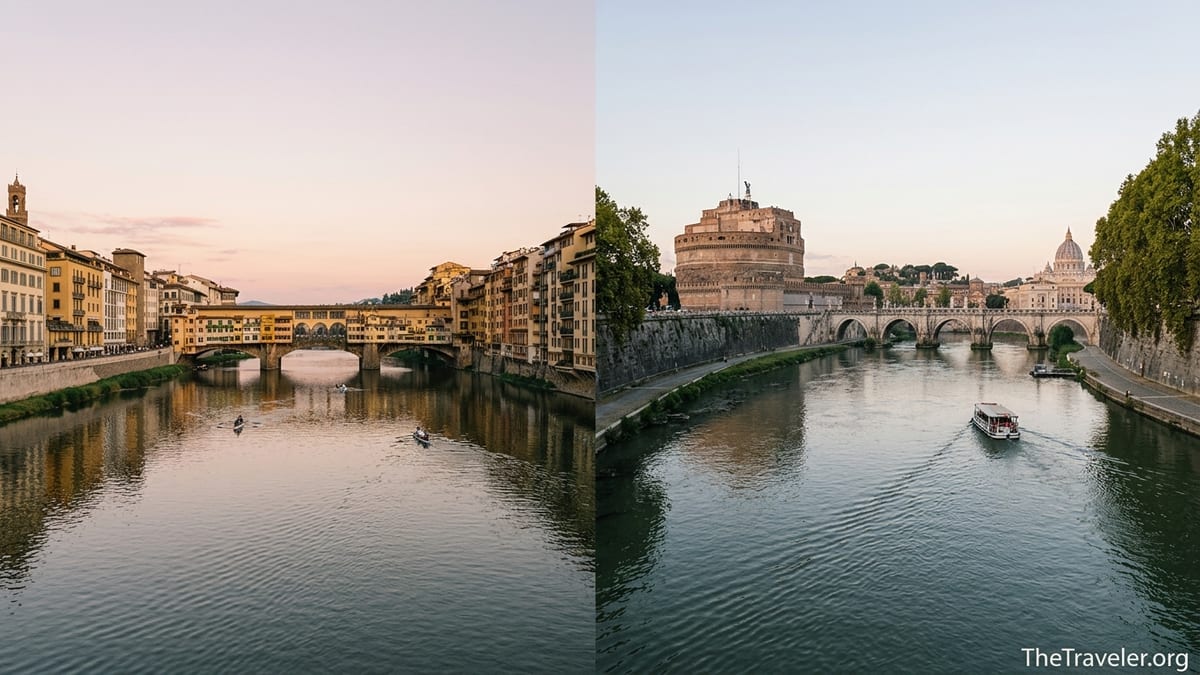
The Rivers at a Glance: Character and First Impressions
Stand on Florence’s Ponte Vecchio at golden hour and the Arno feels almost theatrical. The waterway is relatively narrow as it passes through the historic center, hemmed in by ochre palazzi, church towers and the Uffizi’s stone bulk. In the late afternoon, the facades glow, the river often turns mirror-smooth, and rowers from local clubs slice quietly along the surface. For many travelers, that single view becomes the mental postcard of Florence.
Rome’s Tiber delivers a different kind of first impression. It curves past the city in a broad, slow sweep, far below the traffic and piazzas. High embankment walls built in the 19th century to control flooding separate the historic streets from the river. From the street level, you glimpse green water and pale stone bridges, but much of the river’s life happens below, on bike paths and underpasses that most first-time visitors never reach.
In purely scenic terms, the Arno often feels more accessible and immediately photogenic. From the moment you step onto central bridges like Ponte Santa Trinita, your eye runs along a continuous corridor of historic buildings on both banks. By contrast, the Tiber frequently hides in a trench. Reaching it means walking down staircases from the bridges to river level, where the mood becomes quieter and more introspective.
Both rivers are strongly tied to their city’s identity, but in different ways. Florence seems to present the Arno as a stage, complete with perfectly placed bridges and promenades. Rome often treats the Tiber more as a backdrop, a piece of geography around which the city’s landmarks have accumulated over millennia.
Riverfront Atmosphere: Strolling, Sitting and People‑Watching
The most direct way to compare the Arno and the Tiber is to walk along them. In Florence, a relaxed evening passeggiata commonly includes a stretch along the Lungarno, the boulevards that run beside the river. On the south bank, between Ponte Vecchio and Porta Romana, sidewalks follow the water almost continuously. Visitors stop to sit on low walls near Ponte alle Grazie, order an aperitivo in bars facing the Arno, and linger on bridges as the lights come on.
Prices vary, but in 2026 a spritz or glass of house wine at a simple bar with partial river views near Santa Trinita might cost about 7 to 10 euros, slightly higher if you are in a prime spot looking directly onto Ponte Vecchio. That small premium buys not just the drink but the right to watch the river slowly shift colors as the sun drops behind the hills west of Florence.
In Rome, the situation feels more fragmented. At street level, broad roads such as Lungotevere dei Tebaldi or Lungotevere dei Vallati run along the top of the embankment, but aside from viewpoints near Castel Sant’Angelo or the Isola Tiberina, the river can feel oddly distant. To walk right beside it, you descend to the lower-level towpaths. These are popular with cyclists and joggers and can be a wonderfully traffic-free way to move between, say, the Vatican area and Trastevere, but you are largely separated from the city’s cafes, churches and piazzas.
In summer, pop-up bars and restaurants sometimes appear on platforms along the Tiber, especially near Ponte Sisto and Trastevere. Here you might pay around 8 to 12 euros for a cocktail on a riverside deck while music plays and the dome of St Peter’s hangs in the distance. The mood leans more toward nightlife than quiet contemplation. Overall, though, the average visitor to Rome is less likely to build their stay around riverside walks than a traveler in Florence, for whom the Arno quickly becomes a daily reference point.
Bridges and Views: Iconic Vistas on Each River
If bridges measure the drama of an urban river, the Arno wins on concentration. Within a short, walkable stretch you have Ponte Vecchio with its medieval shops, the elegant arches of Ponte Santa Trinita, and Ponte alla Carraia, all giving subtly different angles on the city. From Ponte Vecchio itself, you cannot see the bridge’s full profile, but move one bridge downstream and it appears as a honey-colored span of houses suspended above the water, especially striking at sunset.
Photographers often favor Ponte Santa Trinita for its symmetrical view of Ponte Vecchio framed by riverside palaces. Arrive about an hour before sunset in high season and you will often find a line of tripods already in place. The reward is a classic Florence scene: the Arno turned coppery, the Arno-side facades gently distorted in reflection, and church bells providing a soundtrack.
Rome’s Tiber, on the other hand, offers variety over proximity. Ponte Sant’Angelo, with its Baroque angels, lines up perfectly with the circular fortress of Castel Sant’Angelo on one side and the long avenue leading toward St Peter’s Basilica on the other. Downstream, Ponte Sisto provides one of the city’s best people-watching spots as Romans and visitors drift between lively Trastevere and central Rome. Farther south, the two bridges that reach the Isola Tiberina give views back to the old synagogue and medieval churches.
Yet even these famous Tiber views often share the frame with cars and embankment walls. Only at certain points, such as the curve near Castel Sant’Angelo where trees overhang the water and the dome of St Peter’s rises in the distance, does the river briefly dominate the composition in the way the Arno does from almost any Florence bridge. Many travelers leave Rome with more photographs of fountains and forums than of the Tiber itself.
History Written in Water: Floods, Legends and Urban Form
Historically, both rivers have been as destructive as they are picturesque. The Arno’s most infamous moment came on 4 November 1966, when days of torrential rain sent a wall of water through Florence. In places, water levels rose several meters above the streets, filling churches and museums, muddying frescoes and destroying or damaging thousands of artworks and rare books. The disaster spurred international rescue efforts and helped modernize conservation practices in museums worldwide, a legacy still discussed in Florence’s cultural institutions today.
Walk around the historic center and you can still see stone plaques on building walls indicating the height the water reached during that flood. These understated markers, often at eye-level or higher, turn a simple stroll along the Arno into an encounter with the city’s vulnerability. They also underline how closely Florence’s identity is tied to this manageable yet occasionally ferocious river.
Rome’s relationship with the Tiber is longer and perhaps more fundamental. Ancient writers describe the river as both lifeline and threat. Early settlements favored the high ground of the Seven Hills because they overlooked a strategic river crossing near a midstream island, now the Isola Tiberina. Over centuries, repeated Tiber floods shaped the low-lying Campus Martius area and influenced building patterns. Major embankment works in the late 19th and early 20th centuries finally curbed most urban flooding but at the cost of cutting the city off from its own waterway behind tall stone walls.
Myth adds an extra layer in Rome that Florence cannot match. According to legend, Romulus and Remus were set adrift on the Tiber as infants, rescued by a she-wolf and later founded the city. While this story has no equivalent along the Arno, Florence’s narrative leans instead on the river’s role in trade and textile production, bringing wool, dyes and raw materials that funded the rise of its merchant families and ultimately its artistic golden age.
Activities on the Water: Cruises, Rowing and Seasonal Events
Visitors who want to get onto the water encounter another contrast. In Florence, the stretch of the Arno through the center does not support large-scale cruise operations. The river is shallow and can run low in summer, and there are environmental and heritage constraints. Instead, small traditional boats known locally as barchetti sometimes offer short, low-key rides between bridges in the warmer months, often in the late afternoon or at sunset. Seats are limited and tours can feel informal, but that intimacy is part of the charm.
Rowing clubs also use this section of the Arno extensively. Watch early on a spring morning from Ponte alle Grazie and you may see single sculls and eights gliding through mist, a reminder that this is still a living river, not just a backdrop for tourists. On sunny weekends, locals sometimes sit along the low banks east of the center with takeaway coffee or gelato from nearby shops, turning the Arno into an informal social space without heavy commercial development.
The Tiber, by contrast, supports more structured tourist offerings, although they remain relatively modest compared with other European capitals. Boat operators in Rome advertise one-hour panoramic cruises that depart near Castel Sant’Angelo or the island area, typically costing in the region of 18 to 25 euros per adult in 2026, depending on inclusions such as drinks or commentary. Evening departures often highlight illuminated bridges and riverside monuments rather than close-up architectural details.
In summer, floating bars, temporary restaurants and events line parts of the Tiber’s lower embankments. These can change from year to year as permits and local policies shift, so visitors should check current listings once in Rome. When active, they turn what can be a quiet, somewhat underused space into a lively promenade with music and food that appeals especially to younger travelers and locals looking for a change from traditional piazza life.
Cleanliness, Perception and Environmental Concerns
Neither the Arno nor the Tiber is a pristine Alpine stream. Both rivers carry silt and urban runoff, and their green-brown tones often surprise visitors expecting postcard-blue water. However, traveler impressions of cleanliness often favor the Arno, largely because it is more visually integrated into Florence’s everyday life. When you see locals lingering on bridges or couples sitting on riverside benches, it lends the water a certain social acceptance, even if swimming is prohibited and water quality is carefully managed rather than idyllic.
The Tiber can feel harsher. Its high embankment walls collect graffiti, and the lower walkways sometimes show signs of neglect between maintenance cycles. After heavy rain, floods can deposit debris on the banks until city crews clear it. While there have been efforts to improve the riverfront, including dedicated cycling routes and occasional environmental clean-up days, the Tiber’s image among many travelers remains that of a somewhat wild and under-appreciated urban river.
Local debate in both cities periodically flares around the aesthetic treatment of the riverbanks. In Florence, for example, discussions over how much to modernize the Lungarno walls or introduce new lighting can spark disagreement between preservationists and residents who favor a more contemporary look. In Rome, proposals to increase riverside cafes or cultural events along the Tiber often raise questions about noise, waste and preserving views of historic monuments.
For visitors, the practical takeaway is straightforward: treat both rivers as scenic assets rather than recreational waters. Enjoy them from boats, bridges and banks, but do not plan to swim, and accept that their color and cleanliness may vary with recent weather and ongoing municipal work.
Which River Leaves a Bigger Impression for Different Travelers?
For many first-time visitors, the Arno leaves a sharper, more cohesive memory because it so clearly frames Florence’s compact historic center. If your ideal city river experience involves contemplative sunset walks, easily accessible viewpoints and a strong sense of architectural unity, Florence delivers all of this in a concentrated package. The river becomes a compass: cross it to reach artisan-filled Oltrarno streets, follow it to find bridges, and use its curves to orient yourself without constantly consulting a map.
In Rome, the Tiber tends to leave its mark more subtly. Travelers who seek out the lower walkways or ride a bike along the river often describe a sense of discovering a parallel city, quieter and more introspective than the busy streets above. For history-minded visitors, the knowledge that this modest-looking river once carried the grain ships and war galleys of an empire, and that it dictated the city’s earliest settlement patterns, can make simply standing on Ponte Sant’Angelo feel profound.
Budget and time also play a role. In Florence, the most memorable river experiences cost little more than the price of a drink or gelato, since the best viewpoints and promenades are public. In Rome, some of the standout Tiber experiences, such as a sunset boat cruise combined with an aperitivo, may require a larger outlay and advance booking in peak season. That can subtly tilt the balance toward the Arno for travelers keeping a close eye on expenses.
Ultimately, which river leaves a bigger impression depends on what you want from the water. If you are drawn to pure visual harmony and easily photographed moments, the Arno in Florence usually wins. If you are captivated by layers of history and enjoy seeking out less obvious spaces in a city, the Tiber can lodge itself more deeply in your memory, precisely because it is not always in the foreground.
The Takeaway
Comparing the Arno and the Tiber is in some sense comparing Florence and Rome themselves: one compact, curated and visually unified, the other sprawling, layered and sometimes contradictory. The Arno feels like a carefully composed painting where every element, from the curve of the river to the color of the buildings, is tuned for impact. The Tiber resembles a palimpsest, carrying traces of ancient trade routes, medieval floods, papal ambitions and modern traffic all at once.
If your trip can include only one deep dive into an Italian city’s riverfront, the Arno generally offers the stronger, more immediate impression, especially for short stays. Its central role in everyday sightseeing, abundance of accessible viewpoints and close relationship with Florence’s Renaissance heritage make it hard to forget. Yet visitors who give the Tiber enough time, walking not just above it but along its lower paths and viewing Rome from the water at least once, often come away feeling they have glimpsed a quieter, more introspective side of the capital.
The happiest solution, of course, is not to choose. A few days in Florence to watch the sun set over the Arno, followed by time in Rome exploring the Tiber from bridge level and riverbank alike, offers a nuanced portrait of how water shapes Italian cities. Together, they show that while rivers may follow the pull of gravity, the stories they carve into stone, memory and travel diaries can be very different indeed.
FAQ
Q1. Can you walk continuously along the Arno River in central Florence?
In central Florence you can walk substantial stretches along both banks, especially between Ponte alle Grazie and Ponte alla Carraia, though some sections are interrupted by traffic or construction.
Q2. Is the Tiber River in Rome safe to walk beside at water level?
During the day the lower Tiber walkways are generally considered safe and are used by joggers and cyclists, but they can feel isolated at night, so many visitors prefer to stay at street level after dark.
Q3. Are there regular boat tours on the Arno River in Florence?
The Arno does not have large-scale cruise operations through the historic center. Seasonal small-boat experiences may be available, but schedules and operators change, so check locally once you arrive.
Q4. How much does a Tiber River cruise in Rome usually cost?
As of 2026, a typical one-hour Tiber River sightseeing cruise in Rome often costs in the region of 18 to 25 euros per adult, depending on inclusions and time of day.
Q5. Which river is more scenic at sunset, the Arno or the Tiber?
Many travelers find the Arno more immediately scenic at sunset because the light hits continuous rows of historic buildings and bridges, though certain viewpoints on the Tiber near Castel Sant’Angelo are also striking.
Q6. Can you swim in the Arno or the Tiber?
No, swimming is not recommended or permitted for visitors in the central stretches of either river, due to safety, currents and water quality considerations.
Q7. Where are the best viewpoints over the Arno in Florence?
Ponte Santa Trinita and Ponte alle Grazie provide classic river vistas, while higher viewpoints like Piazzale Michelangelo give sweeping views over both the Arno and the city’s rooftops.
Q8. Where are the best viewpoints over the Tiber in Rome?
Bridges such as Ponte Sant’Angelo and Ponte Sisto offer atmospheric views, and the area around Castel Sant’Angelo provides excellent vantage points over both the river and St Peter’s dome.
Q9. Which riverfront is better for nightlife, Arno or Tiber?
Florence’s Arno is more about relaxed evening walks and aperitivo bars, while the Tiber can host livelier summer events and floating bars, particularly near Trastevere.
Q10. If I must choose one city for a river-focused visit, should I pick Florence or Rome?
If your priority is a visually coherent, easily walkable riverfront, Florence and the Arno are likely to feel more rewarding. Rome and the Tiber suit travelers who enjoy exploring less obvious, more layered urban spaces.