


Most visitors first meet the Arno River in the crush of people on Ponte Vecchio, staring at sunset over a postcard-perfect bend in the water. Then they move on, ticking off the Duomo and the Uffizi, without ever really following the river that shaped Florence. Step just a bridge or two away, though, and the Arno becomes something very different: a lived-in, local landscape of rowing clubs, riverside parks, neighborhood bars and quiet stone churches that most travelers simply walk past.
Get the latest updates straight to your inbox!
Reading the Arno Beyond the Postcard View
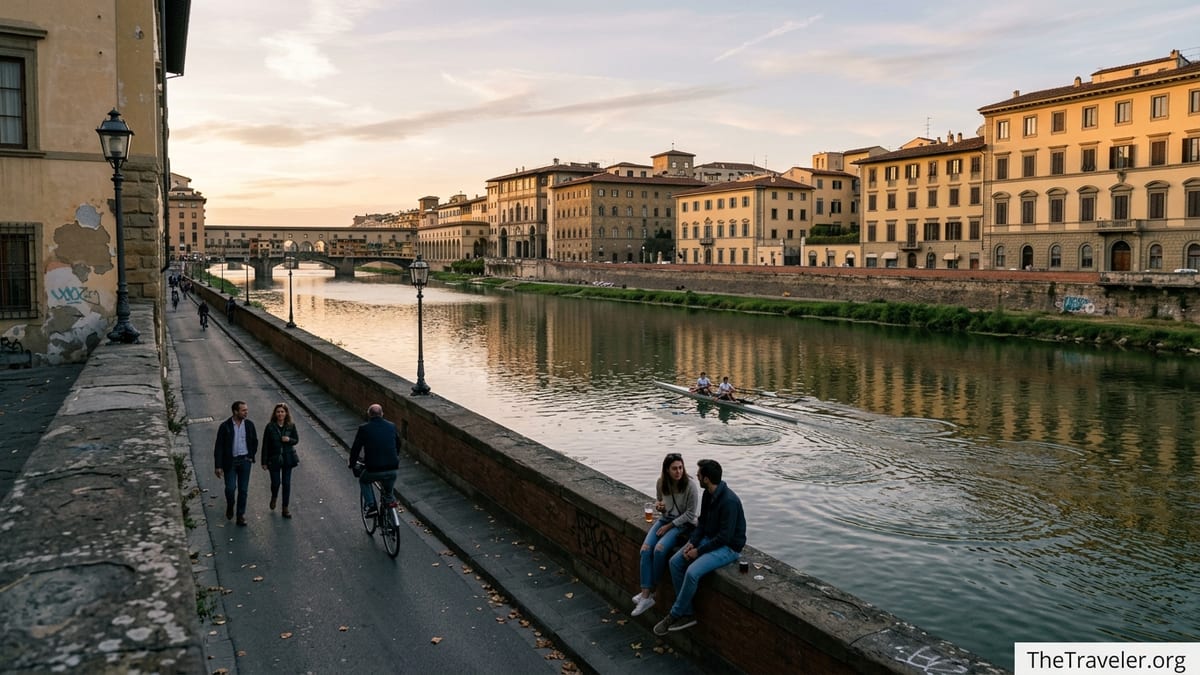
Stand on Ponte Vecchio at golden hour and it feels as if the river exists purely for photographs. In reality, the Arno is a working river threading through daily Florentine life, and its character shifts dramatically once you move beyond this medieval bridge. A ten-minute walk either upstream toward Ponte alle Grazie or downstream toward Ponte alla Carraia already thins the crowds and reveals how locals actually use the waterway: as a commuting route, a running track, a place to walk the dog or sit with a takeaway coffee in the early sun.
The stretch immediately under the Uffizi, at Lungarno Anna Maria Luisa de Medici, hides one of the Arno’s most telling contrasts. Above, tour groups pour across the bridge and through the museum arcades. Below, tucked behind a low green door and a sloping ramp to the water, the Società Canottieri Firenze rowing club trains quietly on the river. Founded in 1911, it is part of a long tradition of Florentine rowing that dates back to the 19th century, yet most visitors never realize that sculling shells glide under the same arches they photograph from above.
To start understanding the Arno beyond Ponte Vecchio, it helps to remember that this river has also been a threat. Plaques across the city mark the terrifying height of the 1966 flood, when the Arno burst its banks and filled the historic center with muddy water. That memory still lives in Florence’s cautious relationship with its river. Walking the quieter lungarni, you will notice high embankment walls, floodgates and oblique weirs like the San Niccolò and Santa Rosa structures: subtle engineering that protects the city while still allowing everyday life to unfold along the water.
Walking Into Oltrarno: The Left Bank Most People Skip
Crossing Ponte Vecchio toward the Oltrarno and then turning away from the jewelers is one of the simplest ways to escape the tourist circuit. The very name Oltrarno means “beyond the Arno,” and it signals a quieter, more residential Florence on the south bank. Within minutes, the luxury storefronts give way to narrow streets like Borgo San Jacopo and Via de’ Bardi, where small workshops, neighborhood groceries and family-run trattorias cluster behind heavy wooden doors.
Most itineraries hurry straight to Palazzo Pitti and the Boboli Gardens, but the riverfront itself is where Oltrarno’s atmosphere really reveals itself. Follow the south bank west from Ponte Vecchio toward Ponte alla Carraia and the mood softens. Here the lungarno is lined with small apartment buildings, laundry often hanging above street level, and bars that open late for aperitivo. Prices tend to dip compared with the historic center. A spritz with a simple snack plate might cost around 6 to 8 euros instead of edging into double digits, and you are more likely to find yourself surrounded by Florentines decompressing after work than tour groups.
If you walk early, around 7 or 8 in the morning, you will often share the pavement with schoolchildren crossing into the center and locals walking to jobs around Santo Spirito or San Frediano. Runners follow the river, sometimes looping over Ponte alla Carraia and back on the quieter north bank. That daily rhythm, invisible from Ponte Vecchio’s packed parapet, is what makes the Oltrarno side of the Arno feel like a real neighborhood rather than a stage set.
The San Niccolò Bend: River, Walls and Hills Collide
Upstream from Ponte Vecchio, between Ponte alle Grazie and Ponte San Niccolò, lies one of the most distinctive and under-appreciated stretches of the Arno. Here the river presses against the steep hillside of the Colle di San Miniato, and the narrow San Niccolò neighborhood is squeezed in between. A short walk along the south bank from Ponte alle Grazie brings you to Porta San Niccolò, a tall 14th-century gate that once formed part of Florence’s defensive walls and, unusually, still preserves its full height.
This square, Piazza Giuseppe Poggi, is where river, history and topography collide. Behind the gate, Giuseppe Poggi’s 19th-century redesign carved a serpentine road up to Piazzale Michelangelo, while below the Arno widens around a weir. On warm evenings, small groups sit on the low riverside walls or in the nearby bars, with prices often noticeably gentler than in the streets around the Duomo. A glass of local white wine at a simple San Niccolò enoteca might be 6 or 7 euros, with cutting boards of pecorino and salumi priced for sharing, and a view that includes both the gate and the river’s slow current.
San Niccolò’s proximity to the Arno has also shaped its architecture. Many buildings sit almost directly on the lungarno, with carved stone doorways facing the water. Inside, you find artist studios, small design shops and restaurants that serve mostly repeat local customers along with the odd traveler who has strayed off the main route. Because the river here lies below the line of the hill, the neighborhood also offers unusual perspectives back toward the center. A late-afternoon walk from Ponte alle Grazie to Ponte San Niccolò rewards you with changing light on the cathedral dome and bell tower, framed between buildings across the water.
Quiet Bridges and Understudied Views
Ponte Vecchio is not the only bridge worth your time. Walk two bridges downstream to Ponte alla Carraia or one more to Ponte Amerigo Vespucci and you will find similar light with a fraction of the people. Ponte alla Carraia, in particular, offers a superb view of the hill crowned by San Miniato al Monte and Piazzale Michelangelo, especially at sunset when the stone facades along the north bank turn amber and the river reflects the last light. It is a favorite spot for local photographers and couples, but remains strangely uncrowded compared with its famous neighbor.
Upstream, Ponte alle Grazie occupies an equally strategic yet overlooked position. From its parapets you see the bell tower of Santa Croce rising just inland, the bulk of the Uffizi and the contour of the Vasari Corridor crossing the river on Ponte Vecchio in the distance. Because there are wide pavements on both sides and fewer selfie sticks, it is easier to stop, lean on the stone rail and simply absorb how the city and river interlock. Early in the morning, you may also catch the sight of rowing shells cutting diagonally across the flow near the San Niccolò weir.
Even the far eastern bridge, Ponte San Niccolò, tends to be ignored by visitors, though it frames a striking “end of town” perspective. Here the historic center gives way to more modern neighborhoods, with tram lines and traffic, but the Arno itself feels broader and more open. A walk from this bridge back toward Ponte alle Grazie along the south bank is one of the easiest ways to experience Florence shifting from residential to monumental in a single, uninterrupted riverside stroll.
Rowing Culture and Life on the Water
From street level, the Arno can seem remote behind its stone embankments, but a closer look reveals an entire river culture that most short-term visitors never see. The Società Canottieri Firenze, headquartered on a terrace just below the Uffizi and near Ponte Vecchio, is the most visible expression of this connection. Members launch long, narrow racing shells and wider training boats directly into the river, sometimes gliding almost silently under the crowded bridge while only a few people above notice.
The club’s presence is a reminder that the Arno is not just background scenery but a sporting venue. Local universities and schools sometimes partner with the rowing society, and visiting athletes occasionally secure temporary access. For most travelers, it is not realistic to simply walk in and rent a boat; this is a private members’ club with training schedules and strict safety rules. Still, watching crews practice provides a different kind of spectacle than the one found in the Uffizi galleries. In early morning light, when mist sometimes lifts off the water and oars catch the first rays of sun, the river feels like a living corridor dividing and uniting the city at once.
Further west along the north bank, near the Cascine area, you may see kayakers or recreational rowers using quieter stretches where river traffic and low bridges are less of a concern. It is here, away from the tourists, that Florence’s residents treat the Arno as their own open-air gym. Cyclists follow long paths parallel to the water, parents push strollers and friends sit on benches overlooking slow eddies and sandbars that would barely register in the more photographed city center.
Riverside Parks, Everyday Bars and Local Rhythms
Florence is better known for stone than for green space, yet the Arno’s banks host several parks and informal lawns that locals reclaim as soon as the weather allows. The largest, Parco delle Cascine, stretches along the north bank to the west of the center in a long ribbon of trees, jogging paths and playing fields. It began centuries ago as a Medici estate and hunting reserve and has evolved into a public park where families spend Sundays picnicking and teenagers practice skateboarding on open concrete squares, all with glimpses of the river through the greenery.
Closer to the historic core, smaller riverfront spaces offer their own low-key charms. On summer evenings, temporary kiosks and bars sometimes appear on grassy terraces along the lungarni, especially near the Oltrarno side or slightly downstream from Ponte Vecchio. Here, a plastic cup of beer or a simple glass of Chianti might cost 5 or 6 euros, and seating is often nothing more than folding chairs and low tables set directly on the grass. For many Florentines, this unpretentious setup is part of the appeal, and the real backdrop is the softly lit skyline reflected in the Arno after dark.
Because the city center is compact, it is easy to incorporate these quieter river spots into your day without elaborate planning. After visiting the Uffizi, for example, you could descend the ramp next to the gallery and simply pause on the lower terrace to watch the water. Or after dinner in Santo Spirito, you might take a ten-minute walk toward Ponte alla Carraia, pick up a gelato from a neighborhood gelateria and eat it while watching the last buses trundle across the bridge. These small river rituals, rarely mentioned in guidebooks, are what linger in memory long after the obligatory museum visits blur together.
History Written in Stone: Churches, Flood Marks and Forgotten Corners
Beyond Ponte Vecchio, the Arno’s banks also hold quieter layers of history. Churches like San Jacopo sopr’Arno on the Oltrarno side tell stories of both faith and disaster. This modest church, set back slightly from the river, has survived repeated damage, including the great flood of 1966 that inundated much of the neighborhood. The stonework bears the marks of repairs and reconstructions, and stepping inside offers a glimpse of a parish that has endured centuries of the river’s moods.
Flood markers, often carved into building walls or inscribed on marble plaques, are easy to miss but deeply evocative once you begin to spot them. Some stand several meters above street level, indicating how high the Arno rose during its most destructive surges. Not all of these signs are on the riverfront; a few streets back from the water, particularly near Santa Croce, you still find reminders that the river once turned these neighborhoods into a temporary lagoon. Walking the lungarni with this history in mind lends weight to the otherwise peaceful scenes of rowers and walkers.
On the more modern eastern stretches, toward Lungarno Ferrucci and beyond, the city’s relationship with the Arno takes on a contemporary character. Here you will pass residential blocks, sports fields and casual riverside cafes serving simple lunches and evening drinks to locals who live far from the standard postcard views. Prices are often lower simply because there are fewer tourists, and menus lean toward straightforward Tuscan fare: plates of pasta with seasonal vegetables, grilled meats, crostini topped with chicken liver pâté and generous house wines poured by the glass or half-liter jug.
The Takeaway
To experience the Arno River as Florentines know it, you have to move away from the crowds bottlenecked on Ponte Vecchio and follow the water itself. Within a twenty-minute walk in either direction, the river shifts from backdrop to everyday companion: a place where rowing clubs launch sleek boats, children ride bikes along park paths, and neighbors gather on low walls with plastic cups of wine to watch the sky darken over the dome.
Exploring beyond Ponte Vecchio does not require special tours or reservations. It simply asks for unhurried time and a willingness to cross one more bridge, to follow a lungarno until the souvenir shops give way to grocery stores, to stop at a small San Niccolò bar instead of the loudest terrace on the main square. Do that, and the Arno ceases to be a postcard and becomes a living thread through your own Florentine story.
FAQ
Q1. Is it safe to walk along the Arno beyond Ponte Vecchio at night?
In general the riverfront near the historic center and Oltrarno is well lit and busy into the evening, especially around popular bridges and squares. As in any city, stay on main routes, avoid very isolated stretches late at night and keep an eye on your belongings.
Q2. How far can I walk along the Arno from the center without needing transport?
Most visitors comfortably walk from Ponte Vecchio to either Parco delle Cascine to the west or Ponte San Niccolò to the east, each direction taking around 30 to 40 minutes at a relaxed pace, with easy opportunities to cross bridges and loop back.
Q3. Are there good sunset spots on the Arno that are less crowded than Ponte Vecchio?
Yes. Ponte alla Carraia and Ponte Amerigo Vespucci downstream, and Ponte alle Grazie upstream, usually offer similar golden light and city views with far fewer people, especially on weekdays.
Q4. Can visitors rent a boat or row on the Arno?
Access to rowing on the Arno is mainly through private clubs such as Società Canottieri Firenze, which usually require membership or a formal arrangement. While some specialized tours or programs may occasionally include river activities, most travelers simply enjoy watching local rowers from the bridges and embankments.
Q5. What should I wear for a long riverside walk in Florence?
Choose comfortable walking shoes with good grip for cobblestones and occasional ramps, and bring a light layer as the air can feel cooler along the river, especially in spring and autumn evenings. In summer, a hat and water bottle help with sun and heat during midday hours.
Q6. Are there cafes or bars directly on the river where locals go?
Several informal kiosks and seasonal bars appear along the lungarni in warmer months, particularly on the Oltrarno side and near small grassy terraces. They tend to be simple and relaxed, with plastic chairs, basic snacks and prices that are often lower than the main piazzas.
Q7. How can I explore the San Niccolò area without getting lost?
Start at Ponte alle Grazie, cross to the south bank and follow the river a short distance to Porta San Niccolò. From there, small streets like Via San Niccolò lead into the neighborhood. Because the area is compact and hemmed in by the hill, it is easy to wander for an hour and still find your way back to the river.
Q8. Is Parco delle Cascine worth visiting for a short trip?
If you enjoy parks, running or seeing how locals spend time outdoors, Cascine is an interesting contrast to the stone center. Even an hour-long stroll from the tram stop through tree-lined paths with glimpses of the Arno gives a refreshing, everyday view of Florence.
Q9. Are there visible signs of past Arno floods that I can look for?
Yes. Look for plaques and markings on building walls indicating water levels from historic floods, especially the 1966 disaster. While many are slightly back from the river near Santa Croce and other districts, walking the lungarni with an eye on facades often reveals these quiet reminders.
Q10. When is the best time of day to walk along the Arno without heavy crowds?
Early mornings, roughly between 7 and 9, offer the calmest atmosphere, with joggers, commuters and soft light on the water. Late afternoon and early evening also feel pleasant, especially a bridge or two away from Ponte Vecchio, when locals come out for aperitivo and the city relaxes.