


I thought I already knew Florence. I had ticked off the museums, climbed the Duomo, queued for the Uffizi, and squeezed through the crowds on Ponte Vecchio. But it was only when I slowed down and began to walk along the Arno River, tracing its curves at different hours of the day, that the city shifted from a checklist of masterpieces to a living place. The river, I realized, is where Florence breathes.
Get the latest updates straight to your inbox!
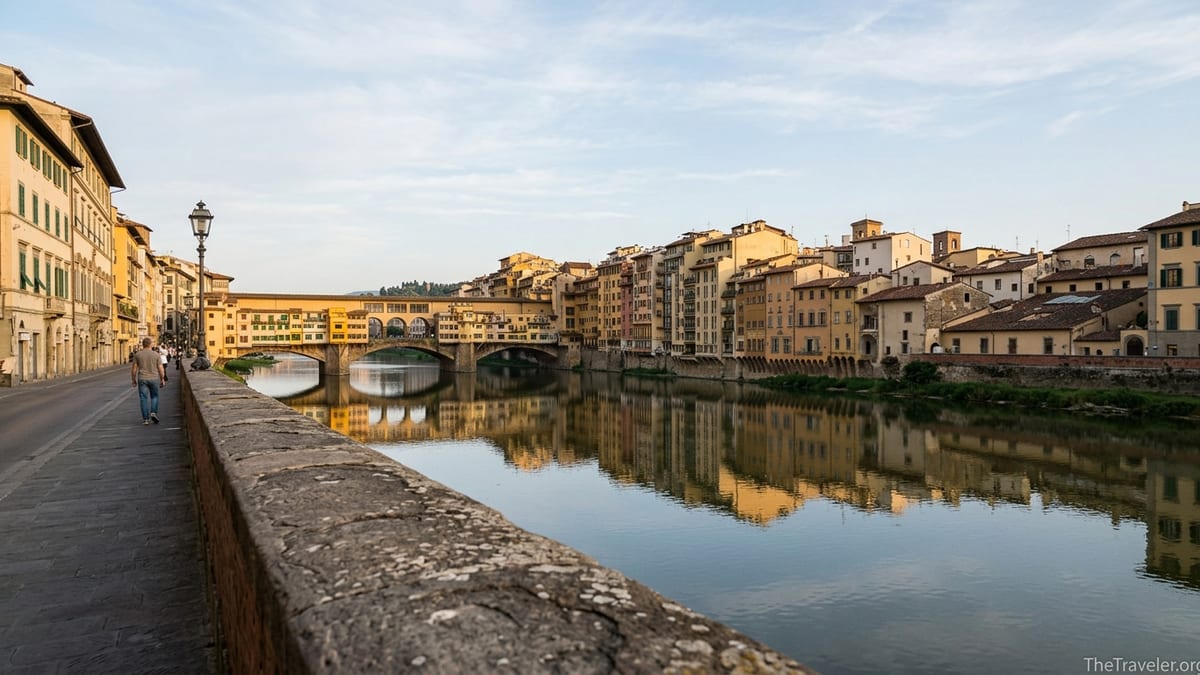
Meeting the Arno at First Light
My relationship with the Arno began one early summer morning, when Florence was still shaking off the night. I left my guesthouse near Santa Maria Novella just after sunrise, when the streets were washed in a gentle, colorless light. Within minutes, I reached Lungarno degli Acciaiuoli, the stretch of riverfront just west of the Uffizi. The Arno looked nothing like the green ribbon I had seen in glossy photos; it was pale and glassy, holding a soft reflection of the palazzi that line the north bank.
At that hour, the city was mostly in the hands of locals. A bar on the corner was serving one-euro espresso and still-warm cornetti; office workers in linen jackets leaned on the counter, sipping quickly before crossing the bridge. A delivery van idled on the lungarno while a vendor unloaded crates of artichokes destined for the Sant’Ambrogio market. It felt a world away from the afternoon crowds in front of the Duomo, but it was only a ten-minute walk downstream.
Following the curve of the river toward Ponte Vecchio, I noticed details I had missed before: faded aristocratic crests on façades, iron rings where boats once tethered, the stone embankments that turned the natural riverbanks into the formal lungarni that still frame the city today. Walking rather than rushing to the next sight quietly rewired the way I read Florence. The Arno was no longer backdrop; it became the spine that held the city’s story together.
From Postcard Florence to the Everyday Lungarno
Most visitors experience the Arno in passing, usually in the middle of the day from the crest of Ponte Vecchio or the elegant curve of Ponte Santa Trinita. The view is famous for good reason: the compact line of jewelry shops, the ochre façades mirrored in the water, the dome of Santa Maria del Fiore hovering behind like a painted backdrop. Yet that first week, I began to learn that the character of the river changes every few hundred meters, sometimes even from one bank to the other.
Heading west from Ponte Santa Trinita along Lungarno Corsini and Lungarno Vespucci, the city loosens its tie a little. Traffic hums, but the foot traffic thins out. In the late afternoon you see teenagers perched on the low wall, feet dangling above the water, passing a speaker between them. A few blocks inland, daily life unfolds in bakeries, neighborhood supermarkets, and hardware stores that few short-stay visitors ever notice.
Crossing to the south bank via Ponte Amerigo Vespucci shifts the mood again. Here, on Lungarno Soderini, the palazzi look a little less polished, balconies are crowded with laundry, and you’ll find more Florentines walking dogs or jogging than groups clutching a guided tour flag. One evening I stopped at a modest café here for an aperitivo: a glass of house white and a plate of olives and crostini for around 7 to 8 euros. Watching the light slide off the stone arches of Ponte alla Carraia, I understood how a simple riverside drink could feel more quintessentially Florentine than any expensive rooftop bar.
Crossing into Oltrarno: Florence Beyond the Museum Rooms
Everything changed again when I began to use the Arno as my gateway to the Oltrarno, the “other side” of Florence on the river’s south bank. Crossing Ponte Vecchio and following Lungarno Torrigiani eastward, the city quickly became more residential and intimate. Here the river offers one of its most beautiful perspectives back toward the Uffizi and the palace-lined north bank, but the sidewalks were filled with locals walking home rather than stopping for photos.
From this stretch it is only a short detour up into the artisan streets of the Oltrarno. Within five minutes’ walk of the river, around Via Maggio and Borgo San Frediano, I found woodworkers hunched over frames, antique shops that seemed frozen in another decade, and small osterie offering handwritten menus. Lunch at a family-run trattoria near Piazza Santo Spirito cost about 14 to 18 euros for a plate of pici cacio e pepe and a glass of house red, a fraction of what I had paid for similar plates near Piazza della Signoria.
At night, the Arno’s bridges became my compass. After dinner in the Oltrarno, I would drift back to the river at Ponte Santa Trinita to watch Ponte Vecchio glow gold against the dark water, then decide on a whim whether to cross back to the historic center or wander deeper into the south bank. This simple act of leaving decisions to the river, rather than my itinerary, turned Florence from a museum circuit into a city of neighborhoods.
Up Above the River: Climbing Toward Piazzale Michelangelo
One afternoon, following a local’s suggestion, I started a river walk not to stay beside the Arno but to climb away from it. From Ponte alle Grazie on the east side of the historic center, I crossed to the south bank and followed the river briefly along Lungarno Serristori before cutting inland at the base of the hill. A series of ramps and staircases led upward toward Piazzale Michelangelo, Florence’s famous terrace above the Arno.
The climb takes roughly 15 to 20 minutes at an easy pace, passing stone walls, small gardens, and the greenery of the Viale dei Colli. As the city fell away behind me, the Arno shrank from river to ribbon. By the time I reached the wide piazza, filled with kiosks selling gelato and statuettes of David, Florence seemed to lie in a shallow bowl: the Duomo, Palazzo Vecchio, and Santa Croce all clearly visible, with the river threading between them.
I had seen this view a hundred times in magazines, yet arriving on foot, following the river’s line and then leaving it, changed how it felt. The bridges no longer looked like isolated monuments but like essential stitching, connecting two distinct halves of a living city. Looking down, I could trace the path I had walked earlier that day along the lungarni, past the Uffizi and the palaces of the north bank. It was like reading a map of my own footsteps.
Practical realities were part of this moment too. Snacks around Piazzale Michelangelo can run a few euros more than similar offerings down by the river, but a simple espresso at the kiosk still cost around 1.50 to 2 euros. Many visitors take the bus or a taxi to the top, but walking up from the river, sweating a little, felt truer to the city’s scale. Florence is compact; from the Arno’s edge to this panoramic terrace is only a modest climb, yet the psychological distance is huge.
Small Rituals on the River: Coffee, Gelato, and Pauses
What ultimately changed how I saw Florence were not the grand views but the small rituals that formed along the river. By the third day I had a preferred circuit. In the morning I would follow the Arno east from Ponte Vecchio to Ponte alle Grazie, detouring briefly to a bar favored by office workers. Standing at the counter with a cappuccino and a small pastry for around 3 euros, I would study the day’s headlines in Italian and watch people talk about anything but the Duomo’s queue times.
In the afternoon heat, the river became my excuse to search out gelato. Rather than stopping at the crowded stands nearest Ponte Vecchio, I walked a few minutes inland from the lungarno to reach smaller gelaterie where locals actually waited in line. A medium cup of pistachio and stracciatella usually cost 3.50 to 4 euros, the same price you might pay at a more touristy shop, but the difference in flavor was startling. Eating it back on the low wall of Lungarno degli Archibusieri while watching rowing crews slice quietly through the water, Florence felt less like a showcase and more like a place designed for these very pauses.
Evenings along the Arno became my unofficial classroom in Florentine life. Families strolled with children, couples leaned on the stone railings, and small groups clustered near kiosks with plastic cups of spritz. An aperitivo by the river, perhaps a spritz or a glass of Chianti with a plate of simple snacks for around 8 to 10 euros, replaced the urge to sprint from one “must-see” sight to another. The city’s monuments were still there, glowing beyond the bends of the river, but they slid into the background as daily life took center stage.
Seeing Both Sides: How the Arno Reframed Florence
Before these walks, I had unconsciously divided Florence into categories: north bank for culture, south bank for atmosphere, museums in one mental folder and food in another. The Arno disrupted those tidy boundaries. Standing midway across Ponte Santa Trinita at dusk, I could see how seamlessly the two halves depend on each other. To the north, the dense palazzi of the historic center pushed right up to the water. To the south, the lower, more irregular roofs of the Oltrarno softened the skyline, hinting at quieter streets and smaller workshops.
I also began to read history differently. Florence has always had a complicated relationship with the Arno, which has flooded the city several times over the centuries, yet the river is also the reason the city exists at all. Walking along the lungarni, I would occasionally spot plaques marking the water level during the devastating 1966 flood, often several meters above my head. Seeing those markers while watching children ride scooters along the same pavement reminded me that Florence’s postcard calm rests on a long and sometimes precarious story with this river.
For a traveler, that realization mattered. Instead of treating the Arno as a line to cross on the way to museums, I began to think of it as the city’s main narrative thread. Using the river as a reference point made navigation simpler, of course, but it also made my days more flexible. If I knew I wanted to end an afternoon in the Boboli Gardens or at Santa Croce, I could sketch a route that began and ended with the comfort of the river, allowing room to wander in between.
It also changed my sense of time. Distances in Florence are short: walking from Ponte alla Carraia to Ponte San Niccolò along one bank takes maybe 25 to 30 minutes at a leisurely pace. Realizing this, I stopped worrying about “fitting everything in” and started designing my days around two or three anchor points, trusting that the river would quietly connect the rest.
The Takeaway
Walking along the Arno did not replace Florence’s headline experiences; it reframed them. The Duomo’s dome rising behind the river suddenly looked less like an isolated marvel and more like the natural high point of a tightly knit city. The Uffizi’s façade became another elegant presence on the riverbank rather than a box to be ticked off a list. Ponte Vecchio, seen from a quieter bridge like Ponte alle Grazie or Ponte Santa Trinita, seemed less like a crowded corridor and more like the improbable survivor of centuries.
For travelers, the lesson is simple: allow the river to organize your time in Florence. Start your days on its banks, use the bridges as your decision points, and return to the water often. Keep an eye out for the small, real-world details that tell you how the city actually lives: a shopkeeper sweeping his threshold on Lungarno Corsini, students sharing a takeaway pizza on the steps near Ponte alla Carraia, an elderly couple walking arm in arm on Lungarno Serristori just after dinner.
By the time I left Florence, I realized that my most vivid memories were not of crowded gallery rooms or famous frescoes, as extraordinary as they are. What stayed with me were the changing colors of the Arno at different hours, the feeling of stone beneath my hands on the bridge railings, the quiet comfort of knowing that if I ever felt lost in the tangle of alleys, the river was only a few minutes away. Walking along the Arno had not just changed how I saw Florence. It had taught me a slower, more grounded way of traveling.
FAQ
Q1. What is the best time of day to walk along the Arno River in Florence?
The early morning and the hour before sunset are ideal. Mornings are quieter, with locals commuting and soft light on the façades, while evenings offer golden reflections on the water and a lively but relaxed atmosphere along the lungarni.
Q2. How long does it take to walk the central stretch of the Arno in Florence?
Walking between Ponte alla Carraia and Ponte San Niccolò at a comfortable pace takes about 25 to 30 minutes on one bank. With photo stops, coffee breaks, and time to enjoy viewpoints, many travelers happily turn it into a one- to two-hour stroll.
Q3. Which side of the Arno is better for first-time visitors?
Neither side is objectively better; they offer different experiences. The north bank holds most headline sights like the Duomo and Uffizi, while the south bank, especially the Oltrarno, feels more residential, with artisan workshops, neighborhood piazzas, and a slightly slower pace.
Q4. Are there good places to stop for food and drinks along the river?
Yes. You can find simple cafés and bars on both banks, with espresso at the counter typically around 1 to 1.50 euros and aperitivo drinks with snacks around 8 to 10 euros. Stepping a few streets inland from the river often leads to better-value trattorias and gelaterie popular with locals.
Q5. Is the river walk suitable for families with children?
Generally yes, but supervision is important, as the stone walls and railings are often low. The pavements along the main lungarni are mostly flat and stroller-friendly, and children often enjoy watching boats, ducks, and the changing reflections on the water.
Q6. Can I see the main sights of Florence while following the Arno?
Many major landmarks are within a few minutes’ walk of the river. From the lungarni you can easily reach the Uffizi, Ponte Vecchio, Palazzo Pitti, Santa Croce, and the historic center. Using the bridges as crossovers allows you to link river views with museum visits in a single walk.
Q7. What should I wear or bring for a day of walking along the Arno?
Comfortable walking shoes are essential, as much of the appeal lies in wandering. In spring and summer, bring sunscreen, a refillable water bottle, and a light layer for breezy evenings. In cooler months, a warm jacket and scarf make it easier to enjoy long river walks.
Q8. Is it safe to walk along the Arno at night?
The central stretches of the river in Florence are generally busy and feel safe in the evening, especially between Ponte Vecchio and Ponte alle Grazie. As in any city, stay aware of your surroundings, stick to well-lit areas, and keep valuables secure, particularly in crowded spots.
Q9. Are there quieter sections of the Arno if I want to avoid crowds?
Yes. Moving a little away from Ponte Vecchio in either direction usually brings thinner crowds. Stretches near Ponte Amerigo Vespucci to the west and toward Ponte San Niccolò to the east often feel more local, especially outside peak summer weekends.
Q10. How can I combine an Arno walk with views from above the city?
A popular option is to follow the river to the east, cross near Ponte alle Grazie, then climb via the ramps and steps toward Piazzale Michelangelo. The walk from the river takes about 15 to 20 minutes and rewards you with a panoramic view of Florence, the Arno, and its bridges.