


More news on this day
Thousands of passengers across Asia faced major travel disruption today as a wave of operational problems led to 3,348 delayed flights and 310 cancellations, affecting major hubs in Thailand, Singapore, Japan, South Korea, Türkiye, Malaysia, China and beyond.
Get the latest news straight to your inbox!
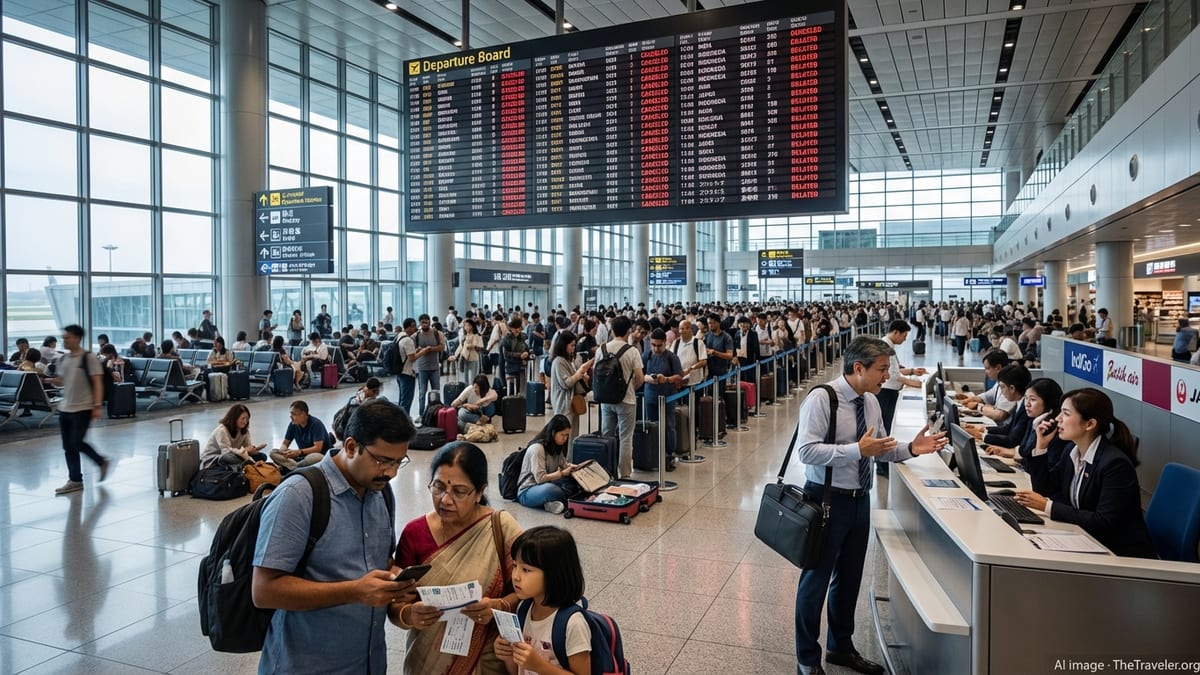
Major Hubs See Cascading Disruptions
According to published coverage, the heaviest disruption was concentrated at some of the region’s busiest airports, including Bangkok Suvarnabhumi, Singapore Changi, Tokyo Haneda, Seoul Incheon, Kuala Lumpur, Beijing Capital, Beijing Daxing, Shenzhen, Guangzhou and Istanbul Sabiha Gökçen. A combination of delays and outright cancellations across these hubs produced a knock-on effect that rippled through domestic and international networks.
Regional reporting indicates that Shenzhen was among the hardest-hit Chinese airports, recording more than 330 delays and a notable number of cancellations, while several other mainland Chinese gateways also saw schedules significantly pushed back. This pattern, replicated in Tokyo, Seoul and Bangkok, resulted in missed connections and last minute rebookings for passengers traveling onward to Europe, the Middle East and North America.
In Southeast Asia, Bangkok and Kuala Lumpur emerged as particularly strained nodes as they connect traffic between South and Northeast Asia as well as long haul markets. Delayed inbound services forced airlines to reshuffle aircraft and crews, with many departures leaving hours behind schedule. Travelers reported long queues at check‑in counters and service desks as airlines worked to reaccommodate affected itineraries.
The disruption also extended into South Asia and parts of the Indian Ocean corridor, as schedules in Delhi, Mumbai and other secondary airports were affected by late‑arriving aircraft from East and Southeast Asian hubs. Published data show that the cumulative impact across the region translated into several hundred lost rotations over the course of the day.
Flag Carriers Under Pressure Across Key Routes
Flag carriers and major regional airlines, including Thai Airways, Korean Air, Japan’s leading full‑service brands and Malaysia Airlines, were all caught in the operational squeeze. With Bangkok, Tokyo, Seoul and Kuala Lumpur serving as core transfer points, any disruption to these carriers’ banked waves of departures quickly cascaded through onward services.
Recent timetable information for routes linking Bangkok with Tokyo and Seoul, as well as Kuala Lumpur with Tokyo and Seoul, highlights how dense these corridors have become, with multiple daily frequencies by Thai Airways, Japan carriers, Korean operators, Malaysia Airlines and low‑cost competitors. When even a fraction of these flights are delayed or removed from the schedule in a single day, network resilience is severely tested.
In Thailand, Thai Airways has already been navigating a complex operating environment. Separate reporting in recent weeks described the airline’s temporary suspension of selected regional routes and adjustments to services to destinations such as Sapporo, Tokyo, Osaka, New Delhi and several Chinese cities as part of broader network management. Today’s widespread delays added a layer of acute disruption on top of those structural changes.
Malaysia Airlines and Korean carriers faced similar challenges as they tried to maintain connectivity from their hubs to Japan, China, Southeast Asia and the Middle East. While most flights eventually departed, the compressed turnaround times and rolling delays left little margin for recovery, increasing the risk of additional schedule changes later in the day.
Operational And External Factors Combine
Publicly available information suggests that today’s irregular operations did not stem from a single incident, but rather a convergence of factors that have been building across the region’s aviation sector. Airlines are contending with high seasonal demand, caps on airport capacity during peak bank periods, and tight aircraft and crew availability after years of cost cutting and restructuring.
Industry analyses have also pointed to sustained pressure from elevated fuel prices, which has already led several regional carriers to trim or suspend marginal routes for the current season. Recent reports about Thai Lion Air, for example, describe cuts or suspensions on more than a dozen routes between June and September, including links to China, Japan, India, Indonesia and Singapore, as the airline responds to rising operating costs and softer low‑season demand.
When such structural constraints collide with localized weather issues, air traffic control restrictions or technical problems, the result is a rapid build‑up of delays that can be difficult to unwind within a single operating day. For hub‑and‑spoke networks that rely on tightly timed transfers, even a short disruption window can translate into missed connections and aircraft being out of position for subsequent rotations.
Aviation observers note that the post‑pandemic recovery has restored traffic volumes faster than staffing and infrastructure have been fully rebuilt, particularly in ground handling, maintenance and air traffic control. These underlying pressures make large‑scale disruption more likely when conditions deteriorate at multiple airports simultaneously.
Impact On Travelers Between Asia, Europe And The Middle East
The disruption across Asian hubs has resonated well beyond the region, especially for travelers connecting between Asia, Europe and the Middle East. With Istanbul, Bangkok and major Chinese and Japanese airports playing important transit roles, delays on feeder flights have jeopardized long‑haul onward journeys, including those operated by partner airlines under codeshare agreements.
Passengers traveling on Thai Airways, Korean and Japanese carriers, as well as Malaysia Airlines and regional low‑cost operators, faced a mix of extended waits, missed transfers and unexpected overnight stays. For some, the tight connection times typically offered for popular routes such as Bangkok to Tokyo, Seoul to Bangkok and Kuala Lumpur to Seoul were no longer viable once earlier flights departed late or were canceled outright.
Industry data providers show a complex web of interline and codeshare arrangements linking these Asian carriers with European and Middle Eastern partners. When schedules unravel at short notice, rebooking options can quickly shrink, particularly on peak‑season dates when load factors are already high. Travelers without flexible tickets or travel insurance can be left with limited alternatives.
Reports from airport terminals across the region describe congestion at customer service counters and self‑service kiosks as travelers attempted to secure new itineraries. While airlines sought to prioritize those with imminent long‑haul connections, the sheer number of delayed services made it challenging to accommodate every disrupted passenger promptly.
What Passengers Should Do Now
Given the scale of today’s disruption, publicly available guidance from aviation and travel industry sources consistently emphasizes preparation and flexibility for anyone flying through Asian hubs in the coming days. Travelers are encouraged to monitor their flight status frequently through airline channels and airport information screens, and to allow additional time for connections through major hubs such as Bangkok, Tokyo, Seoul, Kuala Lumpur and Singapore.
Experts also recommend that passengers hold up‑to‑date contact details in their airline bookings so that they can receive notifications of last‑minute changes. For itineraries involving multiple carriers or separate tickets, travelers may want to build in longer transfer windows or consider consolidating bookings with a single airline group where possible.
Travel insurance with coverage for delays, missed connections and additional accommodation costs can offer a financial backstop when schedules are significantly disrupted. However, policy terms vary, and passengers are advised to review conditions carefully to understand what is and is not covered in the event of large‑scale operational issues across multiple airports.
With airlines and airports across Asia still working to stabilize operations, the full effects of today’s 3,348 delays and 310 cancellations may continue to be felt for at least one or two operating days, particularly on complex multi‑sector journeys. Travelers transiting the region this week are likely to benefit from a cautious approach that assumes longer processing times, potential last‑minute gate changes and the possibility of further schedule adjustments.