


More news on this day
Thousands of passengers across Asia have been stranded or severely delayed after a fresh wave of disruptions led to hundreds of flight cancellations and thousands more delays at major airports from Indonesia and India to Japan, Kuwait and Russia, affecting carriers including Air China, IndiGo, Rossiya and Qatar Airways.
Get the latest news straight to your inbox!
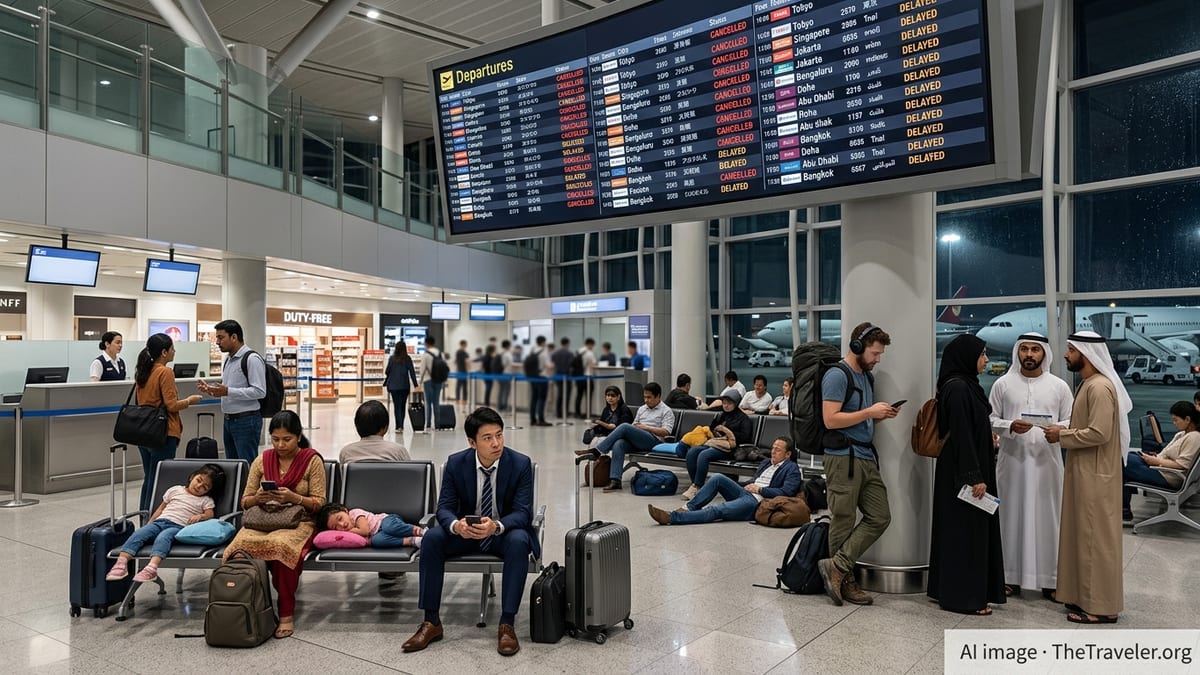
Hundreds of Cancellations and Thousands of Delays Across Key Hubs
According to aviation tracking data and published coverage, at least 546 flights were canceled and more than 4,000 were delayed across Asia in recent days, disrupting travel plans for tourists, business travelers and migrant workers. The operational turbulence has been most visible at large hubs such as Jakarta, Tokyo and Sochi, as well as heavily used seasonal gateways including Srinagar.
Publicly available information indicates that the latest disruption follows several days of elevated irregular operations across the region, with prior monitoring pointing to similar spikes on June 4 and June 5 at airports in Japan, Indonesia, India, China and the Gulf states. These successive waves of cancellations and delays have compounded the backlog of displaced passengers, leaving many travelers struggling to find alternative connections or accommodation at already crowded terminals.
Data compiled from flight status platforms shows that delays now significantly outnumber outright cancellations, with thousands of services departing behind schedule as airports attempt to work through congested departure and arrival banks. The scale of the disruption has meant that even passengers whose flights operated have often encountered missed connections and long queues at transfer desks and immigration checkpoints.
While individual airports in Asia are accustomed to localized weather or technical disruptions, the breadth of the current problems, spanning multiple countries from Indonesia and India to Japan, Kuwait and Russia, has created a ripple effect in airline networks that is proving difficult to absorb quickly.
Multiple Countries and Carriers Caught in the Turbulence
Indonesia, Kuwait, Japan, India and Russia feature prominently in the latest wave of irregular operations, with their airports handling a mix of domestic and long-haul international traffic that connects Asia with Europe, the Middle East and North America. Reports indicate that services at Jakarta’s Soekarno-Hatta International Airport have experienced a spike in delays, impacting both regional low-cost airlines and full-service carriers linking Southeast Asia with East Asia and the Gulf.
In Japan, major metropolitan airports serving Tokyo have reported elevated cancellation and delay numbers, affecting not only local carriers but also Chinese and Middle Eastern airlines that route significant transfer traffic through the country. This has been particularly disruptive for itineraries combining Japan with Southeast Asia, Australia or North America, as missed connections in Tokyo can cascade through multi-leg journeys.
In India, Srinagar has emerged as one of several pressure points, illustrating how stress on domestic networks can quickly affect international schedules. Persistent bottlenecks at busy Indian gateways have increased turnaround times and reduced schedule resilience, leaving airlines more vulnerable when additional issues, such as congestion or airspace constraints, arise elsewhere in the region.
Farther north, Russian airports including Sochi have seen disrupted services involving carriers such as Rossiya, which operates key domestic and regional links. These networks are interwoven with services from Gulf, Indian and East Asian airlines, meaning delays on one side of the continent can reverberate across multiple time zones.
Impact on Airlines: From Air China and IndiGo to Qatar Airways
The disruption has hit a broad mix of airlines, including Chinese, Indian, Russian and Gulf carriers. Monitoring of flight operations suggests that Air China and other Chinese airlines have faced waves of delays on routes linking mainland hubs with Japan, Southeast Asia and the Indian subcontinent, as congested airspace and tight turnaround schedules leave little margin to recover from earlier disruptions.
IndiGo, India’s largest carrier by market share, has been particularly exposed as it balances a dense domestic schedule with an expanding international network. Separate from the current day-of-travel disruption, IndiGo has already announced temporary suspensions of several international routes during the upcoming off-peak season, citing higher operating costs, airspace constraints and softer demand, which reduces flexibility in redeploying aircraft and crews when sudden operational shocks occur.
Russian operator Rossiya has also been affected, especially on services through resort-focused airports such as Sochi that handle a mix of domestic holidaymakers and connecting travelers from other parts of Asia and the Middle East. Any instability in those schedules can quickly spill over to partner and codeshare flights that rely on synchronized timings.
Gulf carriers, including Qatar Airways, have seen knock-on delays as their aircraft and crews rotate through affected Asian hubs. With Doha acting as a major transfer point between Asia and Europe or Africa, even modest scheduling disruptions in Jakarta, Tokyo or Indian cities can create rolling waves of misaligned connections, leading to extended layovers and rebookings for passengers far from the original point of disruption.
Operational and Structural Pressures Behind the Gridlock
A combination of operational strain and broader structural challenges appears to be driving the current wave of cancellations and delays. Industry data and recent airline statements highlight continuing airspace restrictions across parts of West Asia and Eastern Europe, leading to longer routings, higher fuel burn and tighter crew duty margins. These pressures can translate rapidly into delays once an aircraft is pushed beyond its originally planned schedule.
In parallel, many Asian carriers are still working through fleet and staffing imbalances that emerged during and after the pandemic period. While overall capacity has largely returned or even exceeded pre-crisis levels on several regional corridors, staffing, maintenance slots and spare aircraft availability remain constrained. This leaves airlines with less ability to absorb unexpected events such as localized weather disruptions, technical issues or temporary airport closures.
Seasonal demand patterns are adding further complexity. As leisure travel surges to destinations such as Indonesia’s beaches, Japan’s cities and India’s hill stations, some airlines have recreated dense peak-season schedules that offer little slack. When disruptions occur, the high load factors mean that rebooking displaced passengers onto alternative flights can take days rather than hours, particularly on routes with limited daily frequencies.
At the same time, several carriers have been reevaluating route networks amid rising fuel costs and currency volatility, trimming or pausing marginal services. While such measures can improve financial resilience, they also reduce redundancy in the system, so a canceled or severely delayed flight is less likely to have an immediate substitute option on the same route.
Stranded Passengers Face Long Queues, Uncertain Timelines
For travelers caught in the latest disruption, the immediate reality has been long queues at check-in counters, rebooking desks and security lines, combined with uncertainty about when they might reach their destinations. Social media posts and passenger reports describe crowded departure halls at affected airports across Indonesia, Japan, India and Russia as people await updates on re-timed or reassigned flights.
Standard passenger rights frameworks in many of the affected countries provide varying levels of support in the case of significant delays or cancellations, but practical assistance can be constrained when disruption is widespread. Hotels near major hubs often fill quickly, while meal vouchers or transport arrangements may not cover all affected travelers, particularly those on separate or self-connected tickets.
Publicly available travel advisories and airline notices consistently urge passengers to monitor flight status through official channels, arrive early at the airport and prepare for possible extended waits. Travel insurers have also reminded customers in recent guidance that coverage for delays and missed connections typically depends on policy wording and the documented cause and duration of the disruption.
With Asia’s air traffic now operating at very high volumes and multiple structural pressures converging, analysts suggest that travelers planning multi-stop itineraries through hubs such as Jakarta, Tokyo, Srinagar and Sochi should build in additional buffer time and remain prepared for schedule changes as airlines and airports navigate an increasingly fragile operational environment.