


More news on this day
Air travel across Asia experienced another day of severe disruption on May 23, with publicly available tracking data indicating that 3,931 flights were delayed and 267 cancelled across Thailand, Japan, the United Arab Emirates, South Korea, Malaysia, China, and India, hitting major carriers such as AirAsia, Emirates, Japan Airlines, and Korean Air and stranding passengers from Tokyo and Seoul to Bangkok and Dubai.
Get the latest news straight to your inbox!
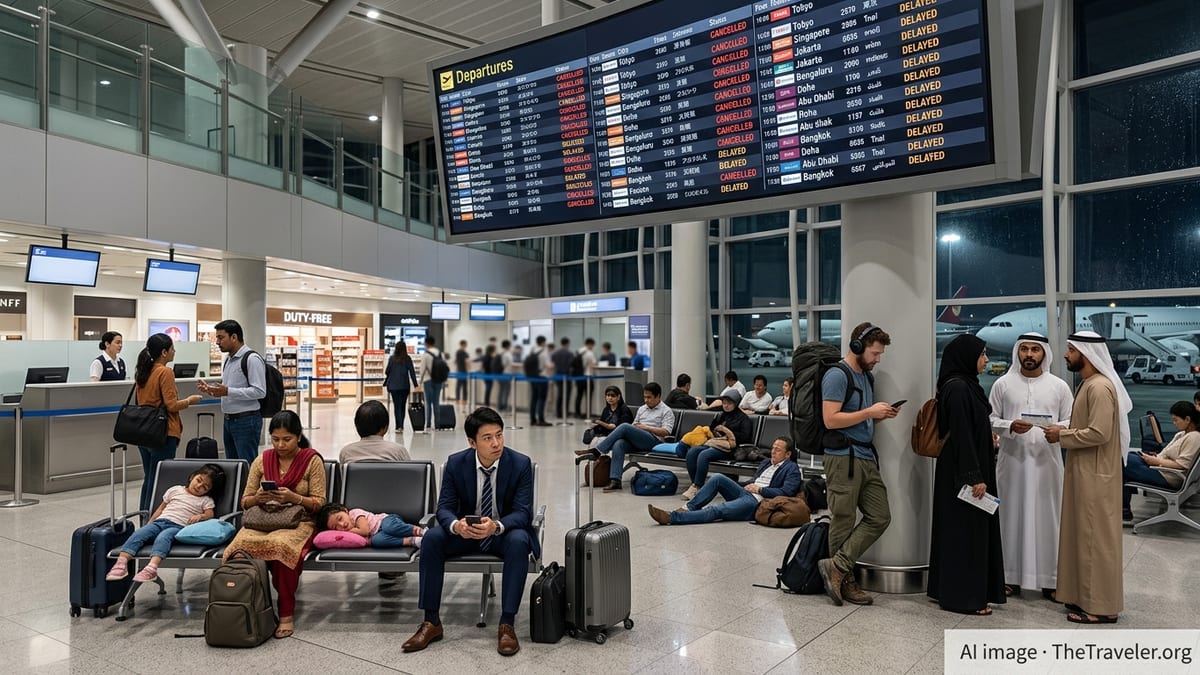
Network Strain From Tokyo To Bangkok
Aggregated aviation data platforms tracking operations across Asia show widespread delays concentrated at major hubs serving Japan, South Korea, Thailand, Malaysia and China, with ripple effects fanning out across domestic and regional routes. Tokyo’s Haneda and Narita airports, Seoul’s Incheon, and Bangkok’s Suvarnabhumi and Don Mueang all reported busy boards with knock-on delays affecting both full-service and low-cost carriers.
In Japan, recent reporting on flight performance has highlighted a pattern of elevated delays at Tokyo, Osaka Kansai, Fukuoka and other busy airports, affecting operators such as Jetstar Japan and Japan Airlines. That trend has continued into this weekend, with dozens of services showing late departures and arrivals as tight turnarounds collide with congested airspace and challenging weather patterns.
Bangkok, a key node for Southeast Asian connections, has also been under pressure. Information from regional outlets in recent weeks has already pointed to route suspensions and reduced frequencies between China and Thai resort destinations, driven by higher fuel costs and a rebalancing of capacity. Today’s live delay figures suggest that remaining services between Thailand and Northeast Asia, including those operated by AirAsia group airlines, are operating in a fragile environment where minor disruptions rapidly build into systemwide congestion.
At Kuala Lumpur International Airport, operational data for Malaysia Airlines and other regional carriers shows a mix of on-time departures, extended delays and ad-hoc cancellations, underscoring how even well-managed hubs are struggling to maintain schedule integrity once upstream flights are pushed off their planned slots.
Middle East Airspace Tensions Hit Emirates And Gulf Connections
In the United Arab Emirates, Dubai’s role as a global transfer hub means any disturbance on Asia–Europe and Asia–Africa corridors quickly cascades through connecting banks of flights. Aviation-focused publications in recent weeks have linked recurring waves of delays and cancellations in the wider region to ongoing geopolitical tensions and related constraints in Middle East airspace, which have forced lengthy reroutings and compressed flight schedules.
Emirates and other Gulf carriers rely heavily on dense banks of arrivals and departures to feed connecting traffic from Asia to Europe and the Americas. When upstream services from Tokyo, Seoul, Bangkok or major Indian and Chinese cities arrive behind schedule, it often leads to missed connections, last-minute aircraft swaps and, in some cases, outright cancellations of lightly booked or operationally difficult sectors.
Travel advisory sites tracking disruption across the Asia–Gulf–Europe corridor have, on multiple recent days, recorded tallies in the hundreds for both cancellations and long delays affecting hubs such as Dubai and Doha. Today’s figures, which show the United Arab Emirates included among the countries with elevated disruption, indicate that those structural pressures remain firmly in place even outside traditional peak holiday periods.
For passengers booked on Emirates and partner airlines, this has translated into extended layovers, rebooked routings via alternative hubs, and late arrivals into Europe and North America, particularly for itineraries originating in East and Southeast Asia.
China, India And Regional Carriers Under Sustained Pressure
China and India, two of the region’s fastest-growing aviation markets, again feature prominently in today’s disruption data. Recent coverage of airline operations in both countries has described repeated waves of cancellations on specific international routes, especially between China and Southeast Asia, as carriers respond to higher operating costs and evolving demand.
Chinese airlines have over the past month trimmed or suspended flights on several leisure routes to Thailand and neighboring countries, with publicly available figures showing entire route pairs temporarily removed from schedules. That left remaining services more vulnerable to overload once weather, technical issues or airspace restrictions reduced capacity on any given day.
In India, consumer forums and local media in the past week have documented a series of late-notice schedule changes and cancellations affecting international flights, including services to Thailand and other regional destinations. While India’s aviation regulations spell out compensation and assistance rules for affected passengers, travelers have reported inconsistent implementation in practice and significant challenges in obtaining timely rebooking when multiple airlines are experiencing strain at once.
Low-cost carriers such as AirAsia and its affiliates, which operate dense networks connecting India, Malaysia, Thailand and beyond, are particularly exposed to cascading delays. Their business models rely on quick aircraft turnarounds; when a single sector runs substantially late due to congestion at a hub like Bangkok or Kuala Lumpur, it can disrupt several subsequent flights on the same aircraft throughout the day.
Weather, Technical Issues And Airspace Constraints Combine
Analysts following Asia-Pacific aviation note that no single cause explains the current disruption. Instead, today’s figures on delays and cancellations appear to be the product of several overlapping factors: unsettled seasonal weather, isolated technical incidents, and wider structural pressures tied to fuel costs and regional airspace constraints.
Recent news from Malaysia offered a clear illustration of how a single technical problem can spill over into broader network disruption. Malaysia Airlines confirmed this week that a Kuala Lumpur to Incheon service was diverted to Hong Kong due to an onboard generator issue, leading to the subsequent cancellation of the scheduled return flight and forcing the airline to redistribute passengers across alternative services.
At the same time, regional reports have repeatedly linked rising jet fuel prices, influenced by tensions involving Iran and related shipping disruptions, to airline decisions to cut or consolidate certain routes. These schedule reductions, while helping carriers control costs, reduce slack in the system; when irregular operations occur, there are fewer spare aircraft and crew available to absorb the shock without major knock-on effects for passengers.
On top of that, accounts from travelers and aviation forums indicate that intermittent air traffic control constraints and reroutings around sensitive airspace are imposing additional time and complexity on flights between East Asia, South Asia and the Gulf, further eroding airlines’ ability to recover from early-morning delays before the end of the operating day.
Travelers Face Crowded Airports And Limited Options
The combined impact of 3,931 delayed and 267 cancelled flights across Asia’s key markets today has left passengers facing crowded terminals, long queues at service desks and limited same-day rebooking options on some routes. In cities such as Tokyo, Seoul, Bangkok and Dubai, where multiple carriers rely on tightly timed connection banks, even modest schedule slips can turn relatively routine journeys into day-long ordeals.
Passenger-rights advocates and travel advisers note that the patchwork of compensation and care rules across Asia means traveler experiences can differ significantly from one country to another. While some jurisdictions offer clear guidelines on hotel accommodation, meals and refunds when flights are cancelled, others rely more heavily on airline policies and goodwill, leaving many customers uncertain about what assistance they can reasonably expect.
Given the sustained pattern of disruption seen across the region in recent weeks, industry observers suggest that travelers planning itineraries through busy Asian hubs should allow longer connection times, monitor flight status closely in the 24 hours before departure, and be prepared for last-minute changes in routing. With airlines, airports and air traffic managers all contending with external shocks and high demand, Asia’s aviation network is likely to remain vulnerable to further days of widespread delays and cancellations in the near term.