


More news on this day
Asia’s aviation network is enduring another turbulent operating day as real-time tracking data points to 4,754 delayed flights and 450 cancellations across major regional hubs, straining airport capacity and disrupting travel plans for tens of thousands of passengers.
Get the latest news straight to your inbox!
Fresh Data Signals Intensifying Operational Strain
The latest disruption figures add to a series of difficult days for Asian air travel at the start of September 2026. Aggregated aviation statistics compiled from live flight-tracking dashboards and analytics platforms indicate that more than 5,000 scheduled services across the region have been affected within a single 24-hour window, with delays far outnumbering outright cancellations. Recent reporting on similar disruption days in early September cited more than 3,600 delays and just under 500 cancellations across 39 airports, underscoring how quickly conditions can deteriorate when weather and congestion coincide.
Publicly available coverage of previous events this month shows that disruption patterns have been building rather than appearing in isolation. Separate tallies for other recent high-impact days recorded around 3,618 delays and 471 cancellations across a similar group of 39 Asian airports, while another data snapshot described nearly 4,000 impacted flights over the same set of hubs. Taken together with the current estimate of 4,754 delays and 450 cancellations, the figures suggest that Asia’s aviation network is operating close to the limits of its resilience when multiple stress factors converge.
Real-time disruption indices published by flight-tracking platforms assign composite scores to major airports by blending delay share, average delay time and cancellation counts. On recent busy days several leading Asian hubs, including Dubai International, Delhi, Singapore Changi and Beijing Capital, have moved into index ranges associated with minor to moderate operational problems at various points in the day. These elevated readings, combined with the latest multi-thousand delay total, point to a regional system that is coping but increasingly stretched.
Major Hubs Shoulder the Heaviest Disruption
The burden of the latest disruption wave is falling disproportionately on a core group of high-volume airports. Coverage of recent Asia-wide events highlights that around 39 major hubs, from Gulf gateways to Northeast Asian megahubs, generated the bulk of delay and cancellation totals on earlier severe days. Airports such as Jakarta Soekarno-Hatta, Shanghai Pudong, Delhi Indira Gandhi, Singapore Changi and Beijing Capital repeatedly appear among the locations with the highest numbers of affected flights.
In earlier disruptions this month, Jakarta’s main airport was singled out for having some of the heaviest cancellation numbers in the region, with more than 50 flights terminated alongside over 200 delays in one 24-hour period. Other large hubs, including Dubai and major Chinese coastal airports, have seen their own surges in delayed departures and arrivals as storms, haze and airspace constraints force rerouting and temporary capacity reductions. The current tally of 4,754 delays and 450 cancellations is consistent with these recent patterns, suggesting that the same set of high-traffic airports is again bearing much of the strain.
Flight-tracking maps for Asia on busy disruption days show how quickly a localized problem can propagate along key corridors. When a high-frequency route, such as those linking major Chinese, Indian, Southeast Asian and Gulf cities, experiences early-morning delays, aircraft and crew positions shift out of sync with schedules for the remainder of the day. Hubs that serve as connection points for long-haul services to Europe, North America and Australia are particularly vulnerable because a single late inbound flight can affect several onward departures.
Weather, Congested Infrastructure and Network Knock-on Effects
Recent coverage of Asian flight disruption episodes points to a familiar combination of causes: adverse weather, structural capacity constraints at busy airports and cascading network effects once delays begin to accumulate. In previous events this northern summer, heavy monsoon rainfall around Delhi, storm systems affecting parts of East and Southeast Asia, and episodes of haze in the region have all coincided with days of elevated delay and cancellation totals. One recent analysis linked more than 4,500 delays and nearly 300 cancellations to extreme weather and waterlogging at several major Asian gateways.
Beyond weather, long-running infrastructure pressures are also in focus. Industry commentary on Asia’s largest hubs has noted that some airports added traffic faster than they expanded runways, taxiways and gate capacity, producing what observers describe as “delay days” where modest disruptions snowball into widespread schedule distortions. Real-time disruption indices for major Asian airports frequently show that once congestion builds, even brief ground holds or runway closures can push airports into ranges associated with significant operational problems.
Network design and aircraft utilization practices further amplify the effect of any disturbance. Short-haul fleets in Asia are often scheduled for multiple back-to-back rotations over a single day, leaving limited margin for recovery after an initial delay. Analyses of recent disruption events describe how a two-hour delay on the first sector can propagate across subsequent legs, sometimes forcing late-evening cancellations when crew duty limits are reached. With 4,754 delays and 450 cancellations now recorded in the latest reporting window, the compounding effect of such scheduling patterns is again evident.
Passenger Experience and Practical Planning Considerations
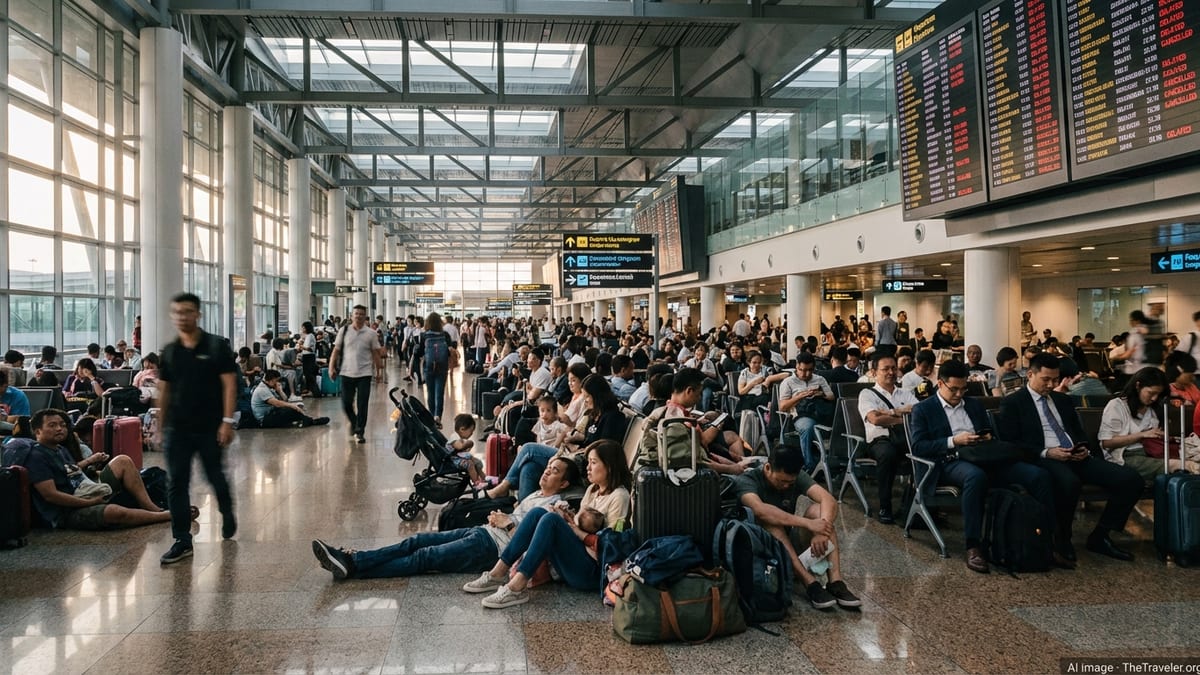
For travelers, the most visible impact of the current disruption wave is extended time in terminals and uncertainty around connections. Reports from previous recent Asia-wide disruption days describe crowded departure halls, long queues at rebooking desks and passenger concerns over missed international connections. In many cases, airlines have resorted to rolling delays rather than immediate cancellations, which keeps flights on the board but prolongs waiting times and complicates planning for ground transportation and accommodation at destination.
Consumer-focused travel advisories responding to the recent spikes in delays and cancellations in Asia encourage passengers to monitor flight status continuously, use airline mobile applications or airport websites for near-real-time updates and build additional buffer time into itineraries, particularly when connecting between separate tickets. Commentators also stress the importance of understanding fare rules and regional passenger-rights regimes, which can differ markedly between domestic and international journeys and from one jurisdiction to another.
As Asia’s peak travel flows continue into late summer and early autumn, the latest count of 4,754 delays and 450 cancellations underscores the value of flexible planning. Travelers connecting through congestion-prone hubs or flying during known storm seasons may benefit from choosing longer connection windows, avoiding the last flight of the day where possible and considering travel insurance products that specifically address missed connections and extended delays. With operational data from recent weeks pointing to repeated multi-thousand-delay days across the region, cautious planning remains advisable for anyone flying to, from or within Asia in the near term.
What the Latest Spike Reveals About Regional Resilience
The current disruption figures add another data point to a season marked by frequent operational stress across Asia’s aviation sector. When compared with other recent disruption snapshots, including events that tallied more than 3,600 delays and around 470 cancellations across 39 airports, as well as weather-driven episodes with over 4,700 delays and more than 1,100 cancellations, the latest 4,754-delay, 450-cancellation day appears less an outlier and more part of a recurring pattern.
Industry-focused analysis of past disruption episodes indicates that, while Asia’s major hubs have largely avoided complete shutdowns, they remain vulnerable to days of severe schedule disorder when adverse weather, airspace restrictions and high seasonal demand converge. Tracking platforms and on-time performance reports suggest that once certain thresholds of congestion and delay share are crossed, recovery can take several operational cycles, leading to knock-on effects that last beyond the initial day of disruption.
For now, the data portrays a system that is strained yet functioning, with most flights eventually departing albeit behind schedule. The persistence of high delay totals, however, signals that improving resilience will likely require a mix of infrastructure upgrades, more conservative scheduling and continued investment in air traffic management technology. Until such measures reduce the frequency and severity of disruption spikes, travelers across Asia will continue to face days like the current one, where thousands of flights are pushed off schedule and hundreds are removed from the departure board entirely.
Flightradar24 Asia airport disruption map
NomadLawyer Asia aviation disruption analysis