


More news on this day
Air travel across Asia and the Middle East is facing another turbulent spell, with publicly available tracking data indicating at least 5,168 flight delays and 341 cancellations affecting routes through China, Indonesia, Taiwan, the United Arab Emirates, Uzbekistan and other markets in recent days.
Get the latest news straight to your inbox!
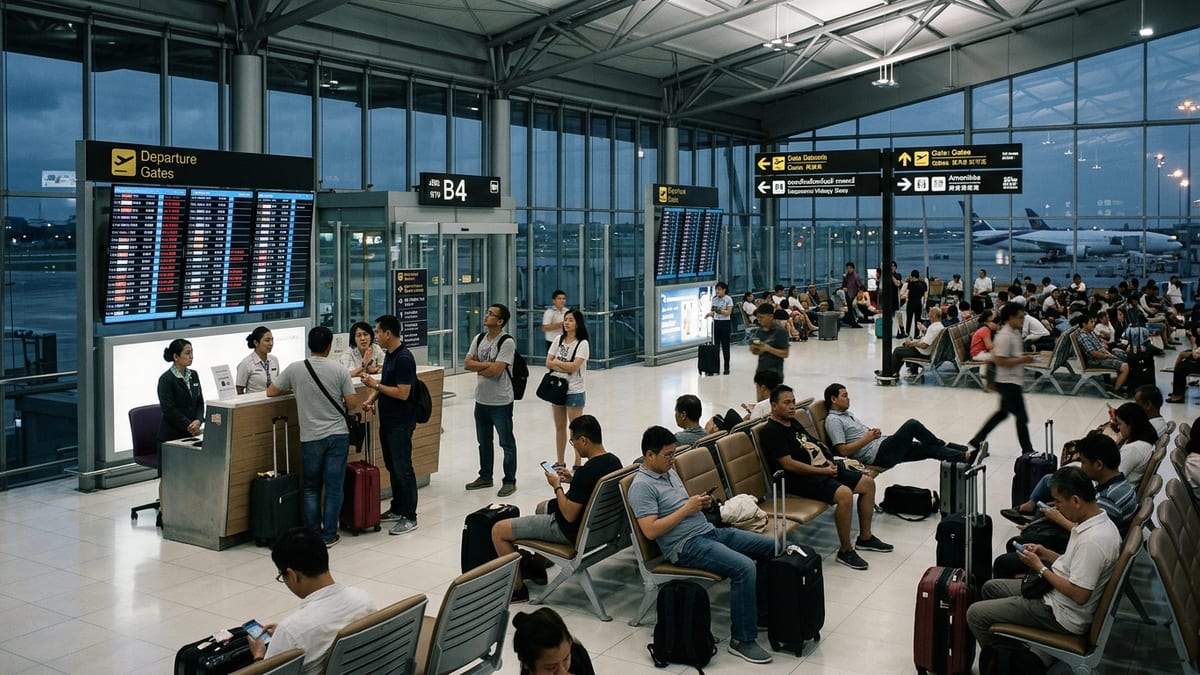
Major Hubs From Guangzhou to Dubai Under Strain
Recent operational data from flight tracking platforms and airport notices shows widespread disruption at several key hubs, including Guangzhou, Jakarta, Taipei, Dubai and Tashkent. The pattern points to rolling delays and targeted cancellations rather than full shutdowns, creating a patchwork of uncertainty for passengers trying to connect across the region.
In China, congestion has been particularly acute at large coastal and southern airports, where earlier incidents this month already produced heavy disruption at Shenzhen, Shanghai and Beijing. Guangzhou, a critical transit point for China Southern and China Eastern, has again seen elevated levels of late departures and missed slots as airlines juggle aircraft rotations and crew availability.
Dubai, one of the world’s largest international transit hubs, continues to operate but with a thinner and less predictable schedule than in more stable periods. Consumer-rights summaries and airport-focused analysis for mid May described more than a hundred flights disrupted in a single day at Dubai and nearby Sharjah, underscoring how even modest schedule adjustments can ripple across Asia bound connections.
Further north and west, Tashkent in Uzbekistan has reported irregular operations on services linking Central Asia with Chinese and Gulf gateways. Individual flights between Guangzhou and Tashkent have been rescheduled or significantly delayed, illustrating how stress at major hubs can spill over into secondary cities.
China Southern, China Eastern and IndiGo Among Affected Carriers
The current wave of disruption is hitting a broad mix of full service and low cost airlines. China Southern and China Eastern, two of China’s largest carriers, feature prominently on delay and cancellation boards at Guangzhou and other mainland cities, reflecting both their scale and their heavy exposure to regional transfer traffic.
In South and Southeast Asia, Indian low cost carrier IndiGo has been navigating the same challenging environment, particularly on routes touching Indonesia and other popular leisure markets. While the bulk of flights continue to operate, schedule adjustments and rolling delays are being reported on select services, forcing passengers into last minute rebooking or overnight stays.
Regional operators such as UNI Air in Taiwan and Air Arabia in the United Arab Emirates are also contending with irregular operations. Public timetables and airline status pages point to trimmed frequencies and isolated cancellations on routes where demand remains solid but operating conditions have become more volatile.
Industry commentary suggests that the disruption is not confined to any single brand or business model. Instead, a wide roster of carriers, including China Southern, China Eastern, IndiGo, UNI Air, Air Arabia and others, are being pushed to make day by day decisions on which flights to operate, retime or remove from sale.
Fuel Costs, Weather and Airspace Constraints Combine
Several overlapping forces appear to be driving the elevated tally of 5,168 delays and 341 cancellations across the region. Aviation analysts and travel industry coverage have repeatedly highlighted the impact of surging jet fuel prices, which have prompted airlines in China, Taiwan and parts of Southeast Asia to pare back marginal routes or reduce weekly frequencies.
Weather has been another major contributor. In early May, poor conditions around Guangzhou led to diversions and extended airborne holding for flights headed to and from the Pearl River Delta, with at least one high profile diversion to Batam in Indonesia drawing attention to the fragility of tight schedules during stormy periods.
Airspace restrictions linked to geopolitical tensions and congestion in parts of the Middle East have further complicated routing for flights connecting Asia and Europe. Passengers traveling between Taiwan, the Gulf and onward destinations have reported abrupt cancellations as airlines adjust flight paths or temporarily suspend certain links when overflight corridors become constrained.
Operational knock on effects are amplified because many Asian carriers run dense hub and spoke systems. A delayed aircraft arriving late into Guangzhou or Dubai may cascade into missed departure windows to Jakarta, Taipei or Tashkent, turning a single weather or routing problem into a series of rolling delays throughout the day.
Passengers Face Missed Connections and Tight Rebooking Windows
The practical impact for travelers has been significant, even if the majority of scheduled flights still take off. Reports from affected passengers across regional forums and travel advisories describe missed connections, last minute gate changes and long waits at transfer counters as airlines work through disrupted rosters.
Public guidance from consumer advocates emphasizes the importance of checking real time flight status through airline apps, airport displays and independent tracking tools before leaving for the airport. With schedules shifting rapidly, especially on routes touching Guangzhou, Jakarta, Taipei, Dubai and Tashkent, same day itinerary changes are becoming more common.
Where cancellations occur, rebooking options can be limited. On busy corridors, alternative flights may already be heavily booked or subject to their own delays, leading some passengers to accept routings through secondary hubs or to shift to rail and coach services on domestic Chinese legs.
Travelers using multi ticket or self connected itineraries appear particularly vulnerable, as protection for missed onward flights can be weaker than on a single through booking. As a result, some frequent flyers are advising longer minimum connection times and flexible hotel reservations when planning journeys through the most affected airports.
What Airlines and Travelers Are Doing Next
Airlines across the region are attempting to stabilize operations by trimming schedules to a level that better matches available aircraft, crews and fuel budgets. In Taiwan, data discussed in local media has pointed to a planned reduction in international flights during the current season, while Chinese carriers are selectively cutting or consolidating services to destinations in Northeast and Southeast Asia.
Gulf carriers and regional players in the United Arab Emirates, including those serving Dubai and Sharjah, are gradually restoring capacity but continue to warn of possible last minute changes. Flight status pages updated on May 22 note that operations have not fully normalized, and passengers are urged through public advisories to verify details on the day of travel.
For travelers, flexibility and preparation are emerging as the main defenses against disruption. Travel specialists recommend booking longer layovers at key hubs, keeping digital copies of tickets and confirmations, and understanding each airline’s policies on meal vouchers, hotel accommodation and refunds when a flight is significantly delayed or cancelled.
With peak summer travel approaching and underlying pressures such as fuel costs and airspace complexity still present, the elevated numbers of 5,168 delays and 341 cancellations across Asia and neighboring regions may not be a short lived anomaly. Airlines and passengers alike are likely to face an extended period in which real time information and adaptable planning remain essential parts of any long haul journey.