


Aspire Lounges have become a familiar sight in airports from London to San Diego, promising a calmer space away from the departure hall along with food, drinks and Wi-Fi. For many travelers, especially those using Priority Pass, DragonPass or credit card lounge programs, Aspire will often be the only non-airline lounge option in a terminal. This review looks at what Aspire actually delivers in 2026, how access works in practice, and whether it is worth paying for on your next trip.
Get the latest updates straight to your inbox!
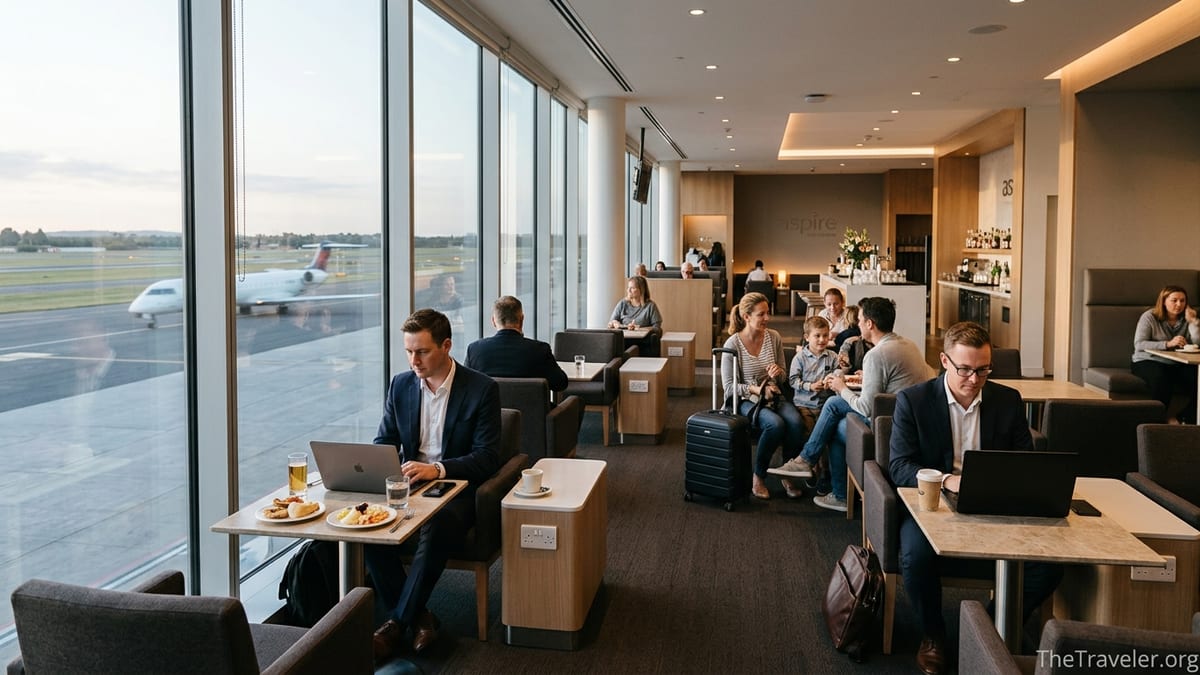
Who Are Aspire Lounges and Where Will You Find Them?
Aspire is the airport lounge brand of Swissport, the global ground-handling company that services hundreds of airlines worldwide. In recent years Swissport has invested heavily in Aspire, describing it as a core hospitality brand and expanding the network to roughly 100 lounges confirmed for 2025 across Europe, North America, Africa, Asia and Australia. In 2024 alone they added more than 20 new lounges, signaling that Aspire is now one of the most visible independent lounge operators globally rather than a niche side project.
Travelers are most likely to encounter Aspire in European hubs such as London Heathrow, London Gatwick, Amsterdam Schiphol and Helsinki, but the brand is also present in North America at airports like San Diego, Calgary, Montreal and Toronto City, as well as in destinations such as Nairobi, Johannesburg, Perth, Sydney and Tokyo Narita. At some airports, Aspire operates under its own name; in others it runs co-branded or partner spaces, including a National Bank lounge in Montreal and a co-branded lounge in Helsinki created with a major Finnish financial group. This mix of own-brand and partnership lounges means the exact experience can vary from airport to airport.
The company positions Aspire as a hotel-style hospitality experience translated to the terminal, with common elements such as comfortable seating, complimentary buffet food, selected alcoholic and soft drinks, barista-style coffee in some locations, Wi-Fi and power sockets. However, because each lounge is built in partnership with the airport and local stakeholders, there are real differences in layout, design and amenities. A compact contract lounge in a crowded European terminal will feel very different from a newer Aspire space in a secondary North American airport with more square footage per guest.
How Aspire Lounge Access Works in Practice
Access to Aspire lounges typically falls into three broad categories: airline-invited passengers, membership program holders and direct-paying guests. At many airports, airlines contract Aspire to host their premium cabin and elite-status passengers when the airline does not operate its own lounge. For example, smaller European or regional carriers departing from Heathrow or Gatwick may send business-class customers to Aspire instead of running their own facility. In Helsinki, Aspire has even designed a co-branded lounge specifically for a financial group’s premium cardholders, showing how flexible the model can be.
For independent travelers, the most common route into Aspire is via lounge membership programs such as Priority Pass, DragonPass and LoungeKey. These programs, often bundled with premium credit cards, grant access to a wide network of contract lounges that includes many Aspire locations. A U.S. traveler holding a Priority Pass through a travel credit card might use an Aspire lounge in San Diego before a domestic flight, then access Aspire in Copenhagen or Schiphol on the same itinerary. In most cases, admission requires showing the membership card or app and a same-day boarding pass.
Direct-paid entry is the third route and can make sense on days when you want a quiet space or need extra time at the airport. At London Gatwick South, for example, the Club Aspire lounge lists entry from about 36 pounds per adult when prebooked, with lower prices sometimes offered in off-peak windows. A similar pattern holds at other UK airports, where walk-up or prebooked Aspire access often falls in the range of roughly 35 to 55 U.S. dollars equivalent for a typical three-hour stay, aligning with independent industry surveys of lounge pricing in the region. Prices are dynamic and can vary by date, time and demand, so checking ahead on the airport or lounge operator’s website is essential.
What You Actually Get Inside: Seating, Food and Drinks
Across the network, Aspire promises a core set of inclusions: seating, Wi-Fi, power outlets, a buffet of hot and cold food and a selection of complimentary drinks. The specifics, however, vary considerably by location and even by time of day. In UK lounges such as Club Aspire Heathrow Terminal 5, typical offerings include items like scrambled eggs, baked beans and pastries at breakfast, moving to soups, pasta dishes, curries or stews with salads and desserts later in the day. Reviews consistently describe this as a step above what many U.S. domestic airline lounges offer for free, but not at the level of a full-service restaurant.
Drinks are generally generous at the basic level. In Heathrow’s Club Aspire lounge, standard alcoholic drinks such as house wine, beer and basic spirits, along with soft drinks, tea and coffee, are complimentary, while premium spirits and cocktails cost extra. This structure is replicated in many Aspire locations, where there is a staffed bar or self-service station with upgrades available for a fee. In San Diego, travelers have noted that the Aspire lounge offers a solid bar and snack setup that compares well with other Priority Pass options in the terminal, though with the same caveat that hot food is limited at certain times.
Seating quality also spans a range. Newer or recently renovated lounges, such as the co-branded space in Helsinki or refurbished areas at continental European airports, tend to feature a thoughtful mix of work pods, dining tables and more relaxed armchairs, sometimes with views of the runway. In contrast, older or more compact lounges in heavily trafficked terminals like Heathrow Terminal 5 or Schiphol can feel more functional: rows of seats packed close together, limited quiet corners and few opportunities for privacy. For many travelers, this contrast between marketing photos and crowded reality is the single biggest surprise of the Aspire experience.
Crowding, Time Limits and the “Contract Lounge” Problem
Crowding has become a defining feature of many contract lounges, and Aspire is no exception. In busy hubs where almost every Priority Pass or DragonPass holder is funneled into the same limited space, peak times can see queues at the door and a scramble for seats inside. Heathrow Terminal 5 is a widely cited example. Travelers report frequent waits to get into the Club Aspire lounge, with some turned away when the lounge reaches capacity, even when they hold a valid membership or have prebooked a slot. Online discussions about Heathrow’s pay-in lounges regularly describe the experience as “packed” and “hardly more relaxing than the main terminal.”
This pattern is not unique to London. At Amsterdam Schiphol, for instance, Aspire Lounge 41 near the non-Schengen gates is often described as too small relative to the volume of Priority Pass users it serves, leading to a crowded feel during the morning and evening long-haul banks. In Copenhagen, travelers using an Aspire lounge by the A gates have noted that the space is pleasant off-peak but can quickly fill around major departures, to the point where it is difficult to find adjacent seats for a family. In smaller airports such as Inverness in Scotland, the Aspire lounge stands out as a surprise amenity in a three-gate terminal, yet even there, capacity can be tight on days with multiple departures.
To manage demand, some Aspire lounges enforce stay limits, typically around three hours, particularly when access is via membership programs. Prebooked visits may also be tied to a defined time window. Travelers should assume that arriving too early might result in being asked to come back closer to departure, while overstaying during peak periods could lead to a polite reminder from staff. These policies are not always consistently communicated at the door, which can leave infrequent lounge users confused if they are asked to leave while others remain.
Showers, Workspaces and Other Amenities
Beyond basic seating and refreshments, Aspire lounges offer an uneven mix of additional amenities. Showers, in particular, are not universal and often incur an extra charge even where they exist. At Heathrow Terminal 5’s Aspire-branded lounge, independent reviewers have long pointed out that shower use is priced at around 20 pounds for a 30-minute slot, a figure that has been criticized as high compared with some airline-operated lounges where showers are included for eligible passengers. For a solo traveler on a long-haul connection, that price might feel justifiable, but for a family of four it can quickly exceed the cost of a decent hotel day room or spa visit in the city.
Workspace quality depends largely on the age and layout of the lounge. Newer Aspire lounges tend to integrate designated business zones with high-backed booths, communal tables with power at every seat and, at times, small meeting rooms that can be reserved. The new co-branded lounge at Helsinki, for example, incorporates private meeting rooms for travelers who need to catch up on work while on the road. Elsewhere, especially in higher-traffic European locations, “workspace” may simply mean standard tables near power outlets, shared with other guests and subject to noise from the buffet and bar areas.
Other amenities are more hit-and-miss. Some Aspire lounges cater strongly to leisure travelers, offering family areas with softer seating, children’s TV corners and relaxed design. Others lean into a premium business aesthetic with muted color palettes, design-led lighting and curated artwork. At a few locations, Aspire operates or partners on elevated products such as “The House” lounges in Australian cities, which deliver a more boutique, airline-style environment under different branding. As a traveler, it is wise to check the specific amenities listed for your departure airport rather than assuming every Aspire lounge will match the best examples you see in promotional images.
How Aspire Compares to Airline and Other Independent Lounges
To understand the value of Aspire, it helps to compare it with the two main alternatives: airline-operated lounges and other independent pay-in lounges. In major hubs with strong home carriers, such as London Heathrow for British Airways or Amsterdam Schiphol for KLM, airline lounges generally offer more space, better food and drink and more consistent access policies for their own elite and premium-cabin passengers. Aspire, by contrast, exists primarily for passengers who are not flying in business class or do not have status with the dominant airline, or for smaller partner carriers that cannot justify their own lounge.
Against other independent lounges, Aspire’s performance is mixed but competitive. At Heathrow Terminal 5, for example, travelers weighing Club Aspire against the rival Plaza Premium lounge often cite Plaza Premium as having a more comfortable environment and better food at similar or slightly higher price points, though availability and queue lengths can tip the balance either way. At Gatwick, reviews of the Club Aspire lounge point to pleasant runway views, a decent buffet and a staffed bar, with prices in the same ballpark as other pay-in lounges in the terminal. In North America, travelers have described the Aspire lounge in San Diego as one of the stronger contract options in that airport, particularly when accessed through a membership program rather than paid day pass.
The broader challenge is that as lounge programs and premium cards proliferate, contract lounges like Aspire are absorbing more guests than they were originally designed to handle. Frequent flyers on online forums increasingly describe Priority Pass-style lounges as “mass market” and “hit or miss,” noting that some Aspire locations deliver a calm, value-for-money experience while others feel like crowded cafeterias with limited food. In that environment, Aspire is neither uniquely poor nor universally excellent. It sits squarely in the mainstream of modern pay-in lounges: useful, occasionally very good, occasionally disappointing, but rarely transformative.
Is Aspire Lounge Access Worth Paying For?
Whether an Aspire lounge represents good value depends heavily on your travel pattern, expectations and the specific airport. Consider a typical scenario at a UK airport where a prebooked Aspire visit costs the equivalent of around 40 to 45 U.S. dollars for three hours. If you plan to have a couple of alcoholic drinks, a hot meal, coffee and a quiet place to work with reliable Wi-Fi, that price may compare favorably to buying similar items individually in the main terminal, where a single sit-down meal with drinks can easily reach the same total. For a solo business traveler with a project to finish before boarding, the cost often feels justified.
For families or groups, the calculation can be less favorable. Four paid entries quickly approach or exceed the cost of a casual restaurant meal in the terminal, and if the lounge is crowded, with limited seating together and a buffet that runs low at peak times, the perceived value drops quickly. Here, having lounge access through a credit card or membership program can tip the scales, since the marginal cost of each visit is much lower. Many travelers treat Aspire simply as a place to grab a light meal and a drink, charge devices and escape the busiest parts of the concourse rather than as a destination in itself.
Timing also matters. Aspire shines most when you have at least 90 minutes to two hours in the airport and when you can avoid the very busiest departure peaks. Arrive too close to boarding and you may spend much of your visit queueing for entry or food; arrive far too early and you may run into time-limit restrictions or find that breakfast has ended but lunch is not yet fully set out. Checking your specific lounge’s opening hours and known busy windows, and aiming for the middle of a service period, can significantly improve the experience.
The Takeaway
Aspire has grown into one of the most prominent independent lounge brands in global aviation, with a network that stretches from major hubs like Heathrow and Schiphol to smaller airports where any lounge at all still feels like a pleasant surprise. The company’s strategy of partnering with airlines, financial institutions and airport operators means you will increasingly encounter an Aspire-branded space or an Aspire-operated lounge when you travel, particularly if you rely on Priority Pass, DragonPass or similar programs for access.
In practical terms, Aspire delivers a generally consistent baseline: a seat, Wi-Fi, buffet food, included basic drinks and a degree of separation from the main terminal. At its best, in newer or less crowded locations, the brand can provide a genuinely relaxing environment with thoughtful design, solid local catering and useful extras like meeting rooms and showers. At its worst, particularly in oversubscribed European terminals at peak times, the experience can feel cramped and underwhelming, with queues at the door and a buffet struggling to keep up with demand.
For most travelers, Aspire is worth using when access comes via an existing membership or credit card benefit, and selectively worth buying outright when you have time to spare and a realistic understanding of what is on offer. The key is to treat Aspire lounges as practical, mid-market spaces designed to make the pre-flight experience a bit easier, not as luxury retreats. Go in with grounded expectations, pick your timing carefully, and in many airports, an Aspire lounge can still turn a stressful wait into a manageable, even pleasant, pause before your next flight.
FAQ
Q1. What is Aspire and who operates Aspire Lounges?
Aspire is an airport lounge brand operated by Swissport, a global ground-handling and airport services company. Swissport has invested heavily in expanding Aspire into a worldwide network of contract lounges that serve airline-invited passengers, lounge program members and paid day-pass guests.
Q2. How do I get access to an Aspire Lounge?
You can typically access Aspire lounges in three ways: as an invited passenger of an airline that uses Aspire for its premium or status customers, through lounge memberships such as Priority Pass, DragonPass or LoungeKey, or by purchasing a day pass directly from the lounge operator or airport, often by prebooking a time slot.
Q3. How much does an Aspire Lounge day pass usually cost?
Pricing varies by airport and demand, but in major UK airports such as London Gatwick and Heathrow, day pass or prebooked entry for adults often falls in the range of about 35 to 55 U.S. dollars equivalent for a stay of around three hours, with lower rates sometimes available off-peak and higher prices at very busy times.
Q4. What is included in the price of Aspire Lounge access?
Most Aspire lounges include a buffet of hot and cold food, soft drinks, tea, coffee, house wine, beer and basic spirits, along with Wi-Fi, power sockets and a variety of seating. Premium drinks, certain menu items and showers, where available, may incur extra charges, so it is wise to check specific inclusions at your departure airport.
Q5. Are Aspire Lounges usually crowded?
Crowding depends on the airport and time of day. In busy hubs such as Heathrow Terminal 5 or Amsterdam Schiphol during peak departure banks, Aspire lounges can become very crowded, sometimes with queues for entry and difficulty finding seats. In smaller or less busy airports, the same brand may feel much calmer and more spacious.
Q6. Do Aspire Lounges have showers and workspaces?
Some Aspire lounges offer showers and dedicated work zones, but these amenities are not universal. Where showers are provided, they often require an additional fee and may need to be reserved. Newer lounges tend to feature more structured business areas and meeting rooms, while older spaces may simply provide standard seating with access to power outlets.
Q7. How does Aspire compare to airline lounges?
Airline-operated lounges at major hubs often provide more space, a wider selection of food and drink and more consistent service for their own premium passengers. Aspire serves mainly as an independent alternative for travelers without airline status or premium tickets, offering a mid-range experience that is generally better than waiting at the gate but not as polished as the best flagship airline lounges.
Q8. Is it better to pay for Aspire or use a lounge membership?
If you travel frequently and can obtain membership through a credit card or standalone subscription, accessing Aspire via a lounge program is usually more economical than paying per visit. Paying directly can still make sense for occasional travelers who want a quiet space with food and drinks on longer layovers, especially when the cost compares favorably to dining and drinking in the main terminal.
Q9. Can I bring guests into an Aspire Lounge?
Guest policies vary. Airline-invited passengers may have specific guest allowances depending on their ticket and status. Lounge membership programs typically allow at least one paid or complimentary guest, with extra guests incurring additional charges. When buying direct access, you generally pay per person, with discounted rates sometimes available for children.
Q10. How can I find out what facilities a specific Aspire Lounge offers?
The best approach is to check the lounge details on the airport or Aspire brand website or within your lounge program’s app for your exact departure terminal and date. Listings typically show opening hours, whether the lounge is before or after security, and which amenities are available, such as showers, family areas, quiet zones, runway views and any time limits that apply.