


For ancient Athenians entering the Parthenon, the first impression was not the marble temple itself but the blinding presence of a gold and ivory goddess. Athena Parthenos, the colossal cult statue by the sculptor Phidias, once dominated the interior of the Parthenon and symbolized the power, wealth, and identity of classical Athens. Today the original is lost, but its story still shapes how we understand the Acropolis and can be vividly explored through modern reconstructions travelers can actually visit.
Get the latest updates straight to your inbox!
Athena Parthenos in the Heart of Classical Athens
The name Parthenon originally referred not to the entire temple, but to the inner chamber that housed the statue of Athena Parthenos. In the mid 5th century BCE, this extraordinary work by Phidias became the visual and spiritual centerpiece of Periclean Athens. Contemporary writers describe a dazzling image that blended religion, politics, and art into one unforgettable statement of power.
Most visitors today encounter the Parthenon as a skeletal ruin under Attica’s bright sky. It can be difficult to imagine that this building once framed a towering figure of Athena gleaming with gold and ivory, surrounded by painted walls, bronze fittings, and polished stone floors. Ancient accounts suggest that the statue was dedicated around 439 or 438 BCE, just as Athens reached the height of its imperial power. The building functioned partly as a temple, but just as importantly as a secure treasury for the city’s wealth, with the statue as its crowning jewel.
For Athenians and foreign visitors arriving by ship at Piraeus and climbing the Acropolis, the Parthenon’s exterior was impressive. Yet the most sacred encounter came on stepping through the huge bronze doors into the naos, the main eastern hall. There, in the half-light, Athena Parthenos stood not as a distant deity on high but at nearly eye level with worshippers on the raised floor in front of her, conveying both protection and immediacy.
Understanding the statue’s original setting helps modern travelers appreciate why later artists and cities have been so determined to recreate it. When you stand today inside the full-scale Parthenon replica in Nashville, Tennessee, and look up at the modern Athena, you get a rare sense of what it meant for a single artwork to anchor an entire architectural complex and civic identity.
What the Lost Statue Looked Like
No part of Phidias’s original statue survives, but ancient descriptions and Roman copies allow us to reconstruct its general appearance with reasonable confidence. Ancient writers place its height at roughly 11 to 12 meters, or about 38 to 40 feet. Modern reconstructions, like the 42-foot version in Nashville, follow this scale closely, giving visitors an immediate sense of its monumental presence.
Athena Parthenos was a chryselephantine statue: her exposed skin was rendered in ivory plates attached to a wooden core, while her peplos, armor, and accessories were made from solid gold plates that could, in theory, be removed and melted down as reserve bullion. Ancient temple inventories treated this gold as part of the city’s financial resources, which is why modern scholars often emphasize the statue’s economic as much as its religious role.
Iconographically, the statue presented Athena as both warrior and protector. She wore a helmet crowned with griffins and sphinxes, the aegis with the Gorgon’s head, and a heavily patterned robe. In her right hand she held a smaller figure of Nike, the personification of Victory, around 1.8 meters high in some reconstructions. Her left arm supported a large shield resting against the ground, with a coiled serpent rising between the goddess and the shield, often interpreted as Erichthonios, a mythic Athenian hero associated with the city’s autochthonous past.
The best visual guide for travelers and students today is the Varvakeion Athena, a Roman-era marble copy about one meter high, now in the National Archaeological Museum in Athens. Although much smaller than the original, its pose, proportions, and details are considered among the most faithful reproductions. Visiting this museum, then walking up to the Acropolis, helps connect the small-scale copy to the vanished colossus that once commanded the Parthenon’s interior.
Inside the Parthenon: Setting and Experience
To picture how Athena Parthenos functioned inside the Parthenon, imagine entering from the east through doors several meters high, leaving the blinding Athenian sunlight and stepping into a cool, dim space. The interior was organized with rows of two-tiered columns, creating a forest of stone that framed, but never obscured, the goddess at the far end. A shallow pool of water, probably slightly salted, is thought to have stood in front of the statue. It may have helped regulate humidity for the ivory and also created shimmering reflections of the gold-clad figure.
The base of Athena Parthenos was itself a decorated sculptural monument. Ancient sources mention battle scenes, possibly the birth of Pandora, carved in low relief on the front. The statue’s shield carried a detailed Amazonomachy, a battle between Greeks and Amazons, while the exterior of the sandal soles showed a Centauromachy. These mythological conflicts echoed the larger narrative of Greek order triumphing over chaos, a theme repeated across the Parthenon’s metopes and frieze.
Modern visitors walking through the ruined Parthenon in Athens must now imagine these layers of imagery. Without a roof or interior walls, the building reads more like a linear viewpoint over the city than a contained sacred chamber. This is why the Nashville replica, despite being thousands of kilometers away, offers such a valuable complement. Its intact roof, painted interior details, and central statue present a spatial experience impossible to recover from the original ruin alone.
Ancient pilgrims approaching the statue would have seen it by flickering torchlight or through shafts of daylight entering from the open doorway and high windows or gaps in the roof structure. Recent research into Greek temple illumination suggests that contrasts of light and shadow were carefully managed to enhance the drama of cult images. Standing before Athena Parthenos was therefore not only a religious act but a kind of choreographed visual encounter.
How and Why Athena Parthenos Disappeared
The original statue’s disappearance is one of classical archaeology’s enduring mysteries. There is no single ancient account that says plainly when and how it was destroyed. Instead, scholars piece together a narrative from scattered references, later Christian sources, and archaeological evidence such as temple inventories and signs of fire damage in the Parthenon.
Most reconstructions suggest that Athena Parthenos survived for several centuries after classical Athens declined. The temple was converted to a Christian church by around the 6th century CE, and some sources imply that the statue may have been removed before or during this transition. Chryselephantine statues were tempting targets in times of economic or political crisis. The gold plates could be detached and melted down, while the ivory and wooden core were perishable materials, easily destroyed by fire or decay.
One line of evidence involves records that parts of the Parthenon and its rear chamber were emptied after a major fire, likely in late antiquity. While details are disputed, it is plausible that the statue suffered either catastrophic damage from fire or deliberate dismantling for its materials. By the time travelers and pilgrims from the medieval and early modern periods describe the Acropolis, no trace of Athena Parthenos remained inside the building.
From a traveler’s perspective, this absence is almost tangible. Standing inside the ruined cella today, you may see only fragments of column foundations and scattered architectural blocks. Yet the emptiness itself invites questions: how can a single lost artwork still shape the way we frame an entire monument, city, and era? That question, more than the precise date of its destruction, explains why modern reconstructions draw such strong interest.
From Lost Original to Modern Reconstructions
Because the original Athena Parthenos vanished, later cultures attempted to resurrect it in various forms. Roman copies like the Varvakeion Athena tried to capture the statue’s iconography for use in villas, sanctuaries, and public spaces across the empire. Many are smaller than life size and carved in marble, not ivory and gold, but they preserve key design elements like the pose, helmet, shield, and Nike figure.
In the 19th and 20th centuries, as classical archaeology matured, scholars produced drawings and plaster maquettes that extrapolated from these Roman copies and from ancient literary descriptions. Museums in Europe and North America sometimes displayed small-scale models of the Parthenon’s interior with a reconstructed Athena to help visitors visualize the lost original. These early efforts tended to show the statue in the white marble aesthetic popular at the time, with minimal color on the surface.
As research into ancient polychromy advanced, especially from the late 20th century onward, reconstructions began to emphasize bright pigments and gilding. Conservators studying microscopic pigment traces on other Greek sculptures showed that classical statues were often vividly colored. This evidence influenced modern full-scale reconstructions, which adopted painted surfaces, patterned garments, and extensive gold leaf to approach what ancient viewers might actually have seen.
Today, travelers interested in Athena Parthenos can experience a spectrum of reconstructions: from modest museum copies a meter high, often in subdued stone, to immersive, full-size recreations in architectural settings. Each offers a different balance of scholarship and imagination. The most striking and accessible example for many international visitors is the Nashville Parthenon in the United States.
Meeting Athena Today: The Nashville Parthenon
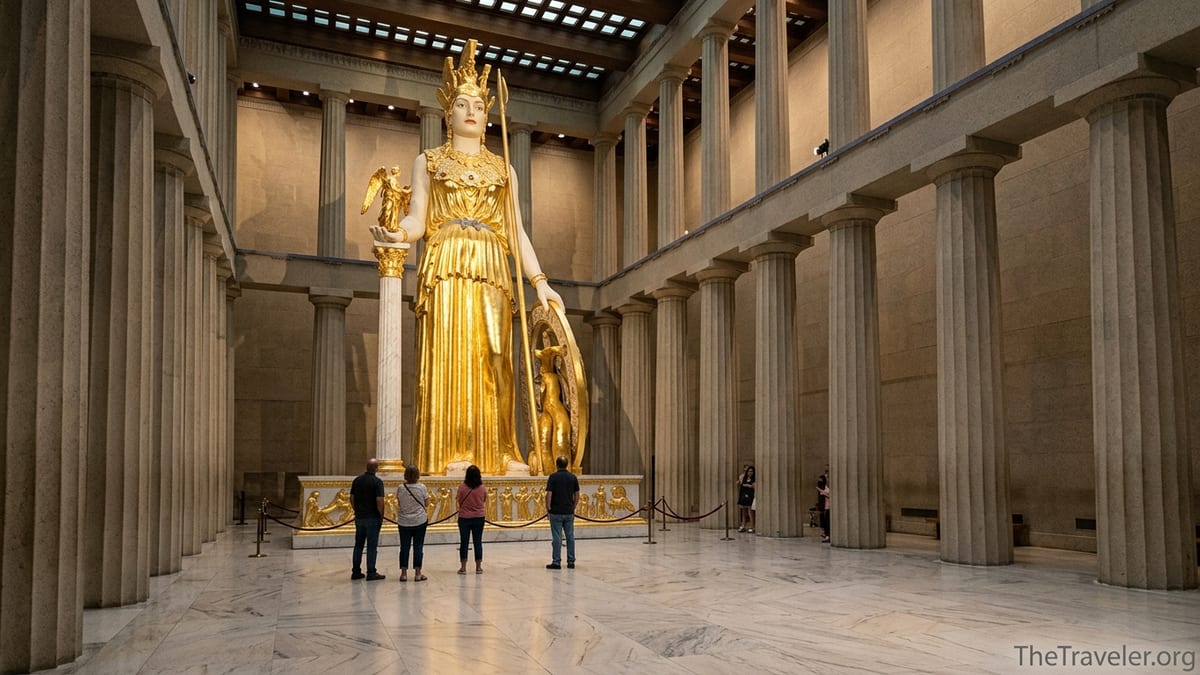
In Nashville, Tennessee, a full-scale replica of the Parthenon stands in Centennial Park, originally built in 1897 for Tennessee’s Centennial Exposition. The building was later reconstructed in concrete as a permanent landmark and today serves as an art museum and historical attraction. Inside, in the eastern hall, stands a 42-foot-tall replica of Athena Parthenos, created by sculptor Alan LeQuire and unveiled in 1990.
For travelers, the Nashville Athena offers perhaps the closest physical experience to standing before Phidias’s original. The statue carries a figure of Nike in her right hand, supports a massive shield with her left arm, and is accompanied by a large serpent near the shield. In 2002, the surface was gilded and painted following scholarly research into ancient color schemes, using several kilograms of gold leaf to evoke the dazzling impact of the lost chryselephantine original.
Visiting the Nashville Parthenon is relatively straightforward for travelers based in or visiting the United States. The site is in a central city park that also hosts walking paths, lawns, and public events. Admission tickets are typically priced in a range similar to other municipal museums in large American cities, making it an accessible stop on a broader Nashville itinerary that might include music venues and local restaurants. Many visitors report that the transition from the familiar cityscape outside to the monumental interior with Athena creates a powerful sense of temporal dislocation.
Although the Nashville reconstruction is based on current scholarship, it is not an exact archaeological replica in every detail. Some critics argue that the facial expression and surface finish reflect modern artistic conventions as much as ancient models. Others note that the building materials differ from the original marble. Yet even with these caveats, the combination of full-scale architecture and statuary offers an invaluable three-dimensional reference when you later stand in front of the real, ruined Parthenon in Athens.
Smaller Replicas and Where to Find Them
Beyond Nashville, numerous museums hold smaller-scale replicas of Athena Parthenos that reward attentive viewing. In Athens, the National Archaeological Museum houses the Varvakeion Athena, generally regarded as the most reliable Roman copy. It dates from the 2nd century CE and stands just over one meter high. Travelers can easily fit a visit into a half-day museum tour that also includes Mycenaean gold, archaic kouroi, and classical bronzes.
At the Acropolis Museum, visitors can view additional fragments and small-scale copies inspired by Athena Parthenos, alongside detailed models and visualizations of the Acropolis complex. While these replicas are far from the original’s size, their context within a museum dedicated to the Acropolis helps highlight how the statue fit into a broader program of cult images, sculpted friezes, and architectural refinements.
Elsewhere in Europe and North America, plaster casts and reduced-size replicas appear in university collections, teaching museums, and occasionally city halls or cultural centers. A traveler planning an itinerary that includes major classical collections in London, Berlin, Paris, Rome, or New York can often find related material in cast galleries or special exhibitions, even if these pieces are not exact reconstructions of Phidias’s work.
For a deeper dive, some travelers plan thematic trips that combine these experiences: beginning in Nashville to grasp the monumental scale, continuing to Athens to see the ruined Parthenon and museum copies, and then visiting major European museums that house Roman-period reinterpretations. With thoughtful planning, flights between these hubs can be sequenced into a single, coherent journey focused on the afterlife of one lost statue.
Practical Tips for Travelers Tracing Athena Parthenos
Travelers interested in Athena Parthenos often start in Athens itself. When visiting the Acropolis, consider timing your ascent for early morning or late afternoon to avoid peak heat and crowds, especially between May and September. After touring the Parthenon and nearby temples, plan at least two to three hours at the Acropolis Museum, located a short walk downhill, to study the architectural sculptures and models related to the temple’s interior.
Set aside a separate half-day for the National Archaeological Museum, where the Varvakeion Athena and other Roman copies can be seen at close range. Observing the details of the shield, Nike, and serpent on these smaller works will make it easier to recognize their magnified equivalents when you later encounter a full-scale reconstruction. Many visitors find it helpful to bring a small notebook or use their phone for quick sketches and notes about specific motifs.
If your travels take you to the United States, plan a visit to Nashville with enough time to experience the Parthenon interior calmly. Weekday mornings outside school holiday periods tend to be quieter, allowing more contemplative viewing of the statue without large tour groups. Simple details like walking slowly around the base, pausing to examine the shield and sandals, and looking up from different angles can reveal subtleties in the reconstruction that are easy to miss in quick snapshots.
For travelers combining multiple destinations, a rough sequence might run from Athens to another European hub, then on to the United States, or vice versa. Multi-city airfare tickets can sometimes be booked at prices not dramatically higher than simple round-trips, especially outside peak summer season. Building your itinerary around Athena Parthenos turns scattered monuments and museums into a coherent narrative: from the ruined temple, to scholarly copies, to an immersive modern reconstruction.
The Takeaway
Athena Parthenos no longer stands inside the Parthenon, yet her absence is as eloquent as any surviving marble block on the Acropolis. Phidias’s colossal chryselephantine statue was both a religious image and a public treasury, a symbol of Athens’s power in the 5th century BCE that later generations dismantled, lost, or transformed as political and religious landscapes changed.
Through a patchwork of ancient descriptions, Roman copies, and modern scholarship, we can now sketch a convincing portrait of what the statue looked like and how it functioned within the Parthenon’s carefully orchestrated interior. Travelers who seek out the Varvakeion Athena in Athens, study models in the Acropolis and other museums, and stand beneath the gleaming reconstruction in Nashville gain something more than art-historical knowledge: they experience how a single work of sculpture can shape architecture, urban identity, and modern memory.
Following Athena Parthenos from Greece to the United States and back again also reframes familiar questions about authenticity and reconstruction. No replica can replace the lost original, yet thoughtful recreations allow us to test hypotheses about scale, color, and spatial experience in ways that drawings or texts alone cannot. For the curious traveler, this dialogue between ruin and reconstruction becomes part of the journey itself.
In the end, seeking out Athena Parthenos is less about recovering a vanished object than about understanding the cultural forces that built, revered, dismantled, and reimagined it over two and a half millennia. Whether you are standing amid the wind-swept columns of the Acropolis or beneath the gold-clad goddess in Nashville, you are participating in a long tradition of visitors trying to see, in their own time, what once stood at the heart of classical Athens.
FAQ
Q1. Can I see the original Athena Parthenos statue anywhere today?
The original chryselephantine statue by Phidias has been completely lost; no surviving fragments are known, only Roman copies and modern reconstructions.
Q2. Where is the best place to experience a full-size reconstruction of Athena Parthenos?
The most famous full-size reconstruction stands inside the Parthenon replica in Centennial Park, Nashville, Tennessee, where a 42-foot-tall Athena dominates the main hall.
Q3. How accurate is the Nashville Athena compared to the ancient original?
It follows ancient literary descriptions and Roman copies closely in scale and iconography, but details like facial features and surface finish inevitably reflect modern artistic choices.
Q4. What materials did Phidias use for the original statue?
The original Athena Parthenos combined ivory for the visible skin, gold plates for clothing and armor, and a wooden core, making it both visually striking and extremely valuable.
Q5. Why did the original statue disappear?
Most scholars believe the statue was dismantled for its gold and destroyed by fire or decay in late antiquity, particularly when religious practices and economic pressures changed.
Q6. Are there smaller, more portable replicas I can see in museums?
Yes, several Roman-era copies exist, with the Varvakeion Athena in the National Archaeological Museum in Athens generally considered the most faithful small-scale reproduction.
Q7. Did the statue and the Parthenon originally have bright colors?
Current research strongly suggests that both were richly painted and gilded, quite different from the bare white stone appearance many people associate with classical antiquity today.
Q8. How tall was the original Athena Parthenos?
Ancient sources and modern reconstructions suggest a height of around 11 to 12 meters, roughly 38 to 40 feet, similar to the 42-foot statue in Nashville.
Q9. Do I need special tickets to see Athena in Nashville or Athens?
Both the Nashville Parthenon and major museums in Athens require standard admission tickets, typically priced in line with other city museums and available on-site or in advance.
Q10. Is it worth visiting both Athens and Nashville to understand Athena Parthenos?
Visiting both offers complementary experiences: Athens provides the original setting and key museum copies, while Nashville delivers the rare impact of seeing a full-scale, roofed interior with a towering goddess at its center.