


Landing at Miami International Airport and heading straight to the sand does not have to start with a pricey Uber or taxi. For many travelers, the Miami Beach Airport Express bus offers a cheap, surprisingly straightforward ride from MIA to Miami Beach and South Beach, with luggage racks, air conditioning, and frequent departures. This guide walks you through exactly how the service works in 2026, what it costs, where it stops, and when the bus is the smarter choice than rideshare.
Get the latest updates straight to your inbox!
What Is the Miami Beach Airport Express?
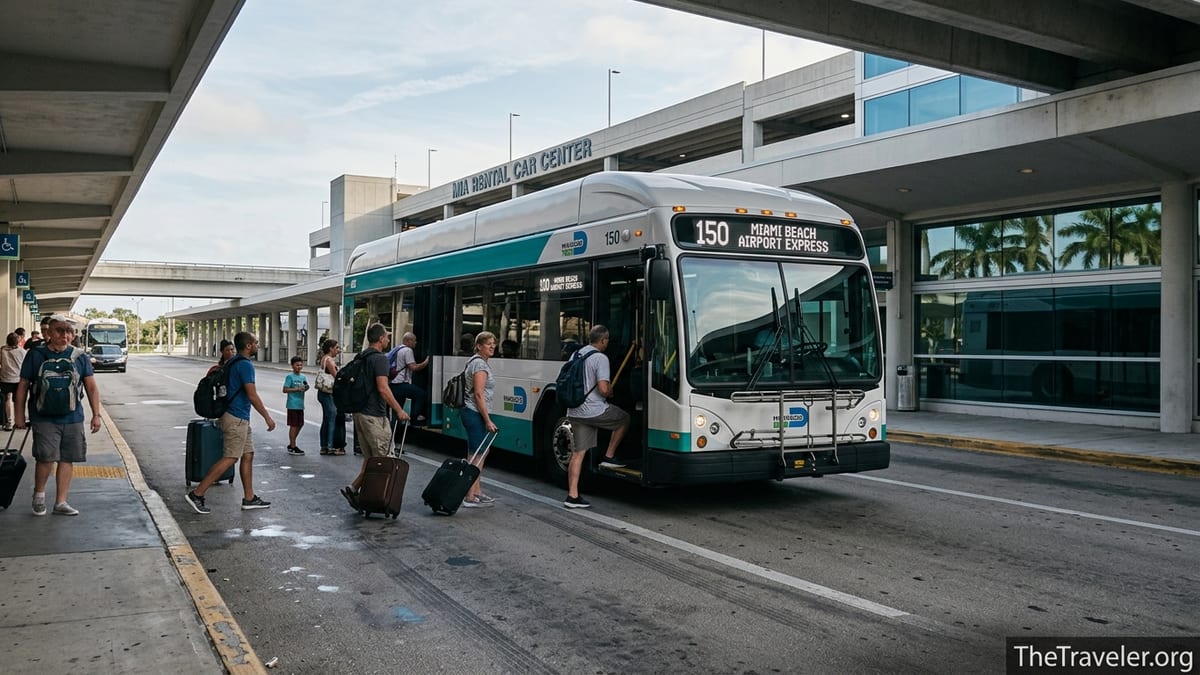
The Miami Beach Airport Express, officially Miami-Dade Transit Route 150, is a limited-stop bus that connects Miami International Airport with Miami Beach, including popular South Beach neighborhoods. It runs along the Julia Tuttle Causeway and then up and down Collins Avenue and Indian Creek Drive, stopping near many major hotels and beach access points. In practice, it functions like a dedicated airport shuttle for budget-conscious visitors.
The route is operated by Miami-Dade Transit and uses standard 40-foot city buses, not private shuttle vans. Inside, you will find all-door boarding at MIA, a central aisle, priority seating at the front, and overhead or standing room for bags. Most runs use modern, air-conditioned buses with digital destination signs clearly marked “150 Miami Beach Airport Express,” which makes them easy to spot amid other Metrobus routes.
From terminal to beach, typical travel time ranges from about 45 minutes to just over an hour, depending on traffic and your exact stop. Travelers heading to central South Beach around 15th Street or Lincoln Road usually see journey times of roughly 50 minutes from the airport station during the day, compared with 25 to 35 minutes by Uber under normal traffic conditions.
For solo travelers or couples without massive suitcases, the Airport Express is often the cheapest sensible way to reach a hotel on Collins, Ocean Drive, or Washington Avenue. It is especially attractive to backpackers, students, and cruise passengers extending their trip with a night or two in Miami Beach before or after sailing.
Current Fare, Payment Options and Daily Caps
As of mid-2026, the standard adult fare on Miami-Dade Metrobus, including the Miami Beach Airport Express, is about 2.25 dollars per person for a one-way ride. This is the same price locals pay for regular bus service, which keeps the route highly competitive against typical Uber or taxi fares from MIA to South Beach that often land in the 25 to 40 dollar range for a standard car at normal times.
You can pay your fare using the EASY Card or EASY Ticket, Miami-Dade Transit’s reloadable fare media, or by tapping a contactless bank card or mobile wallet on the validator where available. Buying an EASY Card at MIA is a good idea if you expect to use transit more than once in a day; Miami-Dade’s fare-capping policy means you are charged per ride up to a daily ceiling, then additional rides that day are effectively free. For most visitors, that daily cap makes it possible to ride the Airport Express plus a couple of local buses without paying more than a modest total.
Cash payment on board is generally accepted but is not recommended if you can avoid it, because drivers do not provide change and you must insert exact bills and coins into the farebox. A common scenario sees a traveler boarding with only a 5-dollar bill for a 2.25-dollar fare and effectively donating the difference. If you know you will rely on the bus, pick up an EASY Ticket from a vending machine at the airport’s Metrorail station level as you arrive from the MIA Mover.
Children, seniors, and certain qualifying riders may be eligible for reduced fares. However, visitors on short stays usually find it simplest to use regular adult fares. For a couple going from MIA to a South Beach hotel and back again, the total round-trip transit cost is usually under 10 dollars per person, far less than a single one-way rideshare in most conditions.
Finding the Bus at MIA: Step-by-Step
One detail that often confuses first-time visitors is that the Miami Beach Airport Express does not depart directly from the baggage claim curb. Instead, all airport buses leave from the Miami International Airport Station, which you reach via the MIA Mover, an automated people mover train that connects the terminals to the Rental Car Center.
After collecting your luggage at MIA, follow the purple “MIA Mover” and “Rental Car Center” signs. Take the escalator or elevator up to the MIA Mover platform and ride the train a few minutes to the Rental Car Center. The MIA Mover is free, runs frequently, and is designed to handle heavy luggage and airport traffic, so you will not pay anything extra just to reach the bus.
When you exit the MIA Mover at the Rental Car Center, follow signs toward “Public Transit,” “Metrobus,” or “Airport Bus Station.” You will enter the Miami Intermodal Center area, where multiple bus bays are lined up. Look for the clearly labeled bay for Route 150. Electronic signs usually show the next departure time, and the bus destination sign should read “150 Miami Beach Airport Express” or similar wording that includes Miami Beach.
If you are unsure, it is perfectly acceptable to ask the driver, “Is this going to South Beach?” Drivers are used to airport travelers with luggage and can confirm whether the 150 will stop near your hotel. Have your fare ready before boarding to keep the line moving, especially at busy times when cruise ships are turning over or multiple flights have just arrived.
Key Miami Beach and South Beach Stops
The Miami Beach Airport Express travels across the Julia Tuttle Causeway into Mid Beach and then continues south through Miami Beach and into South Beach, with stops along Collins Avenue, Indian Creek Drive, and Washington Avenue. While exact stop names can change over time, the bus is designed to serve a chain of hotel and residential clusters rather than every single block, which keeps it faster than a local route.
For many visitors staying in South Beach, important stops include those near 41st Street in Mid Beach, the 2300 to 2500 blocks of Collins Avenue, and the more central South Beach area roughly around Lincoln Road, 17th Street, and 15th Street. Hotels such as the Loews Miami Beach, Royal Palm, or properties around Collins and 16th benefit from being a short walk from one of the 150’s stops. Travelers heading closer to Ocean Drive near 5th Street may still find the Airport Express useful, getting off at a Washington Avenue or Collins Avenue stop and walking or taking a short rideshare hop the rest of the way.
As an example, a traveler booked at a hotel near Collins Avenue and 23rd Street might ride the bus from MIA, get off at a stop in the low 20s on Collins, and walk two to three blocks with their luggage. Another traveler staying near Ocean Drive and 10th Street could exit around 15th or 11th Street and walk roughly 10 minutes down to their hotel. While this adds a bit of walking compared with a door-to-door Uber, it keeps the total transport cost to a couple of dollars instead of 30 dollars or more.
If you are unsure which stop is best for your hotel, check the property’s address in advance and note the cross-street number. Because Collins Avenue in Miami Beach is numbered by streets (for example, 24th Street, 17th Street, 10th Street), it is generally straightforward to match your hotel’s block number to a nearby Airport Express stop and estimate how long you will be walking with bags.
Frequency, Operating Hours and Travel Time
The Miami Beach Airport Express is designed to be frequent enough that most travelers can simply show up and ride without carefully timing their arrival. In practice, buses run roughly every 20 to 30 minutes for much of the day on both weekdays and weekends. During the busiest daytime hours, you will often see headways closer to 20 minutes; very early mornings and late nights may stretch the gap somewhat but generally keep it under half an hour.
Service typically begins in the early morning, around 5 a.m., and continues until close to midnight, aligning with most commercial flight schedules and cruise ship patterns. This span of service makes it practical for morning flights into MIA and evening departures out of the airport. Travelers landing after midnight or catching flights that depart before sunrise should not rely on the bus and may need to plan on rideshare or taxi instead.
Travel time from the airport bus station to central South Beach is usually in the 45 to 60 minute range. The heaviest variability comes from traffic on the causeways and along Collins Avenue, especially during weekend afternoons, holiday periods such as New Year’s Eve or Art Basel, and major cruise turnover days. At those times, the bus can slow to a crawl alongside private cars and rideshares. However, because fares are fixed, at least you are not watching a meter or surge multiplier climb while you sit in gridlock.
On a typical weekday afternoon, a visitor landing at MIA around 2 p.m. might collect bags, ride the MIA Mover, board the Airport Express within 15 to 20 minutes, and reach a hotel near Lincoln Road by around 3:15 to 3:30 p.m. The same trip in an UberX could arrive 10 to 20 minutes sooner, depending on pickup delays and traffic, but at several times the price.
Luggage, Comfort and Who the Bus Works Best For
Because the Miami Beach Airport Express is a public bus, there is no checked-luggage service like you would find on a dedicated coach. Instead, passengers are expected to keep bags with them. The vehicles typically include areas at the front or mid-section where travelers can stand with suitcases or place them in open floor space without blocking the doors. Overhead racks or vertical spaces may handle smaller carry-ons and backpacks, while large checked bags usually stay on the floor beside you.
In practice, the bus works best for travelers with one rolling suitcase and a personal item or backpack. A couple each carrying a medium suitcase and daypack can usually board and find space without trouble, especially outside of absolute peak times. Families traveling with multiple oversized suitcases, strollers, or car seats may find the bus more cumbersome, particularly when boarding and alighting in a crowd.
Comfort is typical of a modern city bus: padded seats, strong air conditioning that can feel cold if you are dressed for the beach, and grab rails for standing passengers. There is no onboard restroom, no dedicated Wi-Fi, and no guaranteed quiet environment. You might share the bus with local commuters and other travelers heading to or from work, hotels, or the convention center. For many budget travelers, this trade-off is acceptable in exchange for paying around 2.25 dollars instead of 30 to 40 dollars for the same basic route.
If you are arriving after a red-eye flight and absolutely need a nap or more privacy, then a rideshare or taxi might still be worth the splurge. However, if you are used to urban transit and comfortable riding airport trains or subways in places like New York, Chicago, or London, the Miami Beach Airport Express will feel familiar and manageable.
Bus vs Rideshare: When the Airport Express Is Better
Deciding between the Miami Beach Airport Express and an Uber, Lyft, or taxi comes down to a few key factors: cost, group size, time of day, and your hotel’s location. For solo travelers and couples staying near Collins Avenue, Washington Avenue, or Lincoln Road, the bus almost always wins on price. A one-way UberX from MIA to central South Beach often falls somewhere around the mid-20s to mid-30s in dollars, and can easily climb higher during surge periods, while the bus keeps the cost around the low single digits per person.
As a concrete example, a solo traveler arriving at 11 a.m. on a weekday and heading to a hotel near Collins Avenue and 17th Street might check a rideshare app and see an estimated fare of 28 dollars for UberX, with a 7-minute pickup time. The Airport Express, by contrast, costs about 2.25 dollars and typically departs every 20 to 30 minutes. Even allowing for a slightly longer journey, they could realistically save about 25 dollars while arriving only 15 to 20 minutes later than a rideshare.
For groups of three or four, the equation shifts. A family of four going straight to a South Beach hotel might pay around 9 dollars total on the bus, versus 30 to 45 dollars for a standard rideshare or metered taxi. The per-person saving is still strong, but now you must factor in the hassle of managing multiple suitcases on and off the bus and perhaps walking several blocks with tired kids. Many families decide that spending an extra 20 to 30 dollars in total is worth the door-to-door simplicity and the ability to secure child seats or booster cushions in advance through premium ride options.
Time of day also matters. During heavy traffic or major events, the bus and rideshare vehicles will sit in the same congestion. In those situations, the one clear advantage of rideshare is door-to-door pickup and drop-off, not speed. On the other hand, during weekday midday lulls or later evenings when roads are a bit clearer, the rideshare may shave 15 to 30 minutes off the journey compared with the bus. If you are arriving close to hotel check-in time and eager to drop bags and jump into the ocean, that shorter ride can feel worthwhile.
Money-Saving Strategies and Practical Examples
A smart approach for many travelers is to mix and match the Airport Express with rideshare depending on the direction and timing of your trip. For instance, you might take the bus from MIA to South Beach when you have more flexibility after landing, then splurge on an Uber or taxi for your return to the airport when you are working backward from a fixed flight departure time.
Consider a couple visiting Miami Beach for a long weekend. They arrive mid-afternoon on a Thursday and are staying near Lincoln Road. Choosing the Airport Express on arrival, they pay roughly 2.25 dollars each and reach their hotel an hour after landing. On Monday morning, they have a 9 a.m. flight home. To avoid cutting it close with morning rush-hour traffic and bus headways, they request an UberX at 6:30 a.m., paying around 30 dollars for a direct ride from hotel door to the MIA departures curb. In total, they have spent just under 35 dollars for two people to travel both ways, which is less than a pair of Uber rides would have cost in one direction alone.
Another example: a solo cruise passenger extending their trip with one night in South Beach might land at MIA, ride the Airport Express to a budget hotel on Collins Avenue, and then, the next day, walk a block or two to catch a shared shuttle or taxi to the Port of Miami. After the cruise, they may return directly to the airport by rideshare. By using the bus for at least one leg, they can trim 20 to 30 dollars off their total ground-transportation budget.
If your hotel is not directly on the route or requires a transfer, it may still be cheaper to ride the Airport Express to a central South Beach stop and then use a short rideshare hop for the last mile. For example, staying in a quieter residential area or on the west side of the island near the bay might mean getting off at Lincoln Road and taking a 7-dollar rideshare instead of a 30-dollar ride all the way from the airport.
Finally, remember that Miami Beach itself is compact enough that, once you arrive, you can often walk most places or use local buses and free trolleys for local trips. That makes the Airport Express particularly attractive as a one-time high-value link between MIA and the island, with little need to rely on cars after you check in.
The Takeaway
For visitors who value saving money over shaving off a few minutes of travel time, the Miami Beach Airport Express is one of the best deals in Miami. At roughly the cost of a cup of coffee, it carries you from the terminal area at MIA across the bay and into the heart of Miami Beach, with stops convenient to many of the island’s most popular hotels and attractions.
The route is not perfect. You will have to navigate the MIA Mover to the bus station, handle your own luggage on a public bus, and possibly walk a few blocks to your accommodation. In heavy traffic, the journey can stretch close to an hour, and families with young children or large amounts of baggage may find rideshare or taxis more comfortable, if more expensive.
However, if you are a solo traveler, a couple, or a small group with manageable luggage, and your plans are flexible enough to account for a bit of extra transit time, the Airport Express offers outstanding value. Used smartly, perhaps in combination with a rideshare for one direction of the trip, it can trim a meaningful amount from your Miami vacation budget without sacrificing the experience of stepping out of your hotel and straight onto the sand.
FAQ
Q1. How much does the Miami Beach Airport Express cost in 2026?
The standard adult fare is about 2.25 dollars per person, the same as other Miami-Dade Metrobus routes, making it far cheaper than typical Uber or taxi rides from MIA to South Beach.
Q2. How often does the Miami Beach Airport Express run?
Buses generally run every 20 to 30 minutes throughout most of the day, on both weekdays and weekends, with service from early morning to around midnight.
Q3. Where do I catch the Airport Express at Miami International Airport?
After baggage claim, follow signs to the MIA Mover, ride it to the Rental Car Center, then follow signs for the public bus or Metrobus station and look for Route 150.
Q4. Does the bus stop directly in front of South Beach hotels?
No. The bus stops at key points along Collins Avenue, Indian Creek Drive, and Washington Avenue. You may need to walk a few blocks from the nearest stop to your hotel.
Q5. Is the Airport Express safe for solo travelers at night?
Service typically runs until around midnight, and many travelers use it in the evening. As with any city bus, it is wise to stay aware of your surroundings and keep valuables secure.
Q6. Can I bring large suitcases or sports equipment on board?
You can bring luggage, but there is no checked-bag service. Large suitcases and items like golf bags or surfboards must be kept with you without blocking aisles or doors.
Q7. Is the bus cheaper than Uber or Lyft for groups?
Per person, yes. For a group of three or four, the total bus fare is usually much lower than one rideshare, but you must weigh that against the added effort of handling luggage and walking.
Q8. Can I pay the fare with cash on the bus?
Exact-change cash fares are typically accepted, but drivers do not give change. Using an EASY Card, EASY Ticket, or contactless payment is more convenient and avoids overpaying.
Q9. How long does the trip from MIA to South Beach take on the bus?
Expect about 45 to 60 minutes from the airport bus station to central South Beach, depending on traffic and the specific stop where you get off.
Q10. When is it better to choose Uber or a taxi instead of the bus?
Rideshare or taxis are often better late at night, when traveling with very young children or a lot of luggage, or when you need the fastest, most direct door-to-door service.