


Walk through Athens, Rome, or any major archaeological museum and you will meet Athena again and again. She appears on marble pedestals, on tiny coins, over temple doors and on glossy postcards, always armed and always watching. For travelers, learning her visual language turns ruined pediments and glass cases into a readable story. This guide explains Athena’s key symbols, where you can see them today, and what they meant to the ancient Greeks.
Get the latest updates straight to your inbox!
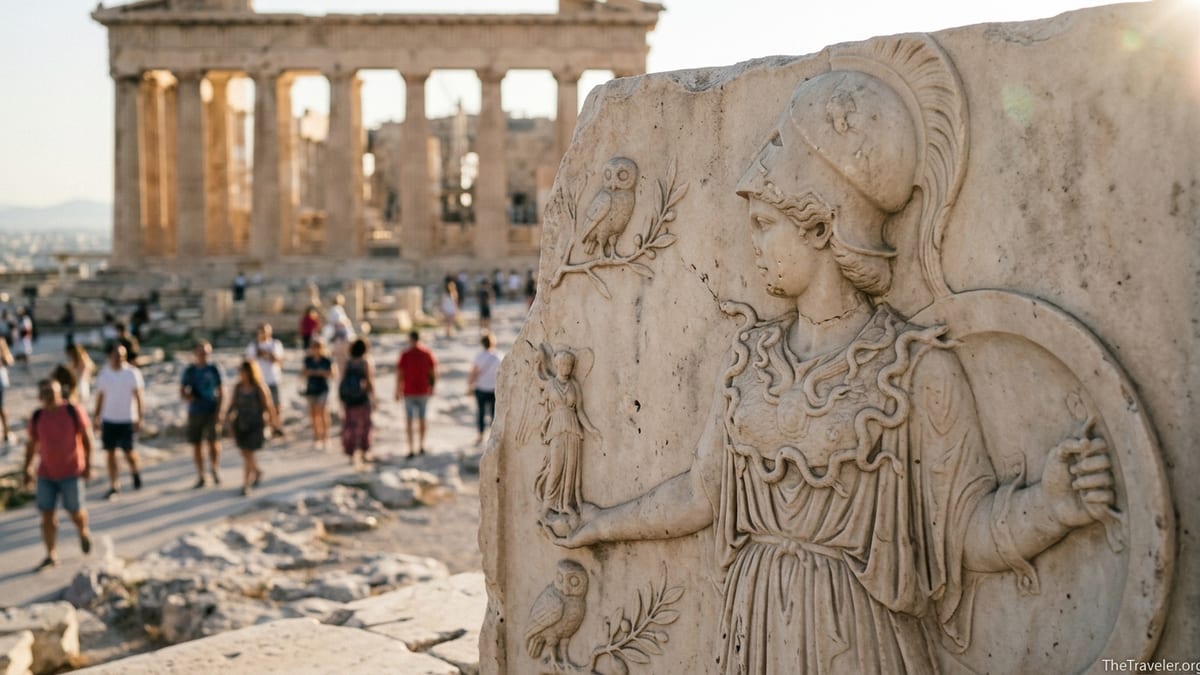
Athena in Art: How to Recognize Her Instantly
If you are new to Greek art, identifying Athena can feel overwhelming at first. Yet the goddess of wisdom, war and craft is actually one of the easiest deities to spot. She usually appears as a mature, composed woman, fully clothed in a long peplos or chiton, often with a cloak and always with at least one piece of armor. Her expression tends to be calm and focused rather than emotional or romantic.
In practical travel terms, you will meet Athena most clearly in Athens itself. At the Acropolis Museum, statues like the Angelitos Athena show her standing upright, wearing a heavy garment, an armored breastpiece and raising a arm that once held a spear. At the nearby Archaeological Museum of Piraeus, the bronze Piraeus Athena wears a tall helmet and a diagonally draped aegis, making her unmistakable the moment you enter the gallery.
Outside Greece, many major museums display Roman copies of famous statues of Athena. In Los Angeles, the Hope Athena in the LACMA collections wears a detailed aegis with Medusa’s head fixed on her chest, while in Nashville a full-scale modern reconstruction of the lost Athena Parthenos towers inside the replica Parthenon. Even without reading the labels, the combination of armor, owl, shield, spear and snake tells you that you are looking at Athena, not Hera or Aphrodite.
Once you know her core symbols, you can start picking Athena out on sarcophagi, vases, mosaics and coins in places as varied as the British Museum in London, the Louvre in Paris or regional museums in Sicily and Turkey. Treat it like a visual scavenger hunt: helmet, owl, olive branch, shield, aegis, Nike, snake. The more of these elements you see together, the more confidently you can say you have found the goddess of Athens.
The Owl: Night Eyes and Everyday Coins
The quickest way to meet Athena’s owl is not in a temple but in a coin cabinet. The classic Athenian silver tetradrachm, minted in huge quantities starting in the 5th century BCE, shows Athena’s helmeted head on one side and a big, front-facing owl with an olive twig on the other. Many museums around the world display these “owl coins,” and specialist coin shops still sell worn examples that travelers can buy as souvenirs, often starting in the low hundreds of dollars depending on condition.
The owl symbolized sharp sight in the dark, and by extension intelligence, strategy and insight. For ancient Athenians, it became a visual shorthand for their city. Even today, you will find the owl printed on modern Greek tourist trinkets: cast in bronze on keyrings around Monastiraki Square, engraved on silver pendants in Plaka jewelry shops, or painted on ceramic mugs in souvenir stalls near the Acropolis. When a guide in Athens points out “the owl of Athena” on a replica coin, they are tapping into this very old association.
Travelers interested in seeing the owl in a more dramatic setting should study the shields and armor of Athena statues. On many Roman copies of Athena Parthenos, a small owl appears on the helmet or shield among other figures. In galleries where labels are minimal, spotting the owl tucked beside a crest or perched near a spear can confirm the identification of a weathered statue fragment. On painted pottery in museums such as the National Archaeological Museum in Athens or the Archaeological Museum of Thessaloniki, owls sometimes appear near warriors or on the prows of ships to signal Athenian involvement in a scene.
Because the owl is so iconic, many modern cultural institutions use it in their branding. University libraries, bookshops and even cafés around Syntagma Square adopt a stylized owl logo for a hint of classical sophistication. When you see that familiar round-eyed bird on a signboard while wandering Athens’ streets, it is another echo of Athena’s presence in the modern city.
The Olive Tree and Branch: Athena’s Gift to Athens
According to myth, Athena became patron of Athens by winning a contest against Poseidon. He offered a saltwater spring; she planted the first olive tree on the Acropolis. The Athenians judged her gift more useful, as olives provided wood, oil, food and lamp fuel. This story still shapes how travelers experience the Acropolis today. Near the Erechtheion on the north side of the hill, guides point out a gnarled olive tree that recalls Athena’s sacred plant, a living symbol amid marble ruins.
In art, the olive appears as a tree, a branch or a small sprig with leaves and olives. On the Athenian tetradrachm, the owl stands beside a neat little olive twig, which signaled both the city and its wealth to ancient traders. When you examine coins in museum cases, look for three small leaves and olives next to the owl; that tiny detail tells you you are looking at Athenian money, not another city’s coinage.
Outside archaeological sites, the olive is one of the easiest Athena symbols to experience in daily travel. Walking up Philopappos Hill or along the paths around the Acropolis, you pass modern olive trees whose silvery leaves rattle in the wind. Many boutique hotels in central Athens place small olive branches or bowls of olives on breakfast tables as a nod to local tradition. Shops in the Plaka and around the Acropolis sell natural olive oil soaps, olive-wood cutting boards and bottles of extra virgin oil that explicitly reference Athena and her gift on their packaging.
When you see an olive wreath on a statue or relief, think of it as a crown of peace and prosperity associated with Athena and, later, with athletic victory. The olive crown worn by Olympic victors in antiquity came from this Athenian tradition. Today, some tour companies end their evening Acropolis walks with a tasting of olive oils from Attica and the Peloponnese, using the myth of Athena’s tree as an engaging story to connect landscape, history and food.
Helmet, Spear and Shield: Athena the Strategist
If the owl and olive tree show Athena as a goddess of wisdom and peace, the helmet, spear and shield display her as a strategist and protector in war. Unlike Ares, who embodies raw battle fury, Athena represents planning, discipline and defensive strength. In almost every major statue, from the Piraeus Athena to the Varvakeion Athena in the National Archaeological Museum of Athens, she wears a high-crested helmet and either holds or once held a spear and shield.
Travelers can see different helmet styles on real statues. The Piraeus Athena wears a Corinthian helmet pushed up on her head, its cheekpieces raised and decorated with small creatures, while other copies of Athena Parthenos show an Attic helmet with three crests and a sphinx or pegasi as ornaments. Up close in a museum, you can trace the carved ridges of the crest and imagine the original bright paint that would once have made the helmet stand out across a temple cella.
The spear is often missing from ancient statues, as it was usually made of metal and detached long ago. Yet the pose tells the story. In the Acropolis Museum, the Angelitos Athena’s surviving arm is raised at an angle that suggests she originally grasped a tall spear. On coinage and vase paintings, tiny spears appear in her hand as straight lines tipped with a triangular point. Learning to recognize this simple motif helps when reading packed battle scenes on red-figure pottery in collections from Berlin to Boston.
Shields linked to Athena are typically round and large, sometimes leaning against her side, sometimes planted on the ground. Travelers in Nashville’s Parthenon replica see Athena gripping a massive shield that almost reaches her shoulder. In smaller Roman copies, a round shield rests on the floor of the gallery, decorated with mythological combat scenes. When you stand in front of such a piece, imagine not only bronze and paint but also the sound of its image: for Athenians, it recalled real hoplite shields lining the city’s armories.
The Aegis and Snake: Protective Terror and Ancestral Power
Of all Athena’s attributes, the aegis can be the hardest for first-time visitors to understand. Ancient texts describe it as a goat-skin cloak or breastplate given to Athena by Zeus, edged with snakes and bearing the severed head of Medusa. In sculpture, it usually appears as a thick, short cape or a kind of armored bib across her chest and shoulders. Look for a circular or oval plate with a grimacing face at its center and a fringe that turns into writhing serpents.
In practical terms, the aegis is easiest to spot in museums with well-lit marble statues. The Hope Athena in Los Angeles has an unmistakable snake-fringed garment across her torso with Medusa’s head in the middle. In Athens, the Varvakeion Athena’s aegis is similarly decorated with a central Gorgon and small snakes. Guides often explain it as a supernatural shield of terror rather than a physical piece of armor, something that scared enemies before battle even began.
The snake motif continues beyond the aegis itself. Many Athena statues include a large serpent coiled beside her shield, a detail especially clear in copies of Athena Parthenos. In Greek tradition, this guardian snake is sometimes connected with Erichthonios, an early Athenian king raised by Athena, and with the earth-bound powers of the Acropolis rock. When you stand before a statue that shows Athena with a snake at her side, you are looking at a layered symbol of ancestry, chthonic power and civic identity.
Travelers will also notice snakes woven into smaller details: as a belt around Athena’s waist, as ornament along the rim of a helmet, or as tiny engraved figures on bronze mirrors and armor plates. In the Acropolis Museum’s sculpture displays, for example, some versions of Athena’s belt resolve into intertwined serpents when viewed up close. This repeated use of the snake makes more sense once you know that, for Athenians, snakes were protective house spirits as well as symbols of ancient earth forces under the city.
Nike, Victory in the Palm of Her Hand
Another figure often tied to Athena is Nike, the winged goddess of victory. On the colossal Athena Parthenos statue that once stood inside the original Parthenon, ancient writers describe a smaller Nike standing on Athena’s outstretched right hand. Modern reconstructions, such as the full-scale statue inside the Nashville Parthenon, follow this description: visitors see a golden Athena supporting a winged Nike who herself holds a wreath or other prize.
In many Roman copies and reliefs, Nike appears perched on Athena’s hand, shoulder or chariot, emphasizing that victory comes through wise strategy rather than brute force. When you examine museum pieces in Athens, Rome or Paris, look for a miniature female figure with wings near Athena. Labels may identify her as Nike, but even without text, the placement on Athena’s hand or near her shoulder is a strong clue.
Travelers see this relationship echoed in countless modern settings. Souvenir shops near the Acropolis sell small bronze or resin statues labeled “Athena Nike,” showing the goddess with wings or with a tiny Nike in her palm. The airline that once bore Nike in its name and branding reinforced this idea of Greek victory spreading beyond its borders. Even in sportswear branding, Nike as a symbol of victory carries distant echoes of statues in the Athenian Acropolis that travelers admire today.
When you stand inside the Nashville Parthenon and look up at Athena’s right hand, you get a sense of what it meant for ancient worshippers to see their city’s protector literally holding victory. Guides there typically time-entry visits and charge a modest admission, making it an accessible way for travelers in the United States to experience something close to the original Athenian cult image without crossing the Atlantic.
Finding Athena’s Symbols on the Road
For modern travelers, Athena’s symbols are not confined to marble halls. They shape how cities present themselves to visitors. In Athens, the owl appears on tourist maps, metro-station art and the logos of bookshops and cultural foundations. Olive branches decorate restaurant menus, wine labels and boutique hotel branding. Even the city’s official promotional materials lean heavily on the image of the Acropolis crowned with Athena’s temples as a symbol of European culture and rational thought.
Beyond Greece, you can trace Athena’s symbols in more unexpected places. In Italy, museums in Rome and Naples display Roman-era statues of Minerva, the Roman equivalent of Athena, still wearing helmet, aegis and shield. In France, the Louvre’s Greek and Roman galleries contain several versions of helmeted goddesses whose attributes are easier to decode once you know what the aegis and owl represent. In the United Kingdom, the British Museum’s Parthenon sculptures’ interpretation panels often mention Athena and her role as the city’s protector, inviting visitors to imagine the lost central statue.
Travelers interested in coins will find Athenian owls not only in major national museums but also at specialist numismatic fairs and shops in cities like London, Munich and New York. Prices vary widely based on condition and authenticity, so many visitors choose museum gift-shop replicas instead. These usually cost the equivalent of a simple café meal and offer a tactile way to remember the goddess’s owl and olive branch long after the trip ends.
Even if your travels never take you to Greece, noticing Athena’s symbols at home can deepen your appreciation of classical heritage. University campuses often adopt Minerva or Athena as an emblem of learning, placing statues with helmet and owl near library steps. Courthouses and civic buildings sometimes display reliefs of a calm, armored woman with a shield, referencing justice and rational law. Once you have learned to read these signs, city walks from Washington to Vienna turn into informal lessons in ancient mythology.
The Takeaway
Learning Athena’s symbols turns museum visits and city walks into richer experiences. The owl and olive tree remind you of a city that valued insight and practical gifts over showy power. The helmet, spear and shield reveal a goddess of strategy rather than chaos, while the aegis and snake hint at deeper layers of protection, terror and ancient earth spirits under the Acropolis rock. The tiny Nike in her hand embodies the idea that true victory is guided by wisdom.
As you move between sites, from the glass floors of the Acropolis Museum to quiet galleries in Piraeus, Rome or Los Angeles, these repeating motifs become familiar companions. They help you recognize Athena even when inscriptions are missing and statues are fragmentary. More importantly, they connect scattered objects into a coherent story about how Athenians saw themselves and their place in the Mediterranean world.
On your next trip, test yourself. Spot the owl on a coin, the olive branch on a hotel logo, the aegis on a marble chest, the tiny Nike figure on a raised hand. With a little practice, you will start seeing Athena everywhere, guiding ships in ancient reliefs, guarding city halls, and presiding silently over the modern crowds that still climb the Acropolis hill at sunset.
FAQ
Q1. How can I quickly recognize Athena in a museum without reading the label?
Look for a fully clothed female figure wearing a helmet and some form of armor, often with a round shield, a spear, an owl, or a snake-fringed breastplate featuring Medusa’s head.
Q2. Where is the best place to see Athena’s symbols in Athens today?
The Acropolis Museum and the National Archaeological Museum in Athens offer the clearest examples, including helmeted statues, aegides with Gorgon heads, owl coins and reliefs from temples.
Q3. Is the olive tree on the Acropolis really connected to Athena?
Yes, the modern olive tree beside the Erechtheion recalls the myth of Athena’s original gift. While the tree itself is not ancient, it marks the spot associated with her sacred olive in tradition.
Q4. What exactly is the difference between Athena’s shield and her aegis?
The shield is the large round defensive weapon she holds or rests beside her, while the aegis is a goat-skin cloak or breastplate worn over her chest and shoulders, edged with snakes and bearing Medusa’s head.
Q5. Why is there a big statue of Athena in Nashville, far from Greece?
Nashville’s full-scale Parthenon replica includes a modern reconstruction of Athena Parthenos, created to show visitors how the original temple and cult statue might have looked in ancient Athens.
Q6. Can travelers buy authentic Athenian owl coins as souvenirs?
Authentic ancient Athenian owl tetradrachms are sold by reputable dealers and at auctions, often costing hundreds or thousands of dollars, so most travelers choose museum-store replicas instead.
Q7. Who is the small winged figure often standing on Athena’s hand?
That figure is Nike, the goddess of victory. Her presence in Athena’s hand symbolizes victory granted through wisdom, strategy and the protection of the city.
Q8. Why do so many Athena statues include snakes?
Snakes on her aegis, belt or at her side symbolize protective power, links to the earth beneath the Acropolis and connections to early Athenian heroes such as Erichthonios.
Q9. Are Athena and the Roman goddess Minerva the same?
Minerva is the Roman counterpart to Athena. In Roman art she keeps most of Athena’s symbols, including helmet, shield, owl and aegis, so travelers can recognize her in Italian museums as well.
Q10. Do any of Athena’s temples on the Acropolis still contain original statues of the goddess?
No original cult statues of Athena survive in their original temples, but travelers can see important copies and related sculptures in the Acropolis Museum, the National Archaeological Museum and museums abroad.